
National Security

Home National Security Page 14

FAA Seeks Permanent Airspace Restrictions Near Trump’s Mar-a-Lago
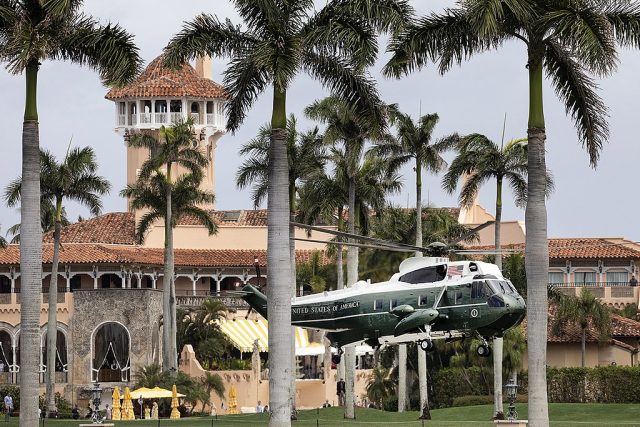
Marine One lifts-off after returning President Donald J. Trump to Mar-a-Lago Friday, March 29, 2019, following his visit to the 143-mile Herbert Hoover Dike near Canal Point, Fla., that surrounds Lake Okeechobee. The visit was part of an infrastructure inspection of the dike, which is part of the Kissimmee-Okeechobee Everglades system, and reduces impacts of flooding for areas of south Florida. (Official White House Photo by Joyce N. Boghosian) [Photo Credit: The White House from Washington, DC, Public domain, via Wikimedia Commons]

The Federal Aviation Administration is moving to permanently tighten the airspace surrounding President Donald Trump’s Mar-a-Lago estate as federal officials confront persistent threats from unauthorized aircraft and potentially weaponized drones.

The proposed rule, requested by the U.S. Secret Service, would establish a permanent Special Flight Rules Area around President Donald J. Trump International Airport in Palm Beach, formerly known as Palm Beach International Airport.

“At the request of the U.S. Secret Service in the interest of national security, the FAA is proposing Special Air Traffic Rules for the airspace near Donald J. Trump International Airport,” an FAA spokesperson told Fox News Digital.

The restricted zone would extend one nautical mile from Mar-a-Lago and reach from the surface to 2,000 feet above sea level.

According to the FAA’s proposed rule, the Secret Service requested permanent restrictions because of “adverse threat intelligence” and the agency’s continuing mission to protect Trump.

The Secret Service argued that stronger rules would “greatly increase” its ability to counter the “persistent risks” posed by unauthorized aircraft and unmanned aircraft systems operating near sensitive locations.

Strict New Rules For Aircraft

Pilots entering the proposed security zone would have to meet several conditions.

Aircraft arriving at or departing from the Palm Beach airport would need an active visual or instrument flight plan, authorization from air traffic control and continuous two-way radio communication. Pilots would also be required to transmit a unique transponder code assigned by controllers.

Military flights supporting the president or Secret Service, along with active law enforcement, firefighting and air ambulance operations, could still enter the area after receiving clearance and meeting the communication requirements.

The permanent zone would not replace the larger temporary flight restrictions imposed when Trump is in Palm Beach. Those presidential restrictions can stretch 30 nautical miles from Mar-a-Lago and reach nearly 18,000 feet.

Instead, the new rules would keep a smaller security perimeter in place even when the broader presidential restrictions are inactive.

A temporary version of the proposed one-mile zone has been operating since October 2025 and is scheduled to expire on Oct. 20. The FAA said converting it into a permanent, charted restriction would improve public awareness and provide greater security than a temporary notice.

FAA Tries To Avoid Airport Chaos

The agency stopped short of proposing a complete ban on flights through the area because Mar-a-Lago sits dangerously close to the airport’s primary commercial runway.

The FAA determined that establishing a fully prohibited zone could make Runway 28R/10L essentially unusable for many commercial aircraft. That runway averaged approximately 86 airline operations per day in 2025.

The proposed system is designed to preserve commercial service while making it easier for federal authorities to identify and track aircraft entering the sensitive zone.

According to the FAA, the plan would have “little to no impact” on the airport’s daily traffic because pilots are already following many of the same procedures under the temporary restriction.

But whether the regulatory line will stop a determined attacker is another question.

Drone Expert Sounds The Alarm

Brett Velicovich, a former Army special operations intelligence analyst and drone expert, warned that declaring an area off-limits cannot replace systems capable of actively detecting and disabling hostile drones.

“We’re going to have to have more counter-drone systems in place because it is not good enough simply for the FAA to send a message saying this area is a no-drone zone,” Velicovich told Fox News Digital. “When you’re a bad actor, that doesn’t matter.”

Velicovich pointed to the 2024 assassination attempt against Trump in Butler, Pennsylvania. Investigators later determined that the gunman had flown a commercially available drone near the rally site before opening fire.

“When you look at what happened in Butler, it was discovered later on that the shooter had done very basic surveillance with a drone — a Chinese drone that you could buy off Amazon — before he conducted the attack against the president,” Velicovich said.

The threat has only become more serious as commercially available drones grow cheaper, more capable and easier to modify.

Fox News Digital reported that authorities disrupted a separate plot in June involving suspects accused of discussing an attack using explosive-laden drones during the UFC Freedom 250 event at the White House.

The FAA proposal is open for public comment through Oct. 2. The White House referred questions about the security plan to the Secret Service, which did not provide Fox News with additional comment.
Trump Publicly Rebukes His China Ambassador Over Stunning Xi Weapons Claim

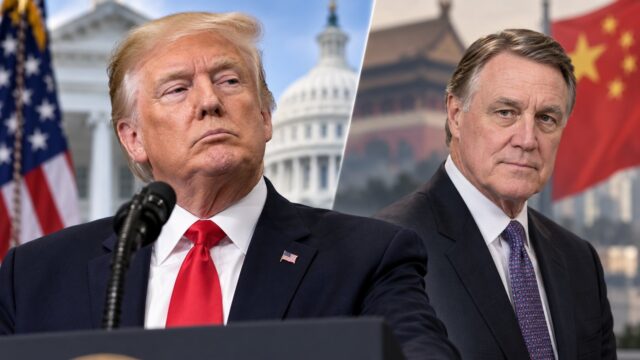
President Donald Trump poured cold water on a remarkable account from his own ambassador to China, saying he never discussed selling American weapons to Chinese President Xi Jinping and suggesting the envoy had confused China with Taiwan.

U.S. Ambassador David Perdue made the claim Sunday on Fox News Sunday while defending the administration’s approach to arms sales to Taiwan. Perdue said Trump had explained to Xi that the United States sells arms around the world, then added: “He actually asked President Xi, would he like to buy some, at one point.” Perdue did not say when the purported exchange happened or describe Xi’s response.

Trump appeared caught off guard when a reporter raised the account at the White House on Monday.

“To China? You mean to Taiwan?” the president asked. After the reporter clarified, Trump replied, “I never heard of that one. I’m going to have to ask him.”

Watch:

Trump said China would probably want American equipment because, in his view, the United States makes better weapons. He briefly mused that selling them might be a good idea, but then rejected Perdue’s account: “We didn’t discuss that.” He suggested Perdue had been referring to Taiwan.

State Department Draws a Hard Line

The public contradiction followed a blunt response from the State Department. “U.S. law prohibits arms sales to China and there is no offer or plan to sell arms to China,” the department said in a statement to ABC News. A U.S. official separately told the outlet the government had no plans for such a sale.

Federal defense export rules list China among countries subject to a policy of denying approvals for defense articles and services. That makes Perdue’s account striking even as Trump insists the conversation never occurred.

Perdue’s comment arose from a different, long-running dispute: U.S. weapons sales to Taiwan, the self-governing island China claims as its territory. Fox host Shannon Bream pressed the ambassador about concerns that arms deliveries or approvals for Taiwan had been delayed to avoid angering Beijing. Perdue rejected the suggestion that Trump was abandoning Taiwan, saying the president remained strong on its defense and that the two leaders had discussed future arms sales to the island.

The White House’s summary of Xi’s state visit described talks on trade, Iran, strategic stability and trilateral arms control. It did not announce any proposed sale of American weapons to China.

For now, the ambassador’s account and the president’s account remain at odds. Trump said he would ask Perdue about the remark. Neither man has publicly explained what Perdue was referring to, while the State Department says an arms offer to China is off the table.

Trump’s DHS Chief Accuses Biden Administration Of ‘Cutting Terrorists Loose’

DHSgov, Public domain, via Wikimedia Commons

The Biden administration let them go. Now Trump’s Homeland Security chief says his department is hunting them down.

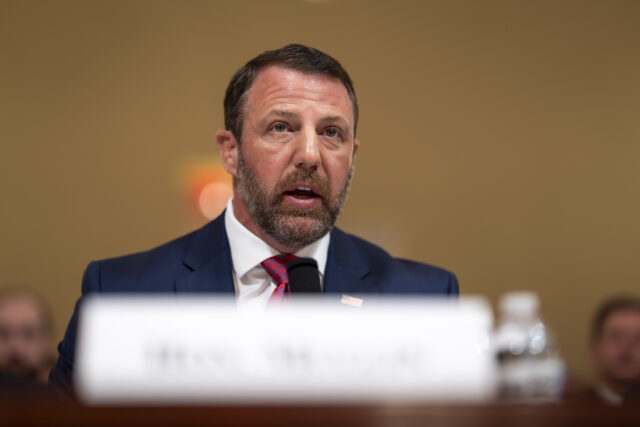
Homeland Security Secretary Markwayne Mullin leveled that explosive accusation Thursday, saying federal authorities have arrested 2,210 people he described as terrorists under President Donald Trump — and accusing the previous administration of releasing dangerous individuals into the country.

“Most of them came over and claimed asylum, gave a fake name,” Mullin told the Ruthless Podcast in a clip released Thursday morning, according to The Daily Wire.

“Some of them we caught, but a lot of them came in and … the Biden administration was just cutting them loose.”

Mullin credited Trump with giving DHS a more aggressive mission: pursue threats before they strike.

“One directive we had is we’re no longer just playing defense,” he said. “We’re on the offense. President Trump has given us the authority to go on the offensive.”

A Troubling Paper Trail

The accusation revives questions raised in an August 2024 report from the Republican-led House Judiciary Committee.

The committee reported that DHS released at least 99 migrants on the terrorist watchlist into American communities after Border Patrol encountered them at the southwest border between fiscal years 2021 and 2023.

That was out of more than 250 watchlisted migrants encountered during that period, according to the report. At least 34 others remained in DHS custody awaiting removal.

The report also examined eight Tajik nationals with potential ISIS ties arrested in June 2024. Three had entered through ports of entry using appointments scheduled through the Biden administration’s CBP One app, the committee said.

The distinction matters: appearing on the terrorist watchlist does not establish a terrorism conviction. The FBI describes the database as containing information about people reasonably suspected of involvement in terrorism or related activities.

DHS’s own September announcement likewise used the category “known or suspected terrorists.” It reported more than 2,150 arrests and 2,015 deportations between January 20, 2025, and September 9, 2026. Mullin’s latest figure raises the arrest total, but his comments, as reported by The Daily Wire, did not identify the detainees’ organizational affiliations.

Trump’s Bigger Offensive

Trump has pushed the crackdown beyond traditional border enforcement.

His January 20, 2025, executive order launched the process of designating international cartels and gangs as terrorist organizations, explicitly identifying Tren de Aragua and MS-13 as threats to American security. The administration subsequently designated those groups and the Sinaloa Cartel, among others.

Then, in a March 7, 2026, proclamation, Trump called for those networks to be stripped of territory, financing and the resources needed to spread violence.

They should be “demolished to the fullest extent possible consistent with applicable law,” the president declared. The proclamation also outlined plans to train and mobilize partner nations’ militaries against the cartels.

Those designations broaden the backdrop to Mullin’s announcement. His arrest figure cannot automatically be read as a tally of ISIS or al-Qaeda operatives; the administration’s terrorist designations also encompass major criminal gangs and drug cartels.

For Mullin, the message is pursuit — including in cyberspace.

“We’re swimming upstream now,” he told Ruthless, according to The Daily Wire. “We’re going after the people that are coming after us.”

Secret Service Reveals Security Lockdown for Trump’s WHCA Dinner Do-Over

The White House, Public domain, via Wikimedia Commons

There will be no second chances for a security nightmare.

Nearly three months after gunfire and chaos cut short the White House Correspondents’ Association Dinner, the Secret Service is locking down Washington’s Waldorf Astoria for President Donald Trump’s return Friday night.

The revamped protection plan includes a private entrance, individually assigned digital tickets, government ID checks, airport-style screening, a heavy police presence and road closures surrounding the Pennsylvania Avenue hotel.

“Our agency grows and adapts from every event we secure, and we have engaged with WHCA to ensure attendees are given timely information in the unlikely event of an emergency during the event,” Secret Service communications director Anthony Guglielmi told Fox News Digital.

Unlike the April 25 dinner at the Washington Hilton, guests will not enter through the hotel’s main lobby. The ballroom will be accessible through a separate, secured entrance, with every pre-screened attendee required to present a unique QR code and valid identification.

“Guests will see a visible police presence around the Waldorf Astoria hotel,” Guglielmi said, adding that everyone holding a ticket will pass through “airport-style magnetometer screening.”

Roads immediately surrounding the hotel will also be closed Friday evening, while detailed arrival instructions are being sent directly to ticket holders.

The Secret Service and a private security company hired by the WHCA have worked together to close the gaps exposed during the April attack, according to People.

That night descended into panic before Trump could deliver his speech.

Federal prosecutors say Cole Tomas Allen, 31, charged through a magnetometer outside the Washington Hilton ballroom while carrying a shotgun. Secret Service Officer Victor Gonzales was struck in the chest but survived because he was wearing a ballistic vest.

Gonzales returned fire as other agents swarmed Allen, who was arrested before reaching the ballroom where Trump, administration officials and hundreds of journalists were gathered.

Authorities recovered a 12-gauge shotgun and a .38-caliber pistol from Allen, according to the Justice Department.

Prosecutors allege Allen traveled from California to Washington by Amtrak and checked into the Hilton one day before the attack. Shortly before the shooting, he allegedly sent a pre-scheduled message to relatives and a former employer apologizing for what he was about to do.

Allen has pleaded not guilty to four federal charges, including attempting to assassinate the president and assaulting a federal officer with a deadly weapon. He remains behind bars awaiting trial, CBS News reported.

While the Secret Service has maintained that its agents successfully prevented Allen from reaching Trump or the ballroom, Friday’s tighter perimeter makes clear that officials are taking no chances.

The venue itself is also a major departure from tradition.

For decades, Washington’s glitzy annual gathering of reporters, celebrities and political power brokers has unfolded inside the sprawling Washington Hilton. Friday’s redo will instead take place inside the Old Post Office building, which housed the Trump International Hotel before becoming the Waldorf Astoria.

The gathering will also be dramatically smaller. Roughly 680 guests are expected, compared with approximately 2,600 people who attended in April, according to People. There will be no red carpet or surrounding weekend party circuit.

Trump, however, will be back at the center of the room.

The president is expected to deliver the remarks he never got to make in April, calling the rescheduled gathering a show of “Strength and Fortitude.”

“We cannot allow Lunatics to change our way of life, or even its scheduling,” Trump wrote when the new date was announced.

Much of Trump’s Cabinet is also expected to attend, including Defense Secretary Pete Hegseth, FBI Director Kash Patel, Homeland Security Secretary Markwayne Mullin and White House press secretary Karoline Leavitt, according to Fox News Digital. First lady Melania Trump, Vice President JD Vance and Secretary of State Marco Rubio will miss the event because of prior commitments.

Friday’s dinner will also put the spotlight back on the officer credited with helping prevent a potential massacre.

Gonzales is set to receive the WHCA’s President’s Award for Exceptional Service for his actions during the attack.

“Officer Gonzales played a significant role when he ran toward danger so that thousands of others could make it home safely,” former WHCA President Weijia Jiang said. “His courage stemmed from a dedication to service, which we are looking forward to honoring this week.”

Three months after the first dinner ended with guests diving beneath tables and armed agents racing through the ballroom, the tuxedos are coming back out.

This time, they will be arriving through a fortress.

Trump’s Arch Plan Pushes Ahead After Preservation Talks Break Down

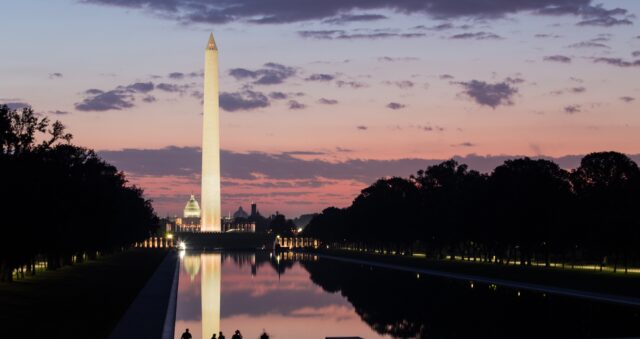
Reflecting Pool

President Donald Trump’s planned triumphal arch has hit a new stage in its fight with preservation officials: A federal council is ending talks aimed at resolving objections to the 250-foot monument near Arlington National Cemetery.

The Advisory Council on Historic Preservation told the National Park Service Thursday that it was “terminating consultation” under the National Historic Preservation Act. The move follows months of disagreement over the arch’s effect on historic views around Memorial Circle, Arlington Memorial Bridge and the approach to the cemetery.

That does not give the project final approval. The council plans to send advisory comments to Interior Secretary Doug Burgum by October 7. Burgum must consider and respond to them before making a final decision under this preservation review. The public and consulting parties have until September 29 to submit their views.

A fight over historic views

The Park Service identified 42 historic properties that could be affected by the project, including six National Historic Landmarks. Its assessment found that the arch would have adverse effects on historic settings and sightlines by adding a prominent structure to the commemorative landscape.

In the council’s letter, the Park Service said further talks on the existing proposal were unlikely to produce an agreement. It also said alternatives that would avoid or reduce the adverse effects would change the project’s fundamental nature and prevent it from meeting its goals.

Virginia officials pushed back. In a letter described by ABC News, state preservation official Samantha Henderson argued that the proposed measures would “further highlight how this undertaking has marred rather than added to these spaces.” She said public and local-government concerns had not been directly addressed in a way that showed an effort to reach agreement.

The administration says the arch would celebrate American triumphs and beautify the capital. Opponents argue that its scale would overwhelm the solemn route between the Lincoln Memorial and Arlington National Cemetery. The proposed site is Memorial Circle on Columbia Island, at the Washington, D.C., end of Arlington Memorial Bridge.

Trump adds a military twist

Trump has also given the project a new purpose. In a Sunday Truth Social post, he said that “at the strong request of the United States Military” he had agreed to turn the arch into a “top grade Military Complex/Triumphal Arch.” He said it would hold drones, provide positions for snipers and store sniper ammunition. The Pentagon declined to comment when ABC News asked about the announcement.

The National Capital Planning Commission approved preliminary site and building plans in July. It requested more information about the arch’s height, traffic effects and aviation-related lighting before final review. That final approval has yet to be granted.

The preservation dispute now moves from negotiations toward a decision at Interior.

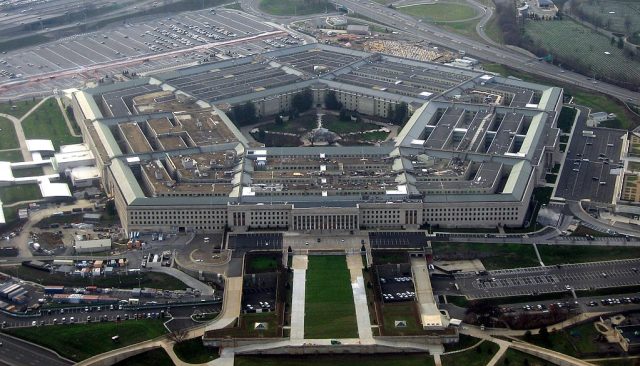
Report: Pentagon Mulls Deploying Anti-Drone Lasers Near Hegseth, Rubio Homes in DC

1
David B. Gleason from Chicago, IL, CC BY-SA 2.0 , via Wikimedia Commons

The Pentagon is weighing the deployment of “powerful” anti-drone technology to a Washington, D.C., military installation that houses two top Cabinet officials, according to a report published Tuesday.

Officials are considering sending a laser-based defense system to Fort Lesley J. McNair, where multiple drones of unknown origin were detected earlier this month, The New York Times reported, citing four people briefed on the discussions. The installation sits less than four miles from the White House and is located within some of the most tightly controlled airspace in the country.

The proposal, however, faces logistical challenges. The Times noted that deploying such a system over Washington’s high-traffic airspace could complicate efforts, given the risks associated with operating advanced counter-drone technology in a densely populated and heavily regulated flight zone.

The deliberations follow a series of recent drone incidents that have raised security concerns across multiple U.S. military installations. Earlier this month, unidentified drones were spotted over Fort McNair on at least one night, prompting heightened monitoring and internal discussions about potential responses. The sightings also led officials to consider relocating senior officials who reside at the base, though they ultimately remained in place, according to prior reporting.

The incidents in Washington are part of a broader pattern of drone activity near sensitive military sites.

On March 9, personnel at Barksdale Air Force Base in Bossier Parish, Louisiana, were ordered to shelter in place after an unmanned aircraft was observed overhead. Although the order was lifted later that day, additional drone sightings were reported at the base throughout the week.

Officials have not publicly identified the source of the drones in any of the incidents, and investigations remain ongoing. The recent activity has underscored growing concerns within the Pentagon about the vulnerability of domestic military installations to unmanned aerial systems, particularly as global tensions continue to rise.