

Iran fired back at President Trump on Saturday after he declared his intention to make the Strait of Hormuz a U.S. territory, insisting that Tehran alone will decide when the strategic waterway opens or closes.
“The Strait of Hormuz has been Iranian, is Iranian, and will remain Iranian,” Iranian Deputy Foreign Minister Kazem Gharibabadi wrote on X, according to an English translation published by The Hill.
“This strait will only be closed and opened under Iran’s command,” he added.
Gharibabadi said Iran would continue enforcing its blockade as long as the United States refused to accept what he called the “reality of defeat” and continued indulging in “delusions.”
The response escalated a growing power struggle over one of the world’s most important shipping routes nearly six months into the conflict.
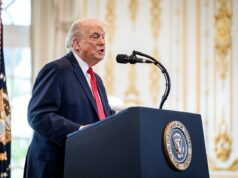
Trump floated the extraordinary move during remarks at a police academy in New York on Friday.
“Pretty soon, I will be declaring the Hormuz Strait a territory of the United States,” Trump said.
The president has repeatedly argued that America’s naval presence and blockade have already placed the strait under Washington’s operational control.
“We have control over it. Nobody else. Only us,” Trump told reporters earlier in the week. “Our Navy is unbelievable, and things are going great for our country.”
The White House previously quoted Trump making a similar declaration during a July interview with Fox & Friends.
“Iran doesn’t control the Strait. We control the Strait,” Trump said, according to the White House summary.
Trump claimed the U.S. blockade was powerful enough to determine which vessels could enter the passage. The administration has twice deployed the blockade during the conflict as it attempts to isolate Tehran and cut off Iranian shipping.
The president, however, has not explained what legal mechanism he would use to designate the waterway as American territory. The strait is an internationally navigable passage bordered by Iran and Oman, with shipping lanes running through their territorial waters.
The Guardian reported that it was unclear whether Trump’s statement represented a formal change in administration policy.
Former U.S. diplomat Richard Haass has also challenged Trump’s assertion, arguing that no single country currently controls the strait.
The collapse in vessel traffic has become a visible test of the competing claims.
Only six ships traveled through the waterway last weekend, according to Kpler data cited by The Hill. Before the war began on Feb. 28, approximately 130 to 140 vessels crossed the strait each day.
The disruption carries consequences far beyond the military confrontation.
Before the conflict, roughly one-fifth of the world’s oil and gas moved through the narrow passage. Its closure has disrupted global supplies, driven up energy prices and forced Middle Eastern producers to reduce output.
The U.S. Energy Information Administration said in June that the strait remained “effectively closed.” The agency projected that Brent crude would average $105 per barrel in June and July as shipments remained limited and regional production declined.
Diplomatic efforts have produced little sign of a breakthrough.
Iranian Foreign Minister Abbas Araghchi said Saturday that Tehran had not decided to resume direct talks with the United States. Messages exchanged through Qatar and Pakistan did not amount to formal negotiations, he said, according to Reuters reporting carried by The Guardian.
Araghchi said Iran’s separate discussions with Oman were focused on establishing a possible shipping route through the strait.
Tehran has continued to demand that Washington end its military campaign and blockade, lift sanctions, release frozen Iranian assets and compensate Iran for wartime damage before the waterway fully reopens.
For now, Trump and Iran are locked in a high-stakes test of power, with both sides claiming control of the world’s most important oil chokepoint.