




2026

Home 2026

Trump-backed Candidates Win Big In Indiana

1
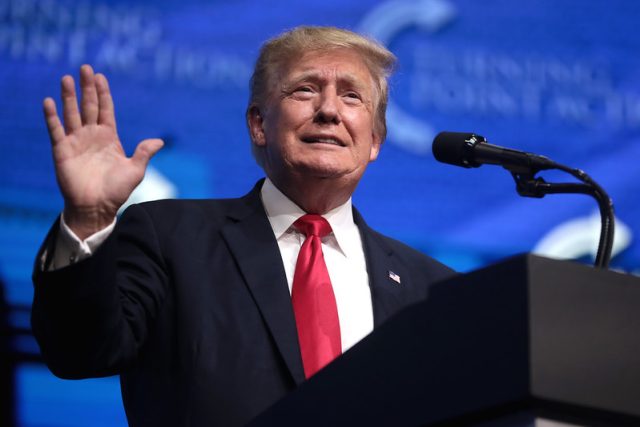
Gage Skidmore from Surprise, AZ, United States of America, CC BY-SA 2.0 , via Wikimedia Commons

President Donald Trump just sent a thunderous warning shot to the GOP establishment — and Indiana Republicans who crossed him are paying the price.

In a stunning early midterm showing, Trump-backed primary challengers are on track to topple at least five of the seven Indiana state senators who defied the president last year on a controversial redistricting vote, according to ABC News.

The races, usually ignored by national media and flooded with only modest cash, suddenly became political war zones after Trump vowed revenge against Republicans who sided with Democrats to block a congressional map overhaul designed to strengthen GOP power in Washington.

And voters appear to have listened.

The seven targeted incumbents were among 21 Republican state senators who broke ranks last year and voted against the mid-decade redistricting proposal — a move that infuriated Trump and his allies.

Now, most of them are heading for the exits.

One incumbent, state Sen. Greg Goode, narrowly survived against a Trump-endorsed challenger. Another, state Sen. Spencer Deery, remained locked in a razor-thin battle late Tuesday night against Trump-backed Paula Copenhaver.

But nearly everywhere else, Trump’s handpicked candidates surged to victory.

Even in a district where the anti-redistricting incumbent chose not to seek reelection, the Trump-endorsed candidate was projected to win — underscoring the president’s growing influence deep inside Republican state politics.

Trump celebrated the victories Tuesday night with a flurry of triumphant social media posts highlighting the winning candidates alongside his own image — a clear signal that he sees the results as a major political flex heading into the 2026 midterms.

The outcome is especially notable because these races became some of the most expensive state Senate primaries Indiana has seen in years. Trump-aligned groups and outside organizations poured millions into defeating the incumbents, overwhelming candidates who were unprepared for a nationalized political assault.

The clashes also exposed lingering divisions inside the Republican Party.

In one closely watched contest, former Vice President Mike Pence backed incumbent state Sen. Jim Buck, breaking publicly with Trump. But Pence’s support wasn’t enough. Trump-endorsed challenger Tracey Powell defeated Buck decisively Tuesday night.

The Indiana results are likely to energize Trump allies nationwide, who see the victories as proof that Republican voters remain fiercely loyal to the president — and willing to punish GOP officials viewed as disloyal.

For establishment Republicans hoping Trump’s grip on the party might weaken ahead of the midterms, Indiana delivered a very different message.

READ NEXT: Former ICE Official Loses GOP Primary In Key Ohio Battleground Republicans Want To Flip

Report: Youngkin’s Trump White House Hopes Dim After Virginia Setback

1
President Donald Trump signs Executive Orders, Thursday, April 17, 2025, in the Oval Office. (Official White House Photo by Molly Riley)

The political fallout from Virginia’s redistricting referendum is reaching beyond the state, cutting into Glenn Youngkin’s standing at a moment that matters for his future.

In recent weeks, the former governor had been floated as a possible pick for a Trump administration role, with secretary of labor among the positions mentioned. He was seen as a Republican who could point to a win in a blue-leaning state and bring a different profile into a national cabinet.

That window now looks narrower.

Timing Undercuts Momentum

The criticism from inside GOP circles is landing at a particularly inconvenient time for Youngkin.

According to Politico’s Dasha Burns, administration officials are blaming him for not doing enough to stop the redistricting measure, which passed by a slim margin and could shift up to four House seats toward Democrats. It’s the kind of loss that gets noticed in Washington, especially when control of the House is on the line.

And it’s not just about the outcome. It’s about perception.

A senior official, speaking anonymously, put it bluntly: “He doesn’t have enough friends here.” That comment points to a problem that goes beyond one referendum. It suggests Youngkin lacks the internal support that often decides who gets a seat at the table.

Burns continues:

Becca Glover, executive director of Youngkin’s Spirit of Virginia PAC, defended the former governor’s efforts, noting he raised and contributed nearly $500,000 to Virginians for Fair Maps and supported the Congressional Leadership Fund and Fair Maps’ fundraising efforts.

“The governor hit the campaign trail making many stops across the Commonwealth from Wise to Virginia Beach to Leesburg to motivate the grassroots to vote no,” Glover said. “He was proud to be part of a team including Speaker [Mike] Johnson and other former governors to get out the vote.”

Glover also pointed to the dozens of interviews Youngkin did and his efforts at retail campaigning.

“He continues to ask that the Supreme Court of Virginia to strike down this unconstitutional power grab,” Glover said.

A source briefed on White House discussions pushed back, saying Youngkin’s actions helped set the stage for the current difficulties facing him and his party in Virginia.

“Look, there’s plenty of blame to go around. But if Youngkin hadn’t left the special session open, Louise Lucas would never have had the chance to ram through those maps,” the person said, referring to the Democratic state senator who played a key role in advancing the redistricting effort. “So he has some responsibility for losing these seats.”

From Rising Star to Question Mark

Youngkin’s appeal to national Republicans has always been tied to his 2021 victory and his ability to win in a competitive state without fully leaning into Trump-style politics.

But that brand cuts both ways.

Inside a Trump-aligned orbit, relationships and loyalty still carry more weight than résumé lines. Another loss in Virginia, even one tied to a ballot measure, gives skeptics more reason to question how much influence Youngkin really has, both at home and in the broader party.

That matters when administration roles are being discussed behind closed doors.

Fewer Openings, More Competition

Even under the best conditions, cabinet-level positions are limited and highly competitive. Candidates need more than a strong narrative. They need advocates inside the administration willing to push their case.

Right now, the signals suggest Youngkin doesn’t have that backing.

The criticism tied to the referendum may not be decisive on its own. But combined with lingering doubts about his connections in Washington, it adds friction at the worst possible time.

READ NEXT: Indicted Democrat Who Resigned From Congress Plans Reelection Bid

Legal Battle Erupts After Judge Halts Virginia Redistricting Certification

3

Virginia’s attorney general is appealing a court order that halted a newly approved redistricting plan, setting off another legal clash with potential ripple effects far beyond the state.

Attorney General Jay Jones said he will challenge a circuit court judge’s decision to block the measure, even after voters narrowly approved it in a statewide referendum.

“As I said last night, Virginia voters have spoken, and an activist judge should not have veto power over the People’s vote,” Jones said. “We look forward to defending the outcome of last night’s election in court.”

Court steps in after close vote

The dispute centers on a temporary constitutional amendment that would allow Democrats to redraw Virginia’s congressional districts before the next census.

The measure passed with 51% support, compared with 48% opposed. Still, Tazewell County Circuit Court Judge Jack Hurley Jr. moved to block it, raising concerns about how the question was presented to voters and when the vote was held.

Hurley had already tried to stop the referendum months earlier. In February, he issued an order preventing the April vote from going forward.

Twice, the Virginia Supreme Court allowed the process to continue anyway. The justices declined to weigh in fully, saying only that the process, not the outcome, could ultimately come under review.

“Issuing an injunction to keep Virginians from the polls is not the proper way to make this decision,” the court said at the time.

What the new map could do

If it stands, the plan could dramatically reshape Virginia’s congressional delegation.

Democrats currently hold a 6-5 edge. Under the proposed map, that margin could widen to as much as 10-1. The arrangement would remain in place until after the 2030 census, when an independent commission would again take over the process.

That potential shift is drawing attention from both parties nationwide.

National fallout and political warnings

Republicans say the move could trigger similar efforts in GOP-led states.

Sen. Lindsey Graham suggested South Carolina should consider a response.

“After the Virginia Democrats’ efforts to redistrict in order to increase Democrat seats in the House of Representatives, South Carolina should consider fighting fire with fire,” he said, urging state leaders to weigh their options.

Democrats, meanwhile, argue the plan is a reaction to earlier redistricting pushes in Republican-controlled states.

Gov. Abigail Spanberger said Virginia voters understood the stakes.

“When we found the results out, I was really excited but not surprised,” she said. “Because it’s been clear for a number of months that Virginians were really motivated to take this temporary responsive stance.”

She pushed back on criticism that the process lets politicians choose their voters, pointing to public access to the maps and contrasting Virginia with states where legislatures acted without voter input.

A broader fight over redistricting

The debate is part of a larger, escalating battle over congressional maps.

House Democratic Leader Hakeem Jeffries cast the Virginia vote as a direct response to pressure from President Donald Trump, pointing to his push for mid-decade redistricting in Texas as the starting point.

“It was important for Democrats to push back aggressively,” Jeffries said, adding that the party would continue to respond in kind.

But not all Democrats are comfortable with that approach.

Sen. John Fetterman (D-Pa.) warned that tit-for-tat redistricting could damage the political system.

“The wrong thing doesn’t make it the right thing,” he said. “If we continue to just attack the other side … our democracy is degraded.”

What comes next

For now, the legal fight returns to the courts, where the future of the voter-approved plan remains uncertain.

At stake is more than Virginia’s map. The outcome could shape how far states are willing to go in redrawing districts mid-decade and how aggressively parties respond to each other in the process

READ NEXT: Republican Colleagues Seek Answers After Congressman Goes Missing

Political Strategist Says Democrats Will Target Trump’s Family After Midterms

Photo via Gage Skidmore Flickr

Veteran Democratic strategist James Carville is escalating his rhetoric against President Donald Trump, warning that Democrats will aggressively target not just the president—but his family—if they win back power in the 2026 midterms.

In a new video this week, Carville predicted sweeping GOP losses in November, framing the expected outcome as a political knockout that would leave Trump exposed to a wave of investigations.

“Let’s talk about your future, your post-November future,” Carville said, anticipating widespread defeat of Trump and the GOP. “The Democrats are going to investigate you to no end.”

“They’re going to start going after you. Then they’re going to start figuring out where all the money stolen is,” he continued. “Then they’re going to go after your stupid jacka– kids and their spouses and all the other bulls— that you see, and they’re going to investigate the s— out of you.”

The comments build on a broader—and increasingly aggressive—set of predictions from Carville, who has repeatedly argued that Democrats are poised for major midterm gains. Across multiple recent appearances, he has claimed Republicans are heading toward significant losses, citing voter frustration over inflation, dissatisfaction with Trump’s leadership, and fallout from the administration’s handling of the Iran conflict.

Carville has gone even further, suggesting those losses could trigger a chain reaction inside Washington: Democratic control of Congress, immediate impeachment proceedings, and a flood of investigations into Trump’s finances, conduct in office, and inner circle.

Trump himself has warned that a Democratic victory would lead to exactly that scenario, arguing that impeachment and investigations would follow quickly if Republicans lose control of the House or Senate.

Carville, however, is not just predicting investigations—he is openly embracing them. He has previously urged Democrats to center their messaging on accountability, including proposals for commissions to examine alleged “war profiteering” tied to the Iran conflict, which he has called a “catastrophe of the first order” and a “racket war.”

In his latest remarks, Carville also raised the possibility that Trump could face scrutiny beyond U.S. borders.

“When it comes to the stuff you’re doing in Iran, I got to tell you, you’re getting really, really, really close to war crimes here. You’re probably going to cross the line,” Carville warned. “And the one thing that Democrats are going to insist on in the 2028 election is that if you’re indicted by the international courts and I think it’s in Hog or Hague or somewhere in the Netherlands, we’re not going to protect your a–, not gonna protect you.”

He added that Trump’s political support could quickly erode—even within his own party—if Republicans suffer major defeats.

“You know who’s going to turn on you?” Carville asked. “What’s left of the Republican senators.”

Carville has repeatedly floated a dramatic endgame: that the mounting pressure—from investigations, impeachment threats, and political isolation—could ultimately push Trump to resign early and seek a pardon from Vice President JD Vance. Still, he has argued that even a presidential pardon would not shield Trump from state-level or international legal exposure.

“I got news for you, dude. You’re done,” he said. “And we’re going to enjoy watching your downfall. Thank you very much.”

The White House quickly fired back. In a statement to Fox News Digital, a spokesperson said, “James Carville is a stone-cold loser who clearly suffers from a severe and debilitating case of Trump Derangement Syndrome that has rotted his peanut-sized brain.”

Carville’s latest comments are consistent with his long track record of blunt—and often controversial—political predictions. In recent years, he has repeatedly forecast Trump’s political collapse, including predicting a Democratic victory in 2024 and even suggesting Trump’s second administration would “collapse in 30 days.”

Now, with the 2026 midterms approaching, Carville is once again making a high-stakes call—this time not just about electoral outcomes, but about what he believes will be an aggressive, wide-ranging effort to investigate Trump, his family, and those closest to him if Democrats take back power.

Pelosi Leaves Door Open To Impeachment If Dems Retake Power

1
Gage Skidmore Flickr

Former House Speaker Nancy Pelosi declined to rule out a future impeachment effort against President Donald Trump if Democrats regain control of Congress, leaving the decision to a potential new majority while emphasizing that the party’s immediate focus remains on policy priorities.

In an interview Tuesday with MSNBC’s Ali Vitali, Pelosi was pressed on whether Democrats would consider impeaching Trump during his second term, particularly amid ongoing voter concerns about “corruption.” While she did not directly endorse such a move, Pelosi made clear that the possibility would ultimately depend on the actions of a future Congress.

“Well, I think that, I’m not, that’s just not where we’re starting with this, but when we get power, we will have power to go there to do what we said we’re going to do, lower the cost of living. Some people say you should use other language, but lower the costs of living, A. B, fix what they have done to the healthcare system with their trillion dollars from Medicaid, half a trillion dollars for Medicare, and the money from SNAP. I do believe that food is medicine as well, especially for children, and again fight their corruption. So that’s what we’re setting out to do,” Pelosi said.

Recent polling has fueled speculation about a potential shift in power. Several surveys show Republicans facing a difficult midterm environment, with Democrats gaining ground in key battleground districts and generic ballot polling tightening or tilting left. That has raised the stakes of questions about what Democrats might do if they reclaim the House.

Vitali followed up, asking Pelosi directly whether she believes Trump has committed impeachable offenses in his second term.

“We have a convicted felon who’s president of the United States. That was then, this is now. I think, that that’s subject to review. But I don’t think that’s something, that’s not where you start. That’s what you have to do because of what he has done. That’s subject a great review. We had great review as to what were the grounds for impeachment. And that’s up to a new Congress to come to that decision. But the fact is that, people want to know what we’re doing for them,” Pelosi responded.

Pelosi repeatedly emphasized that impeachment is not a political starting point but a process that requires evidence and deliberation.

“You’re asking about what comes next. That’s up to the new Congress. And that’s up to them to decide where we go of reviewing what he’s done. And that requires power, all the kinds of things that build a case. It’s not just about, ‘I feel like doing this,'” she added.

Trump, for his part, has already predicted that Democrats would pursue impeachment if they regain control, framing it as a likely political outcome of a Democratic victory in November. His allies have echoed that warning, arguing that impeachment would be a central focus of a Democratic-led House.

Pelosi, however, sought to contrast that narrative by stressing economic and policy concerns as the party’s primary message heading into the midterms. She pointed to lowering costs, restoring healthcare funding, and addressing nutrition programs as top priorities.

The former speaker also reiterated that she has no regrets about leading the House in impeaching Trump twice during his first term, decisions she has long defended as necessary and grounded in evidence.

Her comments mark a notable shift from late 2025, when she told USA Today’s Susan Page that there was not sufficient cause at that time to pursue impeachment again.

“If he crosses the border again,” Pelosi said in that earlier interview. “But that’s not an incidental thing. You say, ‘We’re going to do that.’ No, there has to be cause. There has to be reason. We had review. This was a very serious, historic thing.”

Pelosi, who announced she will not seek re-election when her term ends in January 2027, appears to be leaving the question of impeachment deliberately open-ended—framing it as a decision for future lawmakers rather than a defined campaign promise, even as political pressure builds on both sides ahead of a potentially pivotal midterm election.

Nancy Pelosi Claims Republicans May Hack Voting Machines and Create ‘Fake Count’ in Midterms

Rep. Nancy Pelosi (D-CA) is once again sounding alarms ahead of a major election—this time warning that Republicans aligned with Donald Trump could attempt to manipulate voting systems in the 2026 midterms.

In a sit-down interview with MSNBC’s Ali Vitali, the former House Speaker—long one of Trump’s most vocal critics—predicted Democratic success in the upcoming elections but cautioned supporters to stay vigilant against what she suggested could be underhanded GOP tactics.

“There are so many things that you can do to protect the election, and they are being done, whether it’s litigation or legislation or just mobilization, communication, all of that. But in addition to that, we have to be on guard as to what they may try to do to the technology. They may try to creep into the technology and create a false count,” Pelosi said.

Pelosi, who has spent years opposing Trump and his political movement, framed her concerns as part of a broader battle over the integrity of American democracy. She has consistently accused Trump and his allies of undermining democratic norms—particularly following the 2020 election—and her latest comments reflect that ongoing distrust.

Her remarks come as Democrats continue to push back against Republican-led redistricting efforts and the SAVE Act, a GOP-backed bill that would require stricter voter identification. While the legislation has passed the House, it faces steep odds in the Senate.

Pelosi didn’t hold back in her assessment of Republicans’ motivations.

“Pelosi accused Republicans of having ‘no commitment to the rule of law and doing things the appropriate way.’”

Despite her warnings, Pelosi struck a confident tone about Democratic prospects, outlining what she sees as the party’s core mission heading into the midterms.

“We have three purposes now. One is to win the midterm. Two is to make sure the elections are safe. And three, tell people what we will do when we win. That is the mission,” she said.

The longtime Democratic leader also reflected on the party’s future, predicting that a woman will eventually become president—though she does not expect to see it herself. She credited Vice President Kamala Harris with energizing voters during the 2024 election cycle.

“She turned out so many more people than who would have voted,” Pelosi said.

Watch:

Trump Issues Early Midterm Endorsement – Before Candidate Even Files To Run

0
Donald Trump via Gage Skidmore Flickr

President Donald Trump is throwing his weight behind a potential new Republican candidate in Florida, publicly urging Sydney Gruters to enter the race for Congress in the state’s 16th District — and promising his full endorsement if she does.

In a Tuesday post on Truth Social, Trump signaled strong support for Gruters, who has not yet officially declared her candidacy but is reportedly considering a run.

“Word is that Sydney Gruters, the wife of our GREAT Chairman of the Republican National Committee, Joe Gruters, is considering launching her Campaign for Congress in Florida’s 16th Congressional District!” Trump wrote.

“Should she decide to enter this Race, Sydney Gruters has my Complete and Total Endorsement. RUN, SYDNEY, RUN!” the president added.

The endorsement comes as the seat opens up following GOP Rep. Vern Buchanan’s decision not to seek re-election, setting the stage for what could become a competitive Republican primary in a reliably conservative district along Florida’s Gulf Coast.

Sydney Gruters is married to Joe Gruters, a prominent figure in Republican politics who currently serves as chair of the Republican National Committee and as a Florida state senator. Her potential candidacy would further cement the Gruters family’s influence within both state and national GOP circles.

Responding to Trump’s backing, Gruters expressed gratitude while stopping short of confirming her plans.

“I am deeply honored to have the endorsement of President Donald J. Trump,” she said, according to Florida Politics. “His leadership transformed our country and continues to inspire millions of Americans who believe in putting America First. I’m especially committed to advancing policies that lower the cost of living for hardworking families across our community. I’m grateful for his support and look forward to making an announcement about the path ahead very soon.”

Gruters currently serves as executive director and vice president of advancement for the New College Foundation, giving her a background in education and nonprofit leadership that could shape her campaign message if she enters the race.

Trump’s early endorsement — issued before an official campaign launch — underscores his continued influence in Republican primaries and his willingness to shape candidate fields well ahead of election season. His backing often carries significant weight among GOP voters, particularly in Florida, a state where he remains highly popular within the party.

In his post, Trump also outlined the policy priorities he believes Gruters would champion in Congress, framing her as a reliable ally of his political agenda.

“A Highly Successful Civic Leader and Public Servant, Sydney has dedicated her life to serving her Community, and she and her family are fierce advocates for our Movement to, MAKE AMERICA GREAT AGAIN!,” Trump wrote.

“As your next Congresswoman, Sydney will fight tirelessly to Grow our Economy, Cut Taxes and Regulations, Promote MADE IN THE U.S.A., Unleash American Energy DOMINANCE, Keep our Border SECURE, Stop Migrant Crime, Support our Military/Veterans, Safeguard our Elections, Champion School Choice, and Defend our always under siege Second Amendment.”

With Buchanan stepping aside and Trump already signaling his preferred candidate, the race for Florida’s 16th District is quickly taking shape — even as Sydney Gruters weighs whether to officially enter the contest.

Trump-endorsed Candidate Concedes Primary Following 23-Vote Margin

0
Missvain, CC BY 4.0 via Wikimedia Commons

North Carolina Senate leader Phil Berger, one of the state’s most powerful Republicans, conceded his GOP primary race Tuesday after a second recount confirmed he trailed by just 23 votes. The razor-thin loss to Rockingham County Sheriff Sam Page ends Berger’s long tenure representing the Triad-area district and signals a potential leadership shake-up in a critical battleground state ahead of the midterms.

“While this was a close race, the voters have spoken, and I congratulate Sheriff Page on his victory,” Berger said in a statement following the recount results.

“Over the past 15 years, Republicans in the General Assembly have fundamentally redefined our state’s outlook and reputation. It has been an honor to play a role in that transformation.”

Unofficial results showed Page winning 13,135 votes to Berger’s 13,112, capping a dramatic contest that initially saw Page ahead by just two votes on primary night. His margin grew slightly as election officials reviewed provisional and absentee ballots, and subsequent recounts failed to change the outcome.

Berger’s defeat marks a major upset in North Carolina politics. As Senate leader since 2011, he has been a central figure in shaping Republican policy in the state. His loss comes despite an endorsement from President Donald Trump and reported efforts by GOP leaders to persuade Page to step aside, underscoring tensions within the party as it prepares for a high-stakes election cycle.

The outcome is likely to reverberate beyond the district. North Carolina is one of the nation’s top political battlegrounds, and Republicans are working to defend their legislative supermajority while also competing nationally to maintain their narrow U.S. House majority in the midterm elections. Party leaders have been particularly focused on redistricting efforts, including recent changes to congressional maps aimed at flipping a Democratic-held seat.

Page, who had urged Berger to concede as recounts concluded, framed his victory as a call for unity heading into November.

“I thank him for wishing me the best moving forward,” Page said after Berger called to concede. “Now it’s time for our community to come together and focus on winning in November.”

He will face Democrat Steve Luking in the general election in what is considered a GOP-leaning district. Berger defeated Luking in 2024.

Despite the loss, Berger will remain in office through January and continue to preside over the Senate during the short legislative session. He emphasized his intention to support fellow Republicans as they prepare for the general election.

“Looking ahead, I remain committed to working with my colleagues in the short session to ensure North Carolina continues to be the best state in the nation in which to live, work, raise a family, and retire,” Berger said. “In the months ahead, I will also do everything I can to support all Republican Senate candidates and protect our supermajority.”

With control of Congress and key state legislatures at stake, Republicans are increasingly wary of internal divisions and low-turnout primary surprises. Berger’s narrow defeat highlights how even entrenched incumbents can be vulnerable, adding a new layer of uncertainty as the party heads into a pivotal midterm season.

Trump ‘Going To Campaign Like It’s 2024’ Ahead of Midterm Elections

0
Gage Skidmore Flickr

White House Chief of Staff Susie Wiles said Monday that President Donald Trump will play a far more active role on the campaign trail ahead of next year’s midterm elections—signaling a strategic shift designed to energize the GOP base and capitalize on Trump’s unique voter appeal.

In an interview with The Mom View, Wiles emphasized that Republicans intend to harness the enthusiasm Trump generates among grassroots conservatives, particularly low-propensity voters who often turn out only when the president is directly involved.

Typically in the midterms it’s not about who’s sitting at the White House. You localize the election, and you keep the federal officials out of it. We’re actually going to turn that on its head and put him on the ballot because so many of those low propensity voters are Trump voters,” Wiles said.

Her comments underscore a growing recognition within the GOP that Trump’s presence remains the party’s strongest electoral asset. While midterms traditionally revolve around local issues, Republicans are betting that nationalizing the races around Trump’s leadership—and his policy agenda—will boost turnout in key battleground states.

Wiles noted recent election results as evidence of what happens when the president is not visibly engaged.

“We saw a week ago Tuesday what happens when he’s not on the ballot and not active,” she said, referencing GOP underperformances in off-year contests in Virginia, New Jersey, and a special election in Tennessee’s 7th Congressional District. Despite strong fundamentals in these states, Republican turnout lagged noticeably without Trump’s direct involvement.

“I haven’t quite broken it to him yet, but he’s going to campaign like it’s 2024 again,” she added with a laugh—suggesting that the president’s relentless campaign style, which galvanized millions of new Republican voters in both 2016 and 2024, will be making a return.

So far in his presidency, Trump has spent less time on the campaign trail than in previous cycles, focusing instead on high-stakes foreign policy initiatives and diplomatic travel. But that dynamic may shift as early as Tuesday, when he heads to Pennsylvania, a crucial swing state, to highlight the administration’s efforts to lower costs for American families—a top priority for voters and a central theme in Trump’s economic messaging.

Republicans hope that a more active presidential schedule will help counteract recent Democratic gains and re-energize the coalition that powered Trump to victory. With control of Congress on the line, the party is preparing for a midterm season unlike any in recent memory—one in which the sitting president will again be front and center.

Trump Calls For Investigation Into Iowa Pollster

5
Gage Skidmore from Surprise, AZ, United States of America, CC BY-SA 2.0 , via Wikimedia Commons

President-elect Donald Trump called for an investigation into retired Iowa pollster J. Ann Selzer as he accused her of undermining trust in the 2024 election.

Selzer’s (inaccurate) Iowa reporting threatened to upend the state’s results, however Trump went on toe decisively win the Buckeye State.

“A totally Fake poll that caused great distrust and uncertainty at a very critical time. She knew exactly what she was doing,” Trump posted to his Truth Social site.

In the post, Trump thanked the “GREAT PEOPLE OF IOWA” for their votes, despite alleged possible “ELECTION FRAUD” by Selzer and the newspaper that published the poll, The Des Moines Register.

“An investigation is fully called for!” Trump added.

Just days before the election, Selzer’s survey, which found Vice President Harris leading Trump in Iowa, sent shockwaves nationwide. Trump went on to win the state by more than 20,000 votes.

Selzer announced in a column on Sunday that she will retire from the Register’s Iowa Poll.

Selzer, who has worked on a contract basis for the Register since 1997, said she would have liked to have made the announcement after polling lined up with the election results and admitted “it’s ironic” that it’s the opposite.

Selzer’s poll was widely cited during the final days of the campaign, raising questions about whether its projections shaped voter sentiment or campaign strategies.