


Economics

Home Economics

Trump Says Americans May Soon Pay ‘No Income Tax’
2

President Donald Trump on Tuesday floated the idea that Americans could see their federal income taxes drastically reduced—or potentially eliminated—if tariff revenue continues to rise, calling the amounts collected under his administration “so great… so enormous” that the government may be able to abandon the current system.

Speaking to reporters in a post–cabinet meeting press gaggle, Trump said, “at some point in the not too distant future you won’t even have income tax to pay,” arguing that tariff-driven revenue could eventually replace money now raised through taxes on wages and personal income.

“Whether you get rid of it or just keep it around for fun or have it really low, much lower than it is now, but you won’t be paying income tax,” Trump added.

If pursued, the proposal would amount to one of the biggest shifts in the U.S. tax structure in generations. The federal income tax is a central funding source for Washington, while tariffs—taxes on imported goods—have historically played a smaller role in modern federal budgeting. Trump, however, has repeatedly praised an older era of American finance, when the federal government relied more heavily on customs duties and other consumption-style taxes.

“It’s time for the United States to return to the system that made us richer and more powerful than ever before,” the president said in January. “Instead of taxing our citizens to enrich foreign nations, we should be tariffing and taxing foreign nations to enrich our citizens.”

Trump has previously previewed narrower versions of the same concept. Earlier in his second administration, he floated eliminating income tax for individuals earning under $150,000, again describing tariffs as the replacement revenue stream. That idea—like full repeal—would still require major legislative action and raise large questions about how the federal government would maintain funding levels for defense, Social Security and Medicare administration, interest payments on the national debt, and other functions now supported by income-tax receipts.

The president has also framed the idea as a common-sense bargain rather than a technical redesign of federal finance. Asked by podcaster Joe Rogan whether he was serious about eliminating personal income taxes, then-candidate Trump replied, “Yeah, sure, why not?” and suggested tariffs could fund government operations “instead of wage taxes.”

Even if the White House embraces the concept, the path to implementation is steep. Eliminating or dramatically shrinking the income tax would require rewriting large sections of the tax code—changes that must pass Congress and withstand scrutiny from budget scorekeepers and lawmakers concerned about deficits, household costs, and the economic consequences of sharply expanding tariffs. Those hurdles could be especially high amid tight margins in the House, where leadership often struggles to keep large coalitions together on complex fiscal votes.

Trump’s views on taxation have also shifted over time. During his brief exploration of a 1999 presidential run under the Reform Party banner, Trump considered a one-time “net worth” tax for people with wealth over $10 million—an approach that contrasts with his current push to shift more of the federal tax burden toward imports.

While outright abolition of the income tax has traditionally been a fringe policy idea, Trump’s increasingly explicit endorsement has pushed it closer to mainstream political debate—especially as tariffs become a larger and more central feature of his economic message.
Trump Says U.S. May ‘Almost Completely’ Scrap Income Tax Due to Tariff Revenue

2
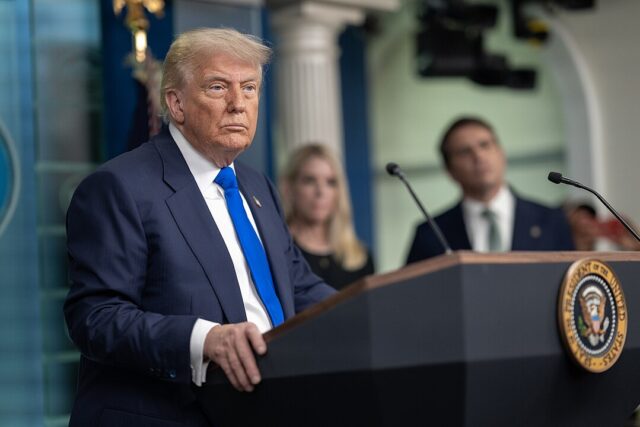
President Donald Trump holds a press conference with Attorney General Pam Bondi and Deputy Attorney General Todd Blanche in the James S. Brady Press Briefing Room on Friday, June 27, 2025. (Official White House Photo by Molly Riley)

President Donald Trump late Thursday said that the United States may “almost completely” eliminate the income tax due to the rising tariff revenue.

“In the next couple of years, I think we’ll substantially be cutting, or maybe cutting out completely, but we’ll be cutting income tax,” Trump said during an event on Thursday.

“Could be almost completely cutting it because the money we’re taking in is going to be so large,” he added.

The Congressional Budget Office (CBO) in June projected that the tariff increases will reduce the federal deficit by $2.8 trillion over the next decade.

Breitbart News reports:

The tariff estimate covers measures implemented between January 6 and May 13, 2025. These include a 30 percent levy on imports from China and Hong Kong, 25 percent duties on autos, auto parts, steel, and aluminum, a 10 percent general tariff on most other imports, and the elimination of duty-free treatment for low-value Chinese shipments.

CBO estimates that, before accounting for economic side effects, the new tariffs will reduce primary deficits by $2.5 trillion and cut interest payments by another $500 billion, for a total deficit reduction of $3.0 trillion. After factoring in modest economic drag — slightly lower GDP and temporarily higher inflation — the net deficit reduction is pegged at $2.8 trillion.

Watch:

Earlier in November, Commerce Secretary Howard Lutnick said that Trump is proposing a tariff dividend check so that Americans understand the impact of Trump’s tariff policies.

“Well, look, the President wants to make sure the American people understand that the tariffs are there for their benefit, right? That it’s — yes, it’s going to drive down our deficit. Yes, it’s going to make the country stronger,” Lutnick said on Fox Business Network’s Kudlow show.

“But he wants the people of America, the American people to appreciate these tariffs, and he knows if he puts money into their pocket and says, ‘Look, this was paid for by the tariffs,’ they’ll better understand how important this is for America. And so, that’s why he’s talking about it.”

Trump Plans To Capitalize On Schumer Shutdown With Plan To Axe Federal Agencies

5

President Donald Trump announced he is scheduled to meet with Russ Vought, director of the Office of Management and Budget, to discuss which parts of the government he recommends cutting amid the Schumer Shutdown.

“I have a meeting today with Russ Vought, he of PROJECT 2025 Fame, to determine which of the many Democrat Agencies, most of which are a political SCAM, he recommends to be cut, and whether or not those cuts will be temporary or permanent,” the president wrote on Truth Social Thursday morning.

“I can’t believe the Radical Left Democrats gave me this unprecedented opportunity,” he continued. “They are not stupid people, so maybe this is their way of wanting to, quietly and quickly, MAKE AMERICA GREAT AGAIN!” 

Trump Warns of Necessary Cuts as Shutdown Looms

President Trump said Tuesday that while he would prefer to avoid a government shutdown, it could provide an opportunity to continue his mission of restoring fiscal sanity in Washington and eliminating wasteful spending.

“We don’t want it to shut down because we have the greatest economy and investment environment ever,” Trump said from the Oval Office. “We’ve got $17 trillion being invested in this country right now. So the last person who wants a shutdown is us.”

“But with that being said,” he continued, “a shutdown allows us to make reforms that are otherwise impossible — cutting bloated programs, trimming the fat, and removing layers of bureaucracy that serve no one but Washington insiders.”

A government funding lapse doesn’t give the president new powers, but it does shift discretion to the White House and the Office of Management and Budget (OMB) to determine which programs must continue and which can pause. The Antideficiency Act requires agencies to halt nonessential spending when Congress fails to pass appropriations, while preserving core constitutional and national security functions.

Trump praised OMB Director Russell Vought for his leadership on budget discipline. “Russell Vought has been very popular lately because he knows how to bring the budget under control in ways Congress never would,” Trump said. “Shutdowns have risk for Democrats too — because during them, we can finally cut things they love to spend on, things that waste taxpayer dollars, and no one can reverse it.”

Later that day, Trump reiterated that he wants a deal but will not ignore the chance to protect taxpayers if Democrats refuse to negotiate responsibly. “A lot of good can come from this,” he said. “We can finally weed out overspending and save Americans’ hard-earned money.”

Vought, in a memo Tuesday evening, declared that a shutdown appeared unavoidable because of what he called “Democrats’ insane policy demands, including $1 trillion in new spending.” He told federal employees to prepare for an orderly pause in operations.


Vice President JD Vance: Focus on Essential Services

On Wednesday, Vice President JD Vance joined the White House press briefing to emphasize that while the administration expects the shutdown to be brief, some workforce reductions are unavoidable.

“We’re going to have to make things work,” Vance said. “That means prioritizing essential functions and, unfortunately, letting go of some nonessential positions. Our goal is to make sure the American people feel as little pain as possible.”

Vance pushed back on criticism that the administration is using the shutdown for partisan targeting: “We’re not going after agencies because of politics. We’re trying to keep critical services running, even when Democrats refuse to fund the government responsibly.”


The Drive to Make Government Leaner

These measures are part of Trump’s larger effort to make the federal government lean, accountable, and responsive to voters — not entrenched bureaucrats. In January, the administration offered voluntary buyouts for employees ready to step aside and avoid deeper cuts. Those were followed by reduction-in-force (RIF) plans across agencies with low performance or duplication of services.

In his March address to Congress, Trump pledged to “reclaim power from unaccountable bureaucracy and return it to the American people.”

“Any federal bureaucrat who resists this change will be removed from office,” Trump said. “We’re draining the swamp. The days of rule by unelected bureaucrats are over.”


DOGE and the Push Against Waste

Central to this reform is the Department of Government Efficiency (DOGE), created to root out waste, fraud, and abuse. Tech entrepreneur Elon Musk was tapped to lead DOGE’s oversight efforts — leveraging innovation and private-sector discipline to expose costly, ineffective programs.

DOGE has flagged millions in questionable foreign aid and pet projects that have little to do with serving Americans, including:

  • $25 million for “biodiversity and socially responsible behavior” in Colombia
  • $40 million to “improve the social and economic inclusion of sedentary migrants”
  • $42 million for “social and behavior change” initiatives in Uganda
  • $10 million for circumcision programs in Mozambique

“Why are we paying for these things abroad when our own border is wide open and Americans are struggling?” Trump asked at CPAC, highlighting the findings.

US Takes 10% Stake In Intel Under Trump To Strengthen Chip Production

Donald Trump via Gage Skidmore Flickr

A public-private deal aims to bring microchip manufacturing back to American soil — and deliver taxpayer returns in the process.

A Strategic Bet on Semiconductors

President Donald Trump announced Friday that chipmaker Intel agreed to give the U.S. government a 9.9% equity stake, valued at $8.9 billion. The move, the first of its kind under the CHIPS and Science Act, is intended to strengthen domestic semiconductor capacity and ensure that federal subsidies come with direct returns for taxpayers.

“They’ve agreed to do it, and I think it’s a great deal for them,” Trump told reporters during a briefing. The agreement follows internal administration discussions about using existing Commerce Department funding to acquire a stake in Intel, an effort confirmed earlier in the week by Commerce Secretary Howard Lutnick.

The stake is expected to be funded through the CHIPS Act and the Department of Defense’s Secure Enclave program. It will be a passive investment, meaning the government will not receive board seats, governance rights, or special access to information.

Intel Under Scrutiny

Trump also shed light on how the agreement came about — including a conversation with Intel CEO Lip-Bu Tan, whose background had drawn criticism from Capitol Hill.

Earlier this month, Sen. Tom Cotton (R-AR) raised alarms over Tan’s past leadership of Cadence Design Systems, which in 2008 pleaded guilty to illegally exporting chip design software to a Chinese military university. Tan’s investments in China-based firms had also raised national security concerns.

“I said, ‘Well that’s right, he should resign,’” Trump said. “And he came in, he saw me, we talked for a while. I liked him a lot. I thought he was very good. I thought he was somewhat a victim, but, you know, nobody’s a total victim, I guess.”

Following their meeting, Trump floated the idea that Intel should offer a 10% equity share to the U.S. government.

“He said, ‘I would consider that,’” Trump recalled. “Intel has been left behind, as you know, compared to [Nvidia CEO] Jensen [Huang] and some of our friends.”

Commerce: “We Can’t Rely on Taiwan”

Commerce Secretary Lutnick emphasized that the deal has more to do with national security than boardroom politics. In an interview on CNBC’s Squawk Box, Lutnick pointed out that Taiwan, which manufactures over 90% of the world’s most advanced semiconductors, sits just 80 miles from China.

“We cannot rely on Taiwan, which is 9,500 miles away from us and only 80 miles from China,” Lutnick said. “So, you can’t have 99 percent of leading-edge chips made in Taiwan. We want to make them here.”

He noted that the administration wants to ensure that U.S. companies are capable of producing next-generation chip nodes domestically.

“One of those pieces is, it would be lovely to have Intel be capable of making a U.S. node or a U.S. transistor — driving that in America,” Lutnick added.

A Rare Bipartisan Signal

The move drew support across ideological lines, with Sen. Bernie Sanders (I-VT) praising the basic premise: that if the federal government is handing out billions in subsidies, the public should see a share of the profits.

“No. Taxpayers should not be providing billions of dollars in corporate welfare to large, profitable corporations like Intel without getting anything in return,” Sanders said. “If microchip companies make a profit from the generous grants they receive from the federal government, the taxpayers of America have a right to a reasonable return on that investment.”

Not Everyone on Board

Some conservatives pushed back against the concept of government equity stakes in private corporations.

Sen. Rand Paul (R-KY) called the proposal a “terrible” precedent.

“If socialism is government owning the means of production, wouldn’t the government owning part of Intel be a step toward socialism?” Paul wrote in a post on X.

Despite the criticism, the administration has defended the agreement as a narrowly targeted investment — not a takeover — intended to align taxpayer contributions with long-term national and economic security.

Looking Ahead

The Intel stake marks a sharp departure from traditional federal industrial policy. Rather than simply issuing grants or tax breaks, the administration is pursuing a more transactional model: public money in, public equity out.

For the Trump administration, the goal is clear — to use government leverage to secure America’s position in next-generation chip manufacturing and reduce dependence on overseas supply chains.

READ NEXT: When Loyalty Breaks: Hegseth Moves Against Key Military Leader

Navarro Recommends Trump For Nobel Prize

1

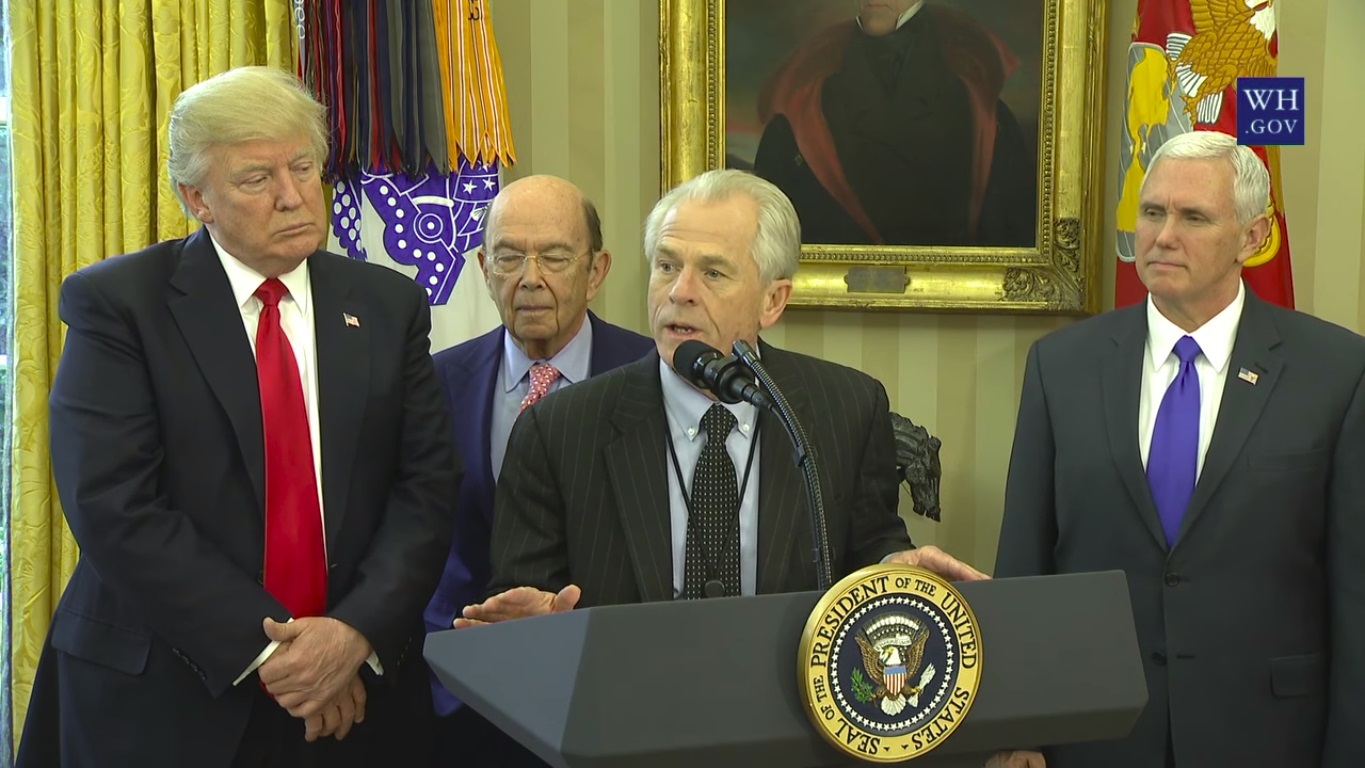
White House trade adviser Peter Navarro has made it clear: President Donald J. Trump’s bold restructuring of global trade deserves the world’s highest economic recognition — the Nobel Prize in Economics.

Appearing on Fox Business, Navarro praised Trump’s unwavering commitment to putting America first at the negotiating table:

“Since President Trump has essentially taught the world trade economics, he might be up for the Nobel on economics. This is a fundamental restructuring of the international trade environment. The largest market in the world has drawn a line: you will not cheat us anymore,” Navarro said.

Under Trump’s leadership, the United States has replaced decades of bad deals with fair and reciprocal agreements. Tariffs — dismissed by critics — have functioned as tax cuts for the American economy, and inflation has stayed under control.

America First Wins on the World Stage
The Trump administration’s trade strategy is delivering results at lightning speed. Landmark agreements have been secured with the United Kingdom, European Union, and Japan, and negotiations are underway with China — the world’s second-largest economy — to ensure fair play and accountability.

Navarro summed it up:

“These deals are happening now fast and are incredibly effective.”

Nominations Rolling In
Trump’s bold leadership isn’t just earning results — it’s earning global recognition. Multiple leaders and officials have nominated him for the Nobel Peace Prize:

  • U.S. Reps. Buddy Carter (GA) and Darrell Issa (CA) for his groundbreaking Middle East peace agreements, including progress toward resolving tensions between Israel and Iran.
  • Israeli Prime Minister Benjamin Netanyahu, who presented Trump with a formal letter of nomination after the President’s push for a ceasefire between Israel and Iran.
  • Pakistani officials praised Trump’s role in de-escalating disputes with India (despite later disagreements over separate actions in the region).

The Trump Standard vs. the Obama Surprise
While Barack Obama received the Nobel Peace Prize just months into his first term without any major achievements, President Trump has delivered historic results — and still doubts the globalist establishment will give him the recognition he’s earned.

“I won’t get a Nobel Peace Prize for this, I won’t get a Nobel Peace Prize for stopping the War between India and Pakistan, I won’t get a Nobel Peace Prize for stopping the War between Serbia and Kosovo,” he wrote in a June Truth Social post, also naming conflicts in North Africa and the Middle East.

“No, I won’t get a Nobel Peace Prize no matter what I do, including Russia/Ukraine, and Israel/Iran, whatever those outcomes may be, but the people know, and that’s all that matters to me!” Trump added.

Trump Peels Back China Tariffs In Trade War Truce

0
By The White House from Washington, DC - President Trump at the G20, Public Domain,

The Trump administration has reached a key deal in its ongoing trade war against China.

Early Monday morning, the U.S. and China released a joint statement revealing that “the United States and China will each lower tariffs by 115% while retaining an additional 10% tariff,” according to the White House. 

The U.S. imposed tariffs as high as 145% on Chinese goods earlier this year as the president looks to bring parity to the nation’s chronic trade deficit with foreign countries.

The move was confirmed by Treasury Secretary Scott Bessent, who told reporters: “The consensus from both delegations this weekend was neither side wants a decoupling.”

Bessent also praised Chinese officials for engaging seriously on fentanyl, saying it was “the first time the Chinese side understood the magnitude of what is happening in the US.”

Secretary of the Treasury Scott Bessent“I’m happy to report that we made substantial progress between the United States and China in the very important trade talks. First, I want to thank our Swiss host. The Swiss government has been very kind in providing us this wonderful venue, and I think that led to a great deal of productivity we’ve seen. We will be giving details tomorrow, but I can tell you that the talks were productive. We had the vice premier, two vice ministers, who were integrally involved, Ambassador Jamieson, and myself. And I spoke to President Trump, as did Ambassador Jamieson, last night, and he is fully informed of what is going on. So, there will be a complete briefing tomorrow morning.”

The truce peels back some of the harshest duties imposed under President Donald Trump’s April tariff hike, which sent U.S. levies on Chinese goods to 125%. China hit back with countermeasures and restricted key mineral exports, rattling global supply chains. Under the new agreement, Chinese tariffs drop to 10%, while U.S. tariffs fall to 30% — though the 20% fentanyl-related tariff remains untouched.

China’s commerce ministry called the move a win for “producers and consumers in both countries,” urging Washington to “completely correct” its unilateral trade posture.

The trade negotiations come as President Trump is slated to depart Washington, D.C., on Monday for visits to Saudi Arabia, Qatar and the United Arab Emirates. The president disclosed last week, when Canadian Prime Minister Mark Carney visited the White House, that he would be making “a very, very big announcement” ahead of his departure for the Middle East, but has not shared additional details. 

Trump Indicates Plan To Lower or Eliminate Income Taxes Thanks To Tariffs

3

This could be huge…

President Donald Trump said that some people’s income taxes will be lowered or perhaps even completely eliminated due to tariffs.

“When Tariffs cut in, many people’s Income Taxes will be substantially reduced, maybe even completely eliminated. Focus will be on people making less than $200,000 a year,” he declared in a post on Truth Social.

“Also, massive numbers of jobs are already being created, with new plants and factories currently being built or planned. It will be a BONANZA FOR AMERICA!!! THE EXTERNAL REVENUE SERVICE IS HAPPENING!!!” the president added.

The president touched on the subjects of income taxes and tariffs while addressing reporters on Sunday.

“And eventually we’ll be reducing taxes very substantially for the people of our country, because the money is so great coming in from tariffs that I’ll be able to reduce taxes … to a very large extent, and maybe almost completely,” he said.

“And it’s possible we’ll do a complete tax cut, because I think the tariffs will be enough to cut all of the income tax,” he noted. 

The president indicated Americans will be given “a tremendous tax cut,” starting “with people making less than $200,000 dollars a year.”

Trump, who has been in the Oval Office for nearly 100 days, has moved at breakneck speed to revitalize America.

Speaker Mike Johnson (R-La.) told Fox News exclusively that President Donald Trump has accomplished more in the first 100 days of his tenure than “most politicians or presidents accomplish in their entire lifetimes.”

“So much of what we’ve done is leading up to the big reconciliation bill, and that is the legislative vehicle, as I’ve explained to people, it will help us, through which we will deliver the president’s America First agenda,” Johnson told Fox News Digital.

“We’ve done it with arguably the smallest margin in the history of the Congress, so challenges every day, but it’s been very rewarding to lead us through that.”

 The speaker also acknowledged that Trump has acted quite a bit on his own, as well.

“He’s issued, I think, 110 executive orders and many other executive actions. And we’ve been working to codify so much of that. It’s been kind of a partnership,” Johnson said.

“I don’t think we’ve ceded any authority. I think that he’s doing what is within his scope to do. There’s an assumption made by Congress that the administration, whoever is in the administration, will use the money that is appropriated to the executive branch as a good steward, that they will take every measure possible to prevent fraud, waste and abuse,” Johnson said. 

“And tariffs as well – the president, whomever is president, has a responsibility and I think an expectation from Congress that they will deal with unfair trade partners around the globe.”

However, while many conservatives have praised Trump’s recent accomplishments, many Democrats have openly decried the moves and spurred concerns they will seek to impeach Trump if they regain control of Congress.

CNN host Dana Bash recently asked Senate Minority Leader Chuck Schumer if he agreed with Sen. Jon Ossoff (D-Ga.) who signaled recently that he would support an impeachment effort against Trump.

“Would that be a priority if Democrats were to take back Congress?” Bash asked. 

“President Trump is violating rule of law in every way. And we’re fighting him every single day in every way. And our goal is to show the American people over and over again, whether it’s the economy, whether it’s tariffs, whether it’s Russia and overseas and whether it’s rule of law, how bad he is. And you know, two years is too far away to predict. Our job is day to day to day, to show who Trump is, what he is doing, and it’s having an effect,” Schumer said.

Bash pressed him further and said, “You’re not saying ‘no.’”

“Look, it’s too far away to even judge,” Schumer responded.

Ossoff signaled support for impeaching Trump during a town hall event in Georgia.

“I saw just 48 hours ago, [Trump] is granting audiences to people who buy his meme coin,” Ossoff said. “There is no question that that rises to the level of an impeachable offense. And the reality is that that’s just one of many [examples] — defying a federal court order, for example.”

Trump Backs Off Powell Firing Talk As Markets Rally

The White House, Public domain, via Wikimedia Commons

President Donald Trump made clear he has “no intention” of dismissing Federal Reserve Chair Jerome Powell, despite recent public criticisms that had unsettled financial markets. Tuesday’s clarification comes after Trump had labeled Powell a “major loser” and suggested his “termination cannot come fast enough.”

The president’s assurance appeared to calm investor fears about the central bank’s independence, triggering a significant market rebound Tuesday that extended into Wednesday morning.

The S&P 500 rose by 3%, and the Nasdaq increased by 3.7%, reflecting investor relief over the reduced likelihood of political interference with the Federal Reserve. European markets also responded positively, with the Stoxx Europe 600 up 1.9% and Germany’s DAX gaining 2.8%.

Despite the president’s recent criticisms, including calls for more aggressive interest rate cuts, Trump emphasized that he never intended to remove Powell from his position. He expressed a desire for the Fed to act more decisively in lowering interest rates but acknowledged Powell’s role would continue until his term concludes in May 2026.

“I would like to see him be a little more active in terms of his idea to lower interest rates…but, no, I have no intention to fire him,” Trump told reporters in the Oval Office, according to a report from The Wall Street Journal:

U.S. stock futures and the dollar rallied following Trump’s remarks. Gold futures dropped, pulling back from record highs.

Trump’s softer tone on Powell came after he lashed out at the Fed chair, writing on social media last week, “Powell’s termination cannot come fast enough!”

But on Tuesday, Trump played down recent comments by Kevin Hassett, the director of the National Economic Council, that the administration was studying whether the president could fire Powell.

“This is a perfect time to lower interest rates. If he doesn’t, is it the end? No. It’s not,” Trump said.

Trump also addressed trade policy, signaling that tariffs on Chinese goods — currently set at 145% — could be “substantially” reduced, though not fully eliminated. The hint at a possible easing of trade tensions, combined with his reaffirmation of the Fed’s independence, fueled the global market rebound. (RELATED: Trump Softens Tariff Stance On China)

While the immediate market reaction has been positive, analysts warn that ongoing tensions between the Trump administration and the Federal Reserve — along with the prospect of slow-moving trade negotiations between the world’s two largest economies — could continue to weigh on financial markets in the weeks and months ahead.

READ NEXT: Jury Issues Decisive Verdict In Onetime Republican Star’s Years-Long Legal Battle

Wall Street Journal Board Urges Potential Trump Impeachment

2
Image via Gage Skidmore Flickr

Yikes…

In a column published late Friday, a member of the Wall Street Journal editorial board claimed it would be “desirable” to subject Donald Trump to a third impeachment.

According to longtime columnist Holman W. Jenkins Jr., Trump’s on-again, off-again tariff threats almost makes it appear he wants to be impeached, with Jenkins writing, “A future Trump impeachment seemed all but guaranteed by last Wednesday morning. It seems only slightly less likely now. It may even be desirable to restore America’s standing with creditors and trade partners.”

Read more from the report:

As he sees it, the president’s last great achievement was being re-elected in 2024, and the damage he has been creating since then belies his promise of a “golden age,” so an impeachment is “already ion the cards.”

“No consensus or even significant coalition exists for trying to force into existence a new American ‘golden age’ with tariffs, which anyway is like asking a chicken to give birth to a lioness. He invented this mission out of his own confused intuition,” he accused.

Noting that conservative historian Niall Ferguson labeled Trump’s trade policy going “full retard,” he contributed, “I go with ‘neurotic’ for the word’s wider applicability to any leader who, lacking a clear bead on his times, fabricates a gratuitously ambitious mission to meet his misguided sense of importance.”

“Nobody in Mr. Trump’s orbit actually shares his belief in the magical efficacy of tariffs because it makes sense only in a world that doesn’t exist, where other countries don’t retaliate,” he pointed out before concluding, “The founders never anticipated today’s instantly responsive trillion-dollar financial markets. And yet these markets neatly adumbrate the founders’ scheme of checks and balances, also known as feedback. Mr. Trump, still sane enough to appreciate what’s good for Mr. Trump, listened this week to their feedback.”

President Donald Trump vowed on Sunday that nobody was getting “off the hook” for unfair trade balances and tariff barriers, which other countries have used against the U.S.

The Trump administration announced Friday that it was exempting imported smartphones, laptops and other electronics from reciprocal tariffs, but the president wanted to clear a few things up.

“There was no Tariff ‘exception’ announced on Friday,” Trump said in a post on X on Sunday. “These products are subject to the existing 20% Fentanyl Tariffs, and they are just moving to a different Tariff ‘bucket.’  The Fake News knows this, but refuses to report it. We are taking a look at Semiconductors and the WHOLE ELECTRONICS SUPPLY CHAIN in the upcoming National Security Tariff Investigations.

Customs and Border Protection issued new guidance on reciprocal tariff negotiations late Friday, noting the exemption of those goods from Trump’s April 2 executive order that declared a national emergency due to non-reciprocal trade practices and structural imbalances in the global trading system. Subsequent executive orders ramped up tariffs on China to 125%.

The updated guidance, which cites a presidential memorandum issued Friday, excluded the products from Trump’s 125% China tariff and his baseline 10% global tariff on some countries. They apply to goods that left a warehouse as of April 5.

Products included in the exemption are things like hard drives, computer processors, solar cells, semiconductor manufacturing equipment, flat-panel TV displays and memory chips.

But in light of the easing of tariffs on electronics, Commerce Secretary Howard Lutnick said Sunday the exemption would be temporary.

“They’re exempt from the reciprocal tariffs, but they’re included in the semiconductor tariffs, which are coming in probably a month or two,” Lutnick told ABC’s “This Week” on Sunday.

Lutnick’s comments Sunday made clear that more changes were on the horizon.

Senators Call On SEC To Open Investigation Into Trump For Insider Trading

5

Democrats are getting desperate…

Senate Minority Leader Chuck Schumer (D-NY) and Sen. Elizabeth Warren (D-MA) sent a letter to the Securities and Exchange Commission (SEC) this week asking for an investigation into President Donald Trump’s social media posts urging stock market purchases ahead of his tariff pause announcement

“We ask the SEC to determine whether President Trump, any members of his cabinet, or other donors, insiders, and administration officials engaged in insider trading, market manipulation or other securities laws violations on April 9, 2025, when President Trump announced that it was a ‘GREAT TIME TO BUY’ into the stock market,” the senators wrote in a scathing letter.

Sens. Adam Schiff (D-CA), Ron Wyden (D-OR), Mark Kelly (D-AZ), and Ruben Gallego (D-AZ) also signed the letter, which slammed Trump for urging his social media followers to buy stocks “just hours before he announced a 90-day pause on his recently announced tariffs, leading to a historic market rally after days of dramatic market declines.”

“THIS IS A GREAT TIME TO BUY!!!” Trump wrote on Truth Social at 9:37 am just ahead of his announcement that he would pause additional tariff increases on 75 countries for 90 days while slapping even higher levies on China.

The letter was addressed to SEC Commissioner Paul Atkins, a Trump appointee, who was confirmed by the Senate on Thursday.

“It is unclear which officials and affiliates for President Trump had advance knowledge of his plans to delay tariffs — but insiders may have known that he was going to announce a tariff pause and that the market would improve,” argued the Senators.