


Crime

Home Crime

Armed Suspect Charged In Alleged Plot To Assassinate Trump At WHCA Dinner

1
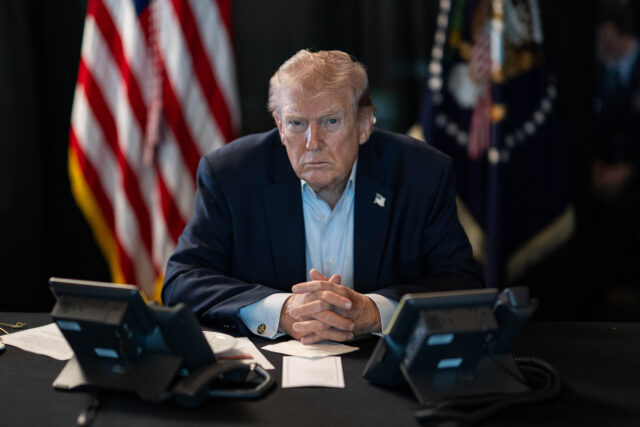
By The White House - https://www.flickr.com/photos/202101414@N05/54581054338/, Public Domain,

A 31-year-old man is now facing federal charges after authorities say he attempted to carry out a shocking attack targeting President Donald Trump and top officials during the White House Correspondents’ Dinner.

Cole Allen appeared in court Monday following the terrifying incident that forced Trump and other high-ranking figures to be rushed out of the Washington Hilton under heavy security.

According to investigators, Allen allegedly stormed a security checkpoint Saturday night armed with a shotgun, a handgun, and multiple knives—triggering panic at the high-profile event packed with journalists and political elites.

The annual black-tie dinner was immediately shut down.

A Secret Service agent was shot during the chaos but survived thanks to a bulletproof vest and has since been released from the hospital.

Chilling “Manifesto” Raises New Questions

Authorities say Allen left behind a disturbing manifesto outlining what appears to be a calculated plan to target members of the Trump administration.

In the writings, he described prioritizing officials “from highest-ranking to lowest,” suggesting a methodical approach to the attack.

He also made clear he was willing to harm others if necessary to reach his intended targets.

In one particularly unsettling detail, Allen referenced his choice of ammunition—claiming he selected buckshot “to minimize casualties,” even as he prepared for violence.

Trump Escorted Out As Event Collapses

President Trump was quickly removed from the venue as the situation unfolded, with law enforcement scrambling to contain the threat.

The Correspondents’ Dinner—long considered one of Washington’s most high-profile media events—was abruptly canceled as the situation spiraled.

Facing Life Behind Bars

Allen is now facing three federal charges tied to what prosecutors describe as an attempt to violently disrupt the event. If convicted, he could spend the rest of his life in prison.

Authorities are continuing to investigate the suspect’s background and motives.

This is a breaking news story. Please check back for updates.

Inside The White House Correspondents’ Dinner Suspect’s ‘Manifesto’

The man accused of opening fire outside the White House Correspondents’ Dinner left behind a detailed “manifesto” describing his intent to target members of the Trump administration, “prioritized from highest-ranking to lowest,” according to a copy obtained by CBS News.

Cole Allen, 31, allegedly sent the writing to family members before the attack. In it, he stated that while law enforcement, hotel employees, and guests were not his intended targets, he was willing to harm them if necessary to reach administration officials. “I really hope it doesn’t come to that,” he wrote.

Authorities say Allen charged a security checkpoint outside the Washington Hilton on Saturday night armed with a shotgun, a handgun, and knives. President Donald Trump and other officials were quickly escorted from the event, which was later canceled. A Secret Service agent who was shot during the incident, while wearing a bulletproof vest, has since been released from the hospital.

The suspect’s brother reportedly alerted police in Connecticut after receiving the email, prompting law enforcement to intervene. Investigators later recovered additional writings from Allen’s home in Torrance, California, and his hotel room at the Hilton.

A chilling and ironic tone

Throughout the message, Allen adopted a matter-of-fact tone, at times veering into irony.

“Hello everybody!” he began. “So I may have given a lot of people a surprise today.”

He apologized to his parents “for saying I had an interview without specifying it was for ‘Most Wanted,’” and to colleagues and students for claiming he had a personal emergency. He suggested that by the time the email was read, he might already require medical attention, referring to potential injuries as “self-inflicted status.”

Declared targets — with one exception

Allen wrote that he chose to act because he did not want the administration’s alleged “crimes” to “coat [his] hands.” While he did not explicitly name Trump or the event, he described a plan to target officials in descending order of rank.

He made one notable exception: “not including Mr. Patel,” he wrote, referencing the FBI director, who was also in attendance.

Allen added that he would avoid targeting Secret Service, Capitol Police, or National Guard personnel unless necessary. “I hope they are wearing body armor,” he wrote.

He also detailed tactical decisions, claiming, “In order to minimize casualties, I will also be using buckshot rather than slugs (less penetration through walls).”

Anticipating criticism

The manifesto included a section addressing hypothetical objections to his actions, along with rebuttals.

“As a half-black, half-white person, you shouldn’t be the one doing this,” he wrote as a potential criticism. “Rebuttal: I don’t see anyone else picking up the slack.”

He also referenced his Christian faith, writing that some might argue he should “turn the other cheek.”

“Rebuttal,” he continued, “Turning the other cheek is for when you yourself are oppressed.”

Allen then described various unnamed individuals experiencing hardship, in some cases attributing their struggles to the administration.

“I don’t expect forgiveness, but if I could have seen any other way to get this close, I would have taken it,” he added.

Criticism of security

In a postscript, Allen sharply criticized security measures at the event.

“PS… what the hell is the Secret Service doing? … No damn security. Not in transport. Not in the hotel. Not in the event,” he wrote.

He claimed that if he had been a foreign agent, he could have brought in heavier weaponry without detection. Officials note that while the Washington Hilton hosted the event, it remained an operational hotel with public access, and only specific areas were secured.

Family warnings and prior behavior

Allen’s sister reportedly told investigators that he frequently used “radical” rhetoric and had previously discussed doing “something” to address what he saw as problems in society and government.

She also revealed her brother was a regular visitor to the shooting range, was a member of a group called “The Wide Awakes” and had previously attended a “No Kings” rally in California. 

Political reaction and unanswered questions

The motive behind the attack remains under investigation.

Former President Barack Obama emphasized the lack of confirmed details while condemning political violence broadly.

“Although we don’t yet have the details about the motives behind last night’s shooting… it’s incumbent upon all of us to reject the idea that violence has any place in our democracy,” Obama wrote. He also praised the Secret Service, calling their work “a sobering reminder of the courage and sacrifice” they show.

During a “60 Minutes” interview, Trump reacted angrily after host Norah O’Donnell read excerpts from the alleged manifesto.

“You read that crap from some sick person? I got associated with all stuff that has nothing to do with me,” Trump said, adding, “You should be ashamed of yourself… You’re a disgrace.”

More than 2,500 people had gathered for the annual dinner, which celebrates the First Amendment. Trump, who has typically declined to attend during his presidency, had made a historic appearance this year and has since said he hopes to reschedule the event within 30 days.

The Full Manifesto

To read Allen’s full 1,052-word manifesto as published by The New York Post, with minor edits to improve profanity, see below:

Hello everybody!

So I may have given a lot of people a surprise today. Let me start off by apologizing to everyone whose trust I abused.

I apologize to my parents for saying I had an interview without specifying it was for “Most Wanted.”

I apologize to my colleagues and students for saying I had a personal emergency (by the time anyone reads this, I probably most certainly DO need to go to the ER, but can hardly call that not a self-inflicted status.)

I apologize to all of the people I traveled next to, all the workers who handled my luggage, and all the other non-targeted people at the hotel who I put in danger simply by being near.

I apologize to everyone who was abused and/or murdered before this, to all those who suffered before I was able to attempt this, to all who may still suffer after, regardless of my success or failure.

I don’t expect forgiveness, but if I could have seen any other way to get this close, I would have taken it. Again, my sincere apologies.

On to why I did any of this:

I am a citizen of the United States of America.

What my representatives do reflects on me.

And I am no longer willing to permit a pedophile, rapist, and traitor to coat my hands with his crimes.

(Well, to be completely honest, I was no longer willing a long time ago, but this is the first real opportunity I’ve had to do something about it.)

While I’m discussing this, I’ll also go over my expected rules of engagement (probably in a terrible format, but I’m not military so too bad.)

Administration officials (not including Mr. Patel): they are targets, prioritized from highest-ranking to lowest

Secret Service: they are targets only if necessary, and to be incapacitated non-lethally if possible (aka, I hope they’re wearing body armor because center mass with shotguns messes up people who *aren’t*

Hotel Security: not targets if at all possible (aka unless they shoot at me)

Capitol Police: same as Hotel Security

National Guard: same as Hotel Security

Hotel Employees: not targets at all

Guests: not targets at all

In order to minimize casualties I will also be using buckshot rather than slugs (less penetration through walls)

I would still go through most everyone here to get to the targets if it were absolutely necessary (on the basis that most people *chose* to attend a speech by a pedophile, rapist, and traitor, and are thus complicit) but I really hope it doesn’t come to that.

Rebuttals to objections:

Objection 1: As a Christian, you should turn the other cheek.

Rebuttal: Turning the other cheek is for when you yourself are oppressed. I’m not the person raped in a detention camp. I’m not the fisherman executed without trial. I’m not a schoolkid blown up or a child starved or a teenage girl abused by the many criminals in this administration.

Turning the other cheek when *someone else* is oppressed is not Christian behavior; it is complicity in the oppressor’s crimes.

Objection 2: This is not a convenient time for you to do this.

Rebuttal: I need whoever thinks this way to take a couple minutes and realize that the world isn’t about them. Do you think that when I see someone raped or murdered or abused, I should walk on by because it would be “inconvenient” for people who aren’t the victim?

This was the best timing and chance of success I could come up with.

Objection 3: You didn’t get them all.

Rebuttal: Gotta start somewhere.

Objection 4: As a half-black, half-white person, you shouldn’t be the one doing this.

Rebuttal: I don’t see anyone else picking up the slack

Objection 5: Yield unto Caesar what is Caesar’s.

Rebuttal: The United States of America are ruled by the law, not by any one or several people. In so far as representatives and judges do not follow the law, no one is required to yield them anything so unlawfully ordered.

I would also like to extend my appreciation to a great many people since I will not be likely to be able to talk with them again (unless the Secret Service is *astoundingly* incompetent.)

Thank you to my family, both personal and church, for your love over these 31 years.

Thank you to my friends, for your companionship over many years.

Thank you to my colleagues over many jobs, for your positivity and professionalism.

Thank you to my students for your enthusiasm and love of learning.

Thank you to the many acquaintances I’ve met, in person and online, for short interactions and long-term relationships, for your perspectives and inspiration.

Thank you all for everything.

Sincerely,

Cole “coldForce” “Friendly Federal Assassin” Allen

PS: Ok now that all the sappy stuff is done, what the hell is the Secret Service doing? Sorry, gonna rant a bit here and drop the formal tone.

Like, I expected security cameras at every bend, bugged hotel rooms, armed agents every 10 feet, metal detectors out the wazoo.

What I got (who knows, maybe they’re pranking me!) is nothing.

No damn security.

Not in transport.

Not in the hotel.

Not in the event.

Like, the one thing that I immediately noticed walking into the hotel is the sense of arrogance.

I walk in with multiple weapons and not a single person there considers the possibility that I could be a threat.

The security at the event is all outside, focused on protestors and current arrivals, because apparently no one thought about what happens if someone checks in the day before.

Like, this level of incompetence is insane, and I very sincerely hope it’s corrected by the time this country gets actually competent leadership again.

Like, if I was an Iranian agent, instead of an American citizen, I could have brought a damn Ma Deuce in here and no one would have noticed s**t.

Actually insane.

Oh and if anyone is curious is how doing something like feels: it’s awful. I want to throw up; I want to cry for all the things I wanted to do and never will, for all the people whose trust this betrays; I experience rage thinking about everything this administration has done.

Can’t really recommend it! Stay in school, kids.

GOP Split Emerges Over Potential Maxwell Pardon In Epstein Investigation

A Divided Republican Conference

Republicans on the House Oversight Committee are facing an internal divide over a sensitive and politically risky question: whether Ghislaine Maxwell, the convicted associate of Jeffrey Epstein, should be considered for a presidential pardon in exchange for cooperation with investigators.

The discussion has largely taken place behind closed doors, but it reflects a broader tension between uncovering new information and maintaining public confidence in the justice system.

Committee Chairman James Comer (R-Ky.) acknowledged the split, noting that some Republicans believe Maxwell could provide valuable testimony about Epstein’s network if offered clemency. Still, Comer made clear he is not among them.

  • He warned that a pardon “looks bad” politically and ethically
  • He emphasized Maxwell’s central role in the underlying crimes
  • He argued that granting leniency could undermine trust in the investigation

Comer summed up his position bluntly, describing Maxwell as one of the most culpable figures in the case.

Democrats Firmly Opposed

Democrats on the committee are unified in rejecting any potential deal.

Ranking Member Robert Garcia (D-Calif.) strongly criticized the idea, arguing that offering clemency to Maxwell would be offensive to victims and damaging to the integrity of the investigation.

Key concerns raised by Democrats include:

  • The impact on survivors of Epstein’s abuse
  • The credibility of any testimony obtained through a pardon
  • The risk of public perception shifting toward a “cover-up”

Garcia warned that even considering such an arrangement could erode confidence in the process and send the wrong signal about accountability.

Maxwell’s Leverage and Conditions

Maxwell is currently serving a 20-year sentence for her role in Epstein’s trafficking operation. So far, she has declined to cooperate with congressional investigators under existing conditions.

Her legal team, however, has signaled a willingness to engage if circumstances change.

According to her attorney:

  • Maxwell would be willing to testify “fully and honestly”
  • Any cooperation would be contingent on clemency
  • She is positioned as a key source of information about Epstein’s network

Her attorney has also claimed that Maxwell could shed light on the involvement, or lack thereof, of high-profile figures, including former presidents. Those assertions have not eased skepticism among lawmakers.

The Political and Legal Stakes

President Donald Trump has not ruled out the possibility of granting clemency, leaving the issue open and politically charged.

The debate highlights a difficult tradeoff:

  • Potential benefit: New details about Epstein’s network and associates
  • Potential cost: Perceived erosion of justice and accountability

For many lawmakers, the question is not just what Maxwell might reveal, but whether the price of that information is too high.

Why This Matters

At its core, the disagreement reflects a broader challenge facing investigators and policymakers:

  • How far should the government go to obtain critical information?
  • Can justice and transparency be balanced in a case with this level of public scrutiny?

There is no clear consensus, and the path forward remains uncertain.

What are your thoughts? Should a pardon be considered if it leads to new information about Epstein’s network? Share your perspective in the comments below.

READ NEXT: Case Against Leading Trump Opponent Abruptly Dropped

DOJ Slams Alleged DC Pipe Bomber’s Bid To Claim Trump Pardon

Tyler Merbler, CC BY 2.0 , via Wikimedia Commons

The Justice Department is forcefully pushing back against a striking legal claim from the man accused of planting pipe bombs in Washington, D.C., on the eve of Jan. 6 — that he was effectively pardoned by President Trump.

In a court filing Friday, prosecutors urged a federal judge to reject Brian Cole Jr.’s attempt to have his charges thrown out, calling his argument flatly incompatible with the “clear and unambiguous terms” of Trump’s sweeping Jan. 6 clemency order.

Cole, who was arrested in December 2025 after years of investigation, is accused of placing two pipe bombs outside the Republican and Democratic National Committee headquarters on Jan. 5, 2021 — just hours before rioters stormed the U.S. Capitol.

The devices never detonated, but the FBI has said they were functional and viable, raising the stakes of a case that remained unsolved for nearly five years.

Earlier this year, Cole’s lawyers made a bold move: They argued that his actions were “inextricably and demonstrably tethered” to the events of Jan. 6 — and therefore covered by Trump’s mass pardon of people tied to the attack.

They pointed to the broad language in Trump’s order, which applies to offenses “related to” events at or near the Capitol, and noted that Cole allegedly traveled to Washington for an election protest tied to the same political moment that fueled the riot.

But the Justice Department isn’t buying it.

“The defendant ignores that the proclamation expressly limited relief to individuals who had been ‘convicted of,’ or had a ‘pending indictment’ for, offenses related to the events at or near the United States Capitol on January 6,” U.S. Attorney for the District of Columbia Jeanine Pirro wrote.

That distinction, prosecutors argue, is decisive.

When Trump’s pardon took effect on Jan. 20, 2025, Cole had not yet been charged — putting him outside the scope of the order entirely.

“The defendant belonged to neither category, and so the proclamation has no bearing on this case,” Pirro wrote.

Cole was indicted weeks later, in January 2026, on charges including interstate transportation of explosives and malicious attempt to use them.

Prosecutors also made clear that even a broader reading of the pardon wouldn’t help him.

“Even if the Court somehow found, notwithstanding its text, that the proclamation could apply to this case,” Pirro wrote, the Justice Department’s interpretation should still prevail as a “consistent, reasonable” reading by the agency tasked with enforcing it.

The clash sets up a high-stakes test of how far Trump’s Jan. 6 pardons can stretch — and whether conduct that happened before the riot, but is arguably connected to it, can fall under their umbrella.

For now, the Justice Department’s position is blunt: Not this case. Not this defendant.

READ NEXT: Congressman’s Sudden Death Upends Key Race

Man Arrested With Body Armor, Rifle Painted Like Toy Near Trump Golf Course

Police image via Pixabay free images

Deputies in Los Angeles stopped what could have turned into a far more dangerous situation near a Trump-owned golf course.

Authorities arrested a 36-year-old Arizona man after he was spotted running through traffic near Trump National Golf Course in Rancho Palos Verdes while armed with multiple weapons, including a loaded rifle painted to resemble a toy.

According to the Los Angeles County Sheriff’s Department, the suspect — identified as Sean Steiner of Glendale, Arizona — had been seen earlier hiking in the area with a duffel bag, step stool, and rifle before entering traffic along Palos Verdes Drive South around 5 p.m. on March 29.

When deputies arrived, they found the rifle had been painted green and purple and marked with the phrases “HA HA HA HA” and “Why so serious?” — a reference to the Joker character from Batman. The tip had also been painted orange, “resembling a toy gun,” according to authorities.

What may have looked theatrical was anything but harmless.

“Not only was the rifle loaded with a round in the chamber and a full magazine inserted… he admitted he had just fired one of the pistols near the landslide area to ‘get some anger out,’” the sheriff’s Lomita Station said in a statement.

Deputies also discovered two loaded handguns, high-capacity magazines, and additional ammunition. Steiner was wearing a ballistic vest capable of stopping rifle rounds.

“Let that sink in,” authorities wrote. “An armed individual, firing a weapon, walking through traffic and trails… in a populated area.”

Sean Steiner, right, is accused of multiple firearm-related felonies after Los Angeles deputies say they arrested him near a Trump-owned golf course with a semiautomatic rifle painted to look like a toy. He is also accused of firing a handgun in the brush nearby before running into traffic. (Lomita Sheriff’s Station via Fox News)

The situation underscores how quickly a volatile scenario can escalate — and how critical early reporting can be. Officials credited witnesses who called in the suspicious behavior before anyone was injured, emphasizing the importance of the public safety mantra: “if you see something, say something.”

Steiner now faces multiple felony firearm charges. He was booked March 29 and released on bond April 1.

While investigators say Steiner had little prior criminal history beyond minor offenses, the incident raises broader concerns about armed individuals near high-profile locations — particularly those associated with President Donald Trump.

It also echoes another alarming case: Ryan Routh, who was previously arrested after allegedly hiding in bushes near a Trump golf course while armed. That case, like this one, highlighted the persistent security risks surrounding prominent political figures and the critical role of vigilant law enforcement.

Gabbard Sends Criminal Referrals To DOJ For 2 Officials Linked To Trump Impeachment

1
Tulsi Gabbard via Gage Skidmore Flickr

Director of National Intelligence Tulsi Gabbard has referred two former U.S. officials to the Justice Department for potential criminal investigation, escalating efforts to revisit the events that led to President Donald Trump’s first impeachment.

A spokesperson for Gabbard confirmed that the referrals target a whistleblower and former Intelligence Community Inspector General Michael Atkinson, both of whom played central roles in the 2019 inquiry. The spokesperson did not specify what crimes were alleged, and any decision to pursue charges rests with federal prosecutors.

The move follows Gabbard’s release of newly declassified testimony and documents that she argues show a “coordinated effort” within the intelligence community to “manufacture a conspiracy” used to justify Trump’s impeachment.

Atkinson’s actions were instrumental in advancing a whistleblower complaint that raised concerns about Trump’s July 2019 phone call with Ukrainian President Volodymyr Zelenskyy. In that call, Trump asked Zelenskyy to investigate then–former Vice President Joe Biden and his son, Hunter Biden.

The whistleblower wrote at the time: “I have received information from multiple U.S. Government officials that the President of the United States is using the power of his office to solicit interference from a foreign country in the 2020 U.S. election.”

Gabbard has sharply disputed the legitimacy of that complaint and Atkinson’s handling of it. Her office said Atkinson relied on “secondhand information” and “politicized, manufactured narratives,” and “did not follow standard IG procedures.”

“In his own words, IC IG Atkinson recognizes that his conclusions were based on a ‘preliminary investigation,’” her office said, quoting testimony in which he acknowledged he had not determined whether the alleged actions “actually took place.”

Under federal law, however, an inspector general’s role at that stage is limited to assessing whether a whistleblower complaint appears credible, not to fully investigate or verify the claims.

In a post on X, Gabbard accused “deep state actors” of constructing “a false narrative that Congress used to usurp the will of the American people and impeach duly-elected President @realDonaldTrump in 2019.”

Atkinson, who was fired by Trump in 2020, previously defended his conduct, saying he had “faithfully discharged” his duties and served “without regard to partisan favor or political fear.”

Democrats quickly condemned the referrals and the broader effort to revisit the impeachment.

Rep. Jim Himes of Connecticut, the top Democrat on the House Intelligence Committee, said the whistleblower “demonstrated courage and principle” in exposing Trump’s “efforts to extort Ukraine and falsely smear his opponent.”

“This apparent criminal referral will amount to nothing because no misconduct occurred,” Himes said. “But what it will do is chill future whistleblowers from coming forward… I suspect that is precisely the point.”

Sen. Mark Warner, the top Democrat on the Senate Intelligence Committee, dismissed the declassified materials as “a nothingburger” and “another sad attempt… to get in Donald Trump’s good graces.”

Trump was impeached by the House of Representatives in December 2019 on charges of abuse of power and obstruction of Congress tied to the Ukraine matter. He was acquitted by the Senate in early 2020 in a largely party-line vote and has consistently denied wrongdoing, calling his conversation with Zelenskyy “perfect.”

The latest referrals come as part of a broader push by Gabbard and other officials to reexamine controversies from Trump’s first term, including intelligence assessments of Russian election interference. While some figures connected to those investigations have been subpoenaed in ongoing probes, no charges have been filed.

At the same time, the effort unfolds against a backdrop of renewed political and legal scrutiny surrounding Trump. While prior impeachment proceedings ended in acquittal and are widely viewed as politically unlikely to result in removal from office, they continue to shape partisan divisions in Washington. Any new impeachment-related efforts would face long odds in Congress, particularly given the high threshold required for conviction in the Senate.

Still, the renewed focus on the 2019 impeachment underscores how the political battles of Trump’s presidency continue to reverberate, with competing narratives over the Ukraine episode remaining central to broader debates about executive power, accountability, and the role of intelligence agencies in U.S. politics.

Trump Rival Eric Swalwell Suspends Campaign

3
Photo via Gage Skidmore Flickr

Rep. Eric Swalwell (D-Calif.) announced Sunday that he is suspending his campaign for governor of California, just over 48 hours after multiple reports surfaced alleging sexual assault and misconduct involving a former aide and other women.

“I am suspending my campaign for Governor,” Swalwell wrote in a post on the social platform X. “To my family, staff, friends, and supporters, I am deeply sorry for mistakes in judgment I’ve made in my past. I will fight the serious, false allegations that have been made — but that’s my fight, not a campaign’s.”

The San Francisco Chronicle first reported Friday that Swalwell allegedly sexually assaulted a former aide in 2019 and 2024, incidents in which the woman was said to be too intoxicated to give consent. CNN later reported that four women had accused Swalwell of sexual misconduct, including one who alleged rape.

Swalwell forcefully denied the claims.

“They are absolutely false. They did not happen,” Swalwell said in a video posted on X on Friday. “They have never happened, and I will fight them with everything that I have. They also come on the eve of an election where I have been the frontrunner candidate for governor in California.”

His attorney has also sent cease-and-desist letters to several of the accusers, according to CNN.

Despite those denials, political support for Swalwell unraveled rapidly. Within hours of the initial reports, his campaign co-chairs — Reps. Adam Gray (D-Calif.) and Jimmy Gomez (D-Calif.) — publicly urged him to exit the race. Rep. Nancy Pelosi (D-Calif.), a longtime power broker in California politics, also called for him to drop out and said the allegations should be “appropriately investigated with full transparency and accountability.”

An unsigned letter from members of Swalwell’s congressional office and campaign described the allegations as “abhorrent, beneath the dignity of those serving in public office and betrays the trust of all Californians,” according to Politico.

Calls for his resignation from Congress have also grown, spanning both parties.

Rep. Anna Paulina Luna (R-Fla.) said she plans to file a motion to expel Swalwell from the House. Expulsion would require a two-thirds vote, meaning significant Democratic support would be necessary. Some Democrats have already indicated they would back such a move if Swalwell does not step down.

Separate investigations may further complicate his situation. The Department of Homeland Security said Sunday it is probing allegations that Swalwell illegally employed a nanny, while Manhattan District Attorney Alvin Bragg’s office confirmed it is reviewing the sexual assault claims.

Before the allegations emerged, Swalwell had been widely viewed as a leading contender in the Democratic gubernatorial primary. He had secured endorsements from major groups, including the California Teachers Association and the California Medical Association — both of which have since rescinded their support.

“CTA’s democratically elected board has voted unanimously to rescind our endorsement of Representative Eric Swalwell in his campaign for Governor of California. We withdraw all support,” the California Teachers Association wrote on X.

The race is now far more uncertain. Democratic strategists say candidates such as billionaire Tom Steyer and former Rep. Katie Porter (D-Calif.) could gain traction as voters reassess their options ahead of the June 2 primary.

Swalwell’s political downfall marks a dramatic turn for a congressman who rose to national prominence as one of former President Donald Trump’s most outspoken critics. A frequent presence on cable news, Swalwell served as an impeachment manager during Trump’s first Senate trial and was a vocal advocate for investigations into Trump’s conduct and associates.

The two have traded barbs for years, with Trump repeatedly targeting Swalwell in speeches and on social media, often mocking him personally and politically. Swalwell, in turn, built a national profile by positioning himself as a leading Democratic counterweight to Trump, including during his brief and unsuccessful 2020 presidential campaign.

Nancy Pelosi Claims Republicans May Hack Voting Machines and Create ‘Fake Count’ in Midterms

Rep. Nancy Pelosi (D-CA) is once again sounding alarms ahead of a major election—this time warning that Republicans aligned with Donald Trump could attempt to manipulate voting systems in the 2026 midterms.

In a sit-down interview with MSNBC’s Ali Vitali, the former House Speaker—long one of Trump’s most vocal critics—predicted Democratic success in the upcoming elections but cautioned supporters to stay vigilant against what she suggested could be underhanded GOP tactics.

“There are so many things that you can do to protect the election, and they are being done, whether it’s litigation or legislation or just mobilization, communication, all of that. But in addition to that, we have to be on guard as to what they may try to do to the technology. They may try to creep into the technology and create a false count,” Pelosi said.

Pelosi, who has spent years opposing Trump and his political movement, framed her concerns as part of a broader battle over the integrity of American democracy. She has consistently accused Trump and his allies of undermining democratic norms—particularly following the 2020 election—and her latest comments reflect that ongoing distrust.

Her remarks come as Democrats continue to push back against Republican-led redistricting efforts and the SAVE Act, a GOP-backed bill that would require stricter voter identification. While the legislation has passed the House, it faces steep odds in the Senate.

Pelosi didn’t hold back in her assessment of Republicans’ motivations.

“Pelosi accused Republicans of having ‘no commitment to the rule of law and doing things the appropriate way.’”

Despite her warnings, Pelosi struck a confident tone about Democratic prospects, outlining what she sees as the party’s core mission heading into the midterms.

“We have three purposes now. One is to win the midterm. Two is to make sure the elections are safe. And three, tell people what we will do when we win. That is the mission,” she said.

The longtime Democratic leader also reflected on the party’s future, predicting that a woman will eventually become president—though she does not expect to see it herself. She credited Vice President Kamala Harris with energizing voters during the 2024 election cycle.

“She turned out so many more people than who would have voted,” Pelosi said.

Watch:

Mike Lindell Appears To Be Served Lawsuit During Live Interview

3
Mike Lindell via Gage Skidmore Flickr

Mike Lindell, the MyPillow CEO and a prominent Trump ally, appeared to be served with legal papers during a live interview at the Conservative Political Action Conference (CPAC) on Thursday, in an interruption that quickly drew attention online.

Lindell was speaking on camera with Michael Casey, a correspondent for O’Keefe Media Group, at the event in Grapevine, Texas, when a woman stepped into frame holding documents. In footage shared by Casey, the woman approached Lindell mid-interview and said: “Hi, sorry to interrupt. I have this for you. You’ve been served.”

Casey described the woman as a “deranged leftist,” though her identity and the nature of the documents have not been independently confirmed.

Lindell attempted to continue the interview, repeatedly asking the woman to move out of the shot. “We’re on TV here, please. We’re on TV, please. OK, we’re on TV,” he said, gesturing for her to step aside.

Watch:

As Casey pressed the woman about what she was delivering, Lindell added: “I’m not accepting it.” The woman insisted the papers had been served regardless. Lindell briefly took the documents before tossing them off camera behind him and continuing the interview.

It remains unclear whether the incident involved a legitimate legal filing or was a staged disruption. No details about the alleged lawsuit were immediately available.

Lindell has been a close ally of former President Donald Trump and one of his most vocal supporters since the 2020 election. He has repeatedly promoted Trump’s false claims that the election was stolen, using his platform, LindellTV, to amplify those assertions. Trump has publicly praised Lindell in the past, often highlighting his loyalty and willingness to fund efforts challenging the election results.

That alignment has also placed Lindell at the center of multiple legal battles. He has faced defamation lawsuits from voting technology companies over his election claims, and earlier this week, he lost a bid to overturn a related defamation verdict.

Trump Official Refers New York AG Letitia James For Prosecution – Again

0
Alec Perkins from Hoboken, USA, CC BY 2.0 via Wikimedia Commons

A senior Trump administration official has made new criminal referrals against New York Attorney General Letitia James.

Federal Housing Finance Agency Director Bill Pulte said in a letter Wednesday to prosecutors in Florida that James may have falsified information on a homeowner’s insurance application submitted to Fort Lauderdale-based Universal Property Insurance. In a separate letter to prosecutors in Illinois, Pulte alleged that James may have also provided false information on an application to Allstate.

The referrals mark the latest development in a series of legal actions pursued by officials in President Trump’s administration against James, a longtime political adversary. In a Truth Social post Wednesday night, President Trump wrote that James had been “referred again for criminal prosecution for alleged homeowner insurance fraud.”

One of the referrals was sent to Jason Reding Quiñones, the U.S. Attorney for the Southern District of Florida. Quiñones is currently leading an investigation into Obama-era officials, including former CIA Director John Brennan, related to intelligence findings that Russia interfered in the 2016 presidential election to benefit Trump. Last year, Quiñones also sought records connected to special counsel Jack Smith’s investigations into Trump.

The second referral was sent to Andrew Boutros, the U.S. Attorney for the Northern District of Illinois.

Abbe Lowell, an attorney for James, rejected the allegations and criticized the administration’s actions.

“abusing their power to pursue a vendetta against her by trying to rename, refile, and repeat baseless allegations.”

“These desperate tactics will fail — just as every previous attempt has failed — and exposes an Administration that has abandoned its responsibility to the American people in favor of petty political payback,” Lowell said.

The new referrals follow a previously dismissed federal case against James. Last fall, she was charged in federal court with bank fraud and making false statements to a financial institution, based on allegations that she misrepresented details about a property in Virginia to secure more favorable mortgage terms. James denied wrongdoing, and the charges were later dismissed.

The earlier indictment came after Pulte referred James for possible mortgage fraud, though the charges ultimately focused on a different property than the one cited in his referral. A federal judge dismissed the case in November, ruling that interim U.S. Attorney Lindsey Halligan had been unlawfully appointed. A separate case brought by Halligan against former FBI Director James Comey was also dismissed, and two federal grand juries later declined to re-indict James on bank fraud charges.

According to the original indictment, James purchased a Virginia home in 2020 using a mortgage that required the property to be used as a second residence, but she allegedly rented it out as an investment property to obtain a lower interest rate.

James has argued that she is being targeted for political reasons, particularly after she sued Trump in civil court during the period between his presidential terms. A New York judge found Trump and his company liable for fraud and ordered them to pay hundreds of millions of dollars, though an appellate court later overturned the financial judgment.

In court filings last year, James’s attorneys accused Pulte of using the Federal Housing Finance Agency — which oversees Fannie Mae and Freddie Mac — as a “weapon to be brandished against President Trump’s political enemies.”

CBS News previously reported that prosecutors have also examined financial transactions between James and her longtime hairdresser, Iyesata Marsh, as part of a separate line of inquiry. Pulte has since sought a protective security detail, citing threats he said were connected to the case.