Economics

Home Economics

Trump Backs Off Powell Firing Talk As Markets Rally

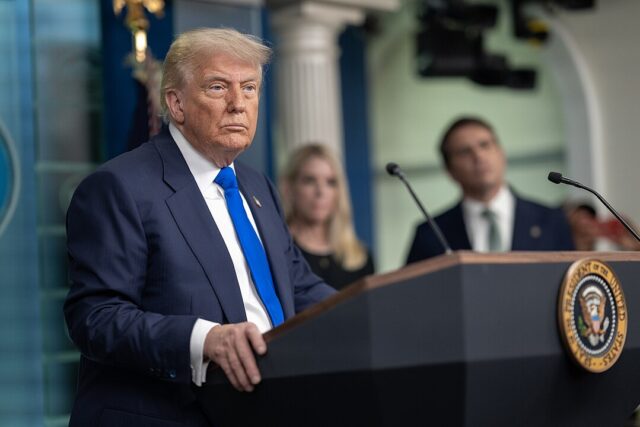
The White House, Public domain, via Wikimedia Commons

President Donald Trump made clear he has “no intention” of dismissing Federal Reserve Chair Jerome Powell, despite recent public criticisms that had unsettled financial markets. Tuesday’s clarification comes after Trump had labeled Powell a “major loser” and suggested his “termination cannot come fast enough.”

The president’s assurance appeared to calm investor fears about the central bank’s independence, triggering a significant market rebound Tuesday that extended into Wednesday morning.

The S&P 500 rose by 3%, and the Nasdaq increased by 3.7%, reflecting investor relief over the reduced likelihood of political interference with the Federal Reserve. European markets also responded positively, with the Stoxx Europe 600 up 1.9% and Germany’s DAX gaining 2.8%.

Despite the president’s recent criticisms, including calls for more aggressive interest rate cuts, Trump emphasized that he never intended to remove Powell from his position. He expressed a desire for the Fed to act more decisively in lowering interest rates but acknowledged Powell’s role would continue until his term concludes in May 2026.

“I would like to see him be a little more active in terms of his idea to lower interest rates…but, no, I have no intention to fire him,” Trump told reporters in the Oval Office, according to a report from The Wall Street Journal:

U.S. stock futures and the dollar rallied following Trump’s remarks. Gold futures dropped, pulling back from record highs.

Trump’s softer tone on Powell came after he lashed out at the Fed chair, writing on social media last week, “Powell’s termination cannot come fast enough!”

But on Tuesday, Trump played down recent comments by Kevin Hassett, the director of the National Economic Council, that the administration was studying whether the president could fire Powell.

“This is a perfect time to lower interest rates. If he doesn’t, is it the end? No. It’s not,” Trump said.

Trump also addressed trade policy, signaling that tariffs on Chinese goods — currently set at 145% — could be “substantially” reduced, though not fully eliminated. The hint at a possible easing of trade tensions, combined with his reaffirmation of the Fed’s independence, fueled the global market rebound. (RELATED: Trump Softens Tariff Stance On China)

While the immediate market reaction has been positive, analysts warn that ongoing tensions between the Trump administration and the Federal Reserve — along with the prospect of slow-moving trade negotiations between the world’s two largest economies — could continue to weigh on financial markets in the weeks and months ahead.

READ NEXT: Jury Issues Decisive Verdict In Onetime Republican Star’s Years-Long Legal Battle

Musk Mulls ‘DOGE Dividend’ Checks For Americans

3
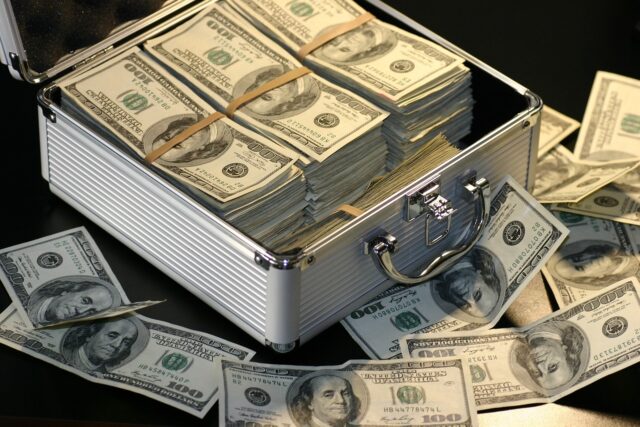
Image via Pixabay free images

Could Americans be in for a payday?

Elon Musk expressed interest in a proposal to use savings from the Department of Government Efficiency (DOGE) to give taxpayers a “DOGE dividend” payment.

X user James Fishback wrote a post that tagged Musk and outlined his plan to take 20% of the savings found by DOGE to send it back “to hard-working Americans as a tax refund check. It was their money in the first place!”

Fishback noted that if DOGE achieves its goal of cutting $2 trillion in federal spending, that would provide the 78 million taxpaying households in the U.S. with about a $5,000 refund or “DOGE dividend” per household, with the remainder used to pay down the national debt.

“Will check with the President,” Musk replied in response to Fishback’s post.

Although DOGE has set a high-end goal of $2 trillion in savings, Musk has suggested that $1 trillion in savings would be a success and explained that goal in an appearance with President Donald Trump on Fox News’ “Hannity” on Tuesday night.

“The overall goal is to try to get a trillion dollars out of the deficit,” Musk said. “If the deficit is not brought under control, America will go bankrupt.” 

“This is a very important thing for people to understand. A country is no different from an individual, in that if an individual overspends, an individual can go bankrupt. And so can a country,” he said. “And the massive waste, fraud and abuse that has been going on, which is leading to a $2 trillion a year deficit.”

DOGE claims an estimated $55 billion in savings achieved to date from canceling certain federal leases and contracts, asset sales, fraud deletion, regulatory savings and workforce reductions.

Musk wrote in a post on Wednesday, “We need to balance the budget as first priority,” in a response to a post by Scott Adams that raised concerns the DOGE dividend could result in the government using the DOGE savings as a “piggy bank.”

US Takes 10% Stake In Intel Under Trump To Strengthen Chip Production

Donald Trump via Gage Skidmore Flickr

A public-private deal aims to bring microchip manufacturing back to American soil — and deliver taxpayer returns in the process.

A Strategic Bet on Semiconductors

President Donald Trump announced Friday that chipmaker Intel agreed to give the U.S. government a 9.9% equity stake, valued at $8.9 billion. The move, the first of its kind under the CHIPS and Science Act, is intended to strengthen domestic semiconductor capacity and ensure that federal subsidies come with direct returns for taxpayers.

“They’ve agreed to do it, and I think it’s a great deal for them,” Trump told reporters during a briefing. The agreement follows internal administration discussions about using existing Commerce Department funding to acquire a stake in Intel, an effort confirmed earlier in the week by Commerce Secretary Howard Lutnick.

The stake is expected to be funded through the CHIPS Act and the Department of Defense’s Secure Enclave program. It will be a passive investment, meaning the government will not receive board seats, governance rights, or special access to information.

Intel Under Scrutiny

Trump also shed light on how the agreement came about — including a conversation with Intel CEO Lip-Bu Tan, whose background had drawn criticism from Capitol Hill.

Earlier this month, Sen. Tom Cotton (R-AR) raised alarms over Tan’s past leadership of Cadence Design Systems, which in 2008 pleaded guilty to illegally exporting chip design software to a Chinese military university. Tan’s investments in China-based firms had also raised national security concerns.

“I said, ‘Well that’s right, he should resign,’” Trump said. “And he came in, he saw me, we talked for a while. I liked him a lot. I thought he was very good. I thought he was somewhat a victim, but, you know, nobody’s a total victim, I guess.”

Following their meeting, Trump floated the idea that Intel should offer a 10% equity share to the U.S. government.

“He said, ‘I would consider that,’” Trump recalled. “Intel has been left behind, as you know, compared to [Nvidia CEO] Jensen [Huang] and some of our friends.”

Commerce: “We Can’t Rely on Taiwan”

Commerce Secretary Lutnick emphasized that the deal has more to do with national security than boardroom politics. In an interview on CNBC’s Squawk Box, Lutnick pointed out that Taiwan, which manufactures over 90% of the world’s most advanced semiconductors, sits just 80 miles from China.

“We cannot rely on Taiwan, which is 9,500 miles away from us and only 80 miles from China,” Lutnick said. “So, you can’t have 99 percent of leading-edge chips made in Taiwan. We want to make them here.”

He noted that the administration wants to ensure that U.S. companies are capable of producing next-generation chip nodes domestically.

“One of those pieces is, it would be lovely to have Intel be capable of making a U.S. node or a U.S. transistor — driving that in America,” Lutnick added.

A Rare Bipartisan Signal

The move drew support across ideological lines, with Sen. Bernie Sanders (I-VT) praising the basic premise: that if the federal government is handing out billions in subsidies, the public should see a share of the profits.

“No. Taxpayers should not be providing billions of dollars in corporate welfare to large, profitable corporations like Intel without getting anything in return,” Sanders said. “If microchip companies make a profit from the generous grants they receive from the federal government, the taxpayers of America have a right to a reasonable return on that investment.”

Not Everyone on Board

Some conservatives pushed back against the concept of government equity stakes in private corporations.

Sen. Rand Paul (R-KY) called the proposal a “terrible” precedent.

“If socialism is government owning the means of production, wouldn’t the government owning part of Intel be a step toward socialism?” Paul wrote in a post on X.

Despite the criticism, the administration has defended the agreement as a narrowly targeted investment — not a takeover — intended to align taxpayer contributions with long-term national and economic security.

Looking Ahead

The Intel stake marks a sharp departure from traditional federal industrial policy. Rather than simply issuing grants or tax breaks, the administration is pursuing a more transactional model: public money in, public equity out.

For the Trump administration, the goal is clear — to use government leverage to secure America’s position in next-generation chip manufacturing and reduce dependence on overseas supply chains.

READ NEXT: When Loyalty Breaks: Hegseth Moves Against Key Military Leader

Trump Pauses Tariffs For One Month After Talks With Mexico

1
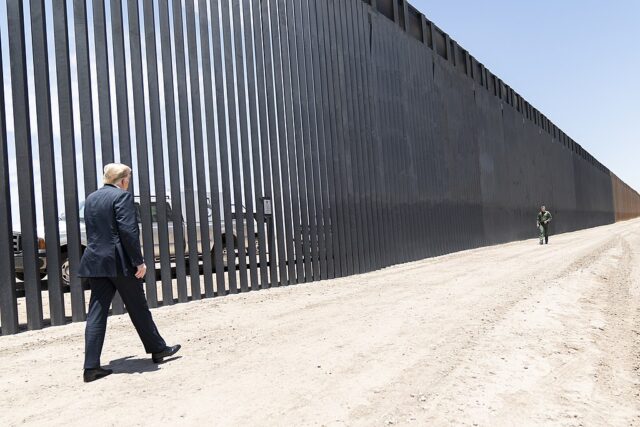
Trump at the border wall via Wikimedia Commons

Mexico‘s President Claudia Sheinbaum Pardo has announced a temporary suspension of tariffs for one month following a productive conversation with U.S. President Donald Trump. The move comes as part of a broader effort to address critical security and economic concerns between the neighboring countries.

As part of the agreement, Mexico will deploy 10,000 troops to bolster security along the U.S.-Mexico border. In return, the U.S. has pledged to ramp up efforts to curb firearm trafficking into Mexico, a persistent issue fueling cartel violence.

CNBC repots:

Sheinbaum also said in a tweet, that after speaking with Trump, Mexico “will immediately reinforce” its northern border with the U.S. with 10,000 National Guard soldiers “to prevent drug trafficking from Mexico to the United States, particularly fentanyl.”

“We had a good conversation with President Trump with great respect for our relationship and sovereignty; we reached a series of agreements,” Sheinbaum wrote in the tweet, according to a translation from Spanish.

“The United States is committed to working to prevent the trafficking of high-powered weapons to Mexico,” she wrote.

The announcement underscores the ongoing collaboration between Mexico and the U.S. on border security and trade, particularly as both nations navigate shifting political landscapes.

Article Published With The Permission of American Liberty News

Canadian Conservative Pushes Ottawa To Remove All US Tariffs

2

As Canada braces for President Trump’s Liberation day tariffs to take effect some Canadian political leaders are suddenly supporting proposals to remove all tariffs.

Maxime Bernier, who served as foreign affairs minister in former Prime Minister Stephen Harper’s Conservative government and now heads the right-wing People’s Party of Canada (PPC), told Fox News Digital in an interview from Halifax that it is “absolutely” the time for Canada to remove all tariffs against the U.S.

He said the 25% duties the Canadian government, under then-Liberal Prime Minister Justin Trudeau, imposed on the U.S. in early February to counter Trump’s 25% tariffs against Canada “won’t hurt the Americans – it is hurting Canadians.”

New Canadian Prime Minister Mark Carney said in a statement following his March 28 call with the president – the first contact between both leaders since Carney was elected Liberal leader by his party nearly three weeks before – that Canada would implement retaliatory tariffs in response to Wednesday’s U.S. “trade actions.”

The PPC leader said that Trump should be told that “the real reciprocal response” to tariffs is “zero on our side, zero on your side.”

Bernier said that instead, Carney and his main rival, Conservative Party Leader Pierre Poilievre, are being “fake patriots using a dollar-for-dollar trade war against Trump” and telling Canadians: “That’s the best thing to do.”

“We cannot impose counter-tariffs,” said Bernier, who also served as industry minister in the Harper government. 

“The Americans are 10 times bigger than us. We won’t win a trade war,” he said, underscoring that retaliation will lead to a recession in Canada.

Former Canadian Conservative politician Tony Clement, who served alongside Bernier in Harper’s Cabinet, told Fox News Digital that “from an economic point of view,” removing Canadian tariffs “makes a lot of sense” and “may come to that at some point, but the public isn’t there right now.”

“From a point of view of the emotional wounds of Canadians created by Trump and his annexation talk and tariffs, I’m not sure that a political voice would survive if it went down that public-policy route,” said Clement, a former Canadian industry minister in the Harper government.

“The mood of the people is outrage. I’ve never seen people in Canada this incandescently mad at the United States,” he said, who is campaigning in the Toronto area for Poilievre’s Conservative Party ahead of the April 28 general election. “There is complete distrust of whatever Trump says because it can change within 24 hours.”

Eliminating Canadian tariffs, without a quid pro quo from Trump, could “show weakness to a bully,” added Clement, who, prior to entering federal politics in 2006, served as a Cabinet minister in former Ontario Premier Mike Harris’ Progressive Conservative government.  

In the statement released following his recent conversation with Trump, Carney said that both leaders “agreed to begin comprehensive negotiations about a new economic and security relationship immediately following the election.” 

Conservative strategist Yaroslav Baran, who served as communications chief for Harper’s successful Conservative 2004 leadership campaign, and director of war room communications for the Harper-led Tories during the 2004, 2006 and 2008 federal election campaigns, told Fox News Digital that under the United States-Mexico-Canada Agreement (USMCA), “trade in goods and services ought to be tariff-free” between Canada and the U.S., excluding carveouts on the Canadian side for dairy, eggs, poultry and softwood lumber. 

However, Baran added that he “can’t semer Ontario Premier Mike Harris’ Progressive Conservative government.  

In the statement released following his recent conversation with Trump, Carney said that both leaders “agreed to begin comprehensive negotiations about a new economic and security relationship immediately following the election.” 

Conservative strategist Yaroslav Baran, who served as communications chief for Harper’s successful Conservative 2004 leadership campaign, and director of war room communications for the Harper-led Tories during the 2004, 2006 and 2008 federal election campaigns, told Fox News Digital that under the United States-Mexico-Canada Agreement (USMCA), “trade in goods and services ought to be tariff-free” between Canada and the U.S., excluding carveouts on the Canadian side for dairy, eggs, poultry and softwood lumber. 

However, Baran added that he “can’t see the removal of all Canadian tariffs on U.S. products as long as the U.S. has tariffs on Canadian products.”

Trump Says U.S. May ‘Almost Completely’ Scrap Income Tax Due to Tariff Revenue

1
President Donald Trump holds a press conference with Attorney General Pam Bondi and Deputy Attorney General Todd Blanche in the James S. Brady Press Briefing Room on Friday, June 27, 2025. (Official White House Photo by Molly Riley)

President Donald Trump late Thursday said that the United States may “almost completely” eliminate the income tax due to the rising tariff revenue.

“In the next couple of years, I think we’ll substantially be cutting, or maybe cutting out completely, but we’ll be cutting income tax,” Trump said during an event on Thursday.

“Could be almost completely cutting it because the money we’re taking in is going to be so large,” he added.

The Congressional Budget Office (CBO) in June projected that the tariff increases will reduce the federal deficit by $2.8 trillion over the next decade.

Breitbart News reports:

The tariff estimate covers measures implemented between January 6 and May 13, 2025. These include a 30 percent levy on imports from China and Hong Kong, 25 percent duties on autos, auto parts, steel, and aluminum, a 10 percent general tariff on most other imports, and the elimination of duty-free treatment for low-value Chinese shipments.

CBO estimates that, before accounting for economic side effects, the new tariffs will reduce primary deficits by $2.5 trillion and cut interest payments by another $500 billion, for a total deficit reduction of $3.0 trillion. After factoring in modest economic drag — slightly lower GDP and temporarily higher inflation — the net deficit reduction is pegged at $2.8 trillion.

Watch:

Earlier in November, Commerce Secretary Howard Lutnick said that Trump is proposing a tariff dividend check so that Americans understand the impact of Trump’s tariff policies.

“Well, look, the President wants to make sure the American people understand that the tariffs are there for their benefit, right? That it’s — yes, it’s going to drive down our deficit. Yes, it’s going to make the country stronger,” Lutnick said on Fox Business Network’s Kudlow show.

“But he wants the people of America, the American people to appreciate these tariffs, and he knows if he puts money into their pocket and says, ‘Look, this was paid for by the tariffs,’ they’ll better understand how important this is for America. And so, that’s why he’s talking about it.”

Trump Holds ‘Productive’ Call With New Canadian Prime Minister

President Donald Trump said he held an “extremely productive call” with Canadian Prime Minister Mark Carney on Friday. 

“I just finished speaking with Prime Minister Mark Carney, of Canada. It was an extremely productive call, we agree on many things, and will be meeting immediately after Canada’s upcoming Election to work on elements of Politics, Business, and all other factors, that will end up being great for both the United States of America and Canada,” Trump wrote on his Truth Social account. 

It was the first time the two leaders have spoken.

On Thursday, Carney said the “old relationship” with the U.S. “is over” while vowing to engage in a renegotiation over a trade agreement.  

Carney, 60, won the Liberal leadership this month with 86% of the vote after former Prime Minister Justin Trudeau stepped down.

In an address to reporters in Ottawa on Thursday, Carney offered a blunt rebuke to the Trump administration as it prepares to slap a 25 percent tariff on foreign car imports — a move the prime minister said won’t go unanswered.

“The old relationship we had with the United States, based on deepening integration of our economies and tight security and military co-operations, is over,” Carney said.

He continued: “What exactly the United States does next is unclear. But what is clear is that we, as Canadians, have agency. We have power. We are masters in our own home. We can control our destiny. We can give ourselves much more than any foreign government, including the United States, can ever take away.”

He added: “We can deal with this crisis best by building our strength right here at home. It will take hard work. It will take steady and focused determination from governments, from businesses, from labour, from Canadians. We will need to dramatically reduce our reliance on the United States. We will need to pivot our trade relationships elsewhere. And we will need to do things previously thought impossible at speeds we haven’t seen in generations.”

Carney vowed a “broad renegotiation” of Canada’s trade and security ties with the U.S., marking a sharp departure from the conventional diplomacy that has long defined cross-border relations.

“We will fight back with everything we have to get the best deal for Canada. We will build an independent future for our country, stronger than ever,” Carney said, promising “retaliatory trade actions” designed for “maximum impact in the US and minimum impacts in Canada.”

Wall Street Journal Board Urges Potential Trump Impeachment

2
Image via Gage Skidmore Flickr

Yikes…

In a column published late Friday, a member of the Wall Street Journal editorial board claimed it would be “desirable” to subject Donald Trump to a third impeachment.

According to longtime columnist Holman W. Jenkins Jr., Trump’s on-again, off-again tariff threats almost makes it appear he wants to be impeached, with Jenkins writing, “A future Trump impeachment seemed all but guaranteed by last Wednesday morning. It seems only slightly less likely now. It may even be desirable to restore America’s standing with creditors and trade partners.”

Read more from the report:

As he sees it, the president’s last great achievement was being re-elected in 2024, and the damage he has been creating since then belies his promise of a “golden age,” so an impeachment is “already ion the cards.”

“No consensus or even significant coalition exists for trying to force into existence a new American ‘golden age’ with tariffs, which anyway is like asking a chicken to give birth to a lioness. He invented this mission out of his own confused intuition,” he accused.

Noting that conservative historian Niall Ferguson labeled Trump’s trade policy going “full retard,” he contributed, “I go with ‘neurotic’ for the word’s wider applicability to any leader who, lacking a clear bead on his times, fabricates a gratuitously ambitious mission to meet his misguided sense of importance.”

“Nobody in Mr. Trump’s orbit actually shares his belief in the magical efficacy of tariffs because it makes sense only in a world that doesn’t exist, where other countries don’t retaliate,” he pointed out before concluding, “The founders never anticipated today’s instantly responsive trillion-dollar financial markets. And yet these markets neatly adumbrate the founders’ scheme of checks and balances, also known as feedback. Mr. Trump, still sane enough to appreciate what’s good for Mr. Trump, listened this week to their feedback.”

President Donald Trump vowed on Sunday that nobody was getting “off the hook” for unfair trade balances and tariff barriers, which other countries have used against the U.S.

The Trump administration announced Friday that it was exempting imported smartphones, laptops and other electronics from reciprocal tariffs, but the president wanted to clear a few things up.

“There was no Tariff ‘exception’ announced on Friday,” Trump said in a post on X on Sunday. “These products are subject to the existing 20% Fentanyl Tariffs, and they are just moving to a different Tariff ‘bucket.’  The Fake News knows this, but refuses to report it. We are taking a look at Semiconductors and the WHOLE ELECTRONICS SUPPLY CHAIN in the upcoming National Security Tariff Investigations.

Customs and Border Protection issued new guidance on reciprocal tariff negotiations late Friday, noting the exemption of those goods from Trump’s April 2 executive order that declared a national emergency due to non-reciprocal trade practices and structural imbalances in the global trading system. Subsequent executive orders ramped up tariffs on China to 125%.

The updated guidance, which cites a presidential memorandum issued Friday, excluded the products from Trump’s 125% China tariff and his baseline 10% global tariff on some countries. They apply to goods that left a warehouse as of April 5.

Products included in the exemption are things like hard drives, computer processors, solar cells, semiconductor manufacturing equipment, flat-panel TV displays and memory chips.

But in light of the easing of tariffs on electronics, Commerce Secretary Howard Lutnick said Sunday the exemption would be temporary.

“They’re exempt from the reciprocal tariffs, but they’re included in the semiconductor tariffs, which are coming in probably a month or two,” Lutnick told ABC’s “This Week” on Sunday.

Lutnick’s comments Sunday made clear that more changes were on the horizon.

Canada Threatens To Retaliate Against U.S. If Trump Admin. Imposes Sweeping Tariff

6

The premier of a critical region in Canada is threatening to cut off energy and critical oil exports to the U.S. if President-elect Donald Trump implements a tariff on all Canadian products. 

Trump recently threatened a 25% tariff on all Canadian and Mexican exports in an effort to stop the flow of illegal immigration and drugs coming into the U.S.

Doug Ford, the premier of Ontario, said that he would consider retaliatory measures against the U.S. if the incoming president acted on his promise.

“We will go to the extent of cutting off their energy – going down to Michigan, going down to New York State and over to Wisconsin,” Ford, who represents a region known for its crude oil production, told reporters. 

The premier added that other officials in the country are reportedly identifying ways they can hurt U.S. exports if Trump enacts a tariff.

“Some premiers proactively identified products that their provinces produce and export to the United States and which the U.S. relies on, and which should be considered as part of the Canadian response. This included some critical minerals and metals,” Ford said.

“Canadians get hurt, but I can assure you one thing: the Americans are going to feel the pain as well, and isn’t that unfortunate?” Ford said.

Trump has responded to the threats, saying “that’s okay if he does that.”

“The United States is subsidizing Canada, and we shouldn’t have to do that,” Trump told CNBC at the New York Stock Exchange on Thursday. “And we have a great relationship. I have so many friends in Canada, but we shouldn’t have to subsidize a country.”

However, a Canadian political science professor noted Ford might not be able to unilaterally cut off the province’s energy supply to the U.S.

“I do not believe Ontario could unilaterally stop electricity exports to the U.S. without Ottawa’s approval. Similarly, Michigan cannot unilaterally stop the flow of western Canadian natural gas to eastern Canada without Washington’s approval,” University of Toronto political science Professor Nelson Wiseman told Now Toronto in response to Ford’s retaliatory threat.

Trump Puts China On Notice With First Wave Of Tariffs

3
By Dan Scavino - https://twitter.com/Scavino45/status/1069069893549490176, Public Domain, https://commons.wikimedia.org/w/index.php?curid=80055244

President Donald Trump announced he is planning a 10 percent tariff on Chinese imports on Feb. 1 over the country’s role in fentanyl trafficking. 

“We’re talking about a tariff of 10% on China, based on the fact that they’re sending fentanyl to Mexico and Canada,” Trump told reporters at the White House on Tuesday. “Probably February 1st is the date we’re looking at.” 

When asked about a conversation he had with Chinese President Xi Jinping ahead of his inauguration this week, Trump added that “We didn’t talk too much about tariffs other than he knows where I stand.” 

During his campaign, Trump threatened tariffs as high as 60 percent on goods from China. He recently pledged on Truth Social to create an “External Revenue Service” to “collect our Tariffs, Duties, and all Revenue that come from Foreign sources.” 

At a press briefing Wednesday, Chinese foreign ministry spokesperson Mao Ning told reporters that “We always believe that there is no winner in a trade war or tariff war,” according to Reuters. 

In late November, Trump wrote on his Truth Social account that he would implement such tariffs on Jan. 20 as one of his first Executive Orders and that the tariffs “will remain in effect until such time as Drugs, in particular Fentanyl, and all Illegal Aliens stop this Invasion of our Country!” 

Those promised tariffs haven’t gone into effect yet, but on Monday, Trump did sign an executive order titled “America First Trade Policy.” 

“The Secretary of Commerce, in consultation with the Secretary of the Treasury and the United States Trade Representative, shall investigate the causes of our country’s large and persistent annual trade deficits in goods, as well as the economic and national security implications and risks resulting from such deficits, and recommend appropriate measures, such as a global supplemental tariff or other policies, to remedy such deficits,” the order says. 

“The Secretary of the Treasury, in consultation with the Secretary of Commerce and the Secretary of Homeland Security, shall investigate the feasibility of establishing and recommend the best methods for designing, building, and implementing an External Revenue Service (ERS) to collect tariffs, duties, and other foreign trade-related revenues,” it adds. 

On Wednesday, President Donald Trump in a Truth Social post said he will institute tariffs on Russia if the yearslong invasion of Ukraine doesn’t come to an end.

Read Trump’s lengthy statement below:

I love the Russian people, and always had a very good relationship with President Putin – and this despite the Radical Left’s Russia, Russia, Russia HOAX,” he said, referring to allegations from Sen. Adam Schiff (D-Calif.) and others that he colluded with Moscow to defeat Hillary Clinton.

“We must never forget that Russia helped us win the Second World War, losing almost 60,000,000 lives in the process. All of that being said, I’m going to do Russia, whose Economy is failing, and President Putin, a very big FAVOR. Settle now, and STOP this ridiculous War! IT’S ONLY GOING TO GET WORSE,” Trump wrote.

“If we don’t make a “deal,” and soon, I have no other choice but to put high levels of Taxes, Tariffs, and Sanctions on anything being sold by Russia to the United States, and various other participating countries. Let’s get this war, which never would have started if I were President, over with.”

‘We can do it the easy way, or the hard way – and the easy way is always better. It’s time to “MAKE A DEAL.” NO MORE LIVES SHOULD BE LOST!!!”