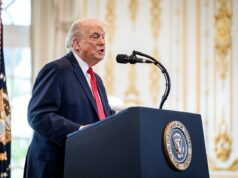


On Thursday evening, President Trump issued pardons to five former NFL players.
White House pardon czar Alice Marie Johnson announced this week that several former professional football players have been granted presidential pardons, underscoring what the administration described as the power of redemption and second chances.
Among those granted clemency were Joe Klecko, Nate Newton, Jamal Lewis, Travis Henry and the late Billy Cannon.
“As football reminds us, excellence is built on grit, grace, and the courage to rise again. So is our nation,” Johnson wrote in a post on X.
Johnson also said that Dallas Cowboys owner Jerry Jones shared the news “personally” with Newton, a three-time Super Bowl champion with the Cowboys during the team’s 1990s dynasty.
Klecko, a former New York Jets standout and Pro Football Hall of Famer, pleaded guilty to perjury after lying to a federal grand jury investigating an insurance fraud scheme.
Newton, a six-time Pro Bowler and two-time All-Pro offensive lineman, pleaded guilty to a federal drug-trafficking charge in 2001 after authorities found $10,000 in cash in his pickup truck and 175 pounds of marijuana in a vehicle traveling with him.
Lewis, who won a Super Bowl with the Baltimore Ravens and was named NFL Offensive Player of the Year in 2003, pleaded guilty in 2000 to using a cellphone to attempt to facilitate a drug deal shortly after being selected with the No. 5 overall pick in the NFL draft.
Henry, a Pro Bowl running back who played for the Buffalo Bills, Tennessee Titans and Denver Broncos, pleaded guilty to conspiracy to traffic cocaine in connection with financing a drug ring that operated between Colorado and Montana.
Cannon, the 1959 Heisman Trophy winner at LSU who later starred for the Houston Oilers and Oakland Raiders, admitted in the mid-1980s to his role in a counterfeiting scheme. He died in 2018. His pardon was granted posthumously.
Presidential Pardons and Clemency
Under Article II of the U.S. Constitution, the president has broad authority to grant pardons and commutations for federal offenses. The power has long been used by presidents of both parties to extend mercy, correct perceived injustices, and offer individuals a second chance after they have served their sentences.
President Donald Trump made use of that authority throughout his first term, often highlighting cases he believed reflected excessive sentencing or personal rehabilitation. His clemency decisions ranged from high-profile political figures to criminal justice reform cases, including Alice Marie Johnson herself. Johnson, who had been serving a life sentence for a nonviolent drug offense, was granted clemency by Trump in 2018 after serving more than two decades in prison. Her case became a symbol for advocates of criminal justice reform and second chances.
Since then, Johnson has played a visible role in clemency advocacy, working with the administration to review cases and elevate stories of individuals seeking pardons.