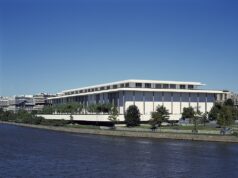

A federal judge on Tuesday blocked the Kennedy Center’s latest attempt to place President Donald Trump’s name on the performing arts complex, ruling that the proposal violated both federal law and an earlier court order.
U.S. District Judge Christopher Cooper issued the order less than an hour before the center’s board was scheduled to meet to consider closing the main building for a two-year renovation, ABC News reported.
“The board resolution bucks a federal court order and a statute Congress enacted,” Cooper wrote, according to ABC News.
The ruling concerned a resolution the board approved in August. It called for an inscription on the building’s facade crediting Trump with having “restored and renovated” the center. The board also sought to designate the grounds in front of the building as the President Donald J. Trump Plaza, according to reports.
Cooper rejected the board’s argument that the inscription would recognize Trump’s work on the renovation rather than rename the institution.
“Linguistic gymnastics cannot extricate the Kennedy Center’s Board from an operative judicial order,” the judge wrote, as quoted by ABC News.
Congress Holds the Naming Authority
The dispute centers on the Kennedy Center’s status as a congressionally designated memorial to President John F. Kennedy.
Federal law identifies the center as the sole national memorial to Kennedy in the Washington area and directs its trustees to prevent additional memorials or memorial-style plaques from being installed in the building’s public areas.
Cooper first ruled in May that the board lacked the authority to rename the center without congressional approval. He ordered Trump’s name removed from the exterior after the board had added it in December 2025. The lettering came down in June.
The August resolution attempted a narrower form of recognition. In addition to the facade inscription and plaza name, it contemplated another inscription if a proposed Trump Kennedy Center Fund raised $100 million, according to the AP.
Tuesday’s ruling blocks the facade tribute and the plaza designation. The Wall Street Journal reported that Cooper did not resolve whether a later inscription tied to a fully funded endowment could be permissible.
Closure Fight Continues
The naming dispute is unfolding alongside a separate battle over whether the Kennedy Center should close for renovations.
The board voted 23-3 in August to approve a two-year closure as part of a renovation plan then estimated at $285 million, according to a court filing cited by ABC News. Congress has already allocated $257 million for infrastructure work at the center.
Kennedy Center officials say the aging building has serious water damage, corrosion and other safety problems. A portion of the ceiling in the Grand Foyer fell during a storm earlier this month; no one was injured. The center said the incident showed why extensive repairs are urgent, while opponents of an immediate closure have challenged whether the available engineering reports support declaring the entire building unsafe. Multiple reports indicated that the center’s leadership renewed its call for a shutdown after the ceiling collapse.
Before Tuesday’s meeting, Justice Department attorneys told the court that the board’s agenda would focus exclusively on the proposed closure and would not include additional measures honoring Trump. An email included with the filing said trustees continued to stand by the recognition resolution they adopted in August.
Rep. Joyce Beatty (D-Ohio) an ex officio member of the board, brought the lawsuit challenging the naming and closure plans. Her attorneys argued that the proposed tribute defied Cooper’s earlier injunction.
The latest order does not end the broader dispute over the center’s future. Questions about the renovation, the proposed two-year shutdown and the institution’s finances remain before the board and the court. But on the naming issue, Cooper’s conclusion was direct: any new memorial at the Kennedy Center requires Congress to act first.