

The Trump administration is erecting a centralized firewall on Capitol Hill before incoming Democratic committee chairs can issue their first round of subpoenas this January.
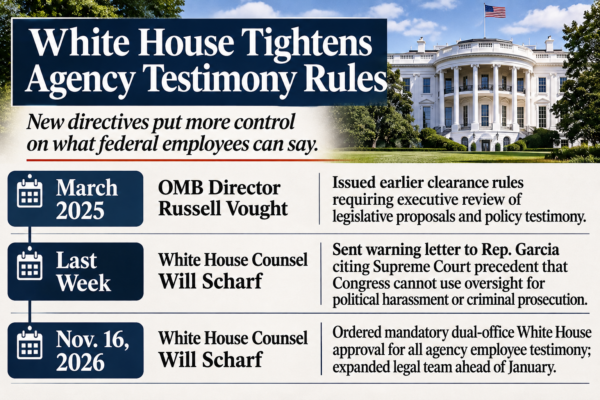
In a one-page memorandum issued Monday, Nov. 16 — and first reported by Axios — White House Counsel Will Scharf ordered every federal agency and department to secure explicit clearance from two senior White House offices before allowing any employee to agree to testify before Congress.
How the New Clearance Rule Works
Rather than letting individual agencies and their in-house lawyers negotiate directly with lawmakers, the directive routes every congressional testimony request straight through the West Wing:
- Two-Office Sign-Off: Agencies must consult and receive approval from both the Office of White House Counsel and the White House Office of Legislative Affairs before any personnel agree to appear before a congressional committee.
- No Blank Check for Partisan Probes: A White House official defended the move bluntly: “The Trump administration will not be extorted, intimidated, or threatened into submission by politically motivated baseless investigations.”
- Unanswered Questions: While the memo stops short of an outright ban on testifying, it sets no deadline for White House responses, spells out no criteria for approval, and leaves unresolved what happens when a committee issues a formal subpoena.
Setting the Stage for January’s Oversight Battle
The timing is unmistakable. Following Democratic victories in the November midterm elections, lawmakers like Rep. Robert Garcia, D-Calif. —the incoming chairman of the House Oversight Committee — are preparing wide-ranging investigations into administration spending, agency decisions, and private-sector ties when the new Congress convenes in January.
The administration has already signaled it intends to play offense rather than defense:
Constitutional Clash: Subpoenas vs. Executive Authority
Administration officials insist they are “ready to engage with Congress” on legitimate requests, arguing federal workers shouldn’t be pulled away from executing the president’s agenda to satisfy partisan fishing expeditions.
Still, the directive sets up an inevitable constitutional collision once Democrats wield subpoena power:
- Congress’ Authority: House and Senate committees hold broad constitutional power to investigate government operations and compel testimony via subpoena — so long as the inquiry serves a legitimate legislative purpose.
- The Executive Branch’s Shield: Presidents have long claimed constitutional authority to supervise executive branch communications and invoke executive privilege, backed by a 2019 Justice Department legal opinion affirming the president’s right to control how agency personnel interact with Congress.
- The Courtroom Showdown: If a Democratic committee subpoenas a federal official whom the White House refuses to clear, the standoff will likely land in federal court — potentially tying up high-profile hearings for months.
What Happens Next
No specific testimony requests have been blocked yet under Monday’s order. Come January, however, incoming Democratic committee chairs will immediately test whether this two-office clearance rule operates as routine White House coordination — or as a deliberate roadblock against congressional investigations.