


Rep. Don Bacon (R-Neb.) issued a stark warning Tuesday to President Trump, cautioning that a unilateral move to withdraw the United States from NATO could fracture the Republican Party and trigger long-lasting internal divisions.
“If he broke up NATO on his own, it would be a civil war in the Republican caucus, or the conference,” Bacon warned CNN’s Kaitlan Collins. “Most of us would find that totally unacceptable, and I’m not alone. There’s a large group of us that believe in our alliances and standing up for freedom and pushing back on China and Russia.
“We don’t want war with these guys, but you’ve got to be strong, and if he went in and somehow destroyed or tore up NATO, it would probably destroy the party for many years,” he added. “There would be many that will never forgive that.”
Bacon, a retired Air Force general who has often positioned himself as a more traditional, internationalist Republican, has at times broken with Trump on foreign policy and national security issues. While not a consistent antagonist of the former president, he has repeatedly defended U.S. alliances and a robust global posture—placing him at odds with Trump.
A moment later, Bacon reiterated that he believes the GOP “would implode” if the U.S. were to depart NATO.
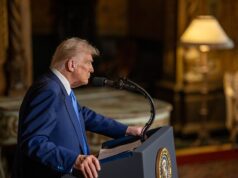
His comments came after Trump sharply criticized the alliance earlier Tuesday in a Truth Social post, arguing that U.S. military strength makes reliance on allies unnecessary. The president lashed out at countries reluctant to support U.S. operations tied to escalating tensions with Iran.
“Because of the fact that we have had such Military Success, we no longer ‘need,’ or desire, the NATO Countries’ assistance — WE NEVER DID!” Trump wrote. “Likewise, Japan, Australia, or South Korea. In fact, speaking as President of the United States of America, by far the Most Powerful Country Anywhere in the World, WE DO NOT NEED THE HELP OF ANYONE!”
Trump has also been pushing for an international coalition to escort commercial ships through the Strait of Hormuz, a critical global shipping route that has been closed since late February amid the conflict with Iran. The disruption has driven sharp increases in oil, gas, and fertilizer prices worldwide.
On Wednesday, President Trump escalated his rhetoric and floated the idea of shifting responsibility for the Strait of Hormuz to other countries that rely on the strategic shipping route after the U.S. has “finished off” Iran, in a jab at America’s “non-responsive allies.”
“I wonder what would happen if we ‘finished off’ what’s left of the Iranian Terror State, and let the Countries that use it, we don’t, be responsible for the so-called ‘Strait?’ That would get some of our non-responsive ‘Allies’ in gear, and fast!!!,” Trump wrote.
Moments later he added: “Remember, for all of those absolute “fools” out there, Iran is considered, by everyone, to be the NUMBER ONE STATE SPONSOR OF TERROR. We are rapidly putting them out of business!”
Despite his criticism of NATO, Trump warned Sunday that the alliance faces a “very bad” future if member nations do not contribute more to joint security efforts. He has long argued that NATO countries fail to meet defense spending commitments and has repeatedly threatened to withdraw the U.S. from the alliance.
Bacon’s warning underscores the divide between Republicans on the issue. As a lawmaker preparing to leave Congress, bacon has opted to speak more candidly about the potential political consequences of Trump’s foreign policy approach. His comments reflect broader concerns among establishment-minded Republicans who view NATO as central to U.S. global leadership and national security.
Formed in 1949 to counter Soviet expansion, NATO remains a cornerstone of Western military cooperation. While some Republicans aligned with Trump have dismissed it as outdated, others—like Bacon—argue that abandoning the alliance would not only weaken U.S. influence abroad but is also likely to ignite a damaging rift at home.


Bacon is a rino, rat-bastard and you can’t believe anything he says…
RINO Bacon: Opinions Are Like Assholes; Everybody’s Got One !
I for one am not pleased with Europe and all Nato countries who take little interest curbing the global threat of Iran and sit idly by while the US takes all the military and financial responsibility of protecting not only them but the world. Sometimes I think we should become more isolationist, except for our one true ally, Israel, and let them fend for themselves (which won’t go well for them).
I completely agree with John as he hts the nail right on the head.
Good thing Bacon is quitting the Congress. He’s been a thorn in the side of the GOP for a long time and for a retired general, has a shocking lack of situational awareness. Our British “allies,” under Starmer, denied us use of Diego Garcia. Our NATO allies showed zero interest, at least initially, in supporting our efforts to protect allied naval fleets and global commerce from the threat of Iran’s intent to acquire hypersonic anti-ship missiles from China. NATO allies have basked safely under our nuclear umbrella- allowing them to do nice things for their citizens like attend college for free, while we subsidized their security. Trump finally made an issue of NATO members not paying their dues and letting their militaries become weak. There are 33 social media arrests on average daily in the UK– God forbid a UK citizen criticizes the migrant invasion. We no longer share common values with NATO nations– the EU was set up to compete against us economically. It’s past time to face this reality. What purpose does NATO serve after the Cold War ended? NATO has helped fuel war in Ukraine for mass profit, a war that was never in our national security interests. Yet curtailing Iran’s nuclear ambitions is. Belatedly, now that Trump’s air strikes have crippled Iran’s military, we see NATO nations saying they’re willing to help defend the Strait of Hormuz. Should we forgive their “wait and see” cowardly attitude earlier?