

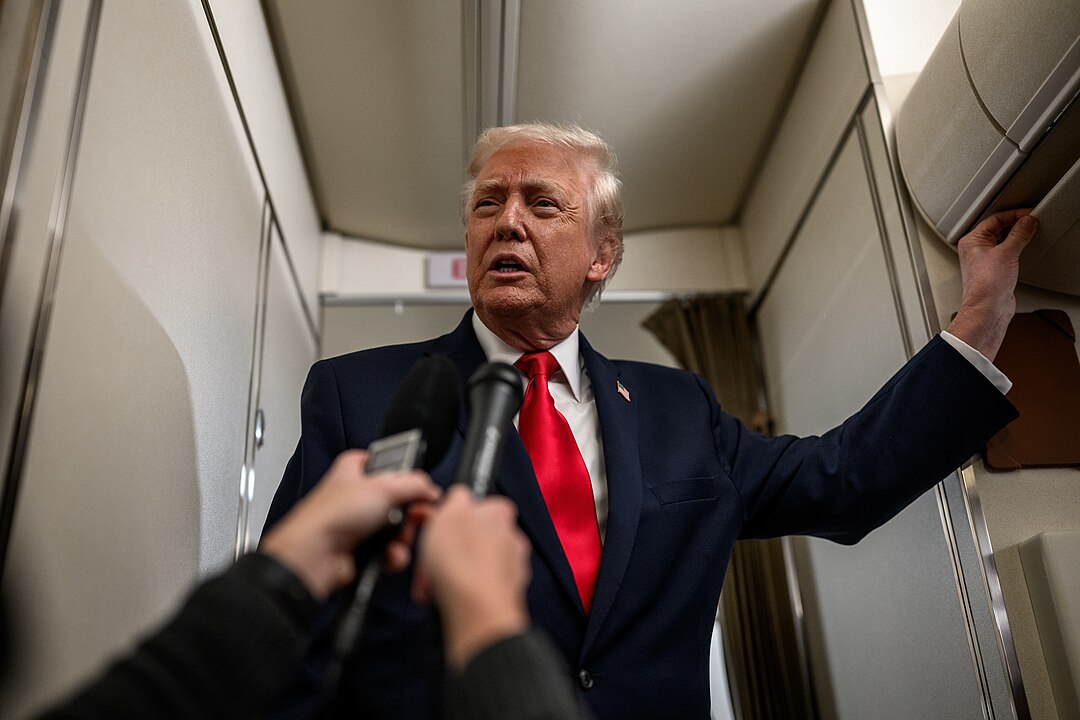
President Donald Trump spent years celebrating the Supreme Court majority he helped build. Now, he says he regrets choosing all three of his appointees.
In a September 28 interview with Time magazine, Trump was asked whether he regretted nominating Justices Neil Gorsuch, Brett Kavanaugh and Amy Coney Barrett.
“Yeah. Yeah. What can I do? I put them in,” Trump replied. “They voted against me too often.”
The blunt admission follows a string of clashes between the president and the court over his administration’s policies on tariffs, birthright citizenship and mail voting.
Trump appointed Gorsuch in 2017, Kavanaugh in 2018 and Barrett in 2020. Those selections helped establish the court’s 6–3 conservative majority — a transformation he has repeatedly touted as one of his biggest accomplishments.
But the president now says his nominees have fallen short of his expectations.
‘Very Disappointing’
During the Time interview, Trump complained that his appointees had received the “position of a lifetime” but nevertheless frequently ruled against his administration.
“They vote for me too,” he acknowledged.
Still, Trump contrasted their decisions with those of the court’s three liberal justices, whom he described as more consistent in voting together.
“The Democrats stick like glue — those three, they virtually never vary,” Trump said.
Although he criticized that approach, he added that “there’s something I admire about it: there’s loyalty.”
Asked whether he wanted loyalty from his own nominees, Trump rejected that characterization.
“No, I don’t want loyalty,” he said. “I want good decisions.”
His assessment of the justices he selected remained harsh.
“I put these people in. It is what it is,” Trump told Time. “Very disappointing, very disappointing for the country — their decisions.”
Mail Voting Clash Fueled His Anger
Trump had already publicly attacked his three appointees in September after the court blocked his administration’s attempt to restrict mail voting ahead of the midterm elections.
In that criticism, he said the justices “are not the people I interviewed to serve” and called them “shells of their former selves.”
The court’s order did not disclose a complete vote breakdown, leaving each justice’s position unclear. Kavanaugh wrote a concurring opinion, while Gorsuch and Barrett did not publicly join the dissent from Justices Clarence Thomas and Samuel Alito.
Trump praised Thomas and Alito as “legends both” while directing his frustration at the broader court.
Tariffs And Citizenship Remain Flashpoints
The president also singled out rulings involving his tariff policies and effort to narrow birthright citizenship.
“The tariff decision was disastrous for the country,” Trump told Time, calling it “an absolute crying shame.”
He argued that the court should have protected the substantial revenue collected under his trade policies.
Trump also criticized the court’s decision involving his attempt to restrict automatic citizenship for some children born in the United States — an executive action challenged under the 14th Amendment.
“It’s unfortunate what they did — not to me, to our country,” he said.
A Court He Once Celebrated
Trump’s frustration marks a striking turn in his public assessment of the court.
His appointees helped deliver major conservative victories, including overturning Roe v. Wade, expanding Second Amendment protections and restricting the use of race in college admissions.
Trump has repeatedly claimed credit for those outcomes, particularly the reversal of Roe.
But Supreme Court justices hold lifetime appointments and remain independent of the presidents who nominate them. Their selection carries no obligation to support an administration’s policies.
That independence has now become a recurring source of frustration for the president who helped shape the current bench.
Asked whether he regretted his three choices, Trump’s answer was unequivocal: “Yeah. Yeah.”

ONLY THREE!?!
Every SCOTUS “Justice” since the inception of the Constitutional Republic has been a disgrace, a purveyor of injustice – per the only One with the authority to determine what constitutes justice:
“…According to Habakkuk 1:7, not only did the Chaldeans’ authority originate with themselves, but so did their justice. And so does the justice of We the People: ‘We the People of the United States, in order to form a more perfect union, establish justice….’ What an audacious assertion. Only Yahweh is just, and only He can establish justice:
‘Justice and judgment are the habitation of thy [Yahweh’s] throne: mercy and truth shall go before thy face.’ (Psalm 89:14)
“In a lecture entitled The Common Law, Constitutional Attorney Herb Titus claimed that the Preamble’s assertion that We the People established justice did not authorize ‘the national government to define justice.’57 However, because the Constitution never declares Yahweh’s law the standard for determining justice, the definition of justice has always been left to the federal and state governments. Instead of confirming the justice inherent in Yahweh’s morality and already established in His perfect law, the framers’ declaration implies that justice had yet to be established. This (and other numerous confirmations throughout the Constitution) reveals they preferred their own justice to the justice of Yahweh.
“Anytime autonomous man attempts to establish justice outside Yahweh’s moral laws, the result is always injustice. In Isaiah 5:20, this transposition is depicted as calling good evil and evil good. The word “autonomous” comes from two Greek words: auto meaning self and nomos meaning law. The word, which literally means “self-law,” is just another way of describing humanism and, in this instance, constitutionalism….”
For more, see Chapter 3 “The Preamble: We the People vs. Yahweh” of free online book “Bible Law vs. the United States Constitution: The Christian Perspective” at bible versus constitution dot org. Click on the top entry on our Online Book page and scroll down to Chapter 3.
Then Chapter 6 “Article 3: Judicial Usurpation.”
Find out how much you really know about the Constitution as compared to the Bible. Take our 10-question Constitution Survey in the sidebar and receive a free copy of the 85-page “Primer” of “BL vs. USC.”
Yaweh. Hmmm. Not sure I believe in a god that asks his children to kill and murder and take over cities.