

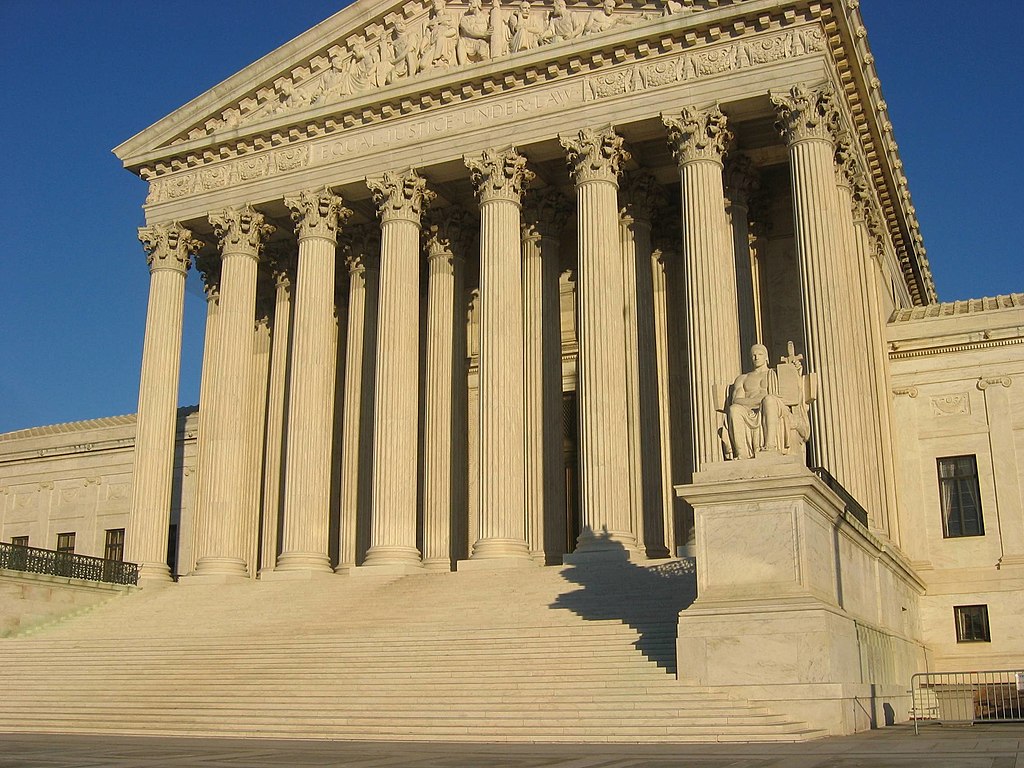
President Donald Trump scored a major legal victory Monday as the Supreme Court cleared the way for his administration to advance new mail-in ballot safeguards ahead of November’s midterm elections.
In a 6-3 decision divided along ideological lines, the justices lifted an injunction that had prevented the administration from implementing key portions of Trump’s election integrity executive order in 23 states and the District of Columbia.
The ruling reverses a significant lower-court setback for Trump, who has repeatedly called for tighter controls on mail-in voting and stronger citizenship verification requirements.
At the center of the dispute is Trump’s March 31 executive order, titled “Ensuring Citizenship Verification and Integrity in Federal Elections.”
The order directs the Department of Homeland Security, working with the Social Security Administration, to compile state-specific lists of confirmed U.S. citizens who will be eligible by age to vote in upcoming federal elections.
It also orders the Justice Department to prioritize investigations and, when appropriate, prosecute election officials or others accused of distributing federal ballots to ineligible voters.
A third provision directed the U.S. Postal Service to establish new standards for federal ballots sent through the mail. Those standards include uniquely serialized barcodes, approved envelope designs and a federal portal through which election officials would submit information about voters receiving mail ballots.
Democratic officials from 23 states and Washington, D.C., sued, arguing that Trump was attempting to seize authority the Constitution gives to states and Congress.
U.S. District Judge Indira Talwani agreed and blocked the administration from implementing portions of the order. The First Circuit Court of Appeals subsequently refused to pause her ruling, prompting the Trump administration to take the fight to the Supreme Court.
The high court’s conservative majority concluded that the states had sued too soon because the executive order itself only directed federal agencies to begin taking action.
The order “imposes no obligations on the States,” the court said in its unsigned ruling, meaning the states had not demonstrated the concrete injury necessary to establish standing.
The majority similarly rejected arguments that Trump’s order immediately interfered with state voter-registration systems.
“This internal directive does not regulate the States’ voter registration processes,” the court wrote. “Nor does it impinge on the States’ authority ‘to create and enforce a legal code’ for elections.”
The ruling gives the administration a powerful procedural victory, but it does not settle whether every part of Trump’s order is ultimately constitutional.
“The Court’s disposition of this application does not mean that any measure taken by the Government to implement the Order will necessarily be lawful,” the majority cautioned. “On that score, time will tell.”
The practical impact before November also remains uncertain. The Postal Service has finalized a rule establishing its new ballot-mail standards, but the agency said it would not enforce those changes for the 2026 election while two court injunctions remained in place.
Monday’s ruling lifts one of those injunctions. A separate order issued in League of Women Voters of Massachusetts v. Trump still stands, meaning the administration may need additional relief before the Postal Service can fully implement its plan.
The Postal Service said it intends to move quickly if that remaining barrier is removed, according to the agency’s final rule scheduled for publication in the Federal Register.
Justices Sonia Sotomayor, Elena Kagan and Ketanji Brown Jackson dissented.
Jackson accused the majority of injecting “chaos and uncertainty” into the midterm elections by forcing states to wait before challenging federal actions that could alter their voting procedures.
For Trump, however, Monday’s decision removes a major obstacle at a critical moment. With control of Congress hanging in the balance, the administration can now continue building its citizenship-verification system and pressing ahead with its wider election integrity agenda while the remaining courtroom battles play out.


The only ‘chaos’ involving mail-in schemes er um systems is that for the most part there have been no checks and balances on them. Seems to me there is only one reason for not having reasonable over sight on those systems is to make it far too easy to cheat. I’m sure that it is only a coincidence that those schemes always favor a certain political party, right?
Hooray reduce 2020 reruns on mail voting right?