

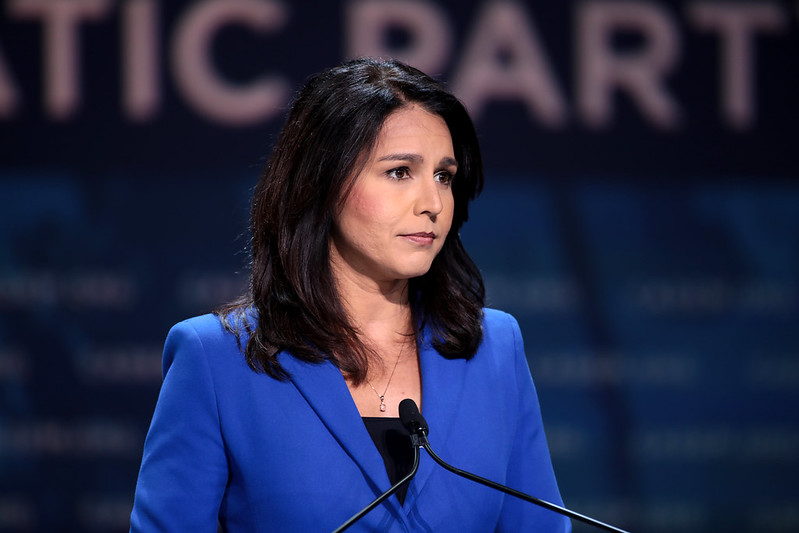
Director of National Intelligence Tulsi Gabbard has referred two former U.S. officials to the Justice Department for potential criminal investigation, escalating efforts to revisit the events that led to President Donald Trump’s first impeachment.
A spokesperson for Gabbard confirmed that the referrals target a whistleblower and former Intelligence Community Inspector General Michael Atkinson, both of whom played central roles in the 2019 inquiry. The spokesperson did not specify what crimes were alleged, and any decision to pursue charges rests with federal prosecutors.
The move follows Gabbard’s release of newly declassified testimony and documents that she argues show a “coordinated effort” within the intelligence community to “manufacture a conspiracy” used to justify Trump’s impeachment.
Atkinson’s actions were instrumental in advancing a whistleblower complaint that raised concerns about Trump’s July 2019 phone call with Ukrainian President Volodymyr Zelenskyy. In that call, Trump asked Zelenskyy to investigate then–former Vice President Joe Biden and his son, Hunter Biden.
The whistleblower wrote at the time: “I have received information from multiple U.S. Government officials that the President of the United States is using the power of his office to solicit interference from a foreign country in the 2020 U.S. election.”
Gabbard has sharply disputed the legitimacy of that complaint and Atkinson’s handling of it. Her office said Atkinson relied on “secondhand information” and “politicized, manufactured narratives,” and “did not follow standard IG procedures.”
“In his own words, IC IG Atkinson recognizes that his conclusions were based on a ‘preliminary investigation,’” her office said, quoting testimony in which he acknowledged he had not determined whether the alleged actions “actually took place.”
Under federal law, however, an inspector general’s role at that stage is limited to assessing whether a whistleblower complaint appears credible, not to fully investigate or verify the claims.
In a post on X, Gabbard accused “deep state actors” of constructing “a false narrative that Congress used to usurp the will of the American people and impeach duly-elected President @realDonaldTrump in 2019.”
Atkinson, who was fired by Trump in 2020, previously defended his conduct, saying he had “faithfully discharged” his duties and served “without regard to partisan favor or political fear.”
Democrats quickly condemned the referrals and the broader effort to revisit the impeachment.
Rep. Jim Himes of Connecticut, the top Democrat on the House Intelligence Committee, said the whistleblower “demonstrated courage and principle” in exposing Trump’s “efforts to extort Ukraine and falsely smear his opponent.”
“This apparent criminal referral will amount to nothing because no misconduct occurred,” Himes said. “But what it will do is chill future whistleblowers from coming forward… I suspect that is precisely the point.”
Sen. Mark Warner, the top Democrat on the Senate Intelligence Committee, dismissed the declassified materials as “a nothingburger” and “another sad attempt… to get in Donald Trump’s good graces.”
Trump was impeached by the House of Representatives in December 2019 on charges of abuse of power and obstruction of Congress tied to the Ukraine matter. He was acquitted by the Senate in early 2020 in a largely party-line vote and has consistently denied wrongdoing, calling his conversation with Zelenskyy “perfect.”
The latest referrals come as part of a broader push by Gabbard and other officials to reexamine controversies from Trump’s first term, including intelligence assessments of Russian election interference. While some figures connected to those investigations have been subpoenaed in ongoing probes, no charges have been filed.
At the same time, the effort unfolds against a backdrop of renewed political and legal scrutiny surrounding Trump. While prior impeachment proceedings ended in acquittal and are widely viewed as politically unlikely to result in removal from office, they continue to shape partisan divisions in Washington. Any new impeachment-related efforts would face long odds in Congress, particularly given the high threshold required for conviction in the Senate.
Still, the renewed focus on the 2019 impeachment underscores how the political battles of Trump’s presidency continue to reverberate, with competing narratives over the Ukraine episode remaining central to broader debates about executive power, accountability, and the role of intelligence agencies in U.S. politics.


That ‘phone conversation was recorded and Trump released it.
In that conversation there was NO talk about anything that could be considered to be in any way illegal.
This was just another attempt ( and a failed one, at that ) by the libs to try to eliminate Trump from his office as president.
They want socialism ( communism ) to be the government of the U.S.
The libs are certainly against capitalism … the only system that has ever brought true freedom and democracy ( representative democracy where THE CIVILIAN CITIZEN PEOPLE ARE THE GOVERNMENT )
This well could cause the American people to rise up and fight, causing another civil war.
WE, THE AMERICAN PEOPLE, WILL NOT LIVE UNDER COMMUNISIM!