

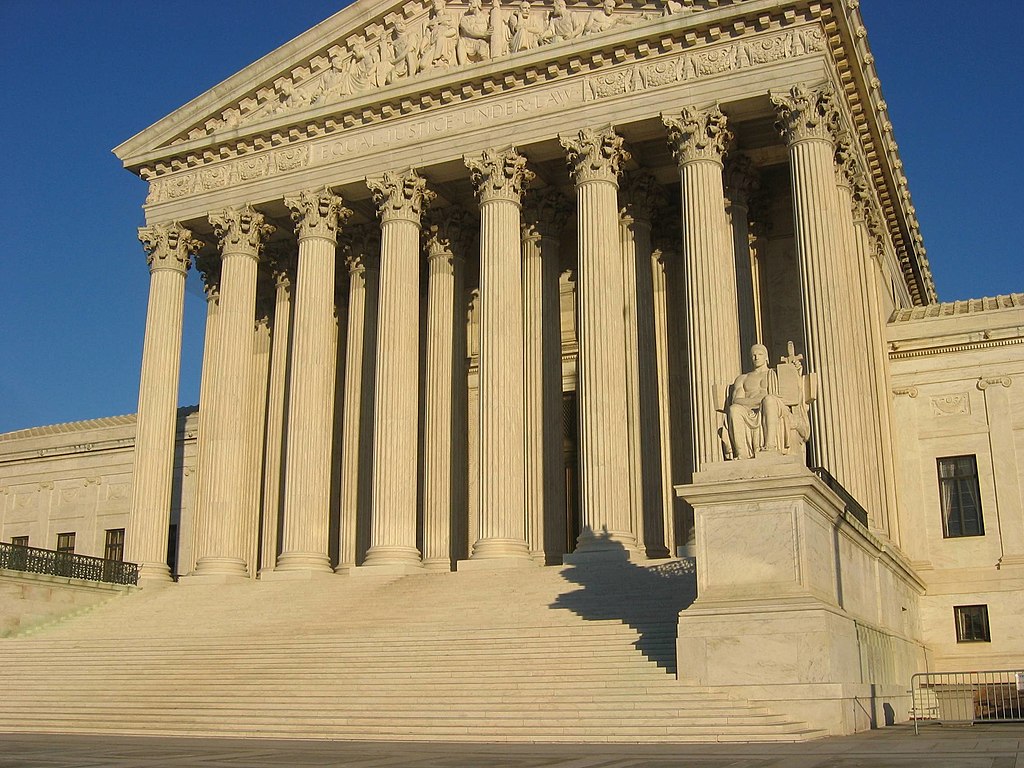
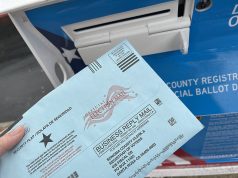
The Supreme Court handed President Donald Trump and the Republican National Committee a significant setback Monday, ruling 5-4 that states may continue counting mail-in ballots that arrive after Election Day as long as they were postmarked by Election Day.
The decision preserves election laws in more than a dozen states that provide a short grace period for mailed ballots to reach election officials, rejecting Republican arguments that federal law requires all ballots to be received before polls close on Election Day.
Justice Amy Coney Barrett authored the majority opinion, joined by Chief Justice John Roberts and the court’s three liberal justices.
“The election-day statutes say nothing about ballot receipt, and we cannot add to the words Congress chose,” Barrett wrote.
The court’s four remaining conservative justices dissented.
The case, Watson v. Republican National Committee, centered on a Mississippi law allowing absentee ballots postmarked by Election Day to be counted if they arrive within five business days. Republicans argued that the practice violated federal statutes establishing a uniform national Election Day for federal races.
The ruling leaves intact similar laws in 14 states, including both Republican- and Democrat-led states, as well as comparable provisions for military and overseas voters in many other states. More than 750,000 ballots nationwide were counted under such grace-period laws during the 2024 election, according to court filings and reporting on the case.
The decision represents a legal defeat for Trump, who has spent years criticizing mail voting and has repeatedly argued that elections should be decided on Election Day.
Trump’s Justice Department backed the Republican National Committee’s challenge before the Supreme Court, continuing the administration’s broader effort to tighten election rules ahead of the 2026 midterms.
The ruling also exposed divisions within the Republican Party.
Mississippi Secretary of State Michael Watson, a Republican, defended his state’s law throughout the litigation, arguing that ballots cast by Election Day should still count if postal delays prevent them from arriving immediately.
Mississippi’s position received support from organizations including the Democratic National Committee, the NAACP and the League of Women Voters, while the RNC was backed by House Republicans’ campaign arm, Citizens United and several Republican-led states.
The legal battle began after the Republican National Committee and the Libertarian Party of Mississippi challenged the state’s absentee ballot law. A federal district court upheld Mississippi’s policy before the Fifth Circuit Court of Appeals sided with Republicans, prompting Watson to appeal to the Supreme Court. Monday’s ruling reverses that appeals court decision.
The decision arrives as Trump continues pushing for stricter election rules nationwide.
In March, the president signed an executive order aimed at restricting mail voting and requiring additional proof of citizenship for federal elections. That order remains tied up in ongoing litigation in lower courts.
This is a breaking news story. Please check back for updates.



Ballots rigged for Dems to win
Stupid ruling.
MOOT DEBATE!
Not only is this debate moot from a biblical paradigm, it wouldn’t even be occurring had the constitutional framers not usurped Yahweh’s exclusive election authority (per Deuteronomy 17:15, etc.) whereby they turned election “discretion” over to We the People.
For anyone who participates in the Constitutional Republic’s biblically abominable elections, I highly recommend listening to Part 4 of the expository series on Colossians, subtitled “Election: Individual and Political” at bible versus constitution dot org. Go to our Audio Messages page and scroll down to T 1483.
See also blog article “Constitutional Elections: Dining at the ‘Devil’s Table.'” Search title on our Blog.
For how the Bible’s one-God, one-vote election system operates, see blog article “Salvation by Election.” Don’t be fooled by the title.