

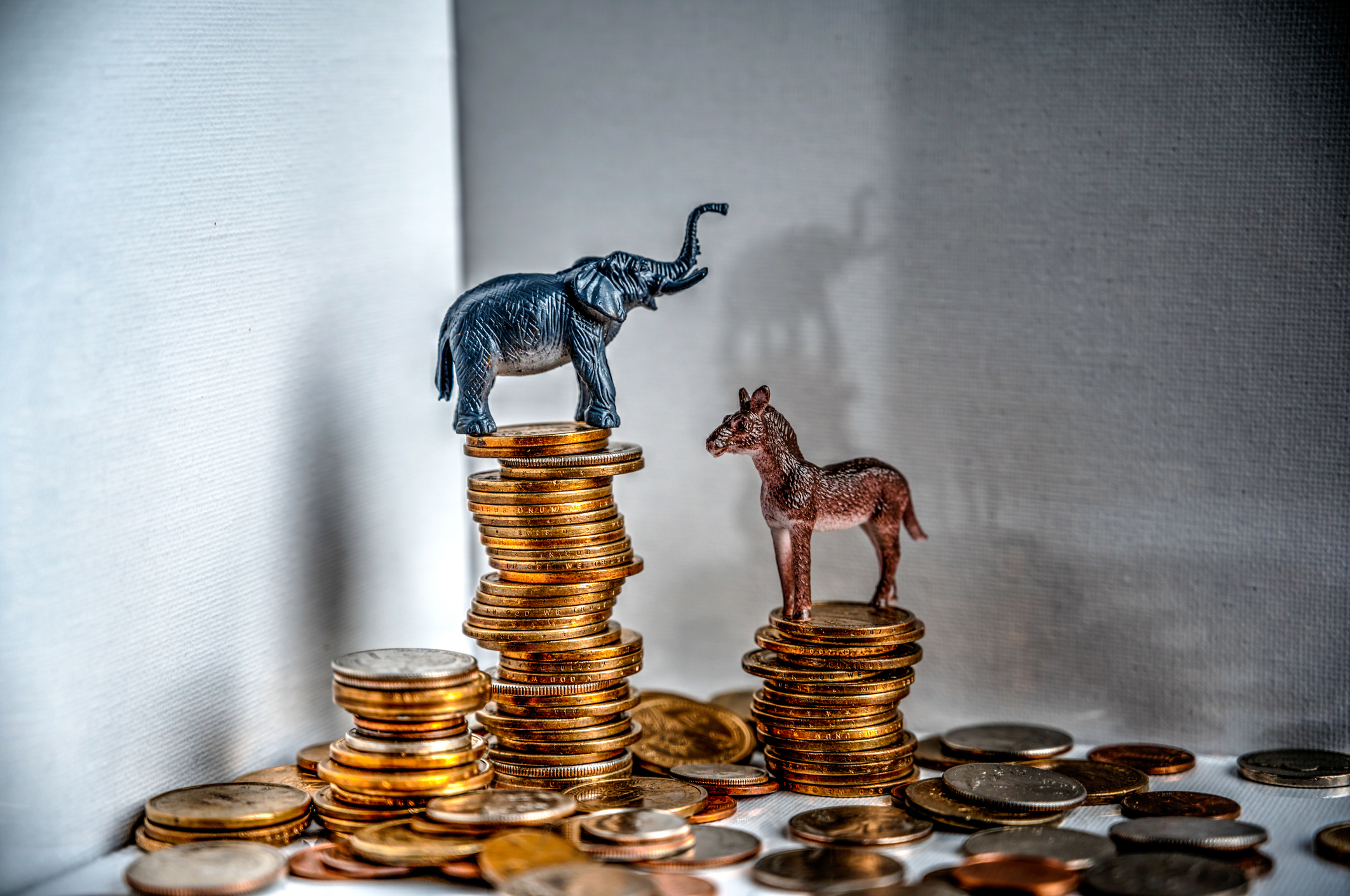
President Donald Trump’s primary super PAC is preparing to enter the midterm fight in August, bringing a roughly $400 million war chest to a congressional map where Republicans are defending narrow majorities and significantly more vulnerable seats.
MAGA Inc. has largely remained on the sidelines this cycle despite accumulating approximately $401 million. Journalist Jake Traylor reported the August spending timeline Monday, citing a Republican operative, while MS NOW separately reported that Trump’s political operation plans to use the money to reinforce Republican incumbents and put Democratic-held seats in play.
James Blair, Trump’s former White House political director and a coordinator of his midterm effort, has promised a substantial investment.
“I won’t specifically say what’s going to be spent, but the president is going to expend substantial resources to win the midterms,” Blair said during a June interview.
“He cares deeply about the party winning and anything he can do to support that he’s going to do and is already doing,” Blair added. “I think you’ll see a lot of spending on behalf of Republicans earlier than you normally do because of the additional resources.”
The scale of those resources is unusual for a super PAC connected to a president who is not on the ballot. MAGA Inc. began 2026 with approximately $300 million and raised nearly $19 million in June, according to its latest federal disclosures. The June haul included $10 million from cryptocurrency investors Tyler and Cameron Winklevoss, the Financial Times reported.
The more pressing question has been when the organization would begin using that money.
MAGA Inc. has spent only about $2.3 million supporting Republican candidates so far—roughly 0.6% of its available cash. Its spending has been limited to special House elections in Georgia and Tennessee and the successful Republican primary challenge against Kentucky Rep. Thomas Massie, according to campaign finance reporting reviewed by Bloomberg and People.
The super PAC has spent approximately $3 million on salaries, fundraising, compliance and other operating expenses—more than it has directed toward congressional races.
“That’s the $400 million question. I don’t know,” one Republican operative told MS NOW when asked why MAGA Inc. had waited. “They have indicated they’re going to spend. But not where or when. And those are kind of big details.”
The August rollout could help answer some of those questions at a critical point in the election calendar.
Republicans are defending 14 of the 18 House seats currently rated as toss-ups by the nonpartisan Cook Political Report. Nine additional districts lean Republican, creating a largely defensive House map for the party.
Four Senate races are currently rated as toss-ups: an open seat in Michigan and Republican-held seats in Alaska, Maine and Ohio. Other contests in Iowa, North Carolina and Texas could also attract significant outside spending as Democrats search for the four-seat net gain they would need to secure an outright Senate majority.
Trump’s operation is expected to give Republican candidates some flexibility to separate themselves from the administration on issues that could become liabilities in individual states or districts. MS NOW reported that strategists are allowing battleground Republicans to create distance from Trump on the economy and the war in Iran, where internal polling reportedly shows dissatisfaction with the administration’s handling of both issues.
One Republican operative said the broader closing argument would establish “a very sharp contrast” between GOP candidates and their Democratic opponents.
Republicans are also being encouraged to localize their campaigns around provisions in Trump’s One Big Beautiful Bill, the tax-and-spending law enacted in 2025. Rather than campaigning on the legislation as a whole, candidates are expected to highlight individual provisions—including changes to taxes on tips and overtime, an expanded child tax credit and a higher cap on state and local tax deductions.
Rep. Tom Barrett offers an early example of that localized approach. The Michigan Republican joined Democrats on Thursday in supporting a resolution directing Trump to end U.S. military operations in Iran. The measure passed the House 214-208, with Barrett among four Republicans who crossed party lines.
Despite the disagreement, Barrett appeared with Trump during the president’s Monday visit to Michigan. Barrett represents a competitive mid-Michigan district expected to draw significant attention from both parties this fall.
MAGA Inc.’s entry will add to a broader Republican financial advantage. Bloomberg calculated that Trump’s political operation, Republican Party committees and GOP-aligned congressional super PACs held approximately $1.1 billion through June, compared with roughly $355 million across equivalent Democratic organizations.
That advantage is not uniform, however. Several Democratic candidates in competitive races have outraised their Republican opponents, while Democratic groups are beginning to place their own major advertising reservations. Senate Majority PAC, the leading Democratic Senate super PAC, recently announced an additional $54 million in television advertising targeting four Republican-held seats.
The arrival of MAGA Inc.’s money could help Republicans erase some of those candidate-level disparities and force Democrats to redirect resources toward races they had expected to defend comfortably.
What remains unknown is how widely Trump’s team will distribute the money—and whether it will concentrate on protecting Republican incumbents or attempt to expand the battlefield into Democratic territory.
With Election Day approaching and most competitive races moving into their general-election phase, that decision could shape where both parties are forced to spend during the final three months of the campaign.

SUICIDE MONEY!
Regardless the amount of money thrown at either of the biblically abominable Democrat and Republican Parties, it will only facilitate America’s suicidal trek to the precipice of moral depravity and destruction – officially commenced when the 1787 cadre of Enlightenment and Masonic theistic rationalists (aka constitutional framers) spurned the Bible’s triune moral law as the law of the land, per Deuteronomy 28:15-68.
Just think, what the same funds could, instead do toward funding a return to America’s true early 1600’s biblical foundations and their governments of, by, and for God expressly established upon His triune moral law, governed exclusively by biblically qualified men of God – the real reason, per Deuteronomy 28:1-14, for America’s former greatness and prosperity.
For more regarding these two polar opposite forms of governments, see Chapter 3 “The Preamble: We the People vs. Yahweh” of free online book “Bible Law vs. the United States Constitution: The Christian Perspective,” in which every Article and Amendment is examined by the Bible, at bible versus constitution dot org. Click on the top entry on our Online Book page and scroll down to Chapter 3.
For more on how the Bible’s integral triune moral law (the Ten Commandments and their respective statutes and judgments) applies and should be implemented today as the law of the land, see free online book “Law and Kingdom: Their Relevance Under the New Covenant.” Go to our Online Book page and scroll down to title.
Then “A Biblical Constitution: A Scriptural Replacement for Secular Government.” This book provides a biblical replacement for the U.S. Constitution’s Preamble and first three Articles.
Find out how much you really know about the Constitution as compared to the Bible. Take our 10-question Constitution Survey in the sidebar and receive a free copy of the 85-page “Primer” of “BL vs. USC.”