

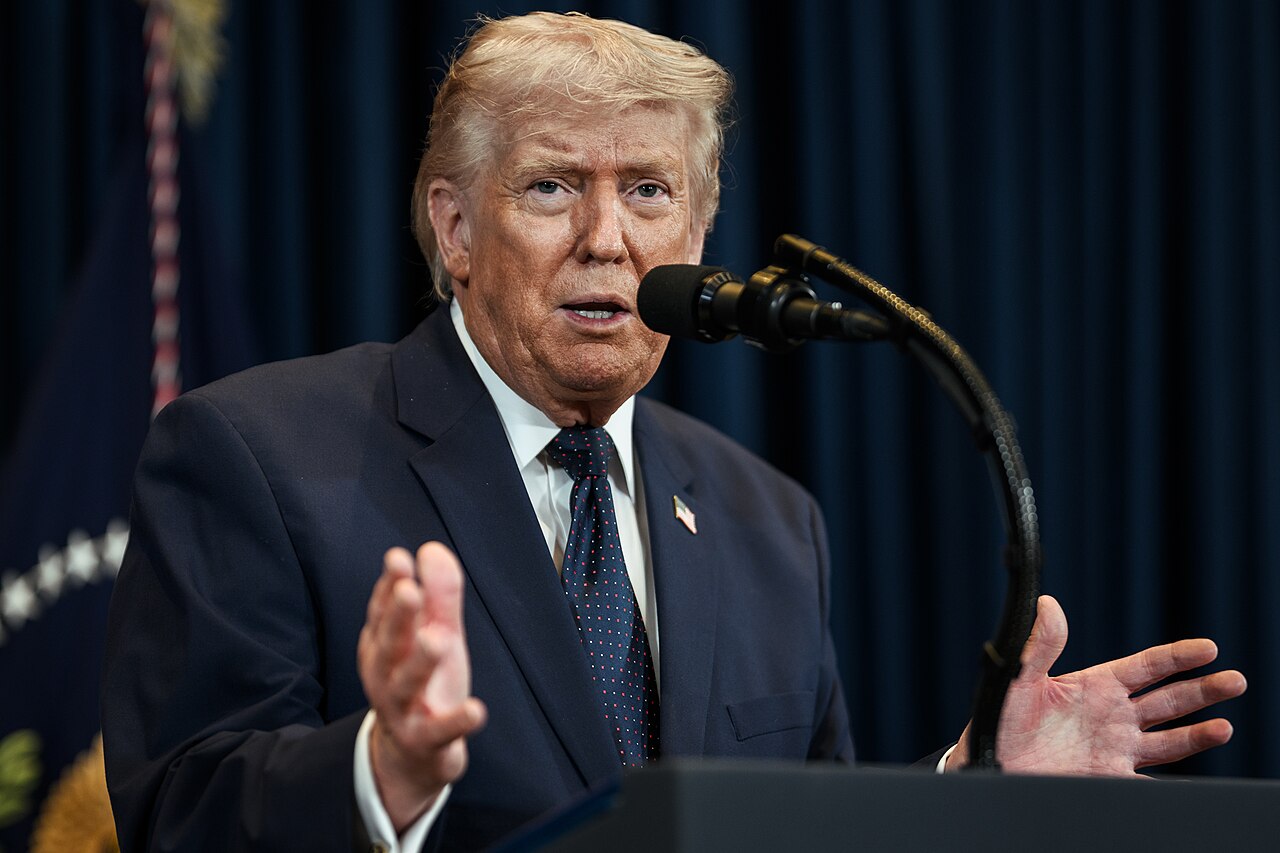
President Donald Trump is urging governors and mayors to welcome artificial intelligence data centers into their communities, arguing that the enormous facilities will generate jobs, tax revenue and technological breakthroughs even as Americans increasingly express concerns about their impact on electricity, water and the environment.
Speaking during a White House meeting with technology and cryptocurrency industry leaders, Trump argued that communities rejecting data-center projects risk being left behind as the United States races to expand its AI infrastructure.
“If I were the mayor of a town or the governor of a state, and I had a chance to get a big plant in an AI plant or a data center, I would absolutely want it because the jobs are enormous, and the money paid, the taxes paid are just enormous,” Trump said.
“And if you don’t take it, you’re going to be left behind because there are plenty of places that want it,” he added.
“Many of them are designed in a very beautiful way,” he said. “It’s really very positive.”
Americans Aren’t So Sure
Trump acknowledged that the rapidly expanding industry may need “a little public relations help,” and polling suggests he has a point.
A Gallup poll released in May found a majority of Americans opposed construction of data centers in their own communities. Among the major concerns are the facilities’ substantial electricity and water requirements, as well as their potential environmental effects.
The electricity issue has become particularly contentious as the AI boom accelerates. Data centers require enormous quantities of power to operate servers and cooling systems, raising questions about whether their expansion could strain electrical grids or ultimately increase utility costs for ordinary consumers.
The Trump administration has attempted to manage that backlash by encouraging technology companies and data-center developers to secure additional sources of electricity rather than simply adding their enormous demand to existing grids.
Trump has also backed efforts to speed construction. An executive order issued in July 2025 called for accelerating federal permitting for qualifying data-center infrastructure.
The president argued Wednesday that communities should weigh those concerns against the economic benefits the projects can bring.
Trump Points to Jobs and Medical Breakthroughs
Asked what he would tell Americans who remain skeptical about AI, Trump again emphasized employment while making a broader case for the technology’s potential.
“I think it’s going to create a lot of jobs. It’s going to create success. It’s going to create tremendous innovation medically,” Trump said.
He referenced an unspecified medical development he had recently reviewed involving a “pretty unstoppable disease.”
“All of a sudden they’re coming up with answers that they never thought were possible,” Trump said.
AI is already being explored for uses ranging from drug discovery and medical imaging to disease detection and personalized treatment, making health care one of the areas frequently cited by the industry’s proponents when arguing that the enormous investments in computing infrastructure could produce benefits beyond the technology sector.
Trump Wants Regulation Without ‘Stifling’ AI
The administration is simultaneously confronting another question: how aggressively Washington should regulate a technology Trump believes could become even more consequential than the internet.
“We’re leading by a lot with AI. We want to keep it that way,” Trump said. “We want to regulate, but we want to have regulation where they can continue to lead, not regulation that’s going to stifle a very important industry.”
Trump has made winning the global AI race a significant economic and national-security priority of his second administration.
On his second day back in office in January 2025, Trump appeared alongside technology executives to announce Stargate, a private-sector venture with plans to invest as much as $500 billion in American AI infrastructure.
Its flagship data-center complex in Abilene, Texas, has since become partially operational, while additional projects have been pursued around the country.
But the scale of the buildout has also transformed data centers from an obscure piece of digital infrastructure into a local political issue. Communities that once competed enthusiastically for major corporate investments are increasingly weighing promised construction jobs and tax revenues against higher electricity demand, water consumption, land use and potential effects on utility bills.
READ NEXT: Biden Weaponizing Artificial Intelligence (AI) to be ‘Woke’


President Trump is looking at AI Data Centers for building wealth, but there are major downsides . There is a worldwide crisis in the need for water. I live in the South West and i am aware that the water levels of two major reservoirs are extremely low, if they go lower hydropower will not be created as turbines will fail in creating electricity. The Erin Brockovich Report stated that there is a critical water shortage in Texas, and also in the Potomac River area. AI Data Centers use billions of gallons of water and contaminate it. They also need a great deal of power from electricity. Water is essential for all Life. The human need for water and food is critical. The need for AI Data Centers as wealth creating tools is questionable. AI Data cAI Data Centers reliance on water and power could put the country in jeopardy. Another major concern… AI Data Centers could eliminate millions of jobs and put many families out on the street. These things must be taken into consideration.