
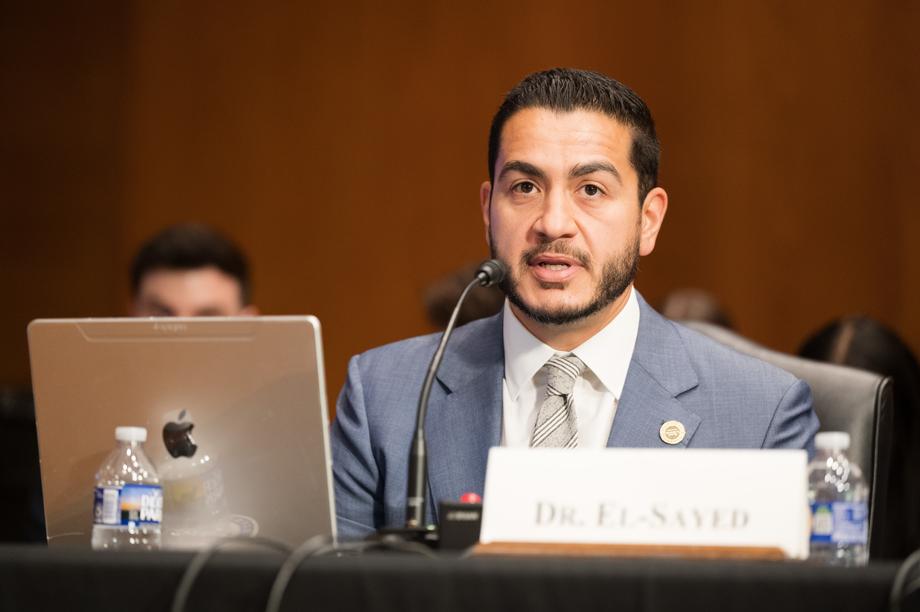
Michigan Sen.-elect Abdul El-Sayed has unveiled a gold-colored “TrumpCare” card bearing President Donald Trump’s signature, offering to put the Republican president’s name on a “Medicare for All” program if he agrees to support universal government-funded health coverage.
Michigan Democratic Sen.-elect Abdul El-Sayed is attempting to win President Donald Trump’s support for Medicare for All with an unusual proposal: Give the sweeping healthcare program the president’s name and issue Americans gold-colored “TrumpCare” cards.
El-Sayed unveiled the proposed card Thursday, Nov. 12, in a social media post directed at Trump, following several television appearances in which he offered to rename his signature healthcare proposal after the Republican president.
The mock card features a gold design and Trump’s signature, resembling the administration’s existing immigration-related Trump Gold Card.
“This is a message for @realDonaldTrump,” El-Sayed wrote on X. “Donald, this is on the table. Guarantee healthcare for every American, from cradle to grave.”
According to Mediaite, the reverse side of the proposed card instructs holders to present it at medical facilities and promises no premiums, deductibles, or copays for covered care.
The proposal is not an official government initiative. It is part of El-Sayed’s effort to persuade Trump to embrace a single-payer healthcare system that would substantially expand the federal government’s role in financing medical services.
Democrat Makes Trump an Offer
El-Sayed, who defeated Republican Mike Rogers in Michigan’s Senate election earlier this month, has made universal health coverage a central priority.
During a Tuesday appearance on CNN’s “The Source,” host Kaitlan Collins asked whether he was serious about his willingness to rename Medicare for All after Trump.
El-Sayed responded by looking directly into the camera and addressing the president.
“Donald, if you’re watching, we can put your name on it,” he said. “I know you like to put your name on stuff.”
He argued that Trump could claim credit for establishing universal health coverage if he agreed to sign the legislation.
Collins appeared surprised by the proposal and pressed the incoming senator on whether he was joking.
“No, I’m absolutely serious,” El-Sayed replied.
He explained that he cared more about expanding health coverage than preserving the Medicare for All name.
“I don’t care what it’s called,” he said. “I want people to have healthcare in this country.”
The exchange, reported by Mediaite, followed similar remarks El-Sayed made during an interview with journalist Mehdi Hasan.
Watch: El-Sayed makes his “TrumpCare for All” proposal during his CNN interview.
What the Gold “TrumpCare” Card Promises
The card’s design is intended to make El-Sayed’s offer tangible.
Rather than merely proposing a name change, the Michigan Democrat has presented a visual representation of what he believes a Trump-branded national health insurance program could look like.
The mock card promises:
- Universal health coverage for Americans.
- No insurance premiums for covered care.
- No deductibles or copayments for covered services.
- Access to participating medical providers under a proposed nationwide system.
Those benefits reflect El-Sayed’s policy goals, not coverage currently available through an enacted program.
A Medicare for All system would require extensive federal legislation addressing eligibility, financing, provider payments, and the future of existing public and private insurance arrangements.
El-Sayed has not demonstrated that changing the program’s name would resolve those policy questions.
His proposal instead focuses on a potential political bargain: Trump would receive prominent recognition for the program in exchange for supporting legislation traditionally associated with progressive Democrats.
A Familiar Design With a Different Purpose
The gold-colored design also draws attention to one of the Trump administration’s existing initiatives.
The administration has promoted a Trump Gold Card immigration program offering a route toward U.S. residency for qualifying applicants who make substantial financial contributions.
El-Sayed’s mock healthcare card borrows the gold aesthetic but proposes an entirely different benefit.
Unlike the immigration initiative, which is designed around a substantial financial payment, the proposed TrumpCare card advertises medical coverage without premiums, deductibles, or copayments.
That distinction underscores the scale of El-Sayed’s proposal.
The senator-elect is not suggesting a limited insurance benefit or a discount program. He wants to replace much of the existing health insurance structure with a publicly financed system covering the population.
Medicare for All Would Require Major Changes
Medicare for All has long been championed by progressive lawmakers, including Sen. Bernie Sanders, I-Vt.
Although proposals differ in their details, the approach generally involves establishing a federal single-payer insurance program that would cover medically necessary services.
Under the versions commonly promoted by Sanders and other advocates, most private insurance plans that duplicate the federal program’s benefits would be eliminated or substantially restricted.
Supporters argue that such a system could simplify administration, reduce medical debt, and remove financial barriers to obtaining care.
Opponents raise concerns about federal spending, taxation, government control over reimbursement rates, and the disruption of employer-sponsored insurance.
Eliminating premiums and copayments would not eliminate the underlying cost of medical treatment. Those expenses would instead be financed through federal revenue and other funding mechanisms.
The precise effects on households, employers, medical providers, and the federal budget would depend on the legislation ultimately introduced.
El-Sayed has not released a complete financing plan for the Trump-branded proposal.
Trump Has Not Endorsed the Idea
The proposal faces a major obstacle: Trump has not publicly indicated that he would support Medicare for All.
During his first administration, Trump sought to repeal and replace the Affordable Care Act, the health insurance law enacted under former President Barack Obama.
A major Senate Republican repeal effort failed in 2017 after three GOP senators opposed the measure.
Trump has continued criticizing the Affordable Care Act and calling for changes to the American healthcare system, but his stated approach has not embraced the single-payer model advocated by El-Sayed.
The incoming Michigan senator nevertheless believes the president could be persuaded.
In his CNN interview, El-Sayed suggested that Democrats might be able to advance the proposal if Trump publicly committed to signing it.
That remains speculative.
There is no announced agreement between the president and El-Sayed, and the White House has not endorsed the proposed gold card.
Sanders Also Raises Possibility of Cooperation
El-Sayed is not the only progressive politician publicly discussing the possibility of Trump signing universal healthcare legislation.
During a recent appearance on MS NOW, Sanders argued that Democrats should pursue Medicare for All regardless of whether the president ultimately supports it.
Sanders suggested that lawmakers should place legislation before Trump and require him to decide whether to approve or reject it.
The Vermont lawmaker argued that passing legislation through Congress would create a clear political decision for the president.
El-Sayed has adopted a different emphasis by attempting to make the legislation more appealing to Trump personally.
His approach highlights a distinction between the policy itself and the political branding surrounding it.
What Happens Next
El-Sayed will enter the Senate in January, when the new Congress convenes.
He has identified Medicare for All, reducing medical debt, and addressing household costs as priorities for his term.
Turning the TrumpCare concept into legislation would require detailed policy language, agreement among lawmakers, and the president’s signature or sufficient congressional support to overcome a veto.
The gold card unveiled Thursday does not alter any existing insurance coverage or establish new federal benefits.
For now, it remains a public invitation to the president.
Whether Trump responds will determine if the proposal develops into a substantive negotiation or remains an unusual example of political outreach between two figures with sharply different agendas.
READ NEXT: Gun Control Group Pressures AI Companies To Restrict Firearm-Related Information