Commentary

Home Opinion Commentary

Inside DOGE: Elon Musk’s Bold Move To Rewiring Federal Thinking

Screenshot via X [Credit: @amuse]

In the history of American bureaucracy, few ideas have carried the sting of satire and the force of reform as powerfully as Steve Davis’s $1 credit card limit. It is a solution so blunt, so absurd on its face, that only a government so accustomed to inertia could have missed it for decades. And yet, here it is, at the center of a sprawling audit by the Department of Government Efficiency, or DOGE, that has, in just seven weeks, eliminated or disabled 470,000 federal charge cards across thirty agencies. The origin of this initiative reveals more than cleverness or thrift. It reflects a new attitude, one that insists the machinery of government need not be calcified. The federal workforce, long derided as passive and obstructionist, is now being challenged to solve problems, not explain why they cannot be solved. This, more than any tally of dollars saved, may be DOGE’s greatest achievement.

When Elon Musk assumed control of DOGE under President Trump’s second administration, he brought with him an instinct for disruption. But disruption, as many reformers have learned, is often easier said than done. Take federal credit cards. There were, as of early 2025, roughly 4.6 million active accounts across the federal government, while the civilian workforce comprised fewer than 3 million employees. Even the most charitable reading suggests gross redundancy. More cynical observers see potential for abuse. DOGE asked the obvious question: why so many cards? The initial impulse was to cancel them outright. But as is often the case in government, legality is not aligned with simplicity.

Enter Steve Davis. Known for his austere management style and history with Musk-led enterprises, Davis encountered legal counsel who informed him that mass cancellation would breach existing contracts, violate administrative rules, and risk judicial entanglement. Most would stop there. But Davis, adhering to Musk’s ethos of first-principles thinking, chose another route. If the cards could not be canceled, could they be rendered functionally useless? Yes. Set their limits to $1.

This workaround achieved in days what years of audits and Inspector General warnings had not. The cards remained technically active, sidestepping the legal landmines of cancellation, but were practically neutered. The act was swift, surgical, and reversible. It allowed agencies to petition for exemptions in cases of genuine operational need, but forced every cardholder and department head to justify the existence of each card. Waste thrives in opacity. The $1 cap turned on the lights.

Naturally, the immediate reaction inside many agencies was panic. At the National Park Service, staff could not process trash removal contracts. At the FDA, scientific research paused as laboratories found themselves unable to order reagents. At the Department of Defense, travel for civilian personnel ground to a halt. Critics likened it to a shutdown, albeit without furloughs. Others, more charitable, described it as a stress test. And indeed, that is precisely what it was: a large-scale audit conducted not by paper trails and desk reviews, but by rendering all purchases impossible and observing who protested, why, and with what justification.

This approach reflects a deeper philosophical question. What is government for? Is it a perpetuator of routine, or a servant of necessity? The DOGE initiative, in its credit card audit, insisted that nothing in government spending ought to be assumed sacred or automatic. Every purchase, every expense, must be rooted in mission-critical need. And for that to happen, a culture shift must occur, not merely in policy, but in mindset. The federal worker must no longer be an apologist for the status quo, but an agent of reform.

Remarkably, this message has found traction. Inside the agencies affected by the freeze, DOGE has reported a surge in what one official described as “constructive dissent.” Civil servants who once reflexively recited reasons for inaction are now offering alternative mechanisms, revised workflows, and digital solutions. One employee at the Department of Agriculture proposed consolidating regional office supply chains after realizing that over a dozen separate cardholders were purchasing duplicative items within the same week. A NOAA field team discovered it could pool resources for bulk procurement, saving money and reducing redundancy. These are not acts of whistleblowing or radical restructuring. They are small, localized acts of efficiency, and they matter.

Critics argue that these are marginal gains and that the real drivers of federal bloat lie elsewhere: entitlement spending, defense procurement, or healthcare subsidies. And they are not wrong. But they miss the point. DOGE’s $1 limit was not about accounting minutiae, it was about psychology. In a system where inertia reigns, a symbolic shock is often the necessary prelude to substantive reform. The act of asking why, why this card, why this purchase, why this employee, forces a reappraisal that scales. Culture, not just cost, was the target.

There is a danger here, of course. Symbolism can become performance, and austerity can become vanity. If agencies are deprived of necessary tools for the sake of headlines, then reform becomes sabotage. This is why the $1 policy included an appeals process, a mechanism for restoring functionality where needed. In a philosophical sense, this is the principle of proportionality applied to public finance: restrictions should be commensurate with the likelihood of abuse, and reversible upon demonstration of legitimate need.

DOGE’s broader audit, still underway, has now expanded to cover nearly thirty agencies. It is not simply cutting cards. It is classifying them, comparing issuance practices, flagging statistical anomalies, and building a federal dashboard of real-time usage. This is not glamorous work. There are no ribbon-cuttings, no legacy-defining achievements. But it is the marrow of good governance. As Aristotle noted, excellence is not an act, but a habit. The DOGE team has adopted a habit of scrutiny. And that habit, when instilled in the civil service, is a kind of virtue.

Here we arrive at the most profound implication. What if the federal workforce is not inherently wasteful or cynical, but simply trapped in a system that rewards compliance over creativity? What if, when given both the mandate and the moral permission to think, civil servants become problem solvers? The $1 limit policy is, in this light, less a budgetary tool than a pedagogical one. It teaches. It asks employees to imagine how their department might function if every dollar mattered, and to act accordingly.

In a bureaucratic culture where the phrase “we can’t do that” serves as both shield and apology, DOGE has introduced a new mantra: try. Try to find the workaround. Try to reimagine procurement. Try to do more with less. This shift may not register on a spreadsheet. It may not win an election. But it rehumanizes the federal workforce. It treats them not as drones executing policy, but as intelligent actors capable of judgment, reform, and even invention.

The future of DOGE will no doubt face resistance. Unions, entrenched bureaucrats, and political opponents will argue it oversteps or misunderstands the delicate machinery of governance. Some of that criticism will be valid. But what cannot be denied is that DOGE has already achieved something rare: it has made federal workers think differently. It has shown that even the most byzantine of systems contains levers for change—if one is willing to pull them.

The $1 card limit is not a policy; it is a parable. It tells us that in the face of complexity, simplicity is a virtue. That in the face of inertia, audacity has a place. And that in the face of sprawling bureaucracies, sometimes the best way to fix the machine is to unplug it and see who calls to complain. That is when the real work begins.

Sponsored by the John Milton Freedom Foundation, a nonprofit dedicated to helping independent journalists overcome formidable challenges in today’s media landscape and bring crucial stories to you.

READ NEXT: Federal Judge Blocks Hugely Popular Trump-Backed Reform

Trump’s Voter Citizenship Requirement Blocked By Federal Judge

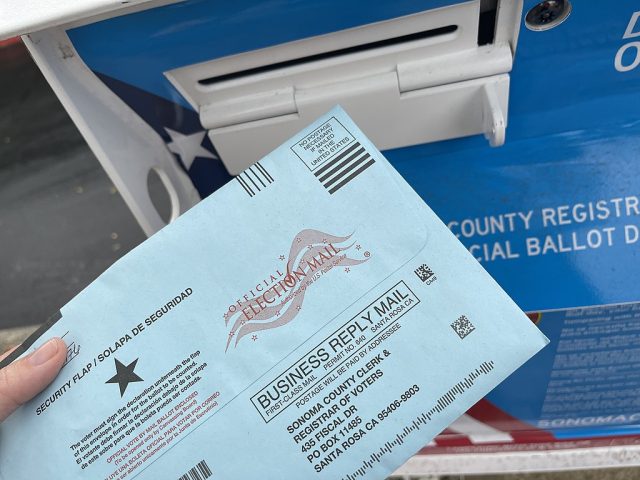
In a controversial decision that critics say undermines basic electoral integrity, U.S. District Judge Colleen Kollar-Kotelly issued a preliminary injunction Thursday blocking the Trump administration from implementing key provisions of its election reform order — including a requirement that individuals provide proof of citizenship when registering to vote in federal elections.

The Trump administration’s order, signed in March, sought to address the widespread public concern over election security by aligning U.S. registration standards with those used by many developed nations — where proof of citizenship is a basic requirement to cast a vote. Yet, in her ruling, Judge Kollar-Kotelly sided with Democratic operatives and partisan groups, granting their request to halt implementation of what should be a commonsense safeguard.

It’s already a felony for noncitizens to vote in federal elections. So why oppose a mechanism to verify that voters are, in fact, eligible citizens? The administration’s proposed policy simply sought to enforce existing law, not change it. But for activists and partisan lawyers, that’s apparently too much.

Critics of the ruling argue that it demonstrates a disturbing disconnect between legal theory and electoral reality. While the plaintiffs claimed the executive order infringes on the “Elections Clause” of the Constitution — which delegates much of the authority over elections to the states — the Trump order targeted the federal voter registration form, which is a product of federal law and administered by a federal agency.

Among the more absurd arguments presented during the case was the suggestion that requiring proof of citizenship would complicate voter registration drives at grocery stores and public venues. In other words, ensuring that only citizens vote is too inconvenient for activists looking to register voters en masse.

But this framing reveals the central issue: voter registration is being treated like a political campaign tactic, not a civic responsibility. If accuracy and integrity are seen as barriers to convenience, something is deeply wrong with the system.

If the courts won’t even allow the federal form to be updated to reflect current law, critics argue, how can Americans have confidence that elections are fair and secure?

Ironically, while liberal groups celebrate the decision as a “victory for voters,” many Americans see it as a victory for loopholes and ambiguity. The same people who insist elections are sacred and democracy is under threat are now openly opposing the most basic eligibility checks used around the world.

Meanwhile, Trump’s other proposed reforms — including tighter mail ballot deadlines and review of voter rolls against immigration databases — were allowed to stand. But with the citizenship requirement blocked, many worry that the core vulnerability in the system remains unaddressed.

When noncitizens can easily register to vote — intentionally or accidentally — and the federal government is barred from checking, who exactly benefits?

This article originally appeared on American Liberty News. The opinions expressed in this article are those of the author and do not necessarily reflect the positions of Great America News Desk. It is republished with permission.

READ NEXT: President Trump Signs Executive Order Requiring Proof Of Citizenship To Vote In Federal Elections

Pope Francis Appoints Vocal Trump Critic As DC Archbishop In Provocative Leadership Move

3

Pope Francis has named Cardinal Robert McElroy, a known advocate for migrants and outspoken critic of President-elect Donald Trump, as the new Archbishop of Washington, D.C. The decision underscores the pontiff’s preference for church leaders who align with his progressive vision, even as it risks further deepening ideological divisions within the millennia-old Catholic Church.

Cardinal McElroy, recognized as a strong supporter of LGBTQ inclusion and other liberal causes, has consistently aligned with Pope Francis on key social and theological issues. His appointment was announced two weeks before Inauguration Day, conspicuous timing that drew widespread attention given the cardinal’s history of publicly criticizing Trump’s policies on immigration and social justice. This is particularly notable in light of McElroy’s emphasis on synodality (dialogue with one another in the presence of the Spirit of God) and church reform, which have drawn both praise and criticism from Catholic observers.

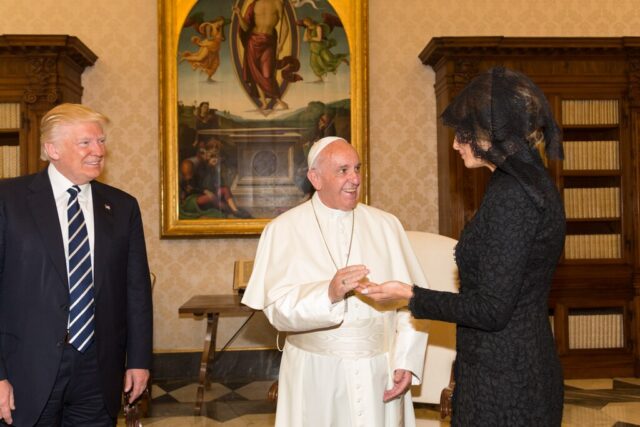
The White House, Public domain, via Wikimedia Commons

As Forbes’ Conor Murray reports, the move to elevate McElroy comes as a stark contrast to Trump’s nomination of Brian Burch as ambassador to Vatican City. Burch, a conservative Catholic activist and president of the right-leaning advocacy group CatholicVote, was instrumental in rallying Catholic support for Trump during the 2024 campaign. His organization has frequently clashed with the more progressive stances of Pope Francis and his allies:

McElroy has largely slammed Trump because of his views on immigration, including his promise to conduct mass deportations. McElroy was one of 12 Catholic bishops from California who co-authored a statement last month voicing support for “our migrant brothers and sisters,” acknowledging the “calls for mass deportations and raids on undocumented individuals” have created fear in migrant communities. After Trump’s first election victory in 2016, McElroy called it “unthinkable” that Catholics would “stand by while more than ten percent of our flock is ripped from our midst and deported.” He called Trump’s mass deportation plan an “act of injustice which would stain our national honor” and compared it to Japanese interment and Native American dispossession. McElroy criticized Trump’s plan to end the Deferred Action for Childhood Arrivals policy in 2017 for lacking any “shred of humanity,” stating Jesus Christ was “both a refugee and an immigrant during his journey.”

In a 2023 column for America magazine, McElroy urged greater welcoming of divorced and LGBTQ Catholics into the church, stating the church’s “disproportionate” focus on sexual activity as sin “does not lie at the heart” of a Christian’s relationship with God and “should change.” McElroy called it a “demonic mystery of the human soul why so many men and women have a profound and visceral animus toward members of the L.G.B.T. communities.” In a February 2024 speech, McElroy considered the lack of support among Catholics for blessing same-sex marriages to be the result of “enduring animus among far too many toward LGBT persons.” McElroy has also criticized abortion being considered a “de facto litmus test for determining whether a Catholic public official is a faithful Catholic.” McElroy, however, called Biden’s lack of support for anti-abortion legislation an “immense sadness” in a 2021 America magazine column, and called the overturning of Roe v. Wade a “day to give thanks and celebrate.”

Burch, founder and co-president of CatholicVote, was once a Trump skeptic but praised him in 2020 for making a “concerted effort to reach out to Catholics in a way that we haven’t seen in the past.” That year, he authored the pro-Trump book, “A New Catholic Moment: Donald Trump and the Politics of the Common Good.” Burch has slammed Francis for “progressive Catholic cheerleading” and accused him of creating “massive confusion” over his approval of blessing same-sex marriages in 2023.

Also on Monday, Francis appointed Sister Simona Brambilla, an Italian nun, to lead a Vatican office, making her the first woman to lead a major Vatican department. The department, the Dicastery for the Institutes of Consecrated Life and Societies of Apostolic Life, is responsible for religious orders. Francis has long voiced support for greater roles for women in the church, though he has ruled out ordaining women as deacons or priests.

McElroy’s appointment also highlights Pope Francis’ broader engagement with U.S. politics. In 2024, the pontiff made headlines when he urged voters to carefully consider their choices, describing the act of voting as a moral responsibility. During a press conference aboard the papal plane, Francis remarked on the complexities of American politics, advising voters to choose “the lesser evil” when faced with challenging decisions.

While the pope has criticized Trump’s hardline immigration policies, he has also expressed concern over Vice President Kamala Harris‘ unwavering support for abortion rights. Both stances, Francis noted, conflict with the Church’s teachings on the sanctity of life. “One must choose the lesser of two evils,” the pope reiterated. “Who is the lesser of two evils? That lady or that gentleman? I don’t know. Everyone with a conscience should think on this and do it.”

Despite the pontiff’s cultural influence, his impact on American politics was negligible. In the 2024 presidential election, former President Donald Trump secured a notable share of the Catholic vote, surpassing his performance in previous campaigns. According to exit polls conducted by The Washington Post, Trump won the national Catholic vote by a 15-point margin, with 56% supporting him compared to 41% for Vice President Kamala Harris.

This represents a notable shift compared to the 2020 election, where the Catholic electorate was nearly evenly split, with 50% supporting Trump and 49% favoring Joe Biden, a lifelong Catholic.

In the 2016 election, Trump secured 52% of the Catholic vote, while Hillary Clinton received 45%.

The 2024 election also saw variations within the Catholic demographic. Trump’s support among white Catholics increased, with 59% backing him compared to Harris’s 39%, a 20-point margin. This was an improvement over his 15-point lead in 2020.

Marburg79, CC BY-SA 3.0 , via Wikimedia Commons

Among Latino Catholics, there was a significant shift toward Trump. In 2020, Biden led this group by a substantial margin, but in 2024, Trump’s support increased notably, contributing to his overall gains among Catholic voters.

The appointment of McElroy is likely to spark further debate within the Church, where a widening schism between liberal and conservative leaders continue to grow. However, it also reflects Francis’ commitment to shaping the Church’s leadership in a way that emphasizes his vision for pastoral care and inclusivity, even at the expense of unity.

Yet, in the United States, voting trends strongly suggest that Trump’s campaign strategies—including selecting Senator JD Vance, a Catholic, as his running mate, and making explicit appeals to Catholic voters—resonated with this demographic, contributing to increased GOP support in the 2024 election and possibly beyond.

Article Published With The Permission of American Liberty News.

Fix The NSC: A Warning & Roadmap For Trump’s Second Term

0
[Photo Cred: Office of the President of the United States, Public domain, via Wikimedia Commons]

A Call to Action: Reforming the National Security Council

Joshua Steinman, the former senior director for cyber on President Trump’s National Security Council (NSC), has issued a stark warning to the incoming president that demands immediate attention. Steinman, who loyally served from Trump’s first day in office to his last, cautions that mistakes in NSC staffing could spell disaster for the administration’s second term, leading to either ineffectiveness or outright betrayal. His insights form a compelling argument for a complete overhaul of the NSC as the cornerstone of Trump’s efforts to govern effectively.

The NSC, as Steinman explains, is not merely a bureaucratic appendage. It is the quarterback of the White House—the entity tasked with ensuring that the president’s directives are executed seamlessly across the vast machinery of the federal government. “If the president is the owner of the football team, the NSC is the quarterback,” he asserts, underscoring the centrality of this institution in driving the administration’s policy agenda. And yet, Steinman’s concerns suggest that the team surrounding this quarterback may not be up to the task.

Reflecting on Trump’s first term, Steinman identifies a critical error: the decision to retain approximately 50% of the NSC staff from the Obama administration. This hesitation to implement a sweeping purge, according to Steinman, allowed disloyal actors to undermine Trump’s policies. Some of these holdovers allegedly continued to operate under Obama-era guidance until explicitly instructed otherwise. Steinman’s message is clear: “Removing people like this isn’t personal; it’s just prudent.”

The stakes are high. Steinman contrasts Trump’s initial approach with the swift and decisive action taken by President Biden, who executed a comprehensive purge of Trump-aligned NSC staff upon taking office. This move ensured that Biden’s team could implement his agenda without interference from ideological adversaries. Critics labeled Biden’s actions a “purge” and raised concerns about the politicization of traditionally non-partisan roles, but his administration’s determination to align its personnel with its policies proved effective in consolidating its power.

Steinman’s critique does not stop at holdovers. He raises alarms about new hires, questioning their loyalty and expertise. Among those rumored to join Trump’s team is Adam Howard, GOP Staff Director for the House Permanent Select Committee on Intelligence (HPSCI), who is set to take the critical role of senior director for intelligence programs. Steinman questions whether Howard’s background equips him to confront potential interference from the intelligence community—a task vital to ensuring Trump’s agenda is not derailed.

The urgency of Steinman’s warning lies in the fundamental truth that personnel is policy. For Trump’s administration to succeed, the NSC must be staffed with individuals who are not only loyal to his vision but also possess the subject-matter expertise to navigate the complexities of their roles. Steinman’s concerns about Anne Neuberger, the Biden-appointed NSC cybersecurity director, exemplify this need. Her alignment with policies on artificial intelligence and tech censorship could undermine Trump’s objectives, should she remain in place.

Trump’s response to these challenges is beginning to take shape. Key appointments to his NSC include:

  • Michael Waltz, National Security Advisor: A Republican Congressman and retired Army Green Beret with a hardline stance on China.
  • Alex Wong, Deputy National Security Advisor: A seasoned diplomat who oversaw North Korea policy during Trump’s first term.
  • Sebastian Gorka, Senior Director for Counterterrorism: A known advocate for robust counterterrorism strategies.
  • Brian McCormack, Senior Advisor: An energy consultant focusing on energy security.
  • Andrew Peek, Middle East Policy Adviser: A seasoned expert on the region’s complexities.

While these appointments reflect a renewed emphasis on loyalty and alignment, Steinman’s cautionary tale lingers. The success of Trump’s second term hinges on avoiding the missteps of the first. The NSC’s ability to serve as an effective quarterback depends entirely on the quality of its staff. As Steinman aptly puts it, “The Intel Senior Director position is one of the most CRITICAL posts in U.S. Government.”

The broader implications of Steinman’s warning extend beyond Trump’s presidency. The debate over Biden’s NSC purge highlighted the tension between ensuring policy alignment and maintaining non-partisan governance. Critics, including the Heritage Foundation, argued that Biden’s actions undermined the apolitical nature of advisory roles, while supporters contended that loyalty is essential for effective governance. Trump’s administration must navigate this delicate balance, prioritizing mission alignment without descending into the partisanship that critics decry.

As Trump prepares to assume office once more, the lessons of his first term and Biden’s purge are clear: the NSC must be reimagined, restructured, and resolutely loyal to the President’s agenda. Failure to act decisively could jeopardize the very goals Trump has championed—from ending unnecessary conflicts to revitalizing the economy. Steinman’s call to action is both a warning and a roadmap: “Fix the NSC, fix the presidency.”

Sponsored by the John Milton Freedom Foundation, a nonprofit dedicated to helping independent journalists overcome formidable challenges in today’s media landscape and bring crucial stories to you.

Pentagon Reveals Records On Operation That Could Have Prevented 9/11

2
David B. Gleason from Chicago, IL, CC BY-SA 2.0 , via Wikimedia Commons

After nearly two decades of courtroom arguments, the Defense Department has finally turned over records on an intelligence program that could have prevented the Sept. 11, 2001 terrorist attacks.

The non-profit public interest law firm Judicial Watch announced in a statement after a nearly 19-year Freedom of Information Act battle, “the Department of Defense produced 62 pages of records out of hundreds of previously withheld documents regarding the U.S. intelligence program ‘Operation Able Danger.’ The Defense Department identified hundreds of pages of responsive records but withheld them, claiming the overwhelming majority are still classified to this day.”

“It shouldn’t take two decades to decide that the American people can’t see documents about a military investigation that could have prevented 9/11. What an insult to the American people and the victims of 9/11,” said Judicial Watch President Tom Fitton.

“Able Danger was formed in 1999. It compiled publicly available information regarding al Qaeda and other targets,” Judicial Watch notes.”

“In August 2005 interviews, Tom Fitton, president of Judicial Watch, and other experts reported that the operation identified four future September 11, 2001, hijackers as al Qaeda members in the United States well before the attacks,” Judicial Watch states, adding, “The Senate Intelligence Committee began its investigation of the program in August 2005. In September 2005, the Senate Judiciary Committee conducted a hearing on Able Danger, however, members of the data-mining team were blocked from testifying.”

That’s when Judicial Watch stepped in, submitting a FOIA request to Defense Department for related records, as well as information on “U.S. intelligence, law enforcement and/or counterterrorism projects and/or programs utilizing data mining software/techniques to search open-source records in the public domain.”

Judicial Watch lays out what they discovered, writing:

The Defense Department response on August 24 from U.S. Special Operations Command identifies hundreds of pages of responsive records but claims the overwhelming majority are still classified and, over 20 years later, remain exempted from disclosure:

[S]pecifically, Sections 1.4(a), military plans, weapon systems, or operations; 1.4(c), intelligence activities (including covert actions), intelligence sources or methods, or Cryptology; 1.4(g), vulnerabilities or capabilities of systems, installations, projects, plans, or protection services relating to the national security; and Section 1.7(e), for compilation of items of information that are individually unclassified, but may be classified if the compiled information reveals an additional association or relationship.

The records obtained by Judicial Watch include an unredacted, declassified Top Secret/SCI record contains a 17-page listing of unclassified, open-source internet resources listing websites and URLs for topics such as terrorism news stories; Office of the Coordinator of Counterterrorism; and “Albanian Terrorism in Kosovo,” among many others. Across the bottom of page three of the lists of open-source records is a statement: “Began to understand the status of ongoing efforts!” The author of the exclamation is not identified.

Small passages of what seem to be declassified Top Secret/SCI analytical reports (unnamed and undated) feature commentary such as:

Arab countries in North Africa especially, Algeria, Tunisia, Morrocco, Libya, Egypt, and almost all other Arab countries have been annoyed for the high profile of Osama bin Laden first in Pakistan and later in Afghanistan especially, when he publicly claims that he trains Arab fundamentalists to overthrow most of Arab regimes in the Middle East.

The records also cite journalist Jason Burke’s December 1998 reporting that Osama bin Laden decided to get into drug trafficking as a new weapon and approached (through intermediaries) major opium and heroin dealers, as well as major landowners in the opium-growing districts of Afghanistan, and offered to buy all of the opium they grow.

Drug trafficking was also featured in an undated/unsourced, declassified TOP SECRET/SCI record that stated:

In fact, heroin is the major source of income for the Taleban [sic] government that has seized power in Afghanistan. It is not the Taleban government alone; heroin is also a major source of earning for the Inter Service Intelligence ISI of Pakistan, which has been providing support and assistance for the Taleban government which has seized power in Afghanistan. The lion’s share of the funds earned through heroin smuggling is spent on intelligence service and also on subversive activities carried out by the ISI in neighboring countries.

Another undated/unsourced excerpt states:

Opium is traded at large bazaars in Afghanistan that are the treacherous domain of criminal syndicates. One of the more notorious is located in the town of Sangin, a three-hour drive west of the Taliban capital of Kandahar. ‘Sangin is known as a dangerous place,’ says Bernard Frahl, head of the U.N. drug-agency office in Islamabad, who visited the market town in October. “It is known for people going in and not coming out.” Of about 500 shopkeepers crowded along one main street, and two or three footpaths off it, he says, almost half sell opium.

“The records produced to Judicial Watch include the homepage of a Swedish construction firm and what appears to be a worker complaint from someone employed in Saudi Arabia,” Judicial Watch adds.

The opinions expressed in this article are those of the author and do not necessarily reflect the positions of American Liberty News.

State Department Hosted ‘Therapy Cry Sessions’ For Employees Following Trump Victory

7

Secretary of State Antony Blinken is facing backlash after reports surfaced that the State Department organized therapy sessions for employees distressed by President-elect Donald Trump‘s victory in the 2024 election. According to sources who spoke to The Washington Free Beacon, the Biden administration’s State Department hosted the sessions for its staff to help them cope with the emotional fallout from the election results raising concerns about professionalism and the Department’s competency.

An internal email sent out by the Department’s Bureau of Medical Services encouraged staff to attend a one-hour webinar on “managing stress during change.” The session offered “effective stress management techniques” to help participants navigate the uncertainty they felt in the wake of the election.

It then invited employees to join a discussion on how to handle their feelings about the outcome of the election. The focus of the session, according to the email, was to “provide tips and practical strategies for managing stress and maintaining your well-being.”

While the initiative was likely well-intentioned in its goal to support mental health, the idea of government workers receiving taxpayer-funded therapy to cope with a political defeat has sparked fierce criticism. Among the most vocal detractors is Rep. Darrell Issa (R-CA), a senior member of the House Foreign Affairs Committee. Issa called the sessions “unacceptable,” emphasizing that government employees should not expect to be “soothed” over the results of a democratic election, especially when their salaries are funded by American taxpayers.

Issa lambasted the State Department for tolerating what he described as a “personal meltdown” from its employees. In a letter to Blinken, Issa noted that the U.S. government champions free and fair elections around the world, and that it was “disturbing” to see U.S. government officials struggling to cope with the results of a legitimate, democratically held election. He went on to question the appropriateness of taxpayer-funded therapy sessions for civil servants who, according to Issa, should be able to handle political change without resorting to emotional support services.

“It is unacceptable that the Department accommodates this behavior and subsidizes it with taxpayer dollars,” Issa wrote. “The mental health of our foreign service personnel is important, but the Department has no obligation to indulge and promote the leftist political predilections of its employees and soothe their frayed nerves because of the good-faith votes of—and at the personal expense of—the American taxpayers.”

Issa’s letter raised broader concerns about the State Department’s ability to effectively carry out its duties in a time of political transition. Given the stark policy differences between the Biden administration and the incoming Trump administration, Issa questioned whether the personnel involved in these therapy sessions would be able to effectively implement the policy priorities of the new president.

“The mere fact that the Department is hosting these sessions raises significant questions about the willingness of its personnel to implement the lawful policy priorities that the American people elected President Trump to pursue,” Issa wrote.

The idea that a portion of the U.S. government workforce may struggle with accepting a Trump victory—despite the fact that elections are a regular and democratic part of American life—raises questions about the professional competence and political neutrality of federal employees.

The controversy over these therapy sessions underscores a growing sense of frustration among conservatives who believe that the federal government has become too politicized, particularly in agencies like the State Department, which often take progressive stances on global issues. Critics argue that such therapy sessions are emblematic of a broader trend within the federal bureaucracy, where employees may prioritize their personal political beliefs over their professional duties to serve the American people impartially.

Article Published With The Permission of American Liberty News.

Election Expert Calls On Biden To Immediately Resign

Photo via Gage Skidmore Flickr

Does Joe Biden have any friends left?

Expert election prognosticator and FiveThirtyEight founder Nate Silver called on President Biden to immediately resign and let Vice President Kamala Harris carry out the remainder of his term.

Silver’s argument came in response to a Washington Post article about Biden’s recent trip to Brazil that began like this:

MANAUS, Brazil — President Joe Biden was in the middle of the Amazon rainforest, unprotected from mosquitoes, fire ants and loud, squawking macaws. But there was another pest he did manage to avoid: the pack of reporters traveling with him.

For a short speech in front of about two dozen people, the journalists were initially instructed to watch Biden on a flat-screen television placed amid sand and lush trees as the president spoke about 50 feet away, though they were eventually moved closer. As Biden finished his remarks, maracas rattled by a local group prevented him from hearing reporters’ shouted questions about Ukraine.

During a six-day foreign trip to Peru and Brazil that wrapped up Monday, the president rarely spoke in public, answering almost no questions despite repeated efforts to engage him. One television producer took to writing messages on a large pad of paper, holding it up as Biden boarded and departed Air Force One.

The story went on to note that Biden has been conspicuously quiet about the results of the 2024 presidential election, which he “repeatedly called the most important election in history” and  “warned would change the country forever if [Donald] Trump prevailed.”

Silver was unamused by Biden’s performance as described by the Post.

“Is there any particular reason to assume Biden is competent to be president right now?” he asked rhetorically on X. “It’s a very difficult job. It’s a dangerous world. Extremely high-stakes decisions in Ukraine. He should resign and let Harris serve out the last 2 months.”