

The attorney representing Massachusetts mother Lindsay Clancy is appealing directly to President Donald Trump after a jury failed to decide whether she was criminally responsible for the deaths of her three young children.
There is just one major obstacle: Trump does not have the constitutional authority to pardon Clancy on state murder charges.
Kevin Reddington made the extraordinary request Tuesday during an interview with ABC’s “Good Morning America,” days after Clancy’s closely watched trial ended with a deadlocked jury.
“Mr. President, I would hope that you would consider this young lady and the person she is, what she’s been through, and consider a pardon,” Reddington said.
Trump Signals Clancy Will Face ‘A Price’
Trump has not publicly responded directly to Reddington’s pardon request, and no response from the White House or another top administration official had been reported as of Tuesday afternoon.
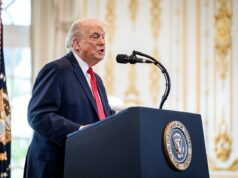
The president did, however, weigh in on the case after the mistrial—and his comments gave no indication that he was considering clemency.
Trump described the deaths as a “horrible tragedy” and said he expected Clancy to face consequences.
“I assume there’s going to be another trial,” Trump told reporters Friday. “There’ll be a price. It’s going to be a mental institution or jail or something.”
Clancy faces three counts of murder in connection with the Jan. 24, 2023, deaths of her children at the family’s Duxbury home. Her daughter Cora was 5, her son Dawson was 3 and her youngest son, Callan, was 8 months old.
Clancy has not denied killing the children. She pleaded not guilty by reason of a lack of criminal responsibility, with her attorneys arguing that she was experiencing severe postpartum psychosis and could not understand the wrongfulness of her actions.
Prosecutors rejected that defense and portrayed the killings as calculated and premeditated.
Pardon Request Faces Constitutional Roadblock
Although Reddington directed his appeal to Trump, the Constitution limits a president’s pardon authority to federal offenses. Clancy was charged in a Massachusetts court under state law, placing the case beyond the reach of a presidential pardon.
Any pardon involving Massachusetts charges would have to come through the state’s clemency system. Democratic Gov. Maura Healey holds the state pardon power with the consent of the Governor’s Council, according to the Massachusetts Secretary of the Commonwealth.
Neither Healey nor the Governor’s Council had been publicly reported as considering clemency for Clancy.
Defense Seeks Deal After 11-1 Split
Judge William Sullivan declared a mistrial on Sept. 4 after jurors deliberated for more than 38 hours without reaching a unanimous decision. Court notes indicated that the jury was divided 11-1, although the court did not formally disclose how the majority intended to vote.
Reddington has said the 11 jurors favored finding Clancy not criminally responsible and accused the lone holdout of refusing to apply the court’s reasonable-doubt instructions.
Before the mistrial was finalized, Clancy’s attorneys unsuccessfully asked the Massachusetts Supreme Judicial Court to intervene and require further questioning of the dissenting juror. The emergency petition was denied.
Reddington now hopes to avoid putting Clancy—and the children’s family—through another grueling trial.
He said Tuesday that he wants Plymouth County District Attorney Tim Cruz to reconsider the case after hearing weeks of testimony from medical experts, relatives and other witnesses.
Cruz has not announced whether prosecutors will pursue another trial. After the mistrial, he emphasized that his office remains focused on securing justice for Cora, Dawson and Callan.
Clancy is scheduled to return to court for a status conference on Sept. 29. A new trial could be held as soon as the fall, though prosecutors could also negotiate an agreement with the defense.


INSANITY PLEA – NOT UNDER A BIBLICAL GOVERNMENT!
Insanity exceptions are but another of the plethora of immoral consequences resulting from the constitutional framers spurning the Bible’s triune moral law (including its Criminal JUSTICE System, and its mandatory death penalty for murderers) as the law of the land.
For more on how the Bible’s integral triune moral law (the Ten Commandments and their respective statutes and judgments) applies and should be implemented today as the law of the land, see free online book “Law and Kingdom: Their Relevance Under the New Covenant” at bible versus constitution dot org. Go to our Online Book page and scroll down to title.
See also free online book “Thou shalt not kill,” the sixth in a series of ten free online books on each of the Ten Commandments and their respective statutes and civil judgments.
Also, free online book “Capital Punishment: Deterrent or Catalyst?”
Find out how much you really know about the Constitution as compared to the Bible. Take our 10-question Constitution Survey in the sidebar and receive a free copy of the 85-page “Primer” of “BL vs. USC.”
She may blow smoke up the world’s skirt, but she will have to face God’s judgment. My personal opinion is she will rot in prison for the rest of her miserable life.
She’s definitely a mental case but she DID know that what she did was wrong. Her lawyer is a mental case for believing that Trump would pardon her, even if he had the authority.
What Law school did he go to? Even a 1st year law student knows the president cannot pardon a state crime!