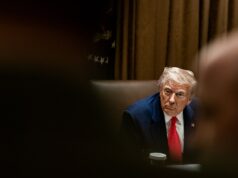


Karoline Leavitt says the administration should explain what it knows about recent disruptions affecting banks, airlines, and government systems, even as senior officials insist there is no evidence of a coordinated cyberattack.
Former White House press secretary Karoline Leavitt is urging President Donald Trump’s administration to communicate more directly with Americans following a series of technology failures that have disrupted banking, air travel, and government operations across the country.
Speaking Tuesday on Fox News’ “Fox & Friends,” Leavitt acknowledged that the outages have left her with some of the same questions facing ordinary consumers.
Now a Fox News contributor, Leavitt said she no longer receives classified intelligence briefings and cannot independently assess what federal officials know about the disruptions.
She said she has even found herself checking her bank account with concern.
“What’s happening?” Leavitt asked during the interview, describing the uncertainty surrounding the incidents.
Her recommendation was straightforward: The administration should explain what investigators have established, what remains unknown, and whether Americans have reason to fear additional disruptions.
The remarks come as Vice President JD Vance and Homeland Security Secretary Markwayne Mullin have sought to reassure the public that the United States is not experiencing a coordinated attack.
The White House has also emphasized that investigators have found no evidence linking the failures to malicious cyber activity.
Leavitt did not accuse the administration of concealing information or suggest that the outages were connected. Instead, she argued that clearer public communication could help prevent uncertainty from turning into unnecessary alarm.
Leavitt says Americans deserve direct answers
During Tuesday’s interview, co-host Ainsley Earhardt asked Leavitt how she would reassure Americans after several days of disruptions involving major technology companies and financial institutions.
Leavitt explained that her perspective has changed since leaving the administration.
Without access to government briefings, she said, she now depends on public information much like other Americans.
“I’m checking my bank account with a little bit of worry,” she acknowledged.
She then emphasized the importance of transparency.
Leavitt suggested that the White House should make a more visible effort to explain the situation rather than relying exclusively on scattered interviews by senior officials.
She specifically referenced Vance’s Monday appearance with Laura Ingraham, during which the vice president said the administration did not anticipate an imminent national crisis.
Leavitt said that message should reach a broader audience.
She also recommended that Trump, who is currently traveling in Asia, or another senior administration representative address the public directly.
Her concern was not limited to the technical failures themselves.
Leavitt said discussion of the outages had spread across social media, particularly TikTok, where speculation about their causes was contributing to public anxiety.
She described hearing similar questions from friends who wanted to know whether the incidents represented something more serious.
The former press secretary’s central argument was that public reassurance becomes more effective when officials explain the evidence behind their conclusions.
Watch: Leavitt Discusses White House Transparency and the Recent Outages
Vance says administration sees no looming crisis
Leavitt’s comments followed an interview in which Vance attempted to address concerns about the stability of essential American infrastructure.
Speaking to Fox News on Monday, the vice president said the administration was preparing for potential emergencies but had not identified an approaching national crisis.
“We do not see some crisis coming down,” Vance said.
He acknowledged that friends had asked whether they should begin stockpiling supplies or constructing emergency shelters.
His response, he explained, was that Americans did not need to take such extraordinary measures based on the available information.
Vance also discussed the challenges posed by aging infrastructure.
He noted that some critical systems depend on decades-old technology that must be maintained through upgrades, repairs, and temporary solutions.
Those systems can be difficult to modernize because replacing them may require substantial federal investment and careful coordination to avoid interrupting essential services.
The vice president’s remarks offered reassurance but did not establish a single technical explanation for the recent outages.
Banks, airlines, and Microsoft report major disruptions
The concerns Leavitt addressed developed after several prominent technology failures occurred within days of one another.
Last Thursday, Microsoft experienced an outage that affected Outlook, Teams, and other widely used services.
The disruption interfered with workplace communications and business operations before the company restored service.
On Friday, a Federal Aviation Administration communications failure triggered a nationwide ground stop.
The incident canceled thousands of flights and disrupted travel plans across the country.
Investigators subsequently focused on a possible router problem involving equipment at an Arkansas facility.
Monday brought another wave of complaints, this time involving major financial institutions.
JPMorgan Chase customers reported problems accessing accounts and completing transactions, while customers of Bank of America, Wells Fargo, and other institutions also reported difficulties.
Chase attributed its problems to a software bug.
Some customers reported difficulties using Zelle, the electronic payment network that connects participating financial institutions.
United Airlines also experienced a separate, relatively brief systems disruption Monday that delayed departing flights.
Although the incidents occurred close together, the available evidence does not establish that they were caused by the same technical failure.
NSA network failure adds to public concerns
Tuesday brought another development when reports emerged that a classified communications network operated by the National Security Agency had experienced a significant disruption.
The affected system supports internal communications involving sensitive intelligence information.
The outage prompted adjustments to employee reporting schedules at the agency’s Fort Meade, Maryland, headquarters.
Later Tuesday, the NSA acknowledged that some internal systems had experienced temporary degradation during scheduled maintenance.
The agency said its mission-critical capabilities remained operational and that redundant infrastructure helped preserve essential functions.
Its statement provided a more specific explanation of the circumstances surrounding the disruption than was available when initial reports emerged.
However, it did not establish that the NSA problem was related to any of the earlier banking, aviation, or technology outages.
Homeland Security secretary rejects cyberattack theory
Homeland Security Secretary Markwayne Mullin has also addressed concerns that the incidents might represent a coordinated attack against American infrastructure.
During media appearances Monday and Tuesday, Mullin said federal officials had not identified evidence of malicious cyber activity connecting the disruptions.
He told CNBC on Tuesday that investigators were not seeing indications that the country was under attack.
Mullin suggested that some failures could reflect the difficulties of integrating newer technology with older computer systems.
However, that broader explanation should not be interpreted as a verified technical finding.
The specific causes of the incidents remain matters for the organizations and investigators responsible for examining them.
The secretary also emphasized that federal authorities were responding to the disruptions and that essential national security capabilities remained available.
Senior Deputy White House press secretary Lauren Bis offered similar reassurance during a Tuesday appearance on Newsmax.
Bis said the administration had not identified evidence of a cyberattack and pointed to the federal response to the FAA ground stop.
She also highlighted the administration’s request for additional funding to modernize air traffic control infrastructure.
Questions remain about infrastructure and federal oversight
The outages have also renewed debate over the condition of American technology infrastructure.
Following the FAA disruption, Transportation Secretary Sean Duffy called for substantial additional federal funding to modernize air traffic control systems.
The administration has sought approximately $50 billion for improvements.
But lawmakers have raised questions about how existing modernization funds have been used.
Congress approved $12.5 billion for air traffic control improvements last year, and Senate Majority Leader John Thune has sought more information about the administration’s additional funding proposal.
The dispute illustrates the challenges involved in replacing older infrastructure while maintaining systems that millions of Americans depend on every day.
Modernization can reduce some risks, but software upgrades and equipment replacements can themselves introduce technical problems if they are not properly tested and managed.
The NSA’s reported maintenance-related disruption is a reminder that even highly secure government networks are not immune to operational failures.
Meanwhile, House Democratic Leader Hakeem Jeffries has called for administration officials to brief lawmakers about the recent outages.
Leavitt urges a coordinated public message
Leavitt’s proposed response focused on communication rather than a new security measure.
She praised Duffy and Mullin for addressing reporters during the aviation disruption and suggested the White House should take a similar approach to the broader series of incidents.
She also acknowledged that emergency preparedness is generally sensible while emphasizing that Vance had not identified an approaching crisis.
The former press secretary did not recommend panic buying, extraordinary financial withdrawals, or other drastic responses.
Instead, she encouraged officials to provide clear explanations from people familiar with the relevant systems and investigations.
That approach could include distinguishing confirmed technical failures from unverified theories, explaining which services have been restored, and identifying any remaining risks.
As of Tuesday afternoon, the administration continued to maintain that the incidents did not represent a coordinated cyberattack.
But the number of disruptions has made public communication an increasingly prominent issue.
For Leavitt, the central concern is that Americans should not have to rely on social media speculation to understand problems affecting essential services.
Her remarks underscore the difference between assuring the public that there is no known crisis and explaining why officials have reached that conclusion.
Both may be necessary to restore confidence after a week in which banking, travel, communications, and government technology have experienced unusually visible failures.
READ NEXT: Hackers Target Federal Election Agency As Midterm Showdown Nears