
Hours after a dramatic U.S. military operation in Venezuela that led to the capture of President Nicolás Maduro, President Donald Trump sharply escalated his rhetoric toward other foreign governments, criticizing Colombia’s president and reviving his long-standing idea of acquiring Greenland.
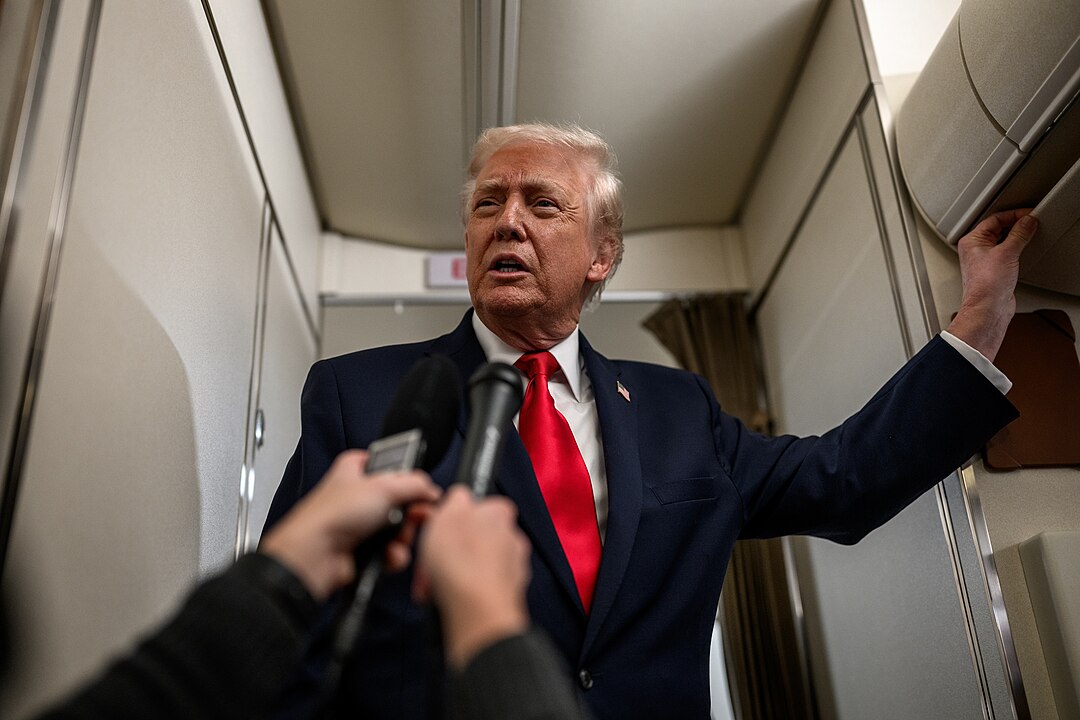
Trump, speaking to reporters aboard Air Force One, was initially responding to questions about a U.S. military operation in Caracas that resulted in the capture of Venezuelan leader Nicolás Maduro and his wife, Cilia Flores, as well as the future of Venezuela, when he shifted his focus to another South American country.
“Columbia’s very sick too, run by a sick man who likes making cocaine and selling it to the United States. And he’s not going to be doing it very long. Let me tell you,” Trump said.
When pressed by a reporter to clarify his remarks, Trump claimed that Gustavo Petro has “cocaine mills and cocaine factories.”
“So there will be an operation by the U.S. in Colombia?” the reporter asked.
“It sounds good to me,” Trump responded.
The comments marked an unusually direct threat to a longtime U.S. partner, officially designated a Major Non-NATO Ally, and drew swift condemnation from Bogotá.
Colombia Condemns Remarks
Colombia’s government rejected Trump’s statements, calling any threat of force against an elected leader a violation of international law and national sovereignty. Officials emphasized that disagreements over narcotics trafficking do not justify military rhetoric against a democratic ally.
Analysts told the Associated Press that while no formal policy change has been announced, Trump’s remarks risk destabilizing diplomatic relations with a key U.S. security and trade partner. Colombia has long collaborated with Washington on counter-narcotics efforts, even as cocaine production has surged in recent years.
The episode follows Trump’s intensifying criticism of Latin American governments he says have failed to curb drug trafficking and migration.
Trump Renews Greenland Focus
Amid the fallout from the Venezuela operation and the Colombia comments, Trump also renewed his interest in Greenland, the Arctic territory governed by NATO ally Denmark.
Trump has repeatedly argued that U.S. control of Greenland is vital to American strategic interests. Both Greenlandic and Danish leaders have firmly rejected the idea, saying the territory is not for sale.
The White House has appointed Louisiana Gov. Jeff Landry as a special envoy to Greenland, with an informal mandate to strengthen ties. Danish officials have criticized the move as an unacceptable challenge to Denmark’s territorial integrity.
While a formal acquisition remains highly unlikely because of legal and diplomatic barriers, Trump’s renewed focus on Greenland has reignited debate over Arctic security and great-power competition.
Echoes of the Monroe Doctrine
Trump has not formally announced a new Monroe Doctrine, but his rhetoric has revived comparisons to the 19th-century policy that treated the Western Hemisphere as a U.S. sphere of influence.
Throughout his political career, Trump has noted that China and Russia are expanding their footprint in Latin America through ports, telecommunications, and energy projects. At the same time, he has argued for withdrawing from overseas wars while taking a harder line closer to home.
Supporters often frame this approach as “America First” realism: resisting foreign powers in the hemisphere while avoiding large-scale military commitments elsewhere. Critics counter that it risks justifying intervention and could lead to a new generation of implacable military campaigns under a different label.
Divisions Inside the MAGA Coalition
Although largely supportive, reactions among Trump’s supporters are not uniform.
Populist nationalists within the MAGA movement strongly support a Monroe-style approach, viewing it as common-sense security and a way to push China out of the region without policing the entire world.
Libertarian-leaning and anti-interventionist conservatives are more skeptical. While they favor restraint abroad, they warn that asserting hemispheric dominance could lead to new interventions closer to home.
Evangelical and values-based conservatives are divided, often supporting resistance to leftist regimes such as Venezuela and Cuba but expressing concern about U.S. backing of governments with poor human rights records, as has been the case in Latin America.
A smaller group of traditional hawks aligned with MAGA favors a tougher posture, particularly to counter China, even if it risks deeper U.S. involvement overseas as domestic problems continue to mount.
The Bottom Line
In the aftermath of the Venezuela operation, Trump has adopted a more confrontational tone toward neighboring governments and revived controversial territorial ambitions abroad. Together, they signal a foreign policy posture that emphasizes regional dominance, skepticism of global institutions, and unilateral U.S. leverage — a combination that has unsettled allies and reopened debates over America’s role in its own hemisphere.
As Trump allies debate whether this approach reflects strategic restraint or intervention by another name, the administration’s next steps will determine whether the rhetoric translates into lasting policy shifts.
Trump then shifted his attention to Greenland, where he once again reiterated an interest in acquiring the Danish territory.
“We need Greenland from the standpoint of national security, and Denmark is not going to be able to do it,” Trump said.
“We need Greenland from a national security situation. It’s so strategic,” he added.
Danish Prime Minister Mette Frederiksen sharply rebuked Trump’s comments, urging him to cease what she described as baseless threats against a close ally.
“The Kingdom of Denmark – and thus Greenland – is part of NATO and is thus covered by the alliance’s security guarantee. We already have a defense agreement between the Kingdom and the USA today, which gives the USA wide access to Greenland. And we have invested significantly on the part of the Kingdom in the security of the Arctic,” said Frederiksen in a press release.
“I would therefore strongly urge that the U.S. stop the threats against a historically close ally and against another country and people who have said very clearly that they are not for sale,” Frederiksen added.