
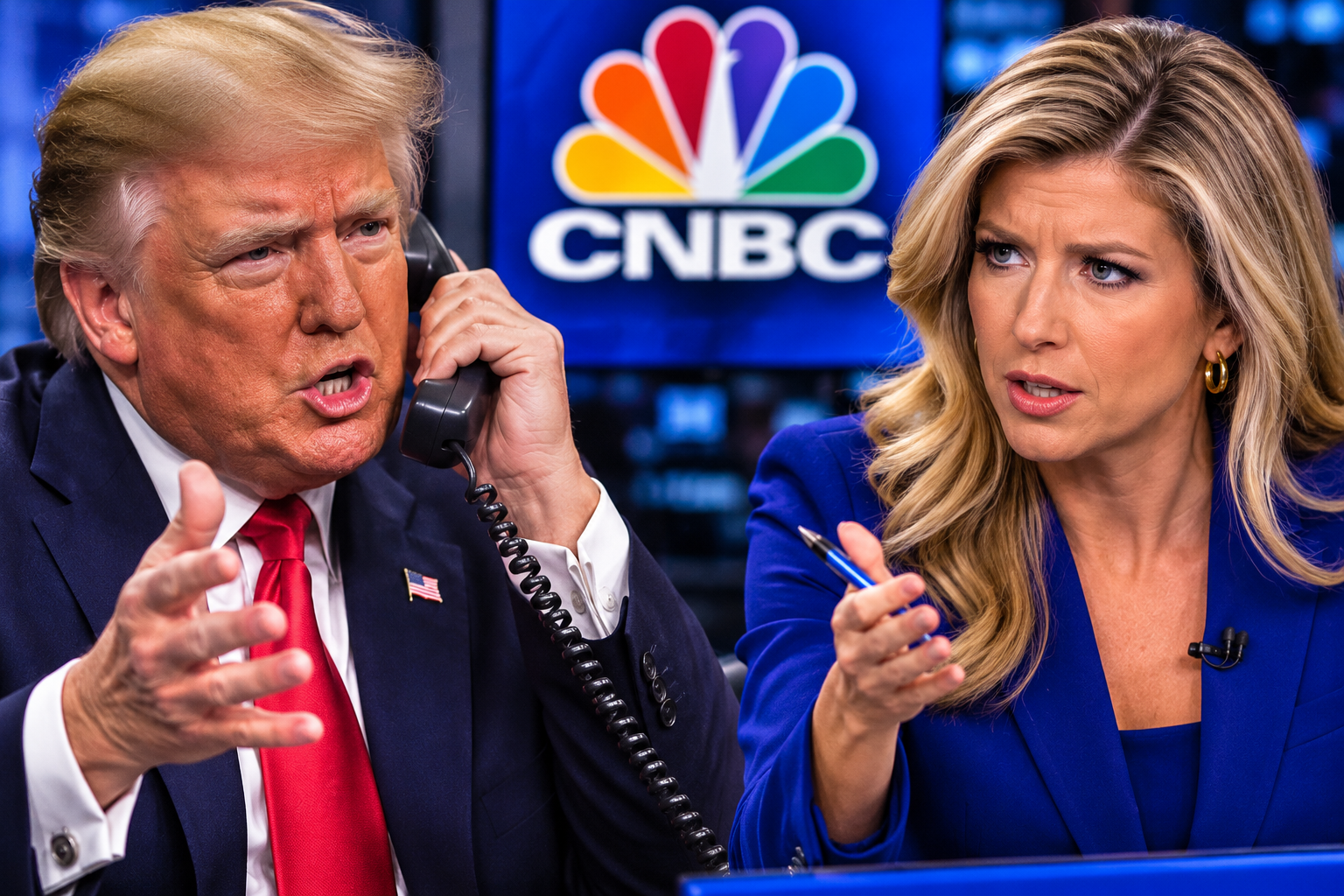
President Donald Trump chose CNBC over Fox News for a live call-in Monday to discuss the reinstatement of Jensen Huang as Nvidia’s CEO, and anchor Sara Eisen made him earn every minute of airtime. “Why is the president of the United States getting involved in corporate governance of who should run a public company?” Eisen pressed, according to Mediaite — the kind of question that tends to produce either a revealing answer or a revealing nonanswer. The extended interview on “Squawk on the Street” generated multiple viral moments and reopened questions about presidential influence over corporate governance, information management and which networks get White House access on market-moving stories.
The backdrop: A corporate bombshell with White House fingerprints
The call-in followed Nvidia’s formal announcement before Monday’s market open that its board of directors voted unanimously to restore Huang as president, chief executive and board director. The reversal, documented in an 8-K filing with the Securities and Exchange Commission, came just 11 days after Huang resigned amid revelations of extramarital affairs, including one with a woman U.S. intelligence officials suspected of spying for China. On air, Trump discussed the scandal in characteristically provocative fashion, claiming Huang had been “exonerated” and “did nothing wrong” while taking credit for speaking directly and indirectly with Nvidia’s board to broker his return.
While Nvidia confirmed in its statement that input from “senior levels of the United States government” assured the board that Huang’s return posed no national security risk, the chipmaker noted that a special committee of independent directors is continuing its investigation into whether Huang was targeted by a foreign intelligence effort. Separately, the SEC and the Justice Department have ongoing probes touching on the company’s disclosures and chip-smuggling allegations, and Huang is scheduled to testify before Congress next month. Direct presidential intervention in the leadership of a publicly traded company with a multi-trillion-dollar market capitalization is far from routine, and the immediate 33% surge in Nvidia’s stock underscored how closely Wall Street tracks both corporate filings and White House signals.
Eisen’s line of questioning
Eisen, a co-host of “Squawk on the Street” and “Money Movers,” is a business journalist by training, and her questioning reflected that orientation. Rather than treating the call as a political victory lap, she zeroed in on the structural question: What business does the Oval Office have influencing who sits in the corner office of a company whose share price moves global indexes? The question is straightforward, but it is the kind of follow-up that requires a host to treat a presidential phone call as a journalistic opportunity rather than a programming gift — a distinction that separates interviewing from access-granting.
Fox News watches from the sideline
A telling media-dynamics detail unfolded shortly after the board’s announcement, when Fox News anchor Bill Hemmer publicly urged Trump on “America’s Newsroom” to call Fox instead and explain why he pressured Nvidia to reverse its decision — only to be passed over in favor of CNBC. The dynamic is a revealing window into White House media strategy: When the story is a market-moving corporate saga, the audience Trump wants is not the Fox News base but CNBC’s investor class. It is also a reminder that access journalism is a two-way transaction, and the terms of trade can shift without warning.
The broader media consequence
The episode raises overlapping questions that no single interview can resolve. First, there is the corporate-governance question: Presidential jawboning and behind-the-scenes lobbying over CEO appointments have the potential to move share prices, draw bipartisan congressional scrutiny and blur the line between persuasion and coercion. Second, there is the information-management question: Trump’s decision to give the interview to CNBC rather than a friendlier venue suggests a deliberate audience-targeting strategy that media critics should track rather than dismiss. And third, there is the access question: When a president calls one network and not another, the network that gets the call gains journalistic credibility, and the one that doesn’t is left reacting to someone else’s footage. Eisen, to her credit, used the access to press rather than to flatter — a choice that is easier to praise in principle than it is to sustain in practice when the next big call-in is on the line.
READ NEXT: FBI Probes Hack Of Crime Database Used For Gun Checks