George Santos did not stretch the truth. He did not fudge numbers. He did not run afoul of technicalities in campaign finance law. He stole, lied, and exploited vulnerable people for personal and political gain. These were not victimless crimes, nor were they victimless lies. They were part of an elaborate scheme to build a fraudulent political career on a foundation of stolen funds, fictitious wealth, and unearned trust. It is time conservatives stop equivocating. If George Santos were not a thief, he might have been a talented, even promising political figure. But he is a thief, and a spectacularly cynical one at that. He stole from the old and the sick, he stole from donors, he stole from the US taxpayer. He is not a misunderstood maverick or a casualty of overzealous prosecution. He is a con man, and a criminal.
Let us begin, as the law did, with the false image he built. Santos, through deliberate lies to the Federal Election Commission and his own party, fabricated a story of fundraising success. In early 2022, he claimed to have raised over $250,000 in a single quarter from third-party donors, including a personal loan of $500,000 to his own campaign. These were lies. He did not have the money. He did not receive these donations. But this mirage of financial viability was just enough to secure his acceptance into the National Republican Congressional Committee’s “Young Guns” program, granting him financial, logistical, and strategic support. The GOP, believing they were backing a legitimate, self-sustaining candidate, diverted valuable resources to a fraud.
But Santos did not merely fake donor support. He invented donors. Using the identities and financial information of real people, Santos charged their credit cards repeatedly, funneling the proceeds into his campaign, other political committees, and even his own bank account. Nearly a dozen people were victimized, including individuals least capable of defending themselves. One woman, suffering from brain damage, had thousands of dollars withdrawn without her consent. Two elderly men in their eighties, each suffering from dementia, had their identities stolen and their cards charged. These were not passive accounting errors or clerical mistakes. These were acts of intimate, cold exploitation. Santos knew these people, spoke with them, thanked them for their support, and then used their vulnerability against them.
In one egregious instance, a donor who had already given the legal maximum found his credit card charged an additional $15,800 without authorization. Santos disguised this theft by attributing the funds to fabricated family members in his FEC reports, a maneuver that allowed him to continue the ruse while avoiding contribution limits. In another, he charged $12,000 to a donor’s account and deposited the majority into his personal bank. From there, it funded clothing, cosmetics, credit card bills, and gambling trips. The campaign, the candidacy, the public service, all were secondary to a lifestyle of luxury paid for by other people’s money.
Perhaps the most hypocritical of Santos’s frauds involved the pandemic. In 2020, he applied for and received over $24,000 in unemployment benefits from the state of New York. At the time, he was gainfully employed as a regional director at a Florida-based investment firm, earning over $120,000 a year. He did not miss a paycheck. He was not laid off. He did not qualify. And yet, each week, he falsely certified his jobless status, drawing taxpayer-funded aid designed for those hit hardest by COVID-19, the unemployed, the underemployed, the financially desperate. In an act of gall that would be laughable if it were not so despicable, Santos later sponsored legislation in Congress to crack down on pandemic unemployment fraud. The man who stole from the system claimed he would reform it.
Nor did the deception stop there. Santos lied on his congressional financial disclosures, the forms meant to ensure transparency for public officials. He claimed to have earned $750,000 in salary from a private company that paid him nothing. He reported receiving $1 to $5 million in dividends that never existed. He declared hundreds of thousands in bank holdings, when in fact his accounts were often in the low thousands, if not lower. In reality, his only actual income came from the investment firm and the unemployment checks he falsely obtained. The lies were not incidental. They were comprehensive, deliberate, and aimed at creating an illusion of wealth and competence.
Even more brazenly, Santos fabricated an independent expenditure group, a supposed political action committee called RedStone Strategies. He solicited two donors for $25,000 each, promising that the funds would be used for media buys and campaign efforts. They were not. Santos transferred the money into accounts he controlled and spent it on Ferragamo, Hermes, Botox, and credit card bills. This was not merely unethical. It was embezzlement. It was theft. It was a fraud perpetrated with full knowledge and intent.
In total, Santos stole or misappropriated approximately $578,750. The court ordered him to pay $373,749.97 in restitution and to forfeit an additional $205,002.97. These numbers were not speculative. They were calculated against real losses to real people, individuals whose credit was damaged, whose money was siphoned away, whose trust was obliterated. Santos’s 87-month sentence, or just over seven years, was not an outlier in the federal system. It was a typical penalty for this kind of sprawling, malicious financial fraud. Defendants with no political profile, who defrauded the government or private individuals out of hundreds of thousands of dollars, routinely receive similar sentences. That Santos was a congressman did not result in his being singled out. If anything, it spared him scrutiny longer than he deserved.
There is no serious argument for clemency here. Clemency is for excess, for injustice, for punishment that outstrips wrongdoing. Clemency is not for grifters who fake their way into office by stealing from pensioners and pandemic relief funds. One does not defend George Santos by invoking freedom, fairness, or limited government. To the contrary, every dollar Santos stole weakened the legitimacy of our electoral system, diverted support from legitimate candidates, and degraded the moral clarity conservatives must offer in a dishonest age. The true conservative position is to say plainly: this man is a crook.
Yes, Santos was charismatic. Yes, he had a knack for commanding attention. And yes, in another life, with honesty and principle, he might have served well. But we do not excuse embezzlement because the embezzler is clever. We do not overlook theft because the thief is funny. Our movement has spent decades insisting that character matters. If that is still true, then George Santos is not a man to be platformed or pitied. He is a cautionary tale.
Some will argue that Santos’s sentence was harsh. Perhaps. But that is not a reason to pardon him. It is a reason to scrutinize sentencing guidelines for all non-violent financial offenders. Santos should be treated like any other fraudster, no worse, no better. And by that measure, he has been.
Others say we should forgive him because the media was against him. But the media is against every Republican. What makes our side different, or should, is our insistence on personal responsibility. George Santos did what he did. He admitted it. He pled guilty. He is being punished in accordance with the law. He is not a martyr. He is a criminal.
Those who now seek to rebrand Santos as a political prisoner or conservative folk hero are doing damage not only to the movement, but to the truth. And that matters. For if we cannot call theft what it is, if we cannot call fraud what it is, if we cannot reject the normalization of criminality in our own ranks, then we are not a movement of principle. We are just another racket.
If you enjoy my work, please consider subscribing: https://x.com/amuse.
READ NEXT: Unstable Leader Pushes Reckless Nuclear Gamble








Time Magazine Denies Nazi-Era Echo In Trump Cover Image
Photographer’s nod to controversial 1963 portrait fuels speculation.
WASHINGTON — Time magazine is facing backlash over its latest cover photo of President Donald Trump, after online critics and media outlets pointed out a visual similarity to a portrait the magazine used 60 years ago featuring convicted Nazi industrialist Alfried Krupp.
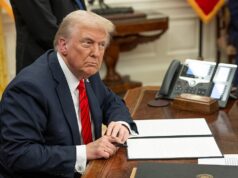
The image, shot by photographer Stephen Voss, shows Trump looming over the Resolute Desk in the Oval Office, dramatically lit from below. According to a report by The Daily Beast, the composition bears a striking resemblance to a 1963 photo of Krupp taken by the Jewish photographer Arnold Newman — a photograph widely studied for its chilling and deliberate framing of a man convicted of facilitating some of history’s most heinous crimes.
The Historical Background
Alfried Krupp von Bohlen und Halbach inherited control of the Krupp industrial empire from his father, Gustav Krupp, who had supported Adolf Hitler and helped finance the Nazis’ rise to power. Under Alfried’s leadership during World War II, Krupp factories supplied the Third Reich with armaments and heavy machinery vital to its war efforts, including tanks, submarines, and artillery.
After Germany’s defeat, Krupp was tried by the U.S. Military Tribunal in the Nuremberg Krupp Trial (officially The United States of America vs. Alfried Krupp, et al.), which took place from 1947 to 1948.
He was convicted primarily for:
He was sentenced to 12 years in prison and had his property confiscated.
Newman’s portrait of Krupp is iconic in photographic circles. In the image, Krupp is seated at a desk under harsh lighting, his posture and setting portraying him as both powerful and ominous, reminiscent of a devil or a fiendish creature. Critics argue that Time’s Trump cover bears such a resemblance to Newman’s portrait that it cannot be a coincidence.
Photographer Reacts on Social Media
Voss, the photographer behind the Trump image, has not publicly commented on the comparison. However, he reportedly “liked” social media posts highlighting the resemblance — a move many interpret as a subtle acknowledgment of influence.
A spokesperson for Time magazine rejected the claims outright, telling The Daily Beast that “any suggestion of an intentional reference is completely untrue.”
Why This Matters
The controversy cuts across political and cultural lines:
What’s Still Unknown
A Larger Media Question
This episode adds fuel to a long-running debate over how the media portrays political leaders — especially those it opposes editorially. It also highlights the power images have in shaping public perception.
In an era when symbolism is parsed as carefully as language, even a magazine cover can carry profound consequences.
Sponsored
JD Vance has a question for YOU! The only thing at the forefront of his mind is serving America-loving patriots. What are the most important issues facing our great country today? [Respond to the Vice Presidential Survey HERE]