

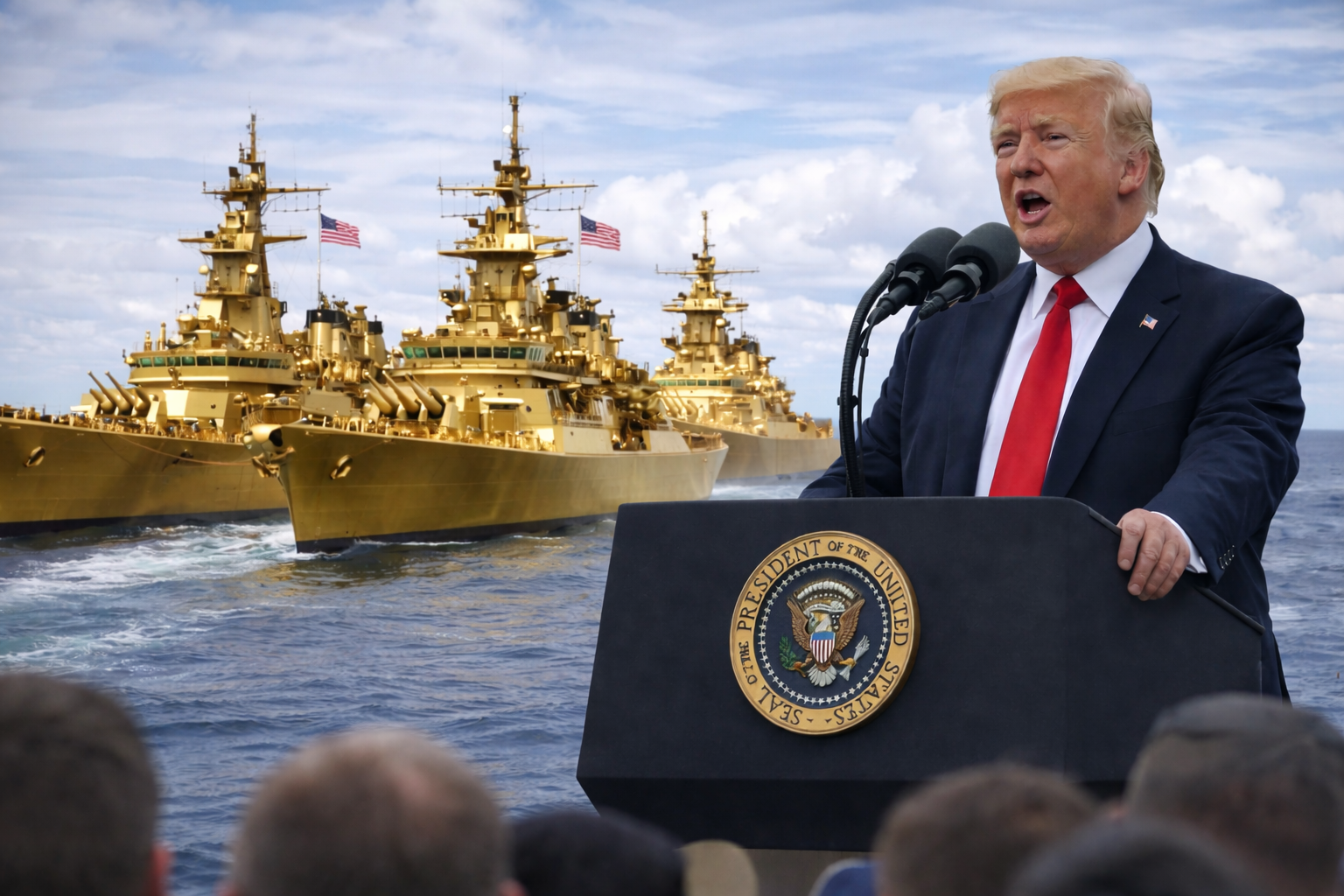
WASHINGTON — President Donald Trump on Monday announced plans for a new class of U.S. Navy warships, reviving the battleship concept roughly 85 years after it was eclipsed by the aircraft carrier as the world’s dominant naval platform.
The proposal is part of a broader shipbuilding initiative Trump has branded the “Golden Fleet.”
Trump made the announcement from his Mar-a-Lago estate in Florida, flanked by senior national security officials, including War Secretary Pete Hegseth, Secretary of State Marco Rubio, and Navy Secretary John Phelan.
A New Naval Push
Under the proposal, the Navy would begin construction on two so-called “Trump-class” battleships, with the potential to expand the fleet to as many as 20 to 25 ships over time.
“These will be the largest battleships in the history of our country — the largest in the history of the world,” Trump said, arguing that the United States needs a stronger and more visible naval presence to deter adversaries.
Trump described the ships as larger, faster, and more powerful than any previous U.S. warship, though few technical details were released during the announcement.
What These Ships Would Likely Be
The idea of building new battleships — a vessel type largely phased out after World War II — immediately raised questions within defense circles.
Traditional battleships, such as the Iowa-class, were centered on heavy guns and thick armor. They fell out of favor as aircraft carriers, submarines, and missile-equipped surface combatants proved more effective in modern warfare.
Retired naval officers familiar with early discussions say the proposed vessels would likely resemble oversized surface combatants rather than classic battleships. Instead of large-caliber guns, they would predominantly feature advanced missile systems, air defense capabilities, and modern sensors.
The Hill continues:
The new vessels will mark an upgrade to the Navy’s Arleigh Burke-class destroyers.
The first ship in the so-called Trump-class will be the USS Defiant, which will carry the nuclear-armed sea-launched cruise missile, according to Phelan.
The Navy secretary said the Defiant will be the “largest, deadliest and most versatile and best looking warship anywhere on the world’s oceans.”
As outlined by Navy officials, the Golden Fleet concept could also include up to 50 support and auxiliary ships to sustain the larger force.
Trump said one of the proposed new warships could be completed in about 2.5 years.
Cost and Capacity Concerns
Defense analysts caution that building a new class of large U.S. Navy warships would present significant industrial and budgetary challenges.
Preliminary estimates suggest the vessels could displace between 15,000 and 20,000 tons and cost billions of dollars per ship. Meeting those requirements would likely force U.S. shipyards to expand facilities and hire additional workers capable of handling construction at that scale.
Shipbuilding capacity is already under strain from ongoing submarine and aircraft carrier programs, raising concerns that adding another major initiative could lead to delays or cost overruns.
The U.S. Navy has not built a battleship since the 1940s and decommissioned its last battleship in 1992. Critics note that many of the missions once assigned to battleships are now fulfilled by other platforms without the need to construct massive surface combatants.
Arleigh Burke-class guided missile destroyers and cruisers, for example, perform air defense, anti-submarine warfare, and land-attack missions using Tomahawk cruise missiles. These ships feature modern designs that proponents argue offer greater survivability than a large, highly visible battleship.
Aircraft carriers remain the Navy’s primary power-projection assets, capable of launching aircraft to strike targets hundreds of miles inland, a reach that far exceeds the range of naval guns — including railguns.
Analysts also point to advances in precision-guided missile technology, which allow a variety of platforms to deliver long-range firepower without the risks associated with deploying a single, large vessel.
Strategic Backdrop
The announcement comes as the U.S. military adjusts its global posture amid rising tensions with Venezuela and other regions, and as China continues to expand its navy at a rapid pace.
Critics argue that resources would be better spent on carrier strike groups, submarines, and dispersed missile platforms rather than reviving the battleship concept. Supporters counter that a larger and more formidable surface fleet could strengthen deterrence and signal U.S. resolve.
For now, key questions about design, cost, and strategy are still unresolved.


MORE FIRE POWER FOR THE INTERNATIONAL BANKERS’ WAR MACHINE for which more of America’s young men and women will be sacrificed as cannon fodder!
“…The power to declare war is a serious responsibility. Why were the framers so vague in defining the parameters of war and the conditions under which it could be declared? Section 8, Clause 11 is the only place of significance where warfare is mentioned in the Constitution. Little wonder this power has been abused. Luther Martin [one of Maryland’s delegates to the Constitutional Convention] protested:
‘…the congress have also a power given them to raise and support armies, without any limitation as to numbers, and without any restriction in time of peace. Thus, sir, this plan of government, instead of guarding against a standing army, that engine of arbitrary power, which has so often and so successfully been used for the subversion of freedom, has in its formation given it an express and constitutional sanction….’40….
“Because the framers provided no Biblical parameters, unbiblical warfare has been the rule ever since. Following is a list of the countries bombed by the United States since World War II:
China: 1945-46; 1950-53
Korea: 1950-53
Guatemala: 1954; 1967-69
Indonesia: 1958
Cuba: 1959-60
Vietnam: 1961-73
Congo: 1964
Laos: 1964-73
Peru: 1965
Cambodia: 1969-70
Granada: 1983
Libya: 1986; 2011
El Salvador: 1980s
Nicaragua: 1980s
Panama: 1989
Iraq: 1991-2001; 2003-09
Sudan: 1998
Afghanistan: 1998; 2003-09
Yugoslavia: 1999.
“From 1945 to the present, the United States has bombed nineteen different countries under the guise of defending America’s sovereignty and promoting democracy. But America is none the better for it, and not one of these countries has become a legitimate democracy – not that this would be anything to celebrate. Something is amiss. Wars fought for political gain or financial profit can only be classified as ungodly acts of aggression….”
For more, see Chapter 4 “Article 1: Legislative Usurpation” of free online book “Bible Law vs. the United States Constitution: The Christian Perspective” at bible versus constitution dot org. Click on the top entry on our Online Book page and scroll down to Chapter 4.
Find out how much you really know about the Constitution as compared to the Bible. Take our 10-question Constitution Survey in the sidebar and receive a free copy of the 85-page “Primer” of “BL vs. USC.”
I see no problem with updating our ships. They are old and new ones are needed. But leave it to democrats to complain. They never have answers just violence