
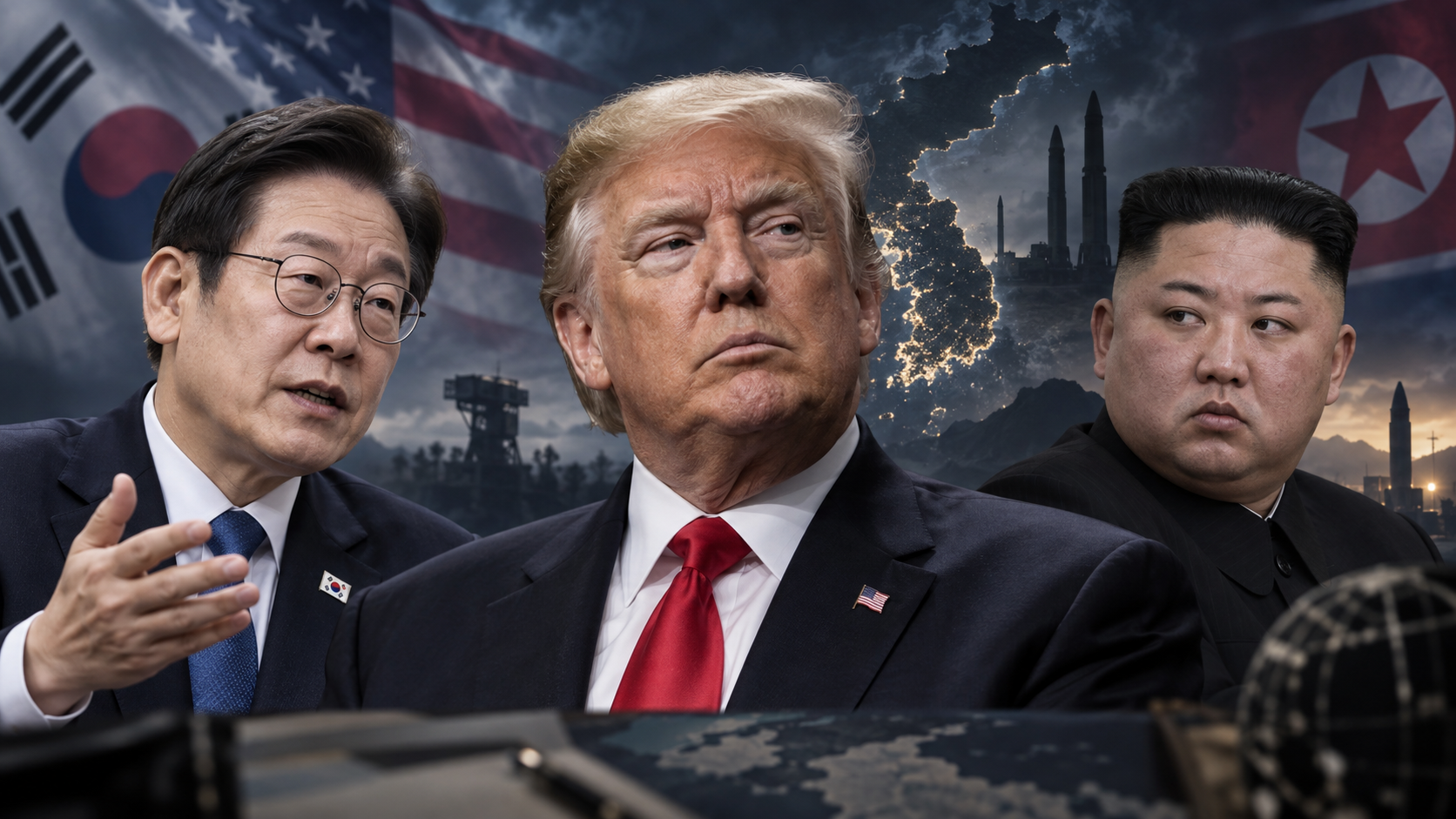
South Korean President Lee Jae Myung is publicly pressing President Donald Trump to consider easing sanctions on North Korea — a high-stakes gamble aimed at stopping Kim Jong Un from adding more nuclear weapons to his growing arsenal.
Lee argued that demanding complete denuclearization before offering Pyongyang anything in return has produced a dangerous stalemate. In an interview with The New York Times, he proposed trading some sanctions relief for a verified halt to North Korea’s development of additional nuclear weapons and intercontinental ballistic missile technology, The Hill reported.
“Aiming for denuclearization under the current circumstances guarantees that nothing will be accomplished,” Lee told the Times.
The South Korean leader said a freeze could open the door to reciprocal concessions, build trust and eventually persuade the North to begin reducing its stockpile. His pitch amounts to a phased approach: stop the growth of the arsenal first, then seek reductions and, ultimately, dismantlement.
But it would also require Trump to decide whether sanctions relief could bring Kim back to the negotiating table — or merely reward a regime that has repeatedly advanced its weapons programs while talks remained frozen.
Lee Warns The Clock Is Ticking
Lee framed the proposal as a response to an increasingly urgent threat. He said South Korean estimates indicate North Korea may now be able to produce an additional 10 to 20 nuclear weapons each year.
“Once it believes it has accumulated enough nuclear weapons and missiles to guarantee its survival, it will be tempted to export them to make money,” Lee told the Times. “That will be a truly dangerous moment.”
The warning comes as Pyongyang continues to demonstrate new military capabilities. North Korea said this week that it tested a new hypersonic weapon designed to maneuver at low altitude and evade missile defenses, according to the Financial Times. The test added fresh pressure to diplomatic efforts by both Trump and Lee.
Kim has also hardened his public position. Earlier this year, he described North Korea’s nuclear force as an “irreversible” shield and tied it directly to the regime’s survival, the Financial Times reported. Pyongyang has meanwhile drawn closer to Russia and China, giving it economic and diplomatic alternatives that could blunt Washington’s leverage.
Trump’s Personal Diplomacy Faces A New Test
Trump met Kim three times during his first term, including summits in Singapore and Hanoi and a meeting at the Korean Demilitarized Zone. The diplomacy produced dramatic images and an exchange of personal letters, but it did not deliver a lasting agreement to dismantle North Korea’s nuclear program.
Trump has nevertheless signaled that he remains open to another meeting. Lee has embraced that possibility, saying earlier this month that South Korea should help create the conditions for renewed U.S.-North Korea talks. He credited Trump’s outreach with creating “at least some possibility for a change” on the peninsula, according to The Korea Herald.
Trump also ordered the annual U.S.-South Korean Ulchi Freedom Shield military exercise shortened in August, a move intended to reduce hostility and encourage diplomacy. North Korea did not respond by returning to talks and instead continued weapons tests and public criticism of the United States.
That history underscores the central risk in Lee’s proposal: sanctions could be relaxed before the United States has proof that Kim intends to move beyond a temporary freeze. Supporters of a phased deal argue that waiting for an all-at-once surrender allows the arsenal to grow unchecked. Skeptics warn that Pyongyang could pocket concessions, preserve its existing weapons and later abandon negotiations.
Washington And Seoul Still Demand Denuclearization
Lee’s push does not formally abandon the goal of a nuclear-free North Korea. His government describes the freeze as the first stage of a longer process, not the final destination.
That distinction was reinforced Monday, when Secretary of State Marco Rubio joined the foreign ministers of South Korea and Japan in reaffirming their “resolute commitment” to the complete denuclearization of North Korea. The three governments also called on Pyongyang to resume dialogue and backed continued efforts to block revenue supporting its nuclear and ballistic missile programs, according to Yonhap News Agency.
The result leaves Trump with a difficult choice. He can maintain maximum pressure in pursuit of complete denuclearization, or test Lee’s argument that a smaller interim deal is the only realistic way to stop North Korea’s arsenal from becoming even more dangerous.
For now, Kim has offered no sign that he is prepared to accept either path.