
Capitol Hill

Home Capitol Hill Page 2

Democrat To Force House-wide Trump Impeachment Vote
3

Rep. Al Green (D-Texas) is forcing the House to confront another attempt to impeach President Donald Trump, creating a politically sensitive vote for Democrats during Congress’ final legislative stretch before the November midterm elections.

Green designated his impeachment measure, H.Res. 1486, as a privileged resolution on the House floor Monday. That procedural move requires House leaders to address it within two legislative days, meaning action is expected no later than Wednesday.

Republican leaders are not required to permit a direct up-or-down vote on impeachment. They could instead move to table the resolution or refer it to a committee—either of which would effectively halt Green’s effort without the House voting on whether Trump should be impeached.

The resolution accuses Trump of failing to uphold his constitutional oath and describes him as “a great threat to democracy and the Constitution.” It alleges that the president has transformed Immigration and Customs Enforcement and Customs and Border Protection into unaccountable forces that operate without adequate oversight.

Green’s resolution specifically names Renée Good, Alex Pretti, Lorenzo Salgado Araujo and Johan Sebastián Durán Guerrero as civilians whose deaths he attributes to unjustified uses of force by federal immigration officers. It further accuses the Trump administration of obstructing investigations and spreading false accounts about the shootings.

Those are Green’s allegations, and the House has not conducted an impeachment inquiry or made formal findings supporting them. The administration has defended its immigration-enforcement operations and disputed Democratic characterizations of the officers’ actions.

“The President is reducing American democracy to an authoritarian regime,” Green said during his Monday floor remarks, according to Deseret News reporting.

In a letter circulated to lawmakers, Green rejected calls to wait until Democrats potentially regain control of the House and can launch investigations.

“How many more lives must we lose?” Green wrote, according to Fox News’ report on the resolution.

Green initially introduced H.Res. 1486 on Aug. 24, when it was referred to the House Judiciary Committee. By raising it as privileged Monday, however, he moved the resolution out of the normal committee process and onto the House’s immediate agenda. The official resolution contains one article of impeachment centered on Green’s allegations concerning immigration enforcement, constitutional rights and executive accountability.

Read the full resolution below:

The maneuver has placed House Democrat leaders in an uncomfortable position. Minority Leader Hakeem Jeffries (D-N.Y.) Democratic Whip Katherine Clark (D-Mass.) and Democratic Caucus Chairman Pete Aguilar, D-Calif., announced that they would vote “present” on the expected Republican motion to table the resolution.

In a joint statement, the leaders argued that impeachment traditionally requires a comprehensive investigation, document collection, witness testimony and congressional hearings.

“None of that serious work has been done,” they said, while promising to use other congressional tools to investigate the administration if Democrats regain control of the House.

Their position allows Democratic leaders to avoid directly endorsing Green’s resolution while also declining to join Republicans in killing it. It reflects the party’s broader attempt to keep its midterm message focused on living costs and health care rather than another impeachment battle.

Some House Democrats have privately expressed frustration with Green’s timing, according to Axios. Green answered those critics by challenging them to state their objections publicly.

The White House dismissed the resolution. “This is more obstruction from the radical Democrats,” White House spokesperson Olivia Wales told Axios.

Green has repeatedly attempted to impeach Trump, including during both of Trump’s terms in office. In June 2025, Green introduced an impeachment resolution accusing the president of abusing his authority by ordering strikes against Iranian nuclear facilities without congressional authorization. The House voted 344–79 to table that measure, with 128 Democrats joining Republicans, according to the official House roll call.

Trump was impeached twice during his first term and acquitted by the Senate both times.

The current push could be among Green’s final major acts in Congress. The 79-year-old lawmaker lost his Democratic primary earlier this year to Rep. Christian Menefee, D-Texas, following redistricting and calls for generational change.

Green has also drawn national attention for protesting Trump during presidential addresses to Congress. He was removed from the chamber after interrupting Trump’s 2025 address and was subsequently censured by the House. He was escorted out again during Trump’s 2026 State of the Union address after displaying a protest sign.

The latest resolution is unlikely to advance in the Republican-controlled House. Its more immediate consequence may be political: forcing lawmakers to record their positions on impeachment just weeks before voters decide control of Congress.

For Democrats, the vote highlights the divide between members demanding immediate action against Trump and party leaders who say any future impeachment effort should follow a full investigation. For Republicans, it offers another opportunity to argue that a Democratic House majority would revive impeachment proceedings against the president.

Whatever procedural path Republican leaders choose, Green has ensured that the issue will reach the House floor this week—and that both parties will have to answer for their positions before the midterms.
Air Force Major Back in Custody After Demanding Trump’s Impeachment

4
Ted Eytan from Washington, DC, USA, CC BY-SA 2.0 , via Wikimedia Commons

An active-duty Air Force major who staged a uniformed protest calling for the removal of President Donald Trump and Vice President JD Vance has been detained for a second time.

Maj. Jason Watson was placed in pretrial confinement Tuesday, Aug. 18, as the Air Force continues investigating his conduct, a service spokesperson confirmed to The Hill.

“Based on probable cause to support allegations of continued misconduct,” Watson was ordered into confinement, the spokesperson said. The Air Force emphasized that Watson is presumed innocent and entitled to a review under military court rules.

Watson had not been formally charged as of Wednesday evening. He was reportedly being held at a county detention facility in Maryland under a military hold.

The latest detention came one day after Watson appeared for an interview with CNN’s Erin Burnett and renewed his criticism of Trump.

Attorney Expects Military Charges

Watson’s attorney, Christopher Mutimer, said the major was arrested while reporting for duty Tuesday.

According to Mutimer, Watson informed his chain of command through counsel that he would no longer wear his uniform. He was then ordered to put the uniform on and was taken into custody roughly 20 minutes later, the attorney told CNN.

“He expected to be arrested,” Mutimer said.

The defense expects that Watson could face allegations under Article 88 and Article 92 of the Uniform Code of Military Justice.

Article 88 prohibits commissioned officers from using contemptuous words against the president, vice president, Congress and certain other senior officials. Article 92 covers violations of lawful general orders or regulations and failures to obey other lawful orders.

Mutimer stressed that those were anticipated charges rather than charges that had already been filed. Depending on how the case proceeds, Watson could face confinement, loss of pay or dismissal from the Air Force.

A review of Watson’s continued confinement was scheduled for Thursday, Aug. 20.

Arrested on the Capitol Steps

The military case follows Watson’s July 1 arrest during a protest on the House steps at the U.S. Capitol.

Watson, wearing his Air Force service uniform, held a sign reading “Impeach Convict Remove” after delivering a speech calling for Trump and Vance to be removed from office. His objections included the administration’s military actions involving Venezuela, Cuba and Iran.

Rep. Al Green, D-Texas, initially accompanied Watson onto the House steps. Green subsequently left, leaving Watson alone in an area where members of the public generally may not demonstrate unless accompanied by a member of Congress.

Capitol Police said officers ordered Watson to stop the demonstration or face arrest. He refused to leave, placed his sign on the ground and was taken into custody for alleged crowding, obstructing and incommoding, according to Military Times.

The D.C. Office of the Attorney General later dropped the civilian charge. Watson was not immediately released, however. Air Force investigators took custody of him and brought him to Joint Base Anacostia-Bolling in Washington.

The Air Force subsequently restricted Watson to specified areas of the base while he performed military duties, Military Times reported.

At that stage, his attorney said investigators were considering possible violations involving contempt toward officials, failure to obey an order, conduct unbecoming an officer and conduct prejudicial to good order and discipline. No military charges had been filed at the time.

Political Activity Rules Under Scrutiny

Active-duty service members retain the right to vote and express personal political opinions, but military rules impose substantial restrictions on partisan activity and conduct that could suggest official military endorsement.

Defense Department Directive 1344.10 bars active-duty members from certain forms of partisan advocacy and directs them to refrain from political activity while in uniform. Violations of the directive may be prosecuted under Article 92.

Watson is a 40-year-old Air Force Academy graduate who entered active duty in May 2009. He has served as a logistics officer and was assigned as a staff officer in Bydgoszcz, Poland, before the Capitol protest, according to Stars and Stripes.

During his CNN interview Monday, Watson said he understood that his public stand could end his military career or lead to prosecution.

“What’s the highest price that I’m willing to pay?” Watson asked while explaining his decision.

The Air Force said Watson’s statements do not represent the views or policies of the service. His case remains under investigation.

Former Top Trump Aide Seeks Restraining Order Against House Republican

0

Former White House press secretary Stephanie Grisham has asked a court to issue a temporary restraining order against Rep. Max Miller (R-Ohio) escalating a long-running legal dispute between two former Trump administration officials.

Grisham’s attorney, Mark S. Zaid, announced the move Monday but did not disclose what prompted the request.

“Today we filed for a Temporary Restraining Order against Cong. Max Miller (R-OH) on behalf of former Trump Press Secretary Stephanie Grisham,” Zaid wrote on X, according to Mediaite.

The filing is a request for court protection; available reporting did not indicate that a judge had granted the order.

Grisham, who also served as White House communications director during President Donald Trump’s first term, dated Miller in 2019 and 2020 while they both worked in the administration.

In her 2021 memoir and a Washington Post opinion piece, Grisham described an allegedly abusive relationship with an unnamed former boyfriend who worked in the White House. She later identified Miller in interviews as the man she was describing.

Miller categorically denied abusing Grisham and sued her for defamation, alleging that she fabricated the claims to promote her book and damage his congressional campaign. He dropped the lawsuit in 2023 after the two sides reached a confidential settlement.

That agreement reportedly prohibited Grisham and Miller from making disparaging statements about one another.

Grisham sued Miller again in July, accusing him of violating the agreement while responding to separate abuse allegations raised by his former wife, Emily Moreno.

During a June 5 interview with Spectrum News, Miller said that every allegation should be taken seriously but questioned the timing of Grisham’s claims, noting that they surfaced alongside her book launch.

Grisham’s lawsuit also cited a social media post in which Miller declared that “everything alleged by Stephanie Grisham was fabricated” and that he had never harmed her. The former Trump aide alleges that Miller breached both the confidentiality and nondisparagement provisions of their settlement. She is seeking monetary damages and a jury trial, according to Spectrum News.

The restraining-order request comes as Miller faces intensifying scrutiny over accusations from Moreno, the daughter of Sen. Bernie Moreno (R-Ohio.)

In court filings and police reports, Emily Moreno accused Miller of throwing her against a wall during a custody exchange, pouring hot water on her during their marriage and previously holding a gun to her head. Authorities also investigated how the former couple’s young daughter suffered a fractured collarbone.

No charges were filed in connection with the child’s injury.

Miller has vehemently denied abusing either his former wife or their daughter. His campaign has pointed to his continued joint custody as evidence that the accusations are not supported by the facts.

“If there were credible evidence supporting these outrageous accusations, that simply would not be the case,” campaign spokeswoman Abigail Angelos told CBS News.

Sen. Moreno has nevertheless called on his former son-in-law to leave Congress, saying Miller “should not serve” in the House and should seek professional help. Moreno said he fears for the safety of his daughter and granddaughter whenever Miller has custody of the child, according to reports.

The controversy is also threatening Miller’s bid for a third term.

Trump publicly described the situation as “a very sad thing” Monday and declined to call for Miller’s resignation, saying the claims remain accusations that the families must resolve.

Privately, however, the president reportedly gave Miller a much starker assessment. Trump told the congressman during a Monday phone call that “things aren’t looking good” and repeatedly warned that his reelection campaign would be difficult, three sources familiar with the conversation told Axios.

Miller reportedly responded that his internal polling showed him in a stronger position and insisted that he would remain in the race.

“I’m not getting out of this race, and I’m winning in November,” Miller said Sunday.

Trump Moves to Ground Senate’s Summer Escape Over Election Bill

2
Ted Eytan from Washington, DC, USA, CC BY-SA 2.0 , via Wikimedia Commons

President Donald Trump just handed Senate Republicans an ultimatum: Pass his election integrity bill — or forget about summer vacation.

Trump turned up the heat on Senate Majority Leader John Thune (R-S.D.) Monday morning, demanding that senators remain in Washington until the SAVE America Act clears the chamber.

“John Thune should not allow the United States Senate to ‘leave town’ until it passes The Save America Act,” Trump wrote on Truth Social.

The president said an even better option would be for Republicans to terminate the legislative filibuster, allowing the party to pass the election bill — along with its budget and debt-ceiling priorities — by a simple majority.

Trump warned that Democrats would scrap the 60-vote threshold themselves as soon as they regained power, adding, “stupidity always brings LOSING & DEATH!”

The pressure campaign lands as senators return to Capitol Hill for their final two weeks of work before an extended August recess. The chamber is scheduled to leave after Aug. 7 and not return until Sept. 14.

Trump’s gambit is clear: Force Thune to either keep senators in Washington or explain why Republicans went home with one of the president’s biggest legislative priorities still collecting dust.

The Trump-backed package would require documentary proof of citizenship to register for federal elections and photo identification at the polls. The White House is also pushing restrictions on mail-in voting, with exceptions for illness, disability, military service and travel, according to its official summary of the legislation.

The House passed its latest version of the measure last week after tying it to legislation banning members of Congress from trading stocks. The combined package passed 232-198, with 13 Democrats joining Republicans, The Daily Wire reported.

But the Senate remains the brick wall.

The legislation needs 60 votes to overcome a filibuster, and Democrats have remained united against it. Thune says supporters are still well short of that mark — and he has repeatedly rejected Trump’s demands to blow up Senate rules.

Trump is no longer alone in demanding that senators sacrifice their summer escape.

“The Senate doesn’t need a summer vacation as much as the country needs the SAVE America Act. Let’s cancel recess,” Sen. Mike Lee (R-Utah) wrote on X over the weekend.

Lee later pledged to object to any attempt to send the Senate into recess before the bill passes and requested a recorded vote, according to Democracy Docket.

Sen. Rick Scott (R-Fla.) also drew a line in the sand.

“I will vote to stay in session unless we have passed the SAVE America Act,” Scott wrote on X. “The American people expect us to deliver. They deserve secure elections.”

Sen. John Kennedy (R-La.) joined the revolt Sunday, arguing that the Senate should remain in session for “a few extra days” to try to break the stalemate.

Thune, however, has shown little appetite for scrapping the filibuster — or accepting blame for the stalled legislation.

White House press secretary Karoline Leavitt said last week that Trump’s “patience is running out” and accused the Republican-controlled Senate of failing to do its job.

Thune fired back.

“Maybe she or somebody else ought to get on the phone and get the votes,” he told reporters. “It’s 50 around here.”

The clash has been building for months. In March, Thune said eliminating the filibuster was “not a realistic option” because Republicans did not have enough votes to change the rules, ABC News reported.

Keeping the Senate in session would not magically produce the missing votes. It would, however, make the standoff impossible to ignore — and give Trump more time to turn up the pressure on Thune and wavering senators.

With fewer than 100 days before the midterm elections, Trump appears determined to make Republicans choose between their vacation plans and a public showdown over election security.

Grassley Joins Democrats Seeking Answers On FBI Director Kash Patel’s Spending, Travel

The White House, Public domain, via Wikimedia Commons

WASHINGTON — Senate Judiciary Committee Chairman Chuck Grassley is pressing FBI Director Kash Patel for answers about his spending, travel, and use of government resources, giving Democrats an influential Republican ally as lawmakers intensify oversight of the bureau’s finances.

In a letter to Patel, Grassley (R-Iowa) requested records related to the FBI director’s travel, security costs, and vehicle purchases, saying Congress has a duty to ensure taxpayer dollars are being spent appropriately.

Grassley Demands Travel Records

Among his requests, Grassley asked Patel to account for any personal use of FBI aircraft.

“For each trip where you used an FBI aircraft for personal travel, have you reimbursed the FBI as required by law? If yes, please provide the records,” Grassley wrote.

The senator also called for an “independent and objective review” of Patel’s travel practices and questioned procurement decisions made under his leadership.

Grassley specifically asked the bureau to explain why it “decided to purchase BMW vehicles instead of Chevy Suburbans,” signaling that his inquiry extends beyond travel expenses to broader spending decisions.

Democrats Raise Similar Concerns

Grassley’s letter follows similar requests from Senate Democrats, who have questioned Patel’s travel, security expenditures, and use of government resources.

As Mediate reports:

Patel’s personal jet travel as the head of the FBI has also raised concern with critics. Officials have said Patel reimburses travel that is personal, which equates to what he would fork over typically for commercial travel.

Democratic lawmakers specifically noted a “VIP snorkel” trip Patel reportedly took. According to a report based on government emails purportedly obtained by the Associated Press, Patel took an “exclusive excursion” around the sunken USS Arizona battleship, a Pearl Harbor memorial during a trip to Hawaii.

“Your VIP snorkeling experience in Hawaii was not an isolated incident,” Rep. Jamie Raskin (D-MD) and Sen. Dick Durbin (D-IL) wrote in a letter. “You frequently demand special perks on ‘official’ trips around the globe, such as a taxpayer-funded helicopter tour during your multi-country jaunt across East Asia and other recreational activities like jet skiing.”

The lawmakers cited a source who told them Patel told field office personnel in a meeting, “If you have golf, hockey, fishing, or hunting and beautiful sights, you’re going to see a lot of me.”

Democratic lawmakers have sought records detailing official travel costs, transportation expenses, and whether taxpayer-funded assets have been used exclusively for government business.

While they have not accused Patel of criminal wrongdoing, they argue Congress has a responsibility to review the bureau’s spending.

FBI Yet To Respond Publicly

The FBI has not publicly responded to Grassley’s latest requests.

Agency officials have previously maintained that travel by the FBI director is driven by operational and security requirements and that associated costs are consistent with those incurred by previous directors.

It remains unclear when the bureau will provide the documents requested by the Senate Judiciary Committee.

Bipartisan Oversight

Grassley’s involvement gives the issue added significance because he has long been one of Congress’ most outspoken Republican advocates for oversight of the FBI and Justice Department.

Throughout his Senate career, Grassley has frequently scrutinized administrations from both parties, arguing that transparency is essential to maintaining public confidence in federal law enforcement.

His latest letter suggests that questions surrounding Patel’s management of the bureau are attracting bipartisan attention.

Pressure Mounts On FBI Leadership

Whether Grassley’s inquiry will uncover any significant issues remains unclear.

But his requests add to the growing scrutiny of Patel’s leadership, as lawmakers in both parties seek a clearer accounting of how the FBI has used taxpayer resources under his tenure.

READ NEXT: Trump Wants Immediate Supreme Court Do-Over

Sen. Mike Lee Says Most Republicans Don’t Know McConnell’s Condition

Gage Skidmore from Surprise, AZ, United States of America, CC BY-SA 2.0 , via Wikimedia Commons

WASHINGTON — Sen. Mike Lee (R-Utah) says most Republican senators have little or no firsthand knowledge of Sen. Mitch McConnell’s medical condition, underscoring the uncertainty surrounding the Kentucky Republican as he remains hospitalized weeks after a serious medical emergency.

Lee made the remarks when asked about McConnell’s prolonged absence from the Senate, saying rank-and-file lawmakers have received few details beyond the limited public statements released by McConnell’s office.

‘Most Of Us Don’t Know’

Lee acknowledged that speculation has grown because so little official information has been released.

His comments contrast with earlier remarks from Senate Majority Leader John Thune, who previously said McConnell “sounded good” during a recent conversation. Lee indicated that most senators have not received similar updates and remain largely in the dark about their colleague’s condition.

Office Continues To Release Limited Information

McConnell’s office has consistently maintained that the 84-year-old senator is recovering and remains engaged with Senate business.

In its latest public statement, spokesman David Popp said McConnell “continues to improve” and is working with staff on Kentucky and Senate matters while Congress is in recess. The office has not disclosed his diagnosis, prognosis, or expected discharge date.

Medical Emergency Prompted Questions

McConnell has not appeared publicly since June 14, when emergency responders were dispatched to his Washington residence.

Emergency dispatch audio reviewed by multiple news organizations described an unconscious patient and referenced CPR in progress. McConnell’s office has not confirmed the specific medical event that led to his hospitalization.

The absence of detailed updates has fueled intense online speculation, including unverified claims promoted by White House confidant Laura Loomer. McConnell’s office has offered no support for those assertions, saying only that the senator continues to improve.

Questions Persist As Senate Recess Continues

The Senate remains in recess until later this month, giving McConnell additional time to recover before lawmakers return to Washington.

Whether he will be able to resume his duties when the Senate reconvenes remains unclear. McConnell previously announced he will not seek reelection and plans to retire when his current term expires in January 2027.

For now, Lee’s comments highlight what many senators have acknowledged privately: beyond the brief statements released by McConnell’s aides, even many of his Republican colleagues say they know little about his current condition.

READ NEXT: McConnell’s Neighbor Breaks The Silence

Trump Says He Aims To Suspend Gas Tax

President Donald Trump said Monday that he supports temporarily suspending the federal gas tax as Americans face soaring fuel prices ahead of the busy Memorial Day travel season.

“I think it’s a great idea,” Trump said during a phone interview with CBS News. “Yup, we’re going to take off the gas tax for a period of time, and when gas goes down, we’ll let it phase back in.”

Gas prices have surged more than 50% since the start of the Iran war on Feb. 28, with the national average climbing above $4.52 per gallon on Sunday, according to AAA. Analysts warn prices could remain elevated as tensions in the Middle East continue and Iran blocks access to the Strait of Hormuz, a key global oil shipping route.

The federal gas tax currently adds 18.4 cents per gallon to gasoline prices and 24.4 cents per gallon to diesel fuel. However, suspending the tax would require approval from Congress and could cost the federal government roughly $500 million per week in lost revenue.

Several Democrat lawmakers have already introduced legislation aimed at either lowering or temporarily suspending the federal gas tax to provide relief to consumers struggling with higher prices at the pump.

Revenue generated by the federal gas tax funds the Highway Trust Fund, which supports road construction and repairs, along with other transportation and transit projects across the country.

The push for relief comes as AAA projects a record-breaking Memorial Day travel weekend. According to the organization, roughly 45 million Americans are expected to travel at least 50 miles from home between May 21 and May 25, slightly surpassing last year’s total.

Of those travelers, an estimated 39.1 million are expected to drive to their destinations despite fuel prices reaching their highest levels since 2022. AAA also warned drivers to expect the heaviest traffic congestion on May 21 and 22 between 3 p.m. and 6 p.m., as well as during the afternoon of May 25. Sunday is expected to be the lightest travel day of the holiday weekend.

Meanwhile, about 3.66 million Americans are expected to fly during the holiday period, accounting for roughly 8% of all travelers. AAA noted that round-trip domestic airfare is currently about 6% cheaper than it was last year.

However, Trump’s idea to pause the federal gas tax faces an uphill climb in Congress.

While rank-and-file GOP lawmakers are eager to get Trump’s backing on any plan to address cost-of-living concerns in a midterm election year, top Republicans are hesitant to endorse the gas tax idea, according to reporting from The Hill.

Trump’s proposal for a federal gas tax holiday got some initial enthusiasm Monday, with Sen. Josh Hawley (R-Mo.) and Rep. Anna Paulina Luna (R-Fla.) quickly saying they would introduce legislation to suspend the 18.4-cent-per-gallon federal tax.

However, Senate Majority Leader John Thune (R-S.D.) pointed out that it supports the Highway Trust Fund, which finances the Interstate Highway System and other surface transportation systems. 

“The best way to get gas prices to normalize in my view is to get the strait open,” Thune said Monday, referring to the Strait of Hormuz. “We do have a Highway Trust Fund and it does perform an important service in making sure that we’ve got highways and roadways across our country that are serviceable.”

GOP Split Emerges Over Potential Maxwell Pardon In Epstein Investigation

A Divided Republican Conference

Republicans on the House Oversight Committee are facing an internal divide over a sensitive and politically risky question: whether Ghislaine Maxwell, the convicted associate of Jeffrey Epstein, should be considered for a presidential pardon in exchange for cooperation with investigators.

The discussion has largely taken place behind closed doors, but it reflects a broader tension between uncovering new information and maintaining public confidence in the justice system.

Committee Chairman James Comer (R-Ky.) acknowledged the split, noting that some Republicans believe Maxwell could provide valuable testimony about Epstein’s network if offered clemency. Still, Comer made clear he is not among them.

  • He warned that a pardon “looks bad” politically and ethically
  • He emphasized Maxwell’s central role in the underlying crimes
  • He argued that granting leniency could undermine trust in the investigation

Comer summed up his position bluntly, describing Maxwell as one of the most culpable figures in the case.

Democrats Firmly Opposed

Democrats on the committee are unified in rejecting any potential deal.

Ranking Member Robert Garcia (D-Calif.) strongly criticized the idea, arguing that offering clemency to Maxwell would be offensive to victims and damaging to the integrity of the investigation.

Key concerns raised by Democrats include:

  • The impact on survivors of Epstein’s abuse
  • The credibility of any testimony obtained through a pardon
  • The risk of public perception shifting toward a “cover-up”

Garcia warned that even considering such an arrangement could erode confidence in the process and send the wrong signal about accountability.

Maxwell’s Leverage and Conditions

Maxwell is currently serving a 20-year sentence for her role in Epstein’s trafficking operation. So far, she has declined to cooperate with congressional investigators under existing conditions.

Her legal team, however, has signaled a willingness to engage if circumstances change.

According to her attorney:

  • Maxwell would be willing to testify “fully and honestly”
  • Any cooperation would be contingent on clemency
  • She is positioned as a key source of information about Epstein’s network

Her attorney has also claimed that Maxwell could shed light on the involvement, or lack thereof, of high-profile figures, including former presidents. Those assertions have not eased skepticism among lawmakers.

The Political and Legal Stakes

President Donald Trump has not ruled out the possibility of granting clemency, leaving the issue open and politically charged.

The debate highlights a difficult tradeoff:

  • Potential benefit: New details about Epstein’s network and associates
  • Potential cost: Perceived erosion of justice and accountability

For many lawmakers, the question is not just what Maxwell might reveal, but whether the price of that information is too high.

Why This Matters

At its core, the disagreement reflects a broader challenge facing investigators and policymakers:

  • How far should the government go to obtain critical information?
  • Can justice and transparency be balanced in a case with this level of public scrutiny?

There is no clear consensus, and the path forward remains uncertain.

What are your thoughts? Should a pardon be considered if it leads to new information about Epstein’s network? Share your perspective in the comments below.

READ NEXT: Case Against Leading Trump Opponent Abruptly Dropped

Senate Confirms Markwayne Mullin As DHS Chief

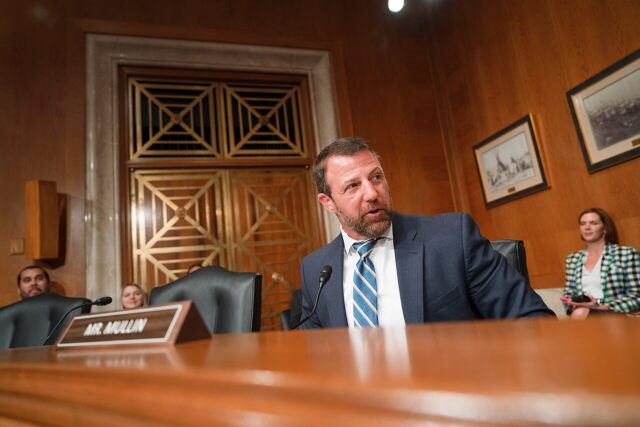
Indian Affairs Committee Hearings to examine Indian Self-Determination and Education Assistance Act successes and opportunities at the Department of the Interior and the Indian Health Service, in Washington, DC on September 17, 2025. (Official U.S. Senate photo by Ryan Donnell)

On Monday evening, the Senate voted to confirm Oklahoma Sen. Markwayne Mullin (R) to lead the Department of Homeland Security.

Mullin, who was picked by President Donald Trump earlier this month to lead the Department of Homeland Security, was confirmed on a largely party-line vote. Sens. John Fetterman (D-Pa.) and Martin Heinrich (D-N.M.) joined nearly every Republican to clinch his nomination.

Before voting to support the nomination, Heinrich said he crossed party lines because he has seen that Mullin — who co-chairs the Senate Legislative Branch spending committee with him — “is not someone who can simply be bullied into changing his views.”

“And I look forward to having a secretary who doesn’t take their orders from Stephen Miller,” Heinrich said.

Sen. Rand Paul (R-Ky.) was the only Republican to vote against Mullin, citing their chilly relationship and Mullin’s past comments that his 2017 assault was “justified.”

Mullin’s confirmation also saw the close of a whirlwind month in which Noem was reassigned after an explosive pair of hearings on Capitol Hill, as well as the deaths of Renee Nicole Good and Alex Pretti, who were fatally shot by Immigration and Customs Enforcement agents.

This is a breaking news story. Please check back for updates.

Trump Allies Plan Senate Floor Protest To Pass SAVE America Act

President Trump’s allies are preparing to turn the Senate floor into a political pressure cooker this week.

Their target: the Safeguard American Voter Eligibility (SAVE America) Act — a bill requiring proof of citizenship to register to vote.

Their strategy: keep the Senate debating it for as long as possible.

That plan sets up a major test for Senate Majority Leader John Thune, who is under intense pressure from Trump and the MAGA base to drag the fight out and force Democrats to defend their opposition in public.

Republicans are keeping their exact floor strategy under wraps. But one thing is clear: they’re expecting long days, late nights, and a drawn-out showdown.

“This is about exhausting Democrats,” one Republican strategist said bluntly. “The point is pain.”

The goal, he added, is simple: force a public confrontation and see who cracks.

“Is this going to be a fistfight or not? How bloody is Thune going to make this?”

Sen. Mike Lee, one of the bill’s leading champions, says Trump wants Republicans to go all-in. Lee has even pointed to the Senate’s legendary two-month battle over the Civil Rights Act of 1964 as a model.

“What I want to do is maximize the time we debate it,” Lee said.

Back in 1964, he noted, supporters faced a 32-vote cloture deficit when the bill arrived in the Senate. Sixty days later, they had the votes. Lee believes extended debate can work the same way here — by raising public pressure and forcing reluctant lawmakers to reconsider.

Meanwhile, Trump is watching closely. The former president has already warned he won’t sign other legislation until the SAVE Act reaches his desk. Whether he’s satisfied with the Senate fight, Lee said, depends on one thing: whether Republicans “gave it everything we have.”

But there’s a catch.

Thune is already warning that the votes simply aren’t there for some of the more aggressive tactics Trump’s allies want — including forcing Democrats into a “talking filibuster.”

Some Republicans are wary anyway. A talking filibuster could backfire by allowing Democrats to force politically painful amendment votes — including votes on restoring Medicaid cuts or extending Obamacare subsidies. So instead of forcing Democrats to hold the floor indefinitely, Thune appears likely to let Republicans do the talking — keeping the bill on the floor long enough to turn the debate itself into a political weapon.

Democrats say they’re ready.

“We’re prepared for every possible scenario,” Senate Leader Chuck Schumer (D) said Sunday.

His caucus views the SAVE Act as a major threat to voting rights. Some Republicans believe Democrats could filibuster the bill for weeks — or even months — by introducing a constant stream of amendments. Which is why the next few days may not just be about passing legislation.

They may be about staging a Senate spectacle.

As Lee put it:

“This bill needs to stay on the floor for as long as it takes.”