

Government

Home Government Page 9

Trump Bombs Venezuela, Maduro And Wife Captured By US Forces

President Donald Trump holds a Cabinet meeting, Wednesday, April 30, 2025, in the Cabinet Room. (Official White House Photo by Molly Riley)

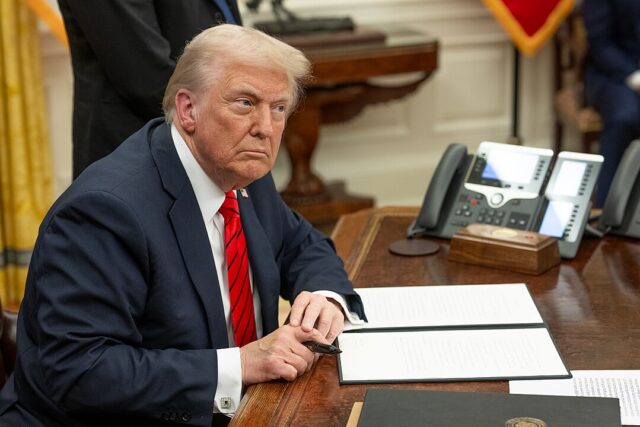
President Donald Trump shared a bombshell announcement in an early-morning social media post as he claimed that the United States has “captured” Venezuelan President Nicolás Maduro and flown him to the U.S. following massive strikes on the Venezuelan capital of Caracas.

News broke after midnight Friday that the United States struck Venezuela’s capital of Caracas early Saturday morning as a series of explosions were reported by multiple news outlets.

At 4:21 AM, Trump posted on Truth Social that Maduro and his wife Cilia Flores were captured, and promised a press conference later in the day:

The United States of America has successfully carried out a large scale strike against Venezuela and its leader, President Nicolas Maduro, who has been, along with his wife, captured and flown out of the Country. This operation was done in conjunction with U.S. Law Enforcement. Details to follow. There will be a News Conference today at 11 A.M., at Mar-a-Lago. Thank you for your attention to this matter! President DONALD J. TRUMP

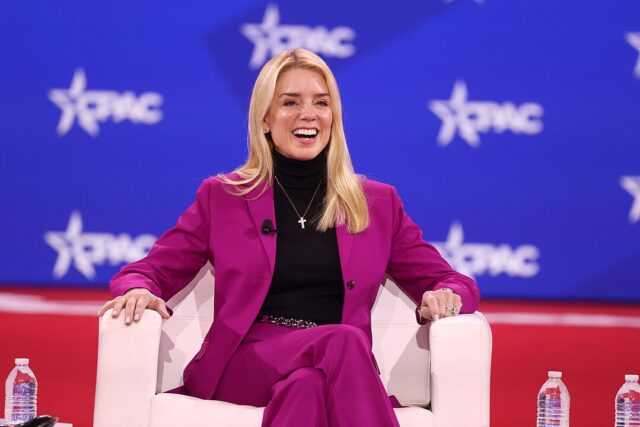
US Attorney General Pam Bondi announced on X, “Nicolas Maduro and his wife, Cilia Flores, have been indicted in the Southern District of New York. Nicolas Maduro has been charged with Narco-Terrorism Conspiracy, Cocaine Importation Conspiracy, Possession of Machineguns and Destructive Devices, and Conspiracy to Possess Machineguns and Destructive Devices against the United States.”

The New York Times reported on reaction from inside Venezuela by that country’s Interior Minister Diosdado Cabello:

Interior Minister Diosdado Cabello of Venezuela, considered one of Nicolás Maduro’s top enforcers, called for calm in televised remarks and urged Venezuelans to trust the leadership. “Let no one fall into despair. Let no one make things easier for the invading enemy,” he said. Cabello also said, without providing evidence, that bombs had struck civilian buildings.

The moves follow months of threats and strikes on alleged drug boats and the U.S. seizure of oil tankers.

This is a breaking news story. Please check back for updates.

House Democrat Puts Trump Chief Of Staff ‘On Notice’ Over Vanity Fair Article

4
By The White House - https://www.flickr.com/photos/202101414@N05/54327362226/, Public Domain, https://commons.wikimedia.org/w/index.php?curid=159757968

Rep. Eric Swalwell (D-CA) is escalating his rhetoric against the Trump White House, warning chief of staff Susie Wiles to preserve internal communications as he vows to launch investigations into what he claims is political “retribution” by President Donald Trump.

The threat follows months of controversy surrounding criminal referrals involving prominent Democrats, including Swalwell himself, Sen. Adam Schiff (D-CA), and New York Attorney General Letitia James—cases Democrats have repeatedly framed as evidence of a politicized justice system, despite a lack of formal charges to date.

In a video posted Monday to his social media accounts, Swalwell said he had formally put Trump officials “on notice,” citing remarks by Wiles in a recent Vanity Fair interview that he claims amount to an admission that Trump is willing to pursue perceived enemies when opportunities arise.

“I want you to hear from me first. I’m going on offense against Donald Trump, and I just put senior Trump officials on notice,” Swalwell said. “Donald Trump once again is trying to weaponize the Department of Justice to go after his enemies list. That’s me, Adam Schiff, Tish James, and (Federal Reserve Governor) Lisa Cook.”

Background: Referrals, Not Charges

The confrontation comes after Trump-appointed Federal Housing Finance Agency Director Bill Pulte referred Swalwell to the Justice Department earlier this year over alleged mortgage and tax irregularities. Swalwell dismissed the referral as politically motivated. Similar referrals or allegations have been made against Schiff and James, though James’ case was dismissed in early December.

Republicans have argued that referrals themselves are routine and that Democrats are attempting to preemptively discredit oversight efforts by framing them as retaliation—particularly given Democrats’ own extensive use of investigations, subpoenas, and prosecutions during Trump’s first term.

The Vanity Fair Interview That Sparked the Fallout

Swalwell’s latest escalation centers on comments made by Wiles—widely viewed as one of Trump’s most disciplined and media-averse operatives—in an unusually candid Vanity Fair interview that has drawn criticism from both sides of the aisle.

When pressed by the magazine about whether prosecutions of Trump critics could appear vindictive, Wiles acknowledged the political optics were problematic.

“I mean, people could think it does look vindictive. I can’t tell you why you shouldn’t think that,” she said.

Wiles added that Trump is not consumed by revenge but does not shy away from confrontation when opportunities present themselves.

“I don’t think he wakes up thinking about retribution,” she said. “But when there’s an opportunity, he will go for it.”

On New York Attorney General Letitia James—who built her political profile around investigations and prosecutions of Trump—Wiles was more blunt.

“Well, that might be the one retribution.”

The remarks quickly circulated online and were seized upon by Democrats as proof that Trump’s critics are being targeted for political reasons, despite the absence of new indictments.

Swalwell Escalates With Threat of Investigations

Swalwell framed Wiles’ comments as an admission that undermines claims that the referrals are routine or apolitical. He said his office has already sent a letter to Wiles demanding the preservation of records.

“So we just sent a letter to Susie Wiles telling her, save your sh*t: your emails, your text messages, everything that records or documents Donald Trump going after his political enemies,” Swalwell said. “Save it because we’re coming for it because we want the truth.”

He vowed to pursue inquiries into Trump’s decision-making process and the actions of his administration.

Watch:

“What did Trump know? What did he order? What do others do on his behalf?” Swalwell asked. “We’re not going away. And the American people are always going to choose the truth over Trump.”

TikTok Signs Trump-Backed Deal With US Investors To Avert Ban

By The White House - https://www.flickr.com/photos/202101414@N05/54581054338/, Public Domain,

TikTok has secured a last-minute lifeline.

The social media giant reached a binding agreement Thursday with a Trump-backed group of U.S. and global investors, restructuring its American operations in an effort to avoid a nationwide ban and remain available to its 170 million U.S. users.

Under the agreement with its Chinese parent ByteDance, the hugely popular social media app will shift control of its core U.S. operations to a newly created joint venture majority-owned by American investors.

TikTok’s U.S. business will be placed under a newly created company, TikTok USDS Joint Venture LLC, majority-owned by American investors including Oracle, Silver Lake, and MGX. ByteDance will retain a 19.9% stake — the maximum allowed under U.S. law.

The new entity will control sensitive areas like user data, algorithms, and content moderation, while ByteDance continues to handle advertising and e-commerce through separate units. Oracle will act as a trusted security partner, hosting U.S. data and monitoring compliance.

The move comes after years of mounting pressure from Washington. A 2024 bipartisan law forced ByteDance to divest TikTok’s U.S. operations or face a ban, putting the platform on borrowed time after repeated deadline extensions.

Trump and other supporters argue the deal protects national security without wiping out one of the country’s most influential tech platforms. Critics remain skeptical, warning that ByteDance’s continued involvement could still pose risks.

At the heart of the TikTok debate is China.

ByteDance operates under Chinese laws that can force companies to turn over user data, intensifying fears in Washington that information on millions of Americans could — or may already — be in Beijing’s hands.

National security officials and lawmakers warn that such data could have military value, raising concerns about potential access by the Chinese Communist Party.

Mediaite continues:

The White House has confirmed that Oracle, co-founded by Trump ally Larry Ellison, will license a copy of TikTok’s powerful recommendation algorithm and expand its existing role managing the data of the app’s 170 million U.S. users. A potential ban was hinged on national security concerns.

In September, Trump said he had spoken directly with China’s leader, adding: “I had a very good talk with President Xi [Jinping]” and “he gave us the go ahead.” A month later, Treasury Secretary Scott Bessent declared that Washington and Beijing had “reached a final deal on TikTok.”

During his first term, Trump threatened to ban TikTok outright in 2020. Congress later passed legislation forcing a sale or shutdown over security fears, which former President Joe Biden signed into law in April 2024. The ban was due to take effect in January 2025, but was repeatedly delayed by Trump as negotiations continued.

Not everyone is on board, however. Senator Elizabeth Warren (D-MA) panned the deal in a post on BlueSky late Thursday: “First Paramount/CBS and now TikTok. Trump wants to hand over even more control of what you watch to his billionaire buddies. Americans deserve to know if the president struck another backdoor deal for this billionaire takeover of TikTok.”

If regulators sign off, the deal is expected to close by Jan. 22, 2026. TikTok says users shouldn’t notice any immediate changes — but scrutiny of the platform is far from over.

READ NEXT: Trump Immediately Suspends Controversial Program Following Shocking Incidents

Report: Dan Bongino Quietly Clearing Out His Office in Preparation for FBI Exit

Deputy FBI Director Dan Bongino is reportedly preparing to leave the Bureau in the coming weeks, fueling speculation that he may soon return to the conservative media landscape where he built a powerful national following. According to The New York Times, several individuals familiar with the situation say Bongino is already packing up his office and sending personal items back to Florida—an indication that an official announcement may be imminent.

These sources told the Times that Bongino could depart “as soon as this week or as late as mid-January,” though he has not yet publicly confirmed his plans. The former Secret Service agent and best-selling author was appointed to the FBI leadership team earlier this year by President Donald Trump, who tasked him with bringing greater transparency, accountability, and ideological clarity to an agency long accused by conservatives of political bias.

Dan Bongino via Gage Skidmore Flickr

Conflicting Signals About Bongino’s Plans

Other reports offer mixed signals. Fox News Digital, citing its own sources, noted Monday that Bongino has “not made a final decision” and disputed claims that his office was already empty. However, Fox’s sources did acknowledge that he is expected to clarify his future “in the coming weeks.”

If Bongino does leave the Bureau, many expect him to reenter the conservative media sphere in time for the 2026 midterm elections, when Republican strategists anticipate a major national referendum on the direction of the country.

Potentially Strategic Timing for His Exit

According to the Times, Bongino has privately floated the idea of aligning his departure with a major law-enforcement development—specifically a press conference connected to the long-running federal investigation into the pipe bombs planted near the DNC and RNC headquarters on January 5, 2021.

The incident, still unsolved after nearly four years, remains a source of public frustration. Conservatives argue the lack of progress underscores deep institutional failures at the FBI—failures Bongino has long criticized both before and during his time at the agency.

Repairing Tensions With Attorney General Pam Bondi

Behind the scenes, Bongino is also said to be smoothing tensions with Attorney General Pam Bondi, whom he sharply criticized earlier this year. In July, Bondi’s office released a memo stating that the much-discussed “Epstein client list” did not exist, contradicting years of speculation amplified in part through Bongino’s own podcast prior to his government service.

The Times reports that Bongino was so dissatisfied with Bondi’s handling of that matter that he threatened to resign at the time. Since then, he has reportedly worked to repair the relationship—an indication that he may be trying to ensure a clean exit from the Bureau, should he choose to move on.

Broader Political Context

Bongino’s potential departure comes at a pivotal moment for federal law enforcement. Republicans continue to push for sweeping reforms at the FBI, citing concerns about political motivations behind high-profile investigations dating back to the Russia probe. Bongino, viewed by many grassroots conservatives as a no-nonsense reformer, entered the FBI leadership at a time when trust in federal agencies has been sharply divided along partisan lines.

A return to broadcasting would position him once again as one of the most influential voices in conservative politics—a role he previously used to energize Republican voters, challenge media narratives, and champion pro-Trump policy priorities.

For now, the timeline remains unclear. But by all accounts, Bongino’s next move—whether announced this week or early in the new year—will be closely watched

Two Senate Republicans Break Ranks To Overturn Trump Executive Order

6
Ted Eytan from Washington, DC, USA, CC BY-SA 2.0 , via Wikimedia Commons

A pair of Senate Republicans has joined Democrats in backing legislation to roll back former President Donald Trump’s executive order on federal unions — but it remains uncertain whether the bill will ever reach the Senate floor.

The House recently passed its version of the measure, the American Workers Protection Act, sponsored by Rep. Jared Golden (D-Maine) The bill would undo Trump’s March executive order that restricts collective bargaining for most federal unions across agencies such as the Departments of War, Justice, State, Energy, and Veterans Affairs.

While nearly two dozen House Republicans crossed the aisle to support the legislation, similar GOP backing in the Senate appears far less likely.

So far, only Sens. Lisa Murkowski (R-Alaska) and Susan Collins (R-Maine) have signed on as co-sponsors of the Senate companion bill, originally introduced in September by Sen. Mark Warner (D-Va.)

Collins, who chairs the Senate Appropriations Committee, said in a statement to Fox News Digital that she agreed with Golden that “collective bargaining, which is afforded to federal employees under the Civil Service Reform Act of 1978, should be restored.”

Murkowski also defended the protections, arguing that federal employees “deserved these protections.”

“Collective bargaining rights and workplace protections have lifted up federal employees across the United States for decades, protecting them from unsafe working conditions and political retribution,” she told Fox News Digital.

But broader Republican support in the upper chamber is doubtful — in part because the bill sits in the Senate Homeland Security and Governmental Affairs Committee, which is chaired by Sen. Rand Paul (R-Ky.) a longtime advocate of right-to-work legislation. Even Sen. Josh Hawley (R-Mo.) — generally more open to pro-worker policies — signaled reservations.

“I don’t know,” Hawley told Fox News Digital. “The public sector unions and private sector unions seem to be two different things.”

The House passed the bill 231–195, with all “no” votes coming from Republicans. Its advancement was made possible only after Golden filed a discharge petition, a procedural tool that forces a vote if a majority of House members sign on — even over leadership’s objections. No similar mechanism exists in the Senate.

Senators could still attempt to force a floor vote, but that would require Republican consent — something that appears unlikely at the moment. Still, a source close to Golden told Fox News Digital that he is actively talking with senators to build support for such a move.

Golden said Friday that both he and Rep. Brian Fitzpatrick (R-Pa.) have begun outreach to Senate offices.

He confirmed he had already spoken with “a few” senators after the House vote but added, “the real push is gonna be coming in the days and weeks ahead.”

Warner, who is leading the Senate effort, argued that the GOP defections in the House show the executive order went too far.

“Republicans and Democrats alike are recognizing that you can’t run a functioning government by attacking the very workforce that keeps Americans safe,” Warner said. “The bipartisan momentum in the House only strengthens our hand in the Senate, and I intend to build on it.”

This is a breaking news story. Please check back for updates.

Report: FBI Doubted Probable Cause For Mar-a-Lago Raid, Pushed Ahead Under Biden’s Pressure

Marine One lifts-off after returning President Donald J. Trump to Mar-a-Lago Friday, March 29, 2019, following his visit to the 143-mile Herbert Hoover Dike near Canal Point, Fla., that surrounds Lake Okeechobee. The visit was part of an infrastructure inspection of the dike, which is part of the Kissimmee-Okeechobee Everglades system, and reduces impacts of flooding for areas of south Florida. (Official White House Photo by Joyce N. Boghosian) [Photo Credit: The White House from Washington, DC, Public domain, via Wikimedia Commons]

Newly declassified documents reviewed by Fox News Digital show that FBI officials repeatedly questioned whether they had probable cause to raid President Donald Trump’s Mar-a-Lago home in 2022—yet the operation moved forward under pressure from the Biden Justice Department. One DOJ official reportedly dismissed concerns about political optics, saying he did not “give a damn about the optics” of the search.

Fox News Digital obtained internal email exchanges between FBI and DOJ personnel from the months leading up to the unprecedented raid. The emails reveal deep internal hesitation about whether the facts supported such an intrusive action against a former president.

In one email, an assistant special agent in charge wrote to colleague Anthony Riedlinger:

“Very little has been developed related to who might be culpable for mishandling the documents. From the interviews, WFO has gathered information suggesting that there may be additional boxes (presumably of the same type as were sent back to NARA in January) at Mar-a-Lago.”

He continued, explaining that the Washington Field Office was struggling to build a reliable affidavit:

“WFO has been drafting a search warrant affidavit related to these potential boxes, but has some concerns that the information is single source, has not been corroborated, and may be dated. DOJ CES opines, however, that the SW’s meet the probable cause standard.”

The agent also suggested pursuing a voluntary approach rather than immediately resorting to a search warrant:

“Even as we continue down the path towards a search warrant, WFO believes that a reasonable conversation with the former president’s attorney…ought not to be discounted.”

He added that even if Trump believed the documents were declassified, they could still be secured cooperatively:

“At a minimum… it can be reasonably argued that the documents remain sensitive and should be properly secured until the matter of classification is sorted out.”

Weeks later, another agent expressed frustration that the FBI still lacked new evidence:

“We haven’t generated any new facts, but keep being given draft after draft after draft. Absent a witness coming forward with recent information about classified on site, at what point is it fair to table this? It is time consuming for the team, and not productive if there are no new facts supporting PC (probable cause)?”

Another internal message was even more direct:

“WFO does not believe (and has articulated to DOJ CES), that we have established probable cause for the search warrant for classified records at Mar-a-Lago.”

Despite the FBI’s objections, the DOJ insisted probable cause existed and pushed for a broad search scope.

The FBI also warned leadership that a raid would likely be “counterproductive” and recommended “alternative, less intrusive and likelier quicker options for resolution.” Those concerns were ultimately overruled.

On Aug. 4, 2022—days before the raid—one agent described the plan:

“The FBI intends for the execution of the warrant to be handled in a professional, low key manner, and to be mindful of the optics of the search.”

Nevertheless, the August 2022 raid went ahead, leading to the seizure of boxes of materials that included documents potentially protected by attorney-client and executive privilege. Trump’s attorneys said they were not allowed to observe the search and questioned how agents were determining which items belonged to Trump personally.


Deadly Force Policy Included in DOJ’s Operations Order

Fox News previously reported that the Biden administration authorized standard DOJ “use of deadly force” language in the operations order for the raid—language also used when searching President Joe Biden’s home in a separate classified documents review.

According to a court filing, the operations order stated:

“Law Enforcement officers of the Department of Justice may use deadly force when necessary.”

The order also showed that agents planned to bring:

“Standard Issue Weapons,” “Ammo,” “Handcuffs,” and “medium and large sized bolt cutters,”

while being instructed to wear “unmarked polo or collared shirts” and keep “law enforcement equipment concealed.”


Legal Aftermath

Special Counsel Jack Smith ultimately charged Trump with 37 felony counts related to alleged improper retention of classified material, later adding three more counts in a superseding indictment. Trump pleaded not guilty to all charges. After Trump won the 2024 presidential election, Smith dropped the case.

This is a breaking news story. Please check back for updates.

Report: Trump Border Czar Homan, DHS Chief Noem Barely Speaking Or Meeting

3
The White House, Public domain, via Wikimedia Commons

A simmering feud between Homeland Security Secretary Kristi Noem and President Trump’s border czar Tom Homan has grown so strained that the two leaders reportedly barely speak or meet with each other, according to a new Axios report. Despite the tension, neither official is in danger of losing their job, and President Trump continues to stand by both as key figures in his aggressive border-security agenda.

The clash—with roots that appear more personal than ideological—has raised eyebrows inside the Department of Homeland Security (DHS). A White House adviser told Axios that Trump views the competition between Noem and Homan as a healthy dynamic that can improve overall performance. “Kristi’s doing a great job,” Trump reportedly said. “Her and Tom don’t get along, but they’re doing great.”

Personality Clash, Not Policy Collapse

Sources say the feud stems largely from a personality clash and differing leadership styles. While both leaders support tough enforcement of immigration laws, Noem’s backers have criticized Homan for oversaturating conservative media with frequent appearances, especially on Fox News, which they say sometimes carries him past official channels or consultation with DHS communications staff. Homan has appeared on conservative outlets far more than Noem this year, which insiders say has aggravated the divide.

Career Officials Bristle, But Trump Wants Results

Career immigration officials have reportedly bristled at Noem’s leadership style, including her public-facing promotion of policies like the CBP Home self-deportation app and the outsized influence of her senior adviser, Corey Lewandowski, who can only officially serve limited days under federal rules.

At the same time, Noem’s allies say Homan’s media presence sometimes strays into self-promotion, making news on policy pronouncements without coordination. But neither side is backing down, and several White House sources say Trump is satisfied with the job both are doing.

What This Means for Border Security

Despite internal friction, the Trump administration’s border enforcement efforts remain robust. Deportations have reached record levels under this team, and DHS continues to pursue hard-line priorities. That focus on illegal immigration enforcement aligns with what Trump was elected to deliver and remains popular among the president’s base.

In public remarks—such as Noem’s recent testimony before the House Homeland Security Committee—Noem has defended the administration’s approach as strengthening national security and deterring illegal entries, insisting DHS is enforcing the law without selective leniency.

Senate Democrats Introduce Bill to Block Trump From Putting Face on Dollar Coin

2
President Donald Trump signs Executive Orders, Thursday, April 17, 2025, in the Oval Office. (Official White House Photo by Molly Riley)

Democratic Senators Jeff Merkley (Ore.) and Catherine Cortez Masto (Nev.) introduced legislation Tuesday aimed at preventing President Trump—or any sitting or living former president—from appearing on U.S. currency. Their proposal, titled the Change Corruption Act, comes as the U.S. Treasury considers issuing a commemorative $1 coin featuring Trump’s image in recognition of America’s 250th anniversary.

The bill, cosponsored by Sens. Ron Wyden (D-Ore.) and Richard Blumenthal (D-Conn.), states plainly: “No United States currency may feature the likeness of a living or sitting President.” The lawmakers argue that the measure reflects historical practice, noting that U.S. currency has traditionally featured only deceased presidents and statesmen.

A Preemptive Strike on a Potential Semiquincentennial Honor

The U.S. Mint is reportedly close to announcing whether it will release a limited-run Trump coin as part of the nation’s celebration of the 250th birthday of the United States in 2026. Commemorative coins—distinct from circulating coins—are historically used to honor major anniversaries, public achievements, and historic figures. Past presidents, including Ronald Reagan and George H.W. Bush, have been featured posthumously on such special-issue coins.

A draft image circulating within the Treasury Department shows Trump’s profile above the word “Liberty,” a standard placement for American coinage.

Democrats Frame the Coin as a Threat to Democratic Norms

In unusually heated language for a discussion about commemorative currency, Merkley compared Trump’s potential appearance on a coin to the behavior of authoritarian regimes:

“President Trump’s self-celebrating maneuvers are authoritarian actions worthy of dictators like North Korea’s Kim Jong Un, not the United States of America,” Merkley said in a statement.

He argued Congress must take action to limit the executive branch’s influence over commemorative designs:

“We must reject his efforts to dismantle our ‘We, The People’ republic and replace it with a strongman state by demanding strong accountability to prevent further abuse of taxpayer dollars.”

Cortez Masto echoed Merkley’s claims, asserting that any depiction of a living president on U.S. coinage would resemble an outdated monarchical tradition:

“While monarchs put their faces on coins, America has never had and never will have a king.”

She added:

“Our legislation would codify this country’s long-standing tradition of not putting living presidents on American coins. Congress must pass it without delay.”

Trump Threatens Perjury Charge Against Former U.S. President

2
Photo via Gage Skidmore Flickr

President Donald Trump announced Friday that he is nullifying all documents allegedly signed by former President Joe Biden using an autopen device.

In a Truth Social post, Trump claimed that 92% of documents signed during Biden’s presidency were executed using an autopen, a tool that mechanically reproduces a person’s signature.

“The Autopen is not allowed to be used if approval is not specifically given by the President of the United States,” Trump wrote. “The Radical Left Lunatics circling Biden around the beautiful Resolute Desk in the Oval Office took the Presidency away from him.”

Trump said he is canceling all executive orders and “anything else that was not directly signed by Crooked Joe Biden, because the people who operated the Autopen did so illegally.” He also threatened to charge Biden with perjury if Biden claims he personally approved the signatures.

Joe Biden via Gage Skidmore Flickr

Background on the Autopen Issue

The autopen, used by the U.S. government since the Truman administration, holds a real pen and signs documents using a template of the signer’s handwriting. Its use is widespread for routine presidential correspondence, and critically, the Department of Justice’s Office of Legal Counsel has affirmed that autopen signatures on legislation and executive actions are legal, provided the president authorizes them.

Trump’s accusation hinges on his claim that Biden did not give such authorization — an assertion for which no verification has yet been provided. Historically, multiple presidents, including George W. Bush and Barack Obama, used the autopen for official documents without controversy. Biden’s use was consistent with this longstanding practice.

Scope of the Impact

During his presidency, Biden issued 162 executive orders and signed hundreds of memoranda, proclamations, and notices. While Trump already rescinded nearly 80 Biden-era orders in January, his new declaration suggests a broader cancellation effort. Policies that could now be subject to invalidation include:

  • Executive Order 14087, aimed at lowering U.S. prescription drug costs
  • Executive Order 14096, focused on environmental justice
  • Executive Order 14110, addressing the development and regulation of artificial intelligence

It remains unclear which authority or process will be used to determine the authenticity or validity of signatures on documents Biden approved.

Trump’s move marks an escalation in his ongoing effort to question the legitimacy of Biden’s presidential actions, extending a line of criticism he frequently employed during and after Biden’s term.

Trump Announces He Will Pardon Ex-Honduran President

0
Image via Pixabay

President Donald Trump announced Friday on Truth Social that he intends to grant a full pardon to former Honduran President Juan Orlando Hernández, who is currently serving a 45-year sentence in U.S. federal prison on drug trafficking and weapons charges.

Hernández, who led Honduras from 2014 to 2022, was arrested in Tegucigalpa in February 2022 following a U.S. extradition request. He was transferred to New York two months later to face charges that federal prosecutors said stemmed from years of cooperation with major drug cartels. Prosecutors accused him of turning Honduras into a “narco-state,” alleging that during his presidency he leveraged political power to help move more than 400 tons of cocaine toward the United States in exchange for millions of dollars in bribes. Among those he allegedly interacted with was notorious Mexican cartel leader Joaquín “El Chapo” Guzmán.

A federal jury convicted Hernández in March 2024 on three counts related to drug-trafficking and firearms conspiracies. On June 26, 2024, he was sentenced to 45 years in prison, followed by five years of supervised release, and ordered to pay an $8 million fine.

In his Friday post, Trump criticized the prosecution’s handling of the case and suggested Hernández had been treated more harshly than warranted. “I will be granting a Full and Complete Pardon to Former President Juan Orlando Hernandez who has been, according to many people that I greatly respect, treated very harshly and unfairly,” Trump wrote. “This cannot be allowed to happen, especially now, after Tito Asfura wins the Election, when Honduras will be on its way to Great Political and Financial Success.”

The message reflects Trump’s increasingly vocal support for Nasry “Tito” Asfura, the conservative National Party candidate in Honduras’ presidential election. Earlier this week, Trump used Truth Social to praise Asfura, writing that the two “can work together to fight the Narcocommunists, and bring needed aid to the people of Honduras.”

Trump’s Friday post escalated that endorsement further, urging Hondurans to “VOTE FOR TITO ASFURA FOR PRESIDENT, AND CONGRATULATIONS TO JUAN ORLANDO HERNANDEZ ON YOUR UPCOMING PARDON. Thank you for your attention to this matter. MAKE HONDURAS GREAT AGAIN!”

He also warned that future U.S. assistance to Honduras could hinge on the election’s outcome, stating that if Asfura loses, “the United States will not be throwing good money after bad, because a wrong Leader can only bring catastrophic results to a country, no matter which country it is.”

Context: Trump’s Recent Use of the Pardon Power

The announcement comes amid renewed attention to Trump’s approach to pardons and commutations, which he has described as an important tool for correcting what he views as systemic unfairness in the U.S. justice system and in politically sensitive prosecutions. In recent months, Trump has signaled his willingness to revisit high-profile cases involving allies, military personnel, and others he says were treated wrongly by federal authorities.

During his first term, Trump issued several controversial pardons, including for former National Security Adviser Michael Flynn, former adviser Roger Stone, and several U.S. military service members involved in war-related prosecutions. He also pardoned political figures such as former Illinois Governor Rod Blagojevich and longtime conservative commentator Dinesh D’Souza, citing prosecutorial excess in those cases.

More recently, Trump has publicly floated pardons for individuals prosecuted for actions related to border security and drug enforcement, arguing that some federal cases—particularly those involving international cooperation or politically volatile regions—deserve closer scrutiny.

Hernández’s case now appears to be the latest example of Trump’s willingness to intervene where he believes U.S. prosecutors overstepped or failed to account for broader geopolitical considerations.

A Sign of Trump’s Foreign Policy Priorities

Trump’s strong backing of Asfura and criticism of the U.S. prosecution of Hernández reflect his broader emphasis on building alliances with conservative governments in Latin America. Throughout his presidency and afterward, Trump has framed left-wing governments in the region as destabilizing forces aligned with organized crime, while praising leaders who adopt pro-business and anti-corruption platforms.

By tying Hernández’s pardon to Honduras’ political future, Trump is signaling that he views Asfura’s victory—and Honduras’ alignment with the United States—as strategically important.