National Security

Home National Security

Secret Service Agent Placed On Leave After Disclosing Sensitive Vance Info

1

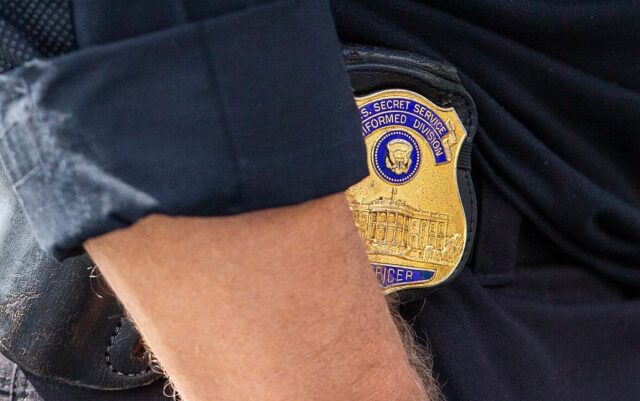
A U.S. Secret Service (USSS) employee assigned to Vice President JD Vance’s protective detail has been placed on administrative leave after an undercover video released by independent journalist James O’Keefe allegedly showed the employee leaking sensitive security information, according to Fox News.

The Secret Service confirmed it is investigating the incident and said the employee’s security clearance has been suspended and access to agency facilities and systems revoked. The episode is reigniting concerns about operational security inside the agency at a time when national political tensions—and threats against Republican leaders—are already at historic highs.

USSS Deputy Director Matthew Quinn told Fox News in a statement:

“The U.S. Secret Service has no tolerance for any behavior that could potentially compromise the safety, privacy or trust of our protectees. This incident is under investigation and the employee involved has been placed on administrative leave with his clearance suspended and access to agency facilities and systems revoked.

“The U.S. Secret Service has also issued an order for all personnel to retake the agency’s required anti-espionage training in order to ensure employees are aware of the threats posed by individuals aiming to exploit agency employees for information about our protective operations,” Quinn added.

“The U.S. Secret Service has a 160-year-old tradition of discretion that sets this agency apart, and we have no tolerance for employees who fail to meet this standard. The U.S. Secret Service deeply apologizes to the Vance family for this violation of their trust and privacy. The faith our protectees place in this agency is not something the U.S. Secret Service takes lightly, and we are committed to taking the necessary actions to ensure that a similar breach of standards does not occur again,” the statement concluded.

Undercover Footage Allegedly Shows Agent Sharing Sensitive Protection Details

In a post on X, O’Keefe claimed undercover footage shows a USSS agent assigned to Vice President Vance’s protective detail sharing sensitive information with someone he believed was a romantic interest.

According to O’Keefe, the agent discussed protective formations, shift schedules, travel movements and advance security procedures, and allegedly sent images while aboard Air Force Two. In the post, O’Keefe wrote that the agent was “recorded on hidden camera providing an undercover journalist with sensitive security information” and allegedly discussed “protective formations, shift schedules, travel plans, & real-time locations.”

O’Keefe also claimed the employee shared information “sometimes days in advance” and acknowledged signing paperwork prohibiting disclosure of the privileged details.

O’Keefe alleged the agent is a “holdover from the Biden administration” who holds anti-ICE and anti-Trump administration personal views—an accusation that, if substantiated, is likely to raise new scrutiny over internal culture and accountability inside an agency that is supposed to remain professional and nonpartisan.

O’Keefe said his organization coordinated with the Secret Service before publication and redacted certain operational details at the agency’s request.

Watch:

A Serious Breach as Political Threats Surge

The incident comes as political violence and targeted threats are becoming a grim reality for Republican leaders, including both President Trump and Vice President Vance.

In recent weeks, the threats against Vance have not been theoretical. A federal judge ordered a Cincinnati man accused of vandalizing Vance’s home to remain jailed ahead of trial after prosecutors alleged he breached the property line and damaged windows and security systems.

The Secret Service was also recently notified of a volunteer radio show host posting assassination threats against VP Vance on the left-wing website Bluesky.

“It’s simple, we kill JD Vance,” said the person behind an account named hanslopez.bsky.social. The person identified themselves as a host of a radio show on WUML, which is funded by the University of Massachusetts at Lowell. The comment was made in response to another Bluesky user who claimed that, “JD VANCE THINKS BRITAIN & FRANCE ARE AMERICAS [sic] LIKELY ENEMIES.”

When the school learned of the post, it contacted authorities, according to a statement provided to Fox News Digital.

“UMass Lowell police promptly coordinated with the FBI, Secret Service and Haverhill police the same day to ensure an appropriate response,” the school said. “Contact was made with the individual in question, and the necessary assessments were conducted in collaboration with federal partners. Authorities confirmed there was no immediate threat.”

More broadly, the Secret Service has faced increasing scrutiny since the assassination attempt against Trump in Butler, Pennsylvania. A Senate Judiciary Committee release tied to a Grassley-requested report said the Secret Service received classified intelligence about a threat to Trump roughly 10 days before the rally—but failed to share it with law enforcement responsible for securing the event.

That backdrop makes the alleged leak involving Vance’s detail even more alarming to critics, since protective operations depend heavily on secrecy, discipline, and strict compliance—not casual conversation or personal judgment calls.

What Happens Next

The Secret Service is tasked with protecting the president, vice president and other designated officials, operating under strict confidentiality rules governing operations.

Officials have not provided a timeline for the investigation’s completion, and it remains unclear whether criminal charges could follow.

Republican Lawmaker Moves To Make Greenland 51st State

A House Republican is moving to back President Donald Trump’s long-standing push to bring Greenland under U.S. control, introducing legislation that could place the Arctic territory on a fast track toward eventually becoming America’s 51st state.

Rep. Randy Fine (R-Fla.) announced Monday that he is introducing a bill authorizing President Trump “to take such steps as may be necessary” to acquire Greenland and begin the process that could ultimately lead to statehood. While the bill would not automatically make Greenland a state, it would formally align Congress with the president’s efforts and remove barriers to negotiation.

“I think it is in the world’s interest for the United States to exert sovereignty over Greenland,” Fine told Fox News Digital in an interview.

“Congress would still have to choose to make it a state, but this would simply authorize the president to do what he’s doing and say the Congress stands behind him. And then it would expedite it into becoming a state, but it would still be up to Congress about whether to do that.”

The renewed push comes as Secretary of State Marco Rubio confirmed last week that he would be meeting with Danish officials to discuss Greenland, signaling that the issue has moved beyond rhetoric and into serious diplomatic engagement.

President Trump first floated the idea of the U.S. purchasing Greenland during his initial term, drawing criticism from Democrats and European elites but sparking quiet agreement among national security experts. Greenland’s strategic location in the Arctic places it along key military and shipping routes near Russia and China, and the island is believed to hold vast reserves of critical minerals essential for advanced technology, defense systems, and energy production.

Republicans argue that as global competition intensifies, especially with adversaries like China and Russia aggressively expanding their Arctic presence, U.S. leadership in the region is no longer optional.

Fine echoed those arguments while also emphasizing what he sees as Denmark’s failure to adequately govern and protect Greenland’s population.

“Their poverty rate is high. Denmark hasn’t treated them well,” Fine said. “When war came to town, Denmark couldn’t protect them. Guess who protected Greenland during World War II? We did.”

During World War II, the United States assumed responsibility for Greenland’s defense after Nazi Germany occupied Denmark, a historical point Republicans frequently cite as evidence of America’s longstanding role in safeguarding the island.

Still, some GOP lawmakers were caught off guard earlier this month when White House press secretary Karoline Leavitt declined to rule out the use of military force if negotiations were to fail. While many Republicans agree with the strategic rationale behind U.S. ownership, there is broad consensus that any acquisition should be peaceful and voluntary.

Asked directly whether he would support military action, Fine emphasized diplomacy.

“I think the best way to acquire Greenland is voluntarily.”

He also criticized Greenland’s current governance structure, framing the issue as both a strategic and ideological concern.

“The poverty rate in Greenland is much, much higher than it is in Denmark. The country is run by socialists, and it is not in America’s interests to have a territory that large between the United States and Russia run by socialists,” Fine said.

Under the U.S. Constitution, Congress holds the power to admit new states into the Union. The process typically involves Congress passing legislation authorizing statehood, followed by the drafting of a state constitution by the territory’s residents. That constitution must be approved locally before Congress votes again to formally admit the state, with final approval coming from the president.

Supporters of the Greenland proposal argue that while statehood would be a lengthy process, securing U.S. sovereignty now would strengthen national security, protect American economic interests, and offer Greenland’s residents greater opportunity and stability under U.S. governance.

Read:

Trump Issues Ultimatum To Cuba

The White House, Public domain, via Wikimedia Commons

Time is running out…

President Donald J. Trump doubled down on his firm foreign-policy agenda Sunday, delivering a stark ultimatum to the Communist regime in Cuba.

In a Truth Social post, Trump declared: “THERE WILL BE NO MORE OIL OR MONEY GOING TO CUBA — ZERO! I strongly suggest they make a deal, BEFORE IT IS TOO LATE.”

The warning comes on the heels of a decisive U.S. operation that resulted in the capture of Venezuelan strongman Nicolás Maduro — a key ally of Havana — by U.S. forces, a watershed moment in halting the flow of oil and cash that long sustained Cuba’s moribund economy.

Trump noted bluntly that Cuba has long depended on “large amounts of OIL and MONEY from Venezuela” — support that has now effectively ended following the removal of Maduro from power.

The Trump administration has aggressively moved to isolate regimes that bankroll corruption, undermine democracy, and threaten American security. Venezuela’s massive oil reserves once underpinned its regional influence, including subsidized shipments to Havana — a relationship the president has now dismantled as part of a broader push to reshape Western Hemisphere energy flows and break the grip of hostile governments.

In recent days Trump also publicly characterized Cuba’s authoritarian leadership as “sick” and close to collapse without Venezuelan support — a reflection of the island’s deep economic crisis and prolonged energy shortages in the absence of Maduro’s patronage.

While Trump provides Cuban leaders a clear path — negotiate and engage on terms favorable to the U.S. — Havana has so far refused to back down.

Report: US Military Seizes Two Sanctioned Tankers In Atlantic Ocean

Just in…

On Wednesday, U.S. forces seized two sanctioned tankers in the Atlantic Ocean.

First, U.S. European Command (EUCOM) announced the seizure of the Russian-flagged Marinera oil tanker in the North Atlantic Sea.

“The @TheJusticeDept & @DHSgov, in coordination with the @DeptofWar today announced the seizure of the M/V Bella 1 for violations of U.S. sanctions,” read a post from EUCOM on X. “The vessel was seized in the North Atlantic pursuant to a warrant issued by a U.S. federal court after being tracked by USCGC Munro.”

“This seizure supports @POTUS Proclamation targeting sanctioned vessels that threaten the security and stability of the Western Hemisphere,” EUCOM added. “The operation was executed by DHS components with support from  @DeptofWar, showcasing a whole-of-government approach to protect the homeland.”

Fox News previously reported that U.S. forces were attempting to board the Marinera tanker, which previously operated under the name Bella 1, in the North Atlantic earlier Wednesday morning.

Fox News reports:

The development comes after the Wall Street Journal reported on Tuesday that Russia had sent a submarine and other naval assets to escort the tanker.

The vessel had spent more than two weeks attempting to slip past U.S. enforcement efforts targeting sanctioned oil shipments near Venezuela, the outlet reported.

“The blockade of sanctioned and illicit Venezuelan oil remains in FULL EFFECT — anywhere in the world,” said Secretary of War Pete Hegseth after the tanker was seized.

White House Confirms It’s Working to ‘Acquire Greenland’

The White House, Public domain, via Wikimedia Commons

President Donald Trump’s White House has officially confirmed that the administration is actively exploring options to acquire Greenland, a strategic Arctic territory currently part of the Kingdom of Denmark.

In a statement to Reuters this week, the White House made clear that President Trump sees Greenland as essential to America’s defense posture:

“President Trump has made it well known that acquiring Greenland is a national security priority of the United States, and it’s vital to deter our adversaries in the Arctic region. The president and his team are discussing a range of options to pursue this important foreign policy goal, and of course, utilizing the U.S. military is always an option at the commander-in-chief’s disposal,” White House Press Secretary Karoline Leavitt said.

Trump’s interest in Greenland is rooted in longstanding strategic logic: the island sits in the high Arctic between North America, Russia, and Europe, giving it unique value for early warning systems, missile defense, space tracking, and controlling emerging Arctic shipping routes as sea ice recedes. The U.S. already operates the Pituffik Space Base on Greenland under longstanding defense arrangements and has eyed the island for more than a century in light of its military advantages.

This isn’t a new idea. President Trump first floated purchasing Greenland from Denmark during his first term, and his Secretary of State has repeatedly emphasized that the proposal is serious and part of protecting U.S. interests.

While diplomacy remains the preferred path — including potential purchase negotiations or a Compact of Free Association with Greenland — the White House statement made clear that no option is off the table, including deploying military measures.

International Reaction

Denmark — a reliable NATO ally — has strongly rebuked the notion of U.S. control over Greenland. Danish Prime Minister Mette Frederiksen responded bluntly, saying:

“It makes absolutely no sense to talk about the need for the United States to take over Greenland.”

She emphasized Denmark’s commitment to mutual defense with the U.S. under NATO and urged Washington to respect Greenland’s sovereignty. Greenland’s own Prime Minister Jens-Frederik Nielsen called Trump’s remarks “very rude and disrespectful,” underscoring that Greenlanders themselves have clearly rejected becoming a U.S. territory.

Despite the international pushback, the Trump administration argues Greenland should be part of a forward-looking defense strategy that safeguards U.S. interests amidst great-power competition.

This development follows broader Trump administration efforts in Latin America — including the recent arrest of Venezuelan President Nicolás Maduro

Hours after the dramatic U.S. military operation in Venezuela, President Donald Trump sharply escalated his rhetoric toward other foreign governments, criticizing Colombia’s president and reviving his long-standing idea of acquiring Greenland.

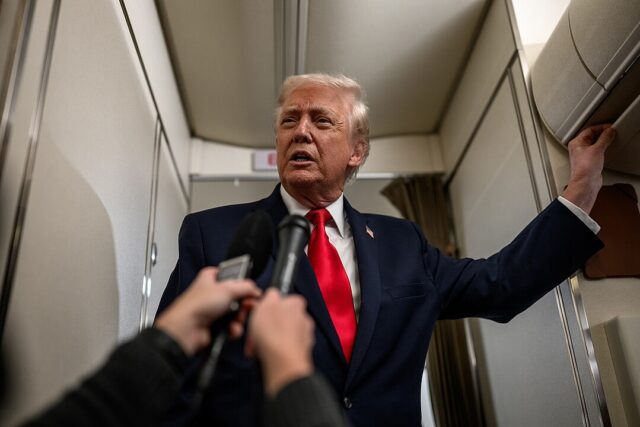
Trump, speaking to reporters aboard Air Force One, was initially responding to questions about a U.S. military operation in Caracas that resulted in the capture of Venezuelan leader Nicolás Maduro and his wife, Cilia Flores, as well as the future of Venezuela, when he shifted his focus to another South American country.

“Columbia’s very sick too, run by a sick man who likes making cocaine and selling it to the United States. And he’s not going to be doing it very long. Let me tell you,” Trump said.

When pressed by a reporter to clarify his remarks, Trump claimed that Gustavo Petro has “cocaine mills and cocaine factories.”

“It sounds good to me,” Trump responded.

“So there will be an operation by the U.S. in Colombia?” the reporter asked.

Trump Sends Ultimatum to Maduro Allies as U.S. Signals End to Negotiations

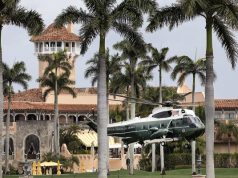
President Donald Trump monitors U.S. military operations in Venezuela, from Mar-a-Lago Club in Palm Beach, Florida, on Saturday, January 3, 2026.

President Donald Trump has delivered a blunt message to Venezuelan strongman Nicolás Maduro and his inner circle: cooperate with the United States—or step aside.

Fox News senior foreign correspondent Benjamin Hall revealed Sunday that Trump personally warned Maduro’s allies that they must either “surrender or play ball,” underscoring what the administration describes as a decisive shift away from diplomacy and toward direct action.

According to Hall, President Trump spoke directly with Maduro roughly a week before Saturday’s strike in Caracas. During that call, Trump reportedly issued a clear ultimatum demanding Maduro’s surrender. Maduro, Trump said, “was not willing.”

Hall noted that while Maduro has now been removed, several senior figures within the Venezuelan regime remain aligned with him, presenting an ongoing challenge for U.S. policymakers seeking stability in the region and an end to what they describe as narco-terrorist activity emanating from the country.

Operation Absolute Resolve – January 3rd, 2026

That message was reinforced by Department of Homeland Security Secretary Kristi Noem, who made clear that the Trump administration has no intention of tolerating continued obstruction from Venezuela’s remaining leadership.

“President Trump is done negotiating. He proved that a couple of days ago, that he is a man of action, that when someone is threatening the United States, he will defend it with every resource that we have, and he’ll continue to do that,” Noem said on Fox News Sunday.

Noem explained that Trump’s communications with Venezuela’s vice president were deliberately direct and unambiguous.

“His conversations now with the vice president in Venezuela are very matter-of-fact and very clear: ‘You can lead, or you can get out of the way because we’re not going to allow you to continue to subvert our American influence and our need to have a free country like Venezuela to work with rather than to have dictators in place who perpetuate crimes and drug trafficking,’” she said.

Her remarks followed the Trump administration’s high-profile operation on Saturday that resulted in the capture of Nicolás Maduro—an unprecedented move that sparked intense debate in Washington. While Democrats and some Republicans raised questions about the legality of the action and the long-term implications for Venezuela, supporters of the operation argued it sent a long-overdue message to hostile regimes.

The operation capped months of U.S. efforts to dismantle what officials describe as a network of narcoterrorism tied to the Venezuelan government. Those efforts included strikes against suspected drug trafficking vessels operating in Caribbean waters and increased enforcement against illicit oil shipments.

Noem pointed to those actions as further proof that the administration is committed to protecting American security interests and cutting off financial lifelines to adversarial governments.

“The Coast Guard has been heavily involved in stopping a lot of this shadow fleet of oil that has been trafficking illegally to many of our enemies in other countries,” she said.

Administration officials argue that Venezuela’s instability has long fueled drug trafficking, mass migration, and regional insecurity, and that decisive action was necessary after years of what they view as failed appeasement. Supporters say Trump’s approach represents a return to peace through strength—using American power to deter threats before they reach U.S. shores.

Trump Bombs Venezuela, Maduro And Wife Captured By US Forces

President Donald Trump holds a Cabinet meeting, Wednesday, April 30, 2025, in the Cabinet Room. (Official White House Photo by Molly Riley)

President Donald Trump shared a bombshell announcement in an early-morning social media post as he claimed that the United States has “captured” Venezuelan President Nicolás Maduro and flown him to the U.S. following massive strikes on the Venezuelan capital of Caracas.

News broke after midnight Friday that the United States struck Venezuela’s capital of Caracas early Saturday morning as a series of explosions were reported by multiple news outlets.

At 4:21 AM, Trump posted on Truth Social that Maduro and his wife Cilia Flores were captured, and promised a press conference later in the day:

The United States of America has successfully carried out a large scale strike against Venezuela and its leader, President Nicolas Maduro, who has been, along with his wife, captured and flown out of the Country. This operation was done in conjunction with U.S. Law Enforcement. Details to follow. There will be a News Conference today at 11 A.M., at Mar-a-Lago. Thank you for your attention to this matter! President DONALD J. TRUMP

US Attorney General Pam Bondi announced on X, “Nicolas Maduro and his wife, Cilia Flores, have been indicted in the Southern District of New York. Nicolas Maduro has been charged with Narco-Terrorism Conspiracy, Cocaine Importation Conspiracy, Possession of Machineguns and Destructive Devices, and Conspiracy to Possess Machineguns and Destructive Devices against the United States.”

The New York Times reported on reaction from inside Venezuela by that country’s Interior Minister Diosdado Cabello:

Interior Minister Diosdado Cabello of Venezuela, considered one of Nicolás Maduro’s top enforcers, called for calm in televised remarks and urged Venezuelans to trust the leadership. “Let no one fall into despair. Let no one make things easier for the invading enemy,” he said. Cabello also said, without providing evidence, that bombs had struck civilian buildings.

The moves follow months of threats and strikes on alleged drug boats and the U.S. seizure of oil tankers.

This is a breaking news story. Please check back for updates.

Trump Vows To Intervene If Iran Starts Killing Protesters

President Donald Trump answers questions from members of the media aboard Air Force One en route to Mount Pocono, Pennsylvania, for a rally on the economy, Tuesday, December 9, 2025. (Official White House Photo by Molly Riley)

President Donald Trump early Friday warned the Islamic Republic of Iran that the United States would intervene if Iranian security forces violently suppress peaceful demonstrators. In a post on Truth Social, Trump wrote that if Iran “shoots and violently kills peaceful protesters, which is their custom,” the U.S. “will come to their rescue.”

He added: “We are locked and loaded and ready to go.”

The president’s warning comes as widespread demonstrations over Iran’s deteriorating economy have expanded beyond Tehran to multiple provinces, raising concerns about a potential heavy-handed crackdown. At least seven people — including both protesters and security personnel — have been reported killed in clashes, according to international reporting.

Iranian officials sharply rebuked Trump’s remarks. Ali Larijani, secretary of Iran’s Supreme National Security Council, posted that U.S. interference “would mean destabilizing the entire region and destroying America’s interests” and urged Trump to reconsider.

The unrest is the most significant since the 2022 protests sparked by the death of Mahsa Amini. This week’s demonstrations began with shopkeepers objecting to a steep depreciation in the Iranian rial and have grown to include students and other citizens chanting against the theocratic leadership. Iranian President Masoud Pezeshkian acknowledged public grievances and urged listening to protesters’ “legitimate demands,” but his government faces limited options as economic conditions worsen.

State media has reported arrests and claims of seized smuggled weapons linked to the unrest, though details remain limited.

Trump’s Recent Iran Statements
Trump’s warning on Friday follows a series of hardline statements on Iran over the past week:

  • On Dec. 29, Trump warned at Mar-a-Lago that the U.S. could support further strikes against Iran if Tehran resumes its nuclear or ballistic-missile programs, saying intelligence suggested Iran may be rebuilding capabilities and that future action may be required.
  • On Dec. 30, Trump again signaled that the U.S. would take military action if Iran attempts to revive its nuclear weapons program, warning reporters that if Tehran “tries to build up again… we have to knock them down.”

These comments come amid heightened regional tensions after U.S. and allied strikes on Iranian nuclear facilities in the summer of 2025 and Iran’s retaliatory attack on the U.S.-linked Al-Udeid Air Base in Qatar.

Domestic Political Support for Tough Stance
Sen. John Fetterman (D–Pa.) — one of the few Democrats to break with his party’s mainstream on Iran — has publicly endorsed a strong military posture toward Tehran. Fetterman praised Trump’s June strikes on Iranian nuclear sites and wrote on X that he “fully support[s] any future strikes to damage or destroy their nuclear ambitions.” x

Fetterman’s stance underscores a rare bipartisan alignment on confronting Iran’s nuclear threat, even as other lawmakers emphasize congressional authority and caution.

Regional and Policy Implications
Iran’s government, beset by economic turmoil and foreign pressure, faces mounting internal dissent. Its currency has sharply depreciated, contributing to public anger and eroding confidence in the regime. Meanwhile, regional actors — including Israel and Russia — are warning against escalation, with Tehran emphasizing resistance against perceived foreign interference and rejecting renewed nuclear negotiations.

Democrat Senator Openly Backs Trump’s Iran Proposal

Gage Skidmore Flickr

President Donald Trump said Monday that the United States and Israel have already destroyed Iran’s nuclear program and warned that Tehran would face renewed military action if it attempts to rebuild its weapons capabilities. His remarks came as new reports allege the Iranian regime is pursuing chemical and biological warheads for its ballistic missiles.

Speaking at Mar-a-Lago alongside Israeli Prime Minister Benjamin Netanyahu, Trump delivered a blunt warning to Tehran over its nuclear and missile ambitions.

“Now I hear that Iran is trying to build up again, and if they are, we’re going to have to knock them down,” Trump said. “We’ll knock the hell out of them.” He added that Iran would be “much smarter” to pursue a deal.

Trump framed Iran’s defeat as central to restoring stability in the Middle East, crediting joint U.S.-Israeli military action with fundamentally shifting the regional balance of power.

“We just won a big war together,” he said. “If we didn’t beat Iran, you wouldn’t have had peace in the Middle East. We wiped it out.”

When asked whether he would support further Israeli military action if Iran continues advancing its missile or nuclear programs, Trump responded without hesitation.

“If they continue with the missiles — yes,” he said. “The nuclear — absolutely.”

Pressed on whether he would support efforts to overthrow Iran’s ruling regime, Trump declined, while pointing to the country’s internal turmoil and economic collapse.

“I’m not going to talk about overthrow of a regime,” he said. “But they have tremendous inflation. Their economy is busted.”

Trump also noted that widespread protests inside Iran are frequently met with deadly force by the government.

The president’s comments followed a report Sunday from Iran International alleging that Iran’s Islamic Revolutionary Guard Corps is accelerating work on unconventional missile payloads, including chemical and biological weapons. The report cited unnamed military and security sources.

Sen. John Fetterman (D-Pa.) echoed Trump’s hardline stance in a Monday post on X, saying he would support military strikes to prevent Iran from obtaining nuclear weapons.

“Iran can’t ever develop a nuclear weapon,” Fetterman wrote.

“Fully supported the strike earlier this year. Fully support any future strikes to damage or destroy their nuclear ambitions,” added Fetterman, a vocal supporter of Israel.


TikTok Signs Trump-Backed Deal With US Investors To Avert Ban

By The White House - https://www.flickr.com/photos/202101414@N05/54581054338/, Public Domain,

TikTok has secured a last-minute lifeline.

The social media giant reached a binding agreement Thursday with a Trump-backed group of U.S. and global investors, restructuring its American operations in an effort to avoid a nationwide ban and remain available to its 170 million U.S. users.

Under the agreement with its Chinese parent ByteDance, the hugely popular social media app will shift control of its core U.S. operations to a newly created joint venture majority-owned by American investors.

TikTok’s U.S. business will be placed under a newly created company, TikTok USDS Joint Venture LLC, majority-owned by American investors including Oracle, Silver Lake, and MGX. ByteDance will retain a 19.9% stake — the maximum allowed under U.S. law.

The new entity will control sensitive areas like user data, algorithms, and content moderation, while ByteDance continues to handle advertising and e-commerce through separate units. Oracle will act as a trusted security partner, hosting U.S. data and monitoring compliance.

The move comes after years of mounting pressure from Washington. A 2024 bipartisan law forced ByteDance to divest TikTok’s U.S. operations or face a ban, putting the platform on borrowed time after repeated deadline extensions.

Trump and other supporters argue the deal protects national security without wiping out one of the country’s most influential tech platforms. Critics remain skeptical, warning that ByteDance’s continued involvement could still pose risks.

At the heart of the TikTok debate is China.

ByteDance operates under Chinese laws that can force companies to turn over user data, intensifying fears in Washington that information on millions of Americans could — or may already — be in Beijing’s hands.

National security officials and lawmakers warn that such data could have military value, raising concerns about potential access by the Chinese Communist Party.

Mediaite continues:

The White House has confirmed that Oracle, co-founded by Trump ally Larry Ellison, will license a copy of TikTok’s powerful recommendation algorithm and expand its existing role managing the data of the app’s 170 million U.S. users. A potential ban was hinged on national security concerns.

In September, Trump said he had spoken directly with China’s leader, adding: “I had a very good talk with President Xi [Jinping]” and “he gave us the go ahead.” A month later, Treasury Secretary Scott Bessent declared that Washington and Beijing had “reached a final deal on TikTok.”

During his first term, Trump threatened to ban TikTok outright in 2020. Congress later passed legislation forcing a sale or shutdown over security fears, which former President Joe Biden signed into law in April 2024. The ban was due to take effect in January 2025, but was repeatedly delayed by Trump as negotiations continued.

Not everyone is on board, however. Senator Elizabeth Warren (D-MA) panned the deal in a post on BlueSky late Thursday: “First Paramount/CBS and now TikTok. Trump wants to hand over even more control of what you watch to his billionaire buddies. Americans deserve to know if the president struck another backdoor deal for this billionaire takeover of TikTok.”

If regulators sign off, the deal is expected to close by Jan. 22, 2026. TikTok says users shouldn’t notice any immediate changes — but scrutiny of the platform is far from over.

READ NEXT: Trump Immediately Suspends Controversial Program Following Shocking Incidents