


News

Home News Page 3

Republican Lawmaker Moves To Make Greenland 51st State

A House Republican is moving to back President Donald Trump’s long-standing push to bring Greenland under U.S. control, introducing legislation that could place the Arctic territory on a fast track toward eventually becoming America’s 51st state.

Rep. Randy Fine (R-Fla.) announced Monday that he is introducing a bill authorizing President Trump “to take such steps as may be necessary” to acquire Greenland and begin the process that could ultimately lead to statehood. While the bill would not automatically make Greenland a state, it would formally align Congress with the president’s efforts and remove barriers to negotiation.

“I think it is in the world’s interest for the United States to exert sovereignty over Greenland,” Fine told Fox News Digital in an interview.

“Congress would still have to choose to make it a state, but this would simply authorize the president to do what he’s doing and say the Congress stands behind him. And then it would expedite it into becoming a state, but it would still be up to Congress about whether to do that.”

The renewed push comes as Secretary of State Marco Rubio confirmed last week that he would be meeting with Danish officials to discuss Greenland, signaling that the issue has moved beyond rhetoric and into serious diplomatic engagement.

President Trump first floated the idea of the U.S. purchasing Greenland during his initial term, drawing criticism from Democrats and European elites but sparking quiet agreement among national security experts. Greenland’s strategic location in the Arctic places it along key military and shipping routes near Russia and China, and the island is believed to hold vast reserves of critical minerals essential for advanced technology, defense systems, and energy production.

Republicans argue that as global competition intensifies, especially with adversaries like China and Russia aggressively expanding their Arctic presence, U.S. leadership in the region is no longer optional.

Fine echoed those arguments while also emphasizing what he sees as Denmark’s failure to adequately govern and protect Greenland’s population.

“Their poverty rate is high. Denmark hasn’t treated them well,” Fine said. “When war came to town, Denmark couldn’t protect them. Guess who protected Greenland during World War II? We did.”

During World War II, the United States assumed responsibility for Greenland’s defense after Nazi Germany occupied Denmark, a historical point Republicans frequently cite as evidence of America’s longstanding role in safeguarding the island.

Still, some GOP lawmakers were caught off guard earlier this month when White House press secretary Karoline Leavitt declined to rule out the use of military force if negotiations were to fail. While many Republicans agree with the strategic rationale behind U.S. ownership, there is broad consensus that any acquisition should be peaceful and voluntary.

Asked directly whether he would support military action, Fine emphasized diplomacy.

“I think the best way to acquire Greenland is voluntarily.”

He also criticized Greenland’s current governance structure, framing the issue as both a strategic and ideological concern.

“The poverty rate in Greenland is much, much higher than it is in Denmark. The country is run by socialists, and it is not in America’s interests to have a territory that large between the United States and Russia run by socialists,” Fine said.

Under the U.S. Constitution, Congress holds the power to admit new states into the Union. The process typically involves Congress passing legislation authorizing statehood, followed by the drafting of a state constitution by the territory’s residents. That constitution must be approved locally before Congress votes again to formally admit the state, with final approval coming from the president.

Supporters of the Greenland proposal argue that while statehood would be a lengthy process, securing U.S. sovereignty now would strengthen national security, protect American economic interests, and offer Greenland’s residents greater opportunity and stability under U.S. governance.

Read:

Justice Department Opens Criminal Probe Into Fed Chair Jerome Powell

0
By Federalreserve - https://www.flickr.com/photos/federalreserve/54004811346/, Public Domain,

Federal prosecutors have opened a criminal investigation into Federal Reserve Chair Jerome Powell, focusing on the costly renovation of the central bank’s Washington headquarters and whether Powell misled Congress about the scope of the project, The New York Times reported. Prosecutors in the U.S. Attorney’s Office for the District of Columbia, with approval from Trump-appointed U.S. Attorney Jeanine Pirro, are examining Powell’s public statements and spending records related to the renovation of the Federal Reserve’s Marriner S. Eccles Building and a nearby structure.

The sprawling $2.5 billion renovation, begun in 2022 and slated for completion in 2027, has drawn intense scrutiny from the White House and Republican allies, who argue the cost overruns and planning discrepancies reflect mismanagement. Federal officials say the increases stem from inflation, supply chain pressures, and unforeseen issues such as asbestos and soil contamination.

Powell, in a video released shortly before the Times report, forcefully denied the investigation was about renovation misstatements. He said it was instead retaliation for his resistance to White House pressure to sharply cut U.S. interest rates.

“This new threat is not about my testimony last June or about the renovation of the Federal Reserve buildings,” Powell said, adding that the Fed had “made every effort to keep Congress informed about the renovation project.”

Watch:

Powell characterized the threat of criminal charges as a broader challenge to the Federal Reserve’s independence. “The threat of criminal charges is a consequence of the Federal Reserve setting interest rates based on our best assessment of what will serve the public, rather than following the preferences of the President,” he said in the statement. “This is about whether the Fed will be able to continue to set interest rates based on evidence and economic conditions—or whether instead monetary policy will be directed by political pressure or intimidation.”

The focus on Powell’s testimony stems from his June appearance before the Senate Banking Committee, when he addressed questions about whether luxury amenities—such as VIP dining spaces, special elevators, marble finishes, and rooftop gardens included in early planning documents—made it into final renovation plans. Powell testified they had not; critics argue internal documents contradict that characterization.

President Trump’s reaction amplified the already heightened tensions. Trump, who has repeatedly criticized Powell for not cutting interest rates as aggressively as he prefers, denied having direct knowledge of the investigation, but attacked Powell’s performance. In a brief television interview, the president said:

“I don’t know anything about it, but he’s certainly not very good at the Fed, and he’s not very good at building buildings,” adding that Powell “hurt a lot of people” by keeping rates too high.

Trump has in recent months publicly disparaged Powell, branding him with nicknames like “Too Late Powell” for perceived slowness in reducing interest rates and threatening legal action over the renovation costs. In late December, he said he was contemplating a lawsuit against Powell for “gross incompetence” regarding the renovation, claiming the project would cost “more than $4 billion — $4 billion!” and blasting it as “the highest price of construction per square foot in the history of the world.”

Although Trump suggested suing or firing Powell, legal experts note that the president cannot remove a Fed chair without cause under current law, and Powell’s term as chair expires in May 2026. Trump is widely expected to announce his successor around that time if he chooses not to renominate Powell.

The investigation’s escalation has drawn concern from lawmakers on both sides of the aisle, with critics warning it could undermine the Federal Reserve’s long-held independence and rattle financial markets.

President Donald Trump will interview Rick Rieder, BlackRock’s chief investment officer of global fixed income, this week to possibly be the next chairman of the Federal Reserve, administration sources told FOX Business.

The sources said the interview with Rieder will take place on Thursday at the White House. It will include Trump, Chief of Staff Susie Wiles, Treasury Secretary Scott Bessent, and Deputy Chief of Staff Dan Scavino.

This will be the fourth and last interview with a candidate to replace Federal Reserve Chairman Jerome Powell, the sources said. Powell’s term as chairman ends on May 15. He was nominated by Trump to lead the Fed in 2017 and confirmed in 2018.

Trump Issues Ultimatum To Cuba

The White House, Public domain, via Wikimedia Commons

Time is running out…

President Donald J. Trump doubled down on his firm foreign-policy agenda Sunday, delivering a stark ultimatum to the Communist regime in Cuba.

In a Truth Social post, Trump declared: “THERE WILL BE NO MORE OIL OR MONEY GOING TO CUBA — ZERO! I strongly suggest they make a deal, BEFORE IT IS TOO LATE.”

The warning comes on the heels of a decisive U.S. operation that resulted in the capture of Venezuelan strongman Nicolás Maduro — a key ally of Havana — by U.S. forces, a watershed moment in halting the flow of oil and cash that long sustained Cuba’s moribund economy.

Trump noted bluntly that Cuba has long depended on “large amounts of OIL and MONEY from Venezuela” — support that has now effectively ended following the removal of Maduro from power.

The Trump administration has aggressively moved to isolate regimes that bankroll corruption, undermine democracy, and threaten American security. Venezuela’s massive oil reserves once underpinned its regional influence, including subsidized shipments to Havana — a relationship the president has now dismantled as part of a broader push to reshape Western Hemisphere energy flows and break the grip of hostile governments.

In recent days Trump also publicly characterized Cuba’s authoritarian leadership as “sick” and close to collapse without Venezuelan support — a reflection of the island’s deep economic crisis and prolonged energy shortages in the absence of Maduro’s patronage.

While Trump provides Cuban leaders a clear path — negotiate and engage on terms favorable to the U.S. — Havana has so far refused to back down.

Kimmel Targets Trump During Critics Choice Awards Acceptance Speech

0

Late-night host Jimmy Kimmel used his acceptance speech at Sunday’s Critics Choice Awards to take another swipe at President Donald Trump after his ABC program won Best Talk Show, continuing a yearslong feud that has made Trump a frequent target of Kimmel’s monologues.

“A FIFA Peace Prize would have been better, but this is nice, too,” Kimmel joked from the stage, referencing FIFA President Gianni Infantino’s decision to award Trump the first-ever FIFA Peace Prize in early December. “Most of all, I want to thank our president, Donald Jennifer Trump, without whom we would be going home empty-handed tonight.”

Kimmel went on to mock Trump directly, adding, “Thank you, Mr. President, for all the many ridiculous things you do each and every day. It’s been a banner couple of weeks, and we can’t wait to get back on the air tomorrow night to talk about them.”

Trump and Kimmel have clashed publicly for nearly a decade, with the comedian routinely criticizing Trump’s policies, personality, and supporters on his show. Trump, in turn, has repeatedly dismissed Kimmel as a partisan entertainer and “ratings-challenged” host who uses political outrage to stay relevant.

Kimmel’s remarks came after a turbulent year for his show. In September 2025, ABC briefly suspended Kimmel following controversial comments he made about conservative activist Charlie Kirk. The suspension sparked backlash from free-speech advocates on the right, who argued the network selectively enforces standards when conservatives are involved. Kimmel returned to the air just days later.

During his acceptance speech, Kimmel thanked his wife, his producers, and members of the entertainment industry who supported him during the suspension.

“Thanks to all the writers and actors and producers and union members, many of you who are in this room, who supported us, who really stepped forward and reminded us that we do not take free speech for granted in this city or in this country,” Kimmel said. “Your actions were important. We appreciate that.”

Critics have noted the irony of Kimmel invoking free speech while routinely advocating for deplatforming or censorship of conservative voices.

Kimmel also reflected on the year during his final episode of 2025, growing emotional as he thanked viewers for their loyalty.

“It has been a hard year. We’ve had some lows. We’ve had some highs — for me, maybe more than any year of my life, but all of us,” he said through tears. “This year you literally pulled us out of a hole, and we cannot thank you enough personally, professionally…”

Even in his closing message, Kimmel appeared unable to resist another jab at Trump and his supporters.

“There is still much more good in this country than bad,” he told viewers, “and we hope that you will bear with us during this extended psychotic episode that we’re in the middle of.”

President Trump has not publicly responded to Kimmel’s latest remarks, though allies have frequently criticized Hollywood figures for using award shows as political soapboxes while claiming to speak for “the country.”

Trump To Ban Corporations Buying Single-Family Homes

1

President Donald Trump announced on Wednesday a plan to ban “large institutional investors” from buying “more single-family homes.”

In a Truth Social post, the president declared the “American dream is increasingly out of reach for far too many people, especially younger Americans.” He blamed economic struggles on former President Joe Biden while announcing his plan to restrict home buying by companies.

Trump wrote:

For a very long time, buying and owning a home was considered the pinnacle of the American Dream. It was the reward for working hard, and doing the right thing, but now, because of the Record High Inflation caused by Joe Biden and the Democrats in Congress, that American Dream is increasingly out of reach for far too many people, especially younger Americans. It is for that reason, and much more, that I am immediately taking steps to ban large institutional investors from buying more single-family homes, and I will be calling on Congress to codify it. People live in homes, not corporations. I will discuss this topic, including further Housing and Affordability proposals, and more, at my speech in Davos in two weeks.

Mediaite reported the housing market has faced challenges in recent years, with inflation and other economic issues leading to fewer and younger people actually buying homes. According to data from the National Association of Realtors (NAR), the average age of a first-time home buyer is around 40, a big jump from previous years. According to the 2025 data, first-time home buyers dropped to a record low of 21%.

The Hill noted that the proposed ban could prove to be a way in for Trump and Republicans to address the issue of affordability ahead of this year’s midterm elections. The president and his Republican allies have struggled to message on the issue as inflation persists and as Democrats have won a number of special and off-year elections.

In his TruthSocial post, the president laid blame on former President Biden for current inflation, which have remained stagnant during Trump’s second-term so far.

“For a very long time, buying and owning a home was considered the pinnacle of the American Dream. It was the reward for working hard, and doing the right thing, but now, because of the Record High Inflation caused by Joe Biden and the Democrats in Congress, that American Dream is increasingly out of reach for far too many people, especially younger Americans,” the president noted. 

Trump Cancels Planned Second Wave Of Venezuela Attacks After Prisoner Release

0
President Donald Trump holds a Cabinet meeting, Wednesday, April 30, 2025, in the Cabinet Room. (Official White House Photo by Molly Riley)

On Friday, President Trump said he canceled an “expected second Wave of Attacks” on Venezuela.

The announcement came nearly a week after US military forces captured Venezuelan President Nicolás Maduro in a shocking raid. Since then, his former vice president, Delcy Rodríguez, has been made the country’s acting president.

Rodríguez confirmed the release of several political detainees on Friday, in a move she said was designed to “consolidate peace.” Nobel Peace Prize-winning opposition leader María Corina Machado praised the release of the prisoners as an “important day” proving that “injustice” would not prevail in the country.

Taking to Truth Social early on Friday, Trump hailed the action as one of “cooperation” and touted major oil sector engagement, saying that at least $100 billion in investment from “BIG OIL” was in the offing:

“Venezuela is releasing large numbers of political prisoners as a sign of ‘Seeking Peace,’” Trump wrote in a post on Truth Social. “This is a very important and smart gesture. The U.S.A. and Venezuela are working well together, especially as it pertains to rebuilding, in a much bigger, better, and more modern form, their oil and gas infrastructure.”

“Because of this cooperation, I have cancelled the previously expected second Wave of Attacks, which looks like it will not be needed, however, all ships will stay in place for safety and security purposes,” the president continued. “At least 100 Billion Dollars will be invested by BIG OIL, all of whom I will be meeting with today at The White House.”

The scale of the releases remains unclear, but, according to the Guardian, it is estimated that Venezuela holds between 800 and 1,000 political prisoners, many of whom were detained for participating in protests following the 2024 election, which opposition figures and international observers widely believe was rigged in Maduro’s favor.

One person who was identified as released was opposition leader Biagio Pilieri, who served on fellow opposition leader María Corina Machado’s 2024 presidential campaign.

Another opposition member who was released was 2024 presidential candidate Enrique Márquez, who was seen on video hugging Pilieri after their release on Thursday.

Alfredo Romero, president of the Venezuelan human rights group Foro Penal, hesitated to say this was “the beginning of the dismantling of a repressive system in Venezuela … and not a mere gesture, a charade of releasing some prisoners and incarcerating others,” the news wire reported. As of Dec. 29, Romero’s organization stated that Venezuela has 863 political prisoners in custody.

Spain’s government said five of its citizens were also released. Two of them, Andrés Martínez and José María Basoa, were arrested by Venezuelan authorities in September 2024, accused of being Spanish spies attempting to destabilize Maduro’s government. Spain denied these allegations.

Trump’s own claim about holding back strikes comes amidst escalating political fallout in Washington after the Senate advanced a War Powers Resolution on Thursday, with the backing of several Republicans.

DeSantis Launches Florida Redistricting Push 

On Wednesday, Florida Gov. Ron DeSantis launched a redistricting effort to potentially secure additional Republican congressional seats in the state.

DeSantis announced the move, saying he will be convening a special session for the state legislature to adjust current maps. The move comes as red and blue states across the country have pursued redistricting to secure an advantage in the 2026 midterm elections.

“Today, I announced that I will be convening a Special Session of the Legislature focused on redistricting to ensure that Florida’s congressional maps accurately reflect the population of our state. Every Florida resident deserves to be represented fairly and constitutionally,” DeSantis wrote.

“This Special Session will take place after the regular legislative session, which will allow the Legislature to first focus on the pressing issues facing Floridians before devoting its full attention to congressional redistricting in April,” he added.

Currently, Republicans hold 20 of Florida’s 28 congressional districts. Florida Republicans may also face challenges because of language in the state’s constitution that puts tight restrictions on gerrymandering.

Texas and California have also pursued major redistricting efforts, with Texas overcoming some initial pushback from the courts.

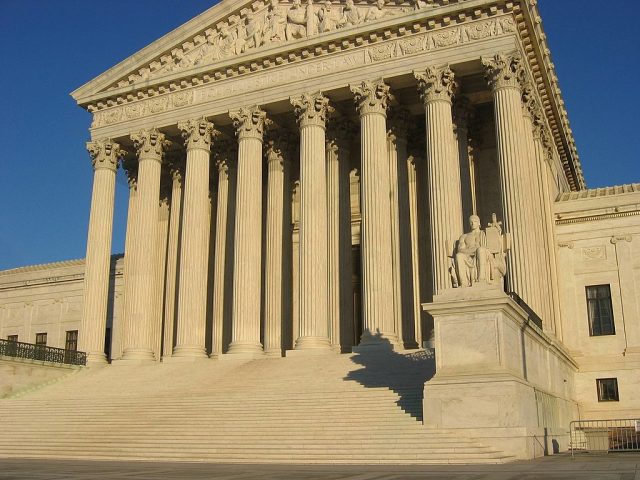
In early December, the Supreme Court delivered a significant victory to Texas Republicans, clearing the way for a new congressional map that could add up to five GOP-leaning seats in 2026. In a 6-3 ruling, the justices halted a lower court order and said Texas can use the map while the legal fight plays out.

Florida is another key battleground where redistricting could bolster Republican prospects. Governor Ron DeSantis has already demonstrated a willingness to redraw maps, most notably by dismantling a North Florida district long viewed as favorable to Democrats. Further tweaks ahead of 2026 could reinforce Republican dominance in the state by locking in gains made over the last two cycles and reducing the number of truly competitive districts. (RELATED: Supreme Court Clears Texas To Use GOP-Friendly Map In 2026)

Similarly, in states like Ohio and Tennessee, GOP legislators continue to test the limits of court rulings and constitutional constraints, seeking maps that better reflect — in their view — statewide partisan preferences, which currently favor Republicans.

While these redistricting efforts are unlikely to produce a dramatic wave of new GOP seats on their own, they could prove decisive in a narrowly divided House. With margins expected to be razor-thin, even two or three additional Republican-leaning districts may be enough to offset losses from retirements or difficult midterm headwinds.

White House Confirms It’s Working to ‘Acquire Greenland’

The White House, Public domain, via Wikimedia Commons

President Donald Trump’s White House has officially confirmed that the administration is actively exploring options to acquire Greenland, a strategic Arctic territory currently part of the Kingdom of Denmark.

In a statement to Reuters this week, the White House made clear that President Trump sees Greenland as essential to America’s defense posture:

“President Trump has made it well known that acquiring Greenland is a national security priority of the United States, and it’s vital to deter our adversaries in the Arctic region. The president and his team are discussing a range of options to pursue this important foreign policy goal, and of course, utilizing the U.S. military is always an option at the commander-in-chief’s disposal,” White House Press Secretary Karoline Leavitt said.

Trump’s interest in Greenland is rooted in longstanding strategic logic: the island sits in the high Arctic between North America, Russia, and Europe, giving it unique value for early warning systems, missile defense, space tracking, and controlling emerging Arctic shipping routes as sea ice recedes. The U.S. already operates the Pituffik Space Base on Greenland under longstanding defense arrangements and has eyed the island for more than a century in light of its military advantages.

This isn’t a new idea. President Trump first floated purchasing Greenland from Denmark during his first term, and his Secretary of State has repeatedly emphasized that the proposal is serious and part of protecting U.S. interests.

While diplomacy remains the preferred path — including potential purchase negotiations or a Compact of Free Association with Greenland — the White House statement made clear that no option is off the table, including deploying military measures.

International Reaction

Denmark — a reliable NATO ally — has strongly rebuked the notion of U.S. control over Greenland. Danish Prime Minister Mette Frederiksen responded bluntly, saying:

“It makes absolutely no sense to talk about the need for the United States to take over Greenland.”

She emphasized Denmark’s commitment to mutual defense with the U.S. under NATO and urged Washington to respect Greenland’s sovereignty. Greenland’s own Prime Minister Jens-Frederik Nielsen called Trump’s remarks “very rude and disrespectful,” underscoring that Greenlanders themselves have clearly rejected becoming a U.S. territory.

Despite the international pushback, the Trump administration argues Greenland should be part of a forward-looking defense strategy that safeguards U.S. interests amidst great-power competition.

This development follows broader Trump administration efforts in Latin America — including the recent arrest of Venezuelan President Nicolás Maduro

Hours after the dramatic U.S. military operation in Venezuela, President Donald Trump sharply escalated his rhetoric toward other foreign governments, criticizing Colombia’s president and reviving his long-standing idea of acquiring Greenland.

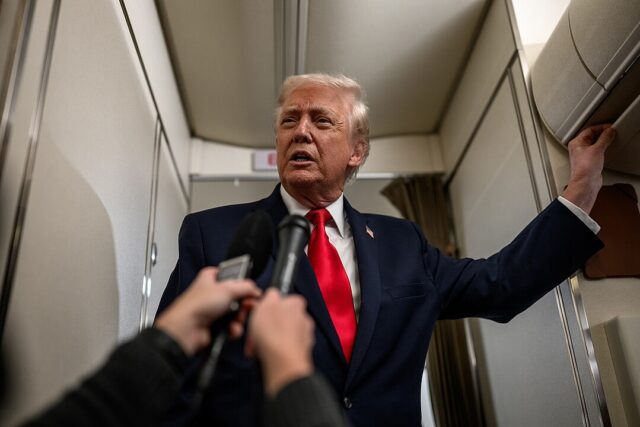
Trump, speaking to reporters aboard Air Force One, was initially responding to questions about a U.S. military operation in Caracas that resulted in the capture of Venezuelan leader Nicolás Maduro and his wife, Cilia Flores, as well as the future of Venezuela, when he shifted his focus to another South American country.

“Columbia’s very sick too, run by a sick man who likes making cocaine and selling it to the United States. And he’s not going to be doing it very long. Let me tell you,” Trump said.

When pressed by a reporter to clarify his remarks, Trump claimed that Gustavo Petro has “cocaine mills and cocaine factories.”

“It sounds good to me,” Trump responded.

“So there will be an operation by the U.S. in Colombia?” the reporter asked.

Republican Congressman Hospitalized In Car Accident

Photo via Pixabay images

Rep. Jim Baird (R-Ind.) has reportedly been hospitalized after a car accident.

Baird is responsive and in stable condition, Fox News reported.

Baird’s hospitalization came moments after it was announced House GOP Rep. Doug LaMalfa (R-Calif.) had suddenly passed away at age 65.

LaMalfa represented part of California and was chair of the Congressional Western Caucus.

“Jacquie and I are devastated about the sudden loss of our friend, Congressman Doug LaMalfa. Doug was a loving father and husband, and staunch advocate for his constituents and rural America. Our prayers are with Doug’s wife, Jill, and their children,” Emmer said.

His death brings House Republicans’ majority down to 218 to 213. 

Machado Says She’d Personally Give Nobel Peace Prize to Trump After Maduro’s Capture

1
By Kevin Payravi - Own work, CC BY-SA 4.0, https://commons.wikimedia.org/w/index.php?curid=179718533

Venezuelan opposition leader María Corina Machado said she would “love” to personally give her Nobel Peace Prize to President Donald Trump, following U.S. air strikes that led to the capture of longtime socialist strongman Nicolás Maduro — a dramatic operation that reshaped the political future of Venezuela and the region.

Machado made the remarks Monday during an appearance on Fox News’ Hannity, where host Sean Hannity pressed her on reports that Trump had declined to support her as Venezuela’s interim leader because she had accepted the Nobel Prize herself — an award Trump has publicly sought for years.

Over the weekend, Trump ordered precision air strikes in Caracas, culminating in the capture of Maduro and his wife, Cilia Flores. The operation drew predictable backlash from Democrats and the media, who criticized Trump for acting without prior congressional authorization and questioned the risks of regime change. Critics also pointed to Trump’s December pardon of former Honduran President Juan Orlando Hernández, despite Maduro’s well-documented record of brutal repression, narco-trafficking ties, and his illegal seizure of a third term in July 2024 after opposition candidate Edmundo González won the election by a wide margin.

Machado herself had been barred from the ballot by Maduro’s regime, despite winning the opposition’s independently run presidential primary with more than 92 percent of the vote.

The day after Maduro’s capture, Trump publicly cast doubt on Machado’s viability as an interim leader.

“It would be very tough for her to be the leader,” Trump said, claiming she “doesn’t have the support or the respect within the country.”

According to The Washington Post, Trump’s rejection stunned members of the Venezuelan opposition. Two sources close to the White House told the paper that Machado’s decision to accept the Nobel Peace Prize last year — rather than explicitly refusing it in Trump’s name — was viewed as an “ultimate sin” by a president who has long believed he deserved the honor.

“If she had turned it down and said, ‘I can’t accept it because it’s Donald Trump’s,’ she’d be the president of Venezuela today,” one source said.

Trump has repeatedly argued over the years that his historic diplomatic efforts — including the Abraham Accords, North Korea negotiations, and Middle East ceasefires — merited a Nobel Peace Prize, particularly after former President Barack Obama received the award early in his presidency. Trump has frequently mocked the Nobel Committee for what he views as partisan double standards.

On Hannity, the Fox News host opened the interview by laying out Machado’s record and the stakes ahead.

“Following the capture of Maduro over the weekend, the end of his horrific regime, the question remains, who will succeed the brutal dictator and bring much-needed change and freedom to the country?” Hannity said.

He noted that Machado had dedicated her Nobel Prize “to the suffering people of Venezuela and to President Trump for his decisive support of our cause,” and had repeatedly praised Trump publicly for his leadership.

Machado thanked Hannity and Fox News for their “incredible support… throughout all this long journey for the cause of democracy for our people in Venezuela,” before recounting how the opposition organized behind González after she was banned from running.

“We defeated Maduro by a landslide — it was incredible, under extreme conditions, unfair conditions,” she said.

Hannity then asked directly about the Nobel Prize dedication.

“It’s not very usual,” Hannity said, “that people will dedicate the Nobel Peace Prize to the leader of a different country and say publicly, he deserves this more than I do. But you did that.”

“Let me be very clear,” Machado replied. “As soon as I learned that we had been awarded the Nobel Peace Prize, I dedicated it to Trump because I knew at that point, he deserved it.”

She praised Trump’s decisive military action, saying many believed it was “impossible to achieve what he has just done on Saturday, January 3rd.”

“January 3rd will go down in history as the day justice defeated tyranny,” Machado said, calling the operation a “milestone” for Venezuela, “humanity, freedom, and human dignity.”

Asked whether she had spoken directly to Trump, Machado said the two last spoke on October 10, the day the Nobel prizes were announced. She emphasized her gratitude for Trump’s leadership.

“He has taken historical actions against these narco-terrorists, to start dismantling the structure and bringing Maduro to justice,” she said. “That means that 30 million Venezuelans are now closer to freedom — but also the United States of America is a safer country nowadays.”

Hannity also addressed reports that Machado had offered to give Trump the Nobel Prize outright.

“Well, it hasn’t happened yet,” Machado said. “But I would certainly love to be able to personally tell him that we believe — the Venezuelan people, because this is a prize of the Venezuelan people — certainly want to give it to him and share it with him.”

Watch:

Meanwhile, the Washington Post reports that the U.S. is now working with Delcy Rodríguez, Maduro’s former vice president and interim leader, who controversially claimed the operation to capture Maduro had a “Zionist tint.”