


Politics

Home Politics

Trump Ally Byron Donalds Taps Cuban-American Conservative as Florida Running Mate

0
Political representation of parties making money

Rep. Byron Donalds has selected Florida state Sen. Bryan Avila as his running mate, adding a Cuban-American military officer and veteran state lawmaker to the Republican ticket in Florida’s race for governor.

Donalds announced the decision Tuesday at Miami’s historic Freedom Tower, calling Avila a “proven warrior” and “conservative fighter” who has battled higher taxes, rising costs and “woke ideology” in Tallahassee.

“He has fought woke ideology, he’s fought higher taxes, he’s fought higher costs every single day, and I could not be more proud to have him stand by my side,” Donalds said, according to The Hill.

The announcement came one week after Donalds won the Republican primary to succeed term-limited Gov. Ron DeSantis. He will face Democratic nominee David Jolly, a former Republican congressman who joined the Democratic Party in 2025, in November.

Avila has represented portions of Miami-Dade County in the Florida Senate since 2022. Before moving to the Senate, he served eight years in the Florida House, including two years as speaker pro tempore.

The Hialeah native currently chairs the Florida Senate’s Finance and Tax Committee and serves as vice chair of its Transportation Committee. He has also served as a captain in the Florida Army National Guard since 2016, according to his official Senate biography.

Donalds emphasized Avila’s personal connection to Florida’s large Cuban-American community, describing him as the son of Cuban exiles who fled communism in search of freedom.

“My parents escaped communist Cuba because they believed America offered something socialism never could — freedom,” Avila said in remarks reported by WFLA.

Avila pledged that the Republican ticket would build on DeSantis’ conservative legacy, make Florida more affordable, protect public safety and defend the freedoms that have attracted millions of new residents to the state.

The selection also strengthens Donalds’ presence in heavily Hispanic South Florida. Avila’s district includes part of Miami-Dade County, while Donalds has represented a Southwest Florida congressional district since 2021.

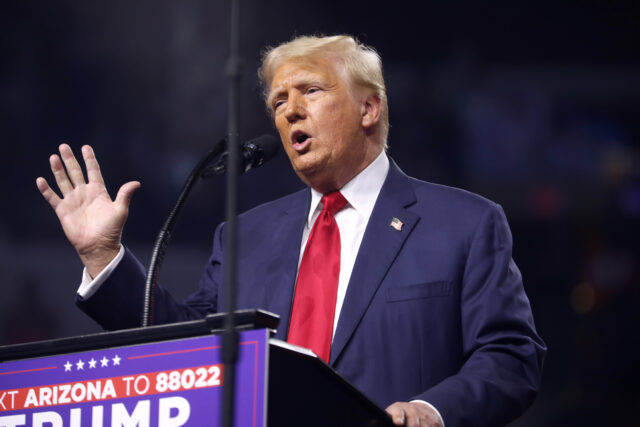
Donalds enters the general election with the enthusiastic backing of President Donald Trump, a friend and political ally who helped propel his gubernatorial campaign from the beginning.

Their alliance became especially visible during the 2024 presidential race. Donalds endorsed Trump over his own governor, DeSantis, and became one of the Trump campaign’s most prominent congressional surrogates. He appeared at campaign events across the country and helped lead the campaign’s outreach to Black voters.

Trump returned that loyalty in February 2025, endorsing Donalds before the congressman had formally entered the governor’s race. Trump personally called Donalds before urging him to run in a Truth Social post declaring, “Run, Byron, Run!”

Donalds responded at the time by thanking Trump and promising, “I will never let you down,” according to WUSF.

The president reaffirmed his support ahead of Florida’s primary, describing Donalds as a “total winner” and saying he would work closely with the White House to advance the America First agenda in Tallahassee.

“Byron Donalds will be a truly Great and Powerful Governor for Florida,” Trump wrote while reiterating his “Complete and Total Endorsement,” according to Space Coast Daily.

If elected, Donalds would become Florida’s first Black governor. His partnership with Avila would unite two politically important parts of the state while pairing Trump’s chosen candidate with a lawmaker deeply rooted in Miami-Dade’s Cuban-American community.

Jolly responded to Avila’s selection by arguing that Trump—not Donalds’ running mate—would remain the central issue in the campaign.

“This race won’t come down to Byron Donalds’ relationship with Avila; it will come down to Byron’s relationship with Donald Trump,” Jolly said in a statement reported by WFLA.

Donalds, however, mocked the opposing Jolly-Gwen Graham ticket as “boring” and tied Florida Democrats to state Rep. Angie Nixon, a Democratic Socialists of America member who won the party’s U.S. Senate nomination last week.

“They’ve joined forces to create the most boring and uninspiring ticket Florida Democrats could have ever put together,” Donalds told supporters.

Republicans will begin the general-election campaign with a sizable historical advantage. No Democrat has won a Florida governor’s race since 1994, and DeSantis carried the state by nearly 20 percentage points in 2022.

With Avila now at his side and Trump firmly behind him, Donalds is pitching the Republican ticket as the team that will preserve Florida’s conservative direction—and keep one of the nation’s most important states solidly red.
Trump Urges Governors to Embrace AI Data Centers as Public Opposition Grows

1
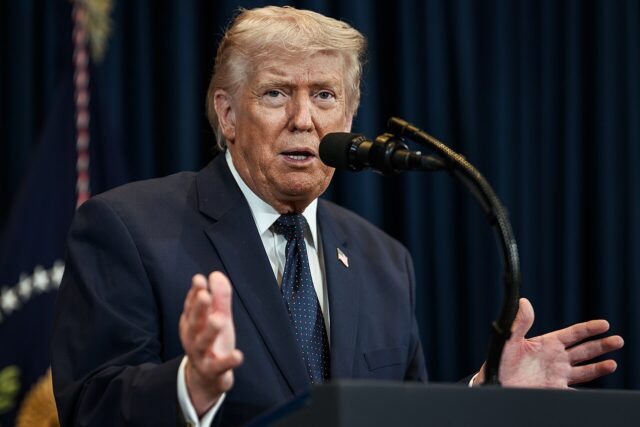
President Donald J. Trump visits the El Arepazo Doral restaurant, Monday, March 9, 2026, in Miami, Florida. (Official White House Photo by Daniel Torok)

President Donald Trump is urging governors and mayors to welcome artificial intelligence data centers into their communities, arguing that the enormous facilities will generate jobs, tax revenue and technological breakthroughs even as Americans increasingly express concerns about their impact on electricity, water and the environment.

Speaking during a White House meeting with technology and cryptocurrency industry leaders, Trump argued that communities rejecting data-center projects risk being left behind as the United States races to expand its AI infrastructure.

“If I were the mayor of a town or the governor of a state, and I had a chance to get a big plant in an AI plant or a data center, I would absolutely want it because the jobs are enormous, and the money paid, the taxes paid are just enormous,” Trump said.

“And if you don’t take it, you’re going to be left behind because there are plenty of places that want it,” he added.

“Many of them are designed in a very beautiful way,” he said. “It’s really very positive.”

Americans Aren’t So Sure

Trump acknowledged that the rapidly expanding industry may need “a little public relations help,” and polling suggests he has a point.

A Gallup poll released in May found a majority of Americans opposed construction of data centers in their own communities. Among the major concerns are the facilities’ substantial electricity and water requirements, as well as their potential environmental effects.

The electricity issue has become particularly contentious as the AI boom accelerates. Data centers require enormous quantities of power to operate servers and cooling systems, raising questions about whether their expansion could strain electrical grids or ultimately increase utility costs for ordinary consumers.

The Trump administration has attempted to manage that backlash by encouraging technology companies and data-center developers to secure additional sources of electricity rather than simply adding their enormous demand to existing grids.

Trump has also backed efforts to speed construction. An executive order issued in July 2025 called for accelerating federal permitting for qualifying data-center infrastructure.

The president argued Wednesday that communities should weigh those concerns against the economic benefits the projects can bring.

Trump Points to Jobs and Medical Breakthroughs

Asked what he would tell Americans who remain skeptical about AI, Trump again emphasized employment while making a broader case for the technology’s potential.

“I think it’s going to create a lot of jobs. It’s going to create success. It’s going to create tremendous innovation medically,” Trump said.

He referenced an unspecified medical development he had recently reviewed involving a “pretty unstoppable disease.”

“All of a sudden they’re coming up with answers that they never thought were possible,” Trump said.

AI is already being explored for uses ranging from drug discovery and medical imaging to disease detection and personalized treatment, making health care one of the areas frequently cited by the industry’s proponents when arguing that the enormous investments in computing infrastructure could produce benefits beyond the technology sector.

Trump Wants Regulation Without ‘Stifling’ AI

The administration is simultaneously confronting another question: how aggressively Washington should regulate a technology Trump believes could become even more consequential than the internet.

“We’re leading by a lot with AI. We want to keep it that way,” Trump said. “We want to regulate, but we want to have regulation where they can continue to lead, not regulation that’s going to stifle a very important industry.”

Trump has made winning the global AI race a significant economic and national-security priority of his second administration.

On his second day back in office in January 2025, Trump appeared alongside technology executives to announce Stargate, a private-sector venture with plans to invest as much as $500 billion in American AI infrastructure.

Its flagship data-center complex in Abilene, Texas, has since become partially operational, while additional projects have been pursued around the country.

But the scale of the buildout has also transformed data centers from an obscure piece of digital infrastructure into a local political issue. Communities that once competed enthusiastically for major corporate investments are increasingly weighing promised construction jobs and tax revenues against higher electricity demand, water consumption, land use and potential effects on utility bills.

READ NEXT: Biden Weaponizing Artificial Intelligence (AI) to be ‘Woke’

McConnell’s Office Publishes New Images After Dramatic Ultimatum Hits His Desk

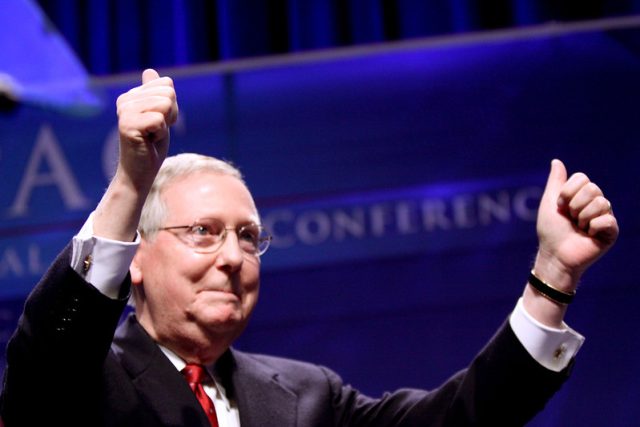
Mitch McConnell via Gage Skidmore Flickr

Kentucky Gov. Andy Beshear escalated pressure on Sen. Mitch McConnell this week, demanding that the longtime Republican lawmaker publicly demonstrate that he remains capable of serving—or resign from office.

In a letter dated Monday and reported Tuesday, the Democratic governor called on McConnell to “directly and verbally address the people of Kentucky” and prove his capacity to continue representing the state.

Beshear’s ultimatum came one day after McConnell’s office released a new photograph of the 84-year-old senator alongside his wife, Elaine Chao, and confirmed that he remains in a rehabilitation facility more than six weeks after being hospitalized.

“It has now been 43 days since news of your hospitalization,” Beshear wrote, according to Mediaite.

McConnell has missed 38 consecutive Senate votes since his hospitalization, according to the Daily Caller News Foundation.

“As Governor of the state you serve, I am calling on you to directly and verbally address the people of Kentucky and provide proof of your capacity to serve, or resign,” Beshear wrote.

The governor also sent the letter to Senate Majority Leader John Thune (R-S.D.) and urged him to investigate McConnell’s ability to remain in office if the senator declines to speak publicly.

Beshear said he would press Thune to report his findings to the American people and begin the process of removing McConnell if an investigation determined that such action was warranted.

“All of this speculation and even this letter could have been avoided with a minimal amount of transparency,” the governor added.

Beshear acknowledged McConnell’s right to medical privacy but argued that elected officials surrender a degree of that privacy when they accept responsibility for representing the public.

The Senate can expel one of its members only with a two-thirds vote. Such action is exceedingly rare: Only 15 senators have been expelled since 1789, with 14 of those removals occurring during the Civil War, according to the Senate Historical Office.

Beshear’s letter represents his second formal request for more information about McConnell’s condition. On July 8, the governor asked the senator to provide Kentuckians with a full health update and clarify whether he remained capable of fulfilling his duties.

McConnell was hospitalized June 14 after suffering a fall at his Washington, D.C., residence that left him briefly unconscious. In a July 12 written statement, the senator said doctors had ruled out a heart attack, stroke, concussion, broken bones, tumors and hemorrhaging. He also disclosed that he had developed a mild case of pneumonia while receiving treatment.

McConnell was eventually transferred from the hospital to a rehabilitation facility, where he has been undergoing multiple physical-therapy sessions each day.

His office released its latest update Monday, accompanied by a photograph that it said was taken July 26 and showed McConnell sitting beside Chao.

The Office of the Attending Physician said McConnell has not been medically cleared to leave the facility and return to his Senate office. Doctors said the lingering effects of the senator’s childhood battle with polio remain a significant factor affecting his mobility.

McConnell said he was still “working hard” to resume his schedule but announced that he would miss Kentucky’s Fancy Farm picnic Saturday. The annual political gathering is a major tradition in the state and one McConnell first attended 42 years ago.

“As always, I appreciate all of your continued well wishes, and I’m looking forward to getting back to the Senate and to Kentucky soon,” McConnell said in the official update.

A spokesman previously said McConnell continued meeting with staff and discussing defense appropriations, foreign policy, the farm bill, constituent services and federal grant requests during his recovery. Republican leaders, including Thune and Senate Majority Whip John Barrasso of Wyoming, have also said they spoke with McConnell by telephone.

The senator has not, however, participated in a live video interview or addressed Kentuckians directly since his hospitalization, leaving Beshear and other critics dissatisfied with the written statements and photographs released by his office.

McConnell has experienced several highly publicized health scares in recent years, including falls, two on-camera freezing episodes in 2023 and an intensive-care hospitalization earlier this year for flu-like symptoms.

The seven-term senator has already announced that he will not seek reelection and plans to leave office when his current term expires in January 2027. If the seat becomes vacant before then, Kentucky law calls for a special election to fill the remainder of the term.

Trump Suggests Pulling His Own Nominee Amid Bitter GOP Standoff

1
Gage Skidmore from Surprise, AZ, United States of America, CC BY-SA 2.0 , via Wikimedia Commons

President Donald Trump threatened Thursday to temporarily withdraw Todd Blanche’s nomination for attorney general and wait for two Republican holdouts to leave Washington before trying again.

The extraordinary maneuver would allow Blanche to remain acting attorney general while Trump attempts to outlast Sens. John Cornyn, R-Texas, and Thom Tillis, R-N.C., whose opposition forced Senate Judiciary Committee Chairman Chuck Grassley, R-Iowa, to postpone Thursday’s scheduled vote.

“Todd Blanche is a STAR, and everyone knows it!” Trump wrote on Truth Social. “He has the potential to go down as one of the Greatest Attorney Generals of All Time.”

Trump then turned his fire on Cornyn and Tillis, accusing the departing senators of blocking a nominee they know is qualified.

“John Cornyn, of Texas, and Thom Tillis, of North Carolina, both of whom I refused to Endorse, and whose political careers have been ended by my action, are refusing to vote for this Great Nominee, who will remain, in any event, as Acting,” Trump wrote.

“I have no objection to temporarily withdrawing Todd’s name, if they do not do the right thing, and putting him back after Cornyn and Tillis are out of office,” he added.

Tillis announced last year that he would not seek reelection, while Cornyn lost the Texas Republican primary to state Attorney General Ken Paxton, who received Trump’s endorsement.

Trump had already suggested Wednesday that Cornyn’s resistance could be rooted in lingering resentment over the primary.

“He’s outstanding,” Trump told reporters when asked about Blanche’s nomination. “Maybe John Cornyn’s upset with me because I didn’t endorse him,” according to The Associated Press.

Cornyn laughed off that suggestion, calling it “a convenient excuse” for the administration’s failure to cooperate with the Judiciary Committee, ABC News reported.

The standoff centers on a controversial settlement of Trump’s $10 billion lawsuit against the Internal Revenue Service over the leaking of his tax returns.

That agreement created a proposed $1.776 billion “Anti-Weaponization Fund” to compensate people who claim they were targeted by the federal government. It also included protections shielding Trump, members of his family and affiliated businesses from certain tax audits.

The Justice Department announced in June that it would no longer move forward with the fund after bipartisan backlash. Blanche also testified at his July 15 confirmation hearing that the fund was “dead.”

Cornyn and Tillis, however, want those assurances put in writing and the settlement language amended so the fund cannot be revived later. Cornyn also wants confirmation that Trump will not receive immunity from audits of future tax returns.

“We want to make sure that it remains dead, and that the president isn’t given any immunity from future audits that the ordinary taxpayer would not enjoy,” Cornyn told CBS News Thursday.

Cornyn said the Justice Department sent him proposed language Wednesday night, but he found it inadequate and responded with a counterproposal Thursday morning. He blamed “higher ups” at the White House for resisting the changes.

“Basically I get the sense that Todd Blanche is not the problem, it’s other folks at the White House who are resistant to any changes, any additional documentation,” Cornyn told The Hill. “But they need to make a fundamental decision whether they want him confirmed or not.”

Tillis similarly suggested that an unnamed White House adviser may be urging Trump to preserve the fund as an option.

“The only reason why we wouldn’t move forward with this language is because that same adviser wants to bring it back to life at some point,” Tillis told CBS News.

“That is horrible policy and it’s horrible politics,” he told The Hill.

Tillis acknowledged that Trump is “perfectly entitled” to hold Blanche’s nomination until January but warned the strategy could backfire if Republicans lose Senate seats—or control of the chamber—in November.

Cornyn also disputed Trump’s portrayal of the fight as a two-senator rebellion.

“POTUS is mistaken if he believes concerns about the provisions in his tax lawsuit settlement are limited to me and Senator Tillis,” Cornyn wrote on X.

Sen. Bill Cassidy, R-La., another outgoing Republican, declined Thursday to say whether he would support Blanche if the nomination came up for a vote, telling CBS News he was still gathering information.

For now, Blanche can continue overseeing the Justice Department in an acting capacity because he was previously confirmed as deputy attorney general. The White House has also highlighted support for his nomination from major law enforcement organizations, Republican state attorneys general and former Attorney General William Barr. The administration called Blanche a proven leader committed to fighting violent crime, fraud and transnational gangs.

Cornyn said Blanche’s nomination could advance as soon as next week if the administration agrees to clarify the settlement. Otherwise, the confirmation fight could stretch into September—or Trump could carry out his threat

Trump-Backed Mike Lindell Surges Ahead In Minnesota Governor’s Race

1
Mike Lindell via Gage Skidmore Flickr

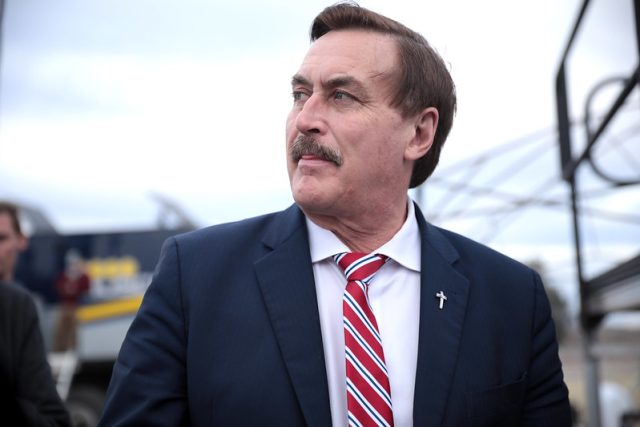
Mike Lindell is no longer merely the most famous Republican running for governor of Minnesota. The MyPillow founder is beginning to pull away from the pack.

A new KSTP/SurveyUSA poll found Lindell leading the Republican primary with 35 percent support—an eight-point jump since June and a nine-point advantage over his closest rival.

Minnesota House Speaker Lisa Demuth climbed four points to 26 percent, while Kendall Qualls, who secured the state Republican Party’s endorsement in May, fell six points to 11 percent.

The survey of 478 Republican voters was conducted from July 15 through July 20 and carried a margin of error of plus or minus 5.4 percentage points.

Lindell’s gains stretched across several important voting blocs. According to KSTP-TV, his support among Republican women climbed nine points, while his backing among voters 65 and older surged by 17 points.

The latest results mark a clear acceleration for Lindell. A June KSTP/SurveyUSA survey placed him at 27 percent, followed by Demuth at 22 percent and Qualls at 17 percent.

At the time, Carleton College political analyst Steven Schier said Lindell’s national profile would make him competitive but warned that he would need additional money to preserve his advantage.

Instead, Lindell has widened his lead just weeks before the Aug. 11 primary—and he is doing it despite the state party establishment lining up behind someone else.

Qualls secured the Minnesota Republican Party endorsement after a chaotic 10-ballot convention marked by lengthy delays and problems with its electronic voting system. But that endorsement has not translated into momentum among the broader Republican electorate.

Lindell received another, far more powerful endorsement on the first day of the new poll’s surveying period: President Donald Trump’s.

Trump threw his “complete and total endorsement” behind his longtime ally in a July 15 Truth Social post, calling Lindell “one of America’s greatest and most hard working Patriots.” (RELATED: Trump Endorses Mike Lindell In Minnesota Governor’s Race)

“Mike will be SPECTACULAR!!!” Trump wrote, adding that Lindell would “MAKE MINNESOTA GREAT AGAIN.”

Lindell welcomed the endorsement and made it clear that his campaign was not a publicity exercise.

“I wanted everyone in Minnesota to know I’m serious,” Lindell told KSTP-TV. “I’m running this campaign. I’m 100% all in.”

The primary winner is expected to face Democrat Sen. Amy Klobuchar in November for the seat being vacated by Gov. Tim Walz.

Walz abandoned his bid for a third term in January as Minnesota faced mounting scrutiny over fraud involving government-funded social-service programs. In his withdrawal statement, Walz acknowledged that the state had a serious problem and declared that “the buck stops with me,” while insisting his administration was taking action.

Fraud and government accountability have since become central issues in the race. Lindell has proposed halting payments to providers flagged as high-risk, expanding audits and data analysis, strengthening protections for whistleblowers and cooperating with federal investigators.

Republican voters now appear increasingly willing to entrust that fight to the outspoken businessman.

Early voting for Minnesota’s primary began June 26, according to the Minnesota Secretary of State’s Office. With less than three weeks remaining before Election Day, Lindell has transformed his celebrity and close relationship with Trump into a commanding—though not yet insurmountable—lead.

Trump’s Handpicked Graham Successor Draws Challenge From Old GOP Nemesis

1
[Photo Credit: The White House from Washington, DC, Public domain, via Wikimedia Commons]

Mark Sanford is back — and once again running headlong into President Donald Trump’s political machine.

The former South Carolina governor and congressman announced Thursday that he is seeking the Senate seat previously held by the late Sen. Lindsey Graham, joining a rapidly expanding Republican field despite Trump already throwing his support behind Graham’s sister, Sen. Darline Graham.

“Our country is at a financial tipping point, and I can’t sit on the sidelines while Washington adds a trillion dollars to the debt every 100 days,” Sanford wrote on social media.

“I’ve spent my entire time in politics fighting this fight, and I’m running for U.S. Senate to keep the American dream alive for our sons, my grandson, and those you love. Join us,” he added.

Sanford’s announcement included a video in which he reflected on Graham’s death and described the loss as a reminder of “how short and precious life is.”

“My own dad got Lou Gehrig’s disease when I was in high school, and this notion of all of us having just a little time has always hit me hard,” Sanford said. “We’re stewards of our lives and the things that we love for just a short time.”

The campaign gives Sanford another opportunity to revive his longtime crusade against federal spending — but it also places him squarely against Trump’s preferred candidate.

Trump announced last week that Darline Graham would receive his “Complete and Total Endorsement” if she entered the race, enthusiastically declaring: “RUN, DARLINE, RUN!” (RELATED: Trump Speaks Out On Potential Lindsey Graham Replacement)

Graham, who was appointed by Gov. Henry McMaster to temporarily fill her brother’s seat, confirmed during an interview with Sean Hannity that she would seek the full six-year term. Her appointment made her the first woman to represent South Carolina in the Senate.

Sanford’s entry creates an especially combustible matchup because he and Trump have already fought — and Trump won.

Sanford repeatedly criticized Trump during his first administration, drawing the president’s wrath while seeking another House term in 2018. Just hours before polls closed in that year’s Republican primary, Trump endorsed Sanford’s opponent, state Rep. Katie Arrington, and declared that Sanford had been “very unhelpful” and was “better off in Argentina.”

The jab referenced Sanford’s infamous 2009 disappearance while serving as governor. His staff initially said he was hiking the Appalachian Trail, but Sanford later acknowledged that he had traveled to Argentina to visit a woman with whom he was having an affair.

Arrington narrowly defeated Sanford, handing him his first loss in a South Carolina election. Arrington had spent much of the campaign portraying Sanford as a “Never Trumper.”

Sanford returned the challenge the following year by launching a long-shot campaign against Trump for the 2020 Republican presidential nomination. That effort, which also focused heavily on the national debt, lasted roughly two months before Sanford pulled the plug after struggling to gain traction.

His latest campaign also represents a reversal from the position he took only months ago.

Sanford briefly launched a campaign for his former House seat earlier this year but withdrew in April, saying “the most effective way I can contribute right now is not by seeking office.” At the time, he said he planned to build a nonprofit and grassroots movement focused on the country’s growing debt.

Graham’s death, however, opened a rare statewide opportunity — and Sanford is now arguing that Washington’s spending binge demands his return to elected office.

The 66-year-old served as South Carolina’s governor from 2003 through 2011. He represented the state’s 1st Congressional District from 1995 through 2001 and again from 2013 through 2019.

Sanford joins a Republican field that already includes Graham, Reps. Russell Fry and Ralph Norman, businessman Mark Lynch and attorney Duke Buckner. Norman has secured support from several prominent conservatives, including Rep. Nancy Mace and former Sen. Jim DeMint, underscoring the resistance to Trump’s effort to consolidate the party behind Graham.

The compressed campaign leaves Sanford little time to rebuild his political organization or convince Republican voters to look past his long-running feud with Trump.

Candidate filing closes July 28. The special Republican primary will be held Aug. 11, followed by an Aug. 25 runoff if no candidate receives a majority. The winner will advance to the Nov. 3 general election against Democrat nominee Annie Andrews, according to the South Carolina Election Commission.

Congressional Candidate Sparks Outrage With Unhinged Anti-Trump Video

0
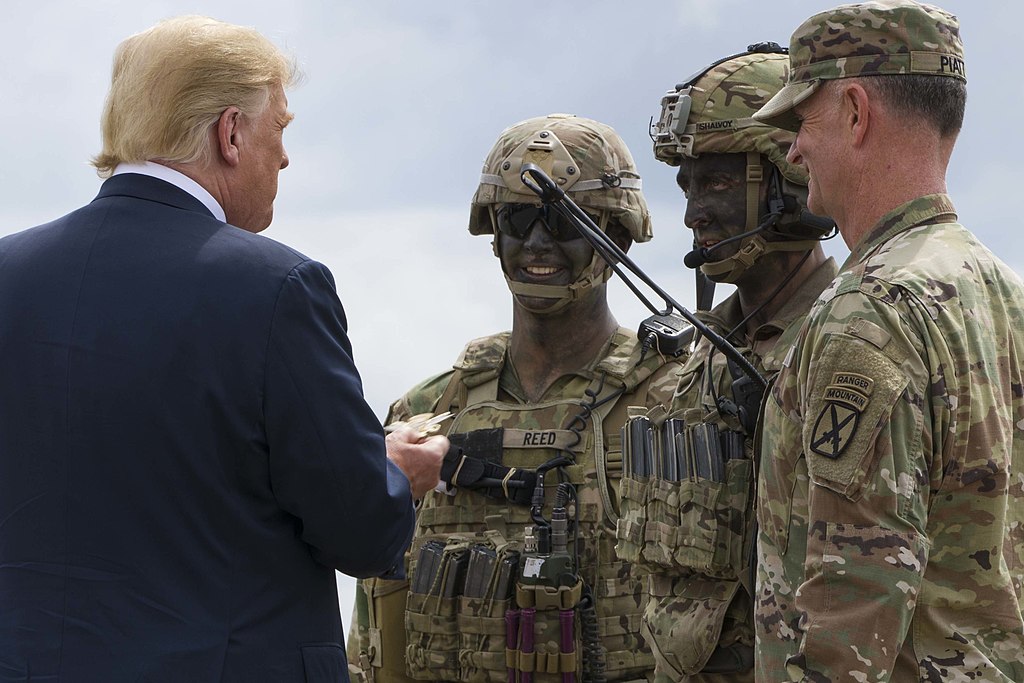
President Donald J. Trump is presented with a 10th Combat Aviation Brigade challenge coin following an air assault and gun rain demonstration at Fort Drum, New York, on August 13. The demonstration was part of President Trump's visit to the 10th Mountain Division (LI) to sign the National Defense Authorization Act of 2019, which increases the Army's authorized active-duty end strength by 4,000 enabling us to field critical capabilities in support of the National Defense Strategy. (U.S. Army photo by Sgt. Thomas Scaggs) 180813-A-TZ475-010

A Republican congressional candidate and former U.S. Marine has triggered a firestorm after posting a bizarre video branding President Donald Trump “the Antichrist” and declaring that he “must be killed.”

William Upham, a write-in candidate for Florida’s 5th Congressional District, delivered the nearly seven-minute religious and political rant while wearing a Marine Corps uniform—even though the service says he was medically discharged more than a year ago.

Upham initially presented his campaign as an effort to restore bipartisanship, return power to working Americans and “fix our broken political system.”

Then the video took a dark turn.

“We are led by a president who is the enemy of God,” Upham said, according to Fox News.

After quoting Bible passages and invoking the oath he took as a Marine officer to defend the Constitution “against all enemies, foreign and domestic,” Upham leveled an extraordinary accusation against the commander in chief.

“There is no doubt in my mind that the president of the United States, Donald J. Trump, is the Antichrist,” Upham said. “He is a false messiah. And he is your enemy. And he must be killed.”

Upham claimed Trump’s criticism of Pope Leo XIV and a previously posted AI-generated image depicting the president in Christ-like imagery helped shape his conclusion, according to the New York Post.

“He is nothing like Jesus Christ,” Upham said.

Later in the video, he urged Americans to consider whether they were “worshiping a false idol” before declaring: “President Trump is the Antichrist. And he will be killed and sent to hell. God will prevail against evil.”

Upham also said violence should never be used for “evil purposes such as vengeance or plunder,” an assertion sharply at odds with his earlier declaration about the president.

The Marine Corps swiftly disavowed the former officer.

“The Marine Corps is aware of the disturbing statements made by William Upham, who was medically discharged on May 30, 2025,” the service said in a statement posted to X. “The comments made by Upham are a direct violation of the oath he swore to uphold and are not in keeping with the service’s values.”

Upham served in the Marines from 2021 until 2025 and reached the rank of first lieutenant, according to Task & Purpose.

Acting Navy Secretary Hung Cao also condemned the candidate’s remarks.

“Unacceptable,” Cao wrote on X. “William Upham is no longer a Marine and does not represent our values or ethos.”

The Secret Service confirmed that it was aware of the video.

“The U.S. Secret Service is aware of the comments made by a congressional candidate in Florida, and we investigate anything that can be perceived as a threat toward one of our protectees,” a spokesperson told Fox News Digital. “Out of concern for operational security, we do not discuss matters of protective intelligence.”

The violent rhetoric is especially alarming after multiple assassination attempts against Trump and the killing of conservative activist Charlie Kirk in September 2025.

Despite the national attention generated by his video, Upham appears to be a fringe contender in the August 18 Republican primary. He is running as a write-in candidate against five-term incumbent Rep. John Rutherford, conservative radio personality Mark Kaye and Donald Muirheid, according to Ballotpedia.

No reputable public opinion poll located as of Thursday showed measurable support for Upham. One prediction-market tracker gave Rutherford a roughly 93% chance of winning the nomination, however it’s important to note that prediction-market odds are not the same as voter polling.

Rutherford also begins the race from a commanding position. The former Jacksonville sheriff won reelection in 2024 with more than 63% of the vote, carrying the heavily Republican district by approximately 26 percentage points.

Upham’s own campaign website describes him as a Marine, prosecutor and Republican running “for God and country.” It also promises voters: “No more insiders. No more extremism. No more excuses.”

After his explosive video, that anti-extremism pitch is now facing intense scrutiny.

Trump Endorses Mike Lindell In Minnesota Governor’s Race

1
President Donald Trump gestures to the crowd after delivering remarks at the House GOP Member Retreat, Tuesday, January 6, 2026, at the Donald J. Trump- John F. Kennedy Center for the Performing Arts in Washington, D.C. (Official White House Photo by Daniel Torok)

President Donald Trump is throwing his political weight behind one of his longest-standing allies, giving MyPillow founder Mike Lindell his “complete and total endorsement” in Minnesota’s closely watched race for governor — a move that underscores the president’s loyalty to one of his fiercest defenders even as Republicans debate the party’s best path to winning a traditionally blue state.

Trump announced his endorsement Wednesday morning in a lengthy Truth Social post, praising Lindell as a tireless supporter who has stood by him through years of political and legal battles.

“Mike Lindell, the ‘Pillow Man,’ and one of America’s greatest and most hard working Patriots, is running to be GOVERNOR OF MINNESOTA, replacing one of the worst and most incompetent governors in the history of the U.S.A.,” Trump wrote.

The president argued Lindell could reverse what he described as the state’s decline under outgoing Democratic Gov. Tim Walz.

“He can do it! Nobody has sacrificed more than Mike Lindell in fighting for our country, especially when it comes to Election Integrity,” Trump continued. “He truly deserves everything he gets – He will MAKE MINNESOTA GREAT AGAIN!!!”

Trump concluded with an unequivocal endorsement.

“MIKE LINDELL HAS MY COMPLETE AND TOTAL ENDORSEMENT – HE WILL NOT LET YOU DOWN. Good Luck Mike!!!”

The endorsement formalizes a relationship that has stretched back years. Lindell emerged as one of Trump’s most visible allies after the 2020 election, frequently appearing alongside the president, using his platform to defend Trump’s claims about election integrity, and becoming a regular presence at rallies and conservative events. His loyalty came at a steep personal and financial cost, with retailers dropping MyPillow products and voting technology companies filing high-profile defamation lawsuits against him over statements about the 2020 election.

Trump has repeatedly praised Lindell for remaining loyal despite those setbacks. Even before issuing his formal endorsement, the president had publicly said last year that Lindell “deserves to be governor of Minnesota.”

Lindell launched his gubernatorial campaign last December, joining a crowded Republican field seeking to replace Walz, who opted against seeking another term. Walz’s administration has faced sustained criticism from Republicans over massive fraud schemes involving state-administered federal nutrition programs, allegations Trump referenced again in his endorsement.

The endorsement also comes as Minnesota Republicans remain divided over their preferred nominee.

While businessman Kendall Qualls secured the Minnesota GOP’s endorsement at the state convention, Lindell has continued campaigning aggressively and has remained competitive in public polling. A recent SurveyUSA/KSTP poll showed Lindell leading the Republican primary field with 27% support, ahead of Minnesota House Speaker Lisa Demuth at 22% and Qualls at 17%, though roughly one-quarter of Republican voters remained undecided.

If Lindell captures the Aug. 11 Republican primary, he would likely face Democratic Sen. Amy Klobuchar, who entered the governor’s race after Walz stepped aside and has built a substantial fundraising advantage. Multiple early surveys have shown Klobuchar beginning the general election campaign as the favorite.

Trump nevertheless argued Republicans can prevail, while again alleging election problems have hurt the GOP in Minnesota.

In a separate Truth Social post Wednesday, the president blasted Klobuchar as “lightly respected” and accused her of knowing about the fraud allegations surrounding Minnesota’s child nutrition reimbursement programs.

“I have gotten to know Klobuchar over the years, and find her to be equally as incompetent as Walz, and probably equally as corrupt in that, as a high Government Official from Minnesota, she knew everything that was going on,” Trump wrote.

He also claimed, “If the Elections in Minnesota weren’t RIGGED, any Republican could win, but they were, and that is why nobody has won there since Richard Nixon many years ago. I thought I won it all three times, only to be disappointed in the end.”

Minnesota’s Republican primary is scheduled for Aug. 11, with the general election set for November.

Trump-Backed Pastor Drops Congressional Bid After Texting Scandal

2

A prominent Oklahoma pastor who built his national profile as a staunch Trump ally and conservative Christian activist has abruptly suspended his campaign for Congress after reports revealed intimate text exchanges with a former beauty queen connected to his campaign.

Jackson Lahmeyer, founder of the pro-Trump organization Pastors for Trump, announced he was ending his bid for Oklahoma’s 1st Congressional District following reports detailing flirtatious messages between him and former Miss Oklahoma USA Caitlin Simmons Key, who worked as a fundraiser for his campaign.

The controversy quickly exposed an uncomfortable contradiction for a candidate who has spent years promoting conservative family values while presenting himself as a moral voice within the MAGA movement.

Lahmeyer admitted he had “crossed a boundary line through text messaging” but denied having a physical affair. He said he and his wife had already addressed the matter through counseling and prayer.

“I decided to choose my wife over my ambition,” Lahmeyer told reporters after announcing his withdrawal.

The political consequences were swift.

President Donald Trump, who had previously endorsed Lahmeyer and praised him as a “MAGA Warrior,” publicly abandoned the pastor and shifted his support to Oklahoma state Rep. Mark Tedford.

While Trump thanked Lahmeyer for his loyalty and years of support, he made clear that Tedford would now carry the America First banner in the race.

Lahmeyer insists his decision to leave the race was made before Trump’s endorsement switch became public. Still, the timing underscored how quickly political fortunes can change when personal scandals collide with public campaigns.

For years, Lahmeyer cultivated close ties to the Trump movement. His Tulsa church hosted appearances from Donald Trump Jr. and Eric Trump, and he became a nationally recognized evangelical voice defending Trump’s agenda. He also promoted claims of widespread voter fraud following the 2020 election and worked to mobilize evangelical voters during Trump’s 2024 campaign.

Now, the pastor who built his reputation on faith, family values, and political activism finds himself stepping away from public office after failing to meet the standards he routinely championed.

His exit effectively clears the path for Tedford to become the Republican nominee in the race to replace outgoing Rep. Kevin Hern, who is running for the U.S. Senate.

This article originally appeared on Election Watch News. It is republished with permission. To receive more reporting and analysis from Election Watch News, subscribe by clicking here.

GOP Senator Warns Trump Is Headed For A Midterm ‘Disaster’ After Brutal Primary Defeat

5
Political representation of parties making money

A veteran Republican senator who was just driven from office by President Donald Trump’s political machine is now warning that the president may soon regret it.

Sen. John Cornyn (R-Texas), who lost his Republican Senate primary runoff to Trump-backed Texas Attorney General Ken Paxton, is predicting that Republicans could face major trouble in the 2026 midterm elections — and that Trump himself will suffer the consequences.

In an interview with The New York Times, Cornyn said he believes the president is setting himself up for what could become “the most miserable two years of his life” if Republicans lose ground in Congress next November.

“I think November is going to be a disaster,” Cornyn told the newspaper. “He’s going to have the most miserable two years of his life in the last two years of his term.”

The warning comes just weeks after Paxton delivered a crushing defeat to Cornyn in the Texas GOP runoff, ending the senator’s more than two-decade Senate career. Trump endorsed Paxton late in the race, helping push the controversial attorney general to victory over one of the most senior Republicans in Washington.

Cornyn admitted he believed Trump might stay neutral in the contest.

“I had really thought that we’d gone on so long with no endorsement that he was just going to stay out of it,” Cornyn told the Times. “But he couldn’t resist.”

The outgoing senator also suggested Trump’s treatment of him revealed a broader problem inside today’s Republican Party.

“If he would do that to me, he would do that to anybody,” Cornyn said. “There’s never going to be good enough for him, other than 100 percent, slavish adherence to whatever he wants.”

Cornyn argued that such demands run counter to the constitutional role of senators, who are supposed to provide checks and balances rather than unquestioning loyalty to any president.

The comments mark one of the sharpest public rebukes Trump has received from a longtime Republican ally. Despite occasional disagreements, Cornyn voted with Trump’s agenda at an exceptionally high rate during the president’s first term and was widely viewed as part of Senate Republican leadership’s institutional wing.

Trump nevertheless sided with Paxton, whom he praised as a loyal supporter of both himself and the MAGA movement. Following the runoff, Trump wrote on Truth Social that Cornyn would remain his friend and that Republicans would soon see Paxton become “a fantastic, common sense Senator.”

Cornyn was not impressed.

“If that’s the way friends treat you, you wonder about his enemies,” he remarked.

A Growing Republican Concern

Cornyn’s warning reflects concerns that have quietly surfaced among some Republicans since Paxton’s victory.

Several GOP senators and strategists argued before the runoff that replacing Cornyn with Paxton could complicate Republican efforts to hold the seat in November. Paxton carries years of political baggage, including impeachment proceedings in Texas and numerous ethics controversies that Democrats are expected to spotlight during the general election campaign.

According to reporting from Semafor, some Republican senators privately worried that Trump’s endorsement would make the Texas race significantly more expensive and difficult to defend, forcing the GOP to divert resources from other key battlegrounds.

TIME magazine similarly reported that establishment Republicans viewed Cornyn as a safer candidate and feared Trump’s intervention could create an opening for Democrats in a state that has remained reliably Republican for decades.

ABC News noted that Cornyn’s loss joins a growing list of Republican officials whose conservative credentials proved insufficient after falling out of favor with Trump.

Looking Ahead To 2026

Cornyn’s prediction comes as both parties begin looking toward the 2026 midterms, when control of Congress will once again be on the line.

Historically, the president’s party often loses seats during midterm elections, particularly during a second term. Should Republicans suffer significant losses in either chamber, Trump could find himself facing congressional investigations, legislative gridlock, and renewed political battles during the final two years of his presidency.

For now, however, Trump’s grip on the Republican base remains strong enough to reshape the party even against the wishes of many of its elected leaders.

Cornyn’s defeat may ultimately become one of the clearest examples yet of that reality.

The question now is whether his warning about a coming Republican “disaster” proves prophetic — or whether Trump’s political dominance continues carrying the GOP through another election cycle.

READ NEXT: Trump Calls For Expulsion Of Rep. Jamie Raskin, Escalating Feud Over Impeachment Efforts