



Fox Host Praises Trump’s $5K Pledge As Questions Mount Over Cost And Authority
Rachel Campos-Duffy called the president’s proposal “creative and rule-breaking,” but the conditional payments could cost more than $1 trillion, require congressional approval, and far exceed current tariff revenue.
Fox News host Rachel Campos-Duffy praised President Donald Trump’s promise to send $5,000 to every adult American citizen if Republicans retain control of Congress, calling the proposal “creative and rule-breaking.”
Speaking Thursday on “Fox & Friends,” Campos-Duffy said the pledge could help Republicans build momentum before the Nov. 3 midterm elections.
“This shows just how creative and rule-breaking and out of the box President Trump is,” Campos-Duffy said. “I’m surprised no one has thought of this before.”
She added: “I mean, it’s actually a great way, as you say, to sort of get that momentum, push things forward. Especially if you are running, you know, as the incumbent in the midterm, you know you’re already going to have those headwinds. This was a brilliant idea on their part.”
The political appeal is easy to understand. The policy behind it remains largely undefined.
Trump cannot distribute the money without congressional authorization, Congress has not approved the estimated $1.2 trillion needed to fulfill the promise, and the White House has not released a detailed funding plan.
WATCH: Rachel Campos-Duffy reacts to Trump’s $5,000 dividend pledge
Trump Ties Payments to Republican Victory
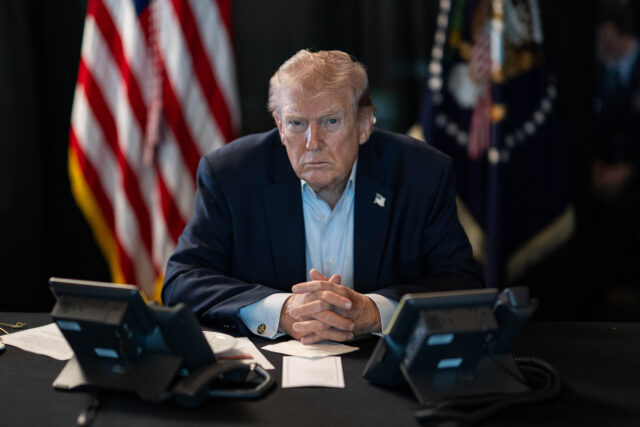
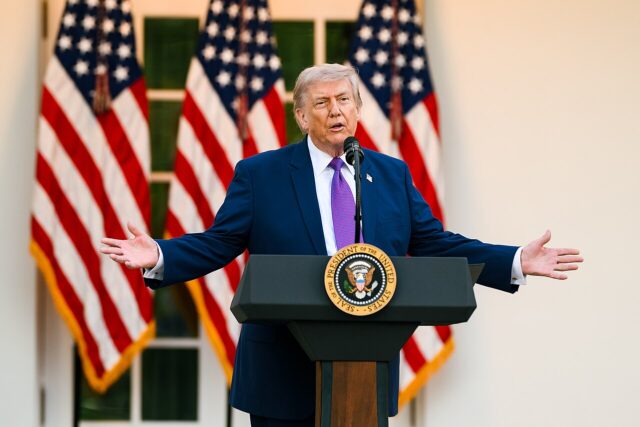
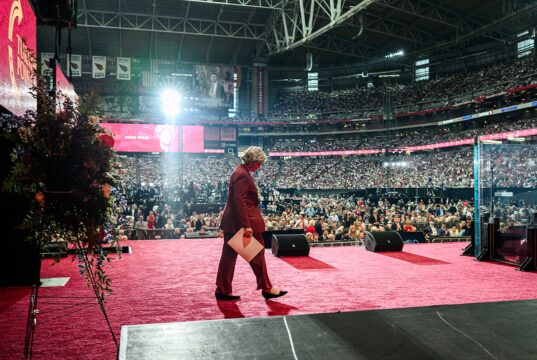
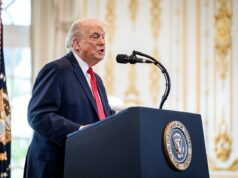
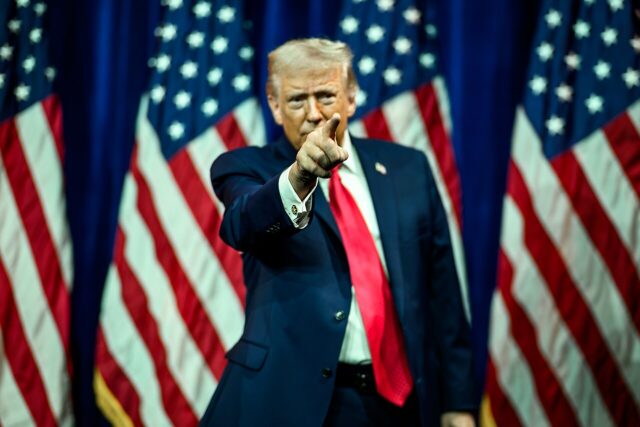
Trump unveiled what he called the “Trump Dividend” Wednesday night during the Republican Party’s midterm convention in Dallas.
“Here is my promise: If the Republicans win the House of Representatives and the United States Senate — both of them —because of our tremendous economic success, like in history. We’ve never had anything like what’s happening. But because of our tremendous strength and success economically, I will issue a dividend to every adult citizen in the United States of America for $5,000.”
“That alone should win the midterms,” Trump added.
Trump said recipients would be required to spend the money inside the United States, but he did not explain how the government would enforce that restriction. His remarks also did not specify a delivery date, an income limit, a legislative structure, or a precise funding source.
The president compared the payment to a profitable company distributing money to its shareholders.
“If the Republicans win, you win with us,” Trump told the crowd. “Now all we have to do is win.”
The White House had not released legislation or a formal cost estimate as of Thursday.
Cost Could Reach $1.2 Trillion
The United States has approximately 240 million adult citizens. Paying each of them $5,000 would cost roughly $1.2 trillion before administrative expenses.
That would represent a major new federal expenditure while the government is already operating at a substantial deficit. The Congressional Budget Office reported that the federal deficit totaled nearly $1.8 trillion in fiscal 2025.
The Constitution gives Congress — not the president acting alone — control over federal appropriations. Lawmakers would therefore have to authorize the payments and identify a source of funding.
Sen. Bernie Moreno (R-Ohio) endorsed Trump’s proposal and said he would prepare legislation authorizing the dividend if Republicans win in November.
Other Republicans have been more cautious.
Rep. Chip Roy (R-Texas) told Politico that he wanted to know how the administration intended to finance what he calculated would be a payment “well over $1 trillion.”
The final cost could be lower if Congress imposed income limits or narrowed eligibility. Such restrictions would depart from Trump’s initial promise of payments to “every adult citizen.”
Vance Suggests Wealthy Americans May Be Excluded
Vice President JD Vance suggested after Trump’s speech that wealthy Americans might not qualify.
Vance also argued that tariff revenue could help finance the plan.
“Tariffs have generated a lot of revenues,” Vance told Fox News anchor Bret Baier. “The president is saying, if you keep us in power, then you will share in some of the benefit of this incredible wealth that we are creating.”
Tariffs have generated additional federal revenue, but not nearly enough to finance universal $5,000 payments.
Treasury Department figures cited by Time magazine show that customs duties generated approximately $154.5 billion during the first 10 months of fiscal 2026. A $1.2 trillion dividend would cost nearly eight times that amount.
Some tariff revenue also could be reduced by refunds connected to duties the Supreme Court determined were unlawfully imposed under the International Emergency Economic Powers Act.
Unless lawmakers approved substantial spending cuts or another source of revenue, the payments would increase federal borrowing.
Economists have also warned that injecting more than $1 trillion into the economy could increase inflationary pressure. The extent of that effect would depend on the payments’ timing, eligibility requirements, and financing.
Critics Use ‘Bribery’ Label
Some of Trump’s opponents characterized the promise as a “bribe” because he explicitly conditioned the payments on Republicans winning both chambers of Congress.
Baier raised that criticism during his interview with Vance.
“I can hear the critics’ heads exploding,” Baier said. “They’re saying out loud, I guarantee you, ‘the president is bribing voters to vote for Republicans to take over the House, and then he’s bankrupting the country because the deficit and debt is huge and inflation would come back if this comes into play.’ So how do you answer those criticisms?”
Candidates routinely campaign on promises involving tax reductions, new benefits, or government payments that require them and their allies to win office. Trump did not offer individual voters money in exchange for demonstrating how they cast their ballots.
Legal experts told the Associated Press that the proposal would not ordinarily constitute criminal voter bribery, describing it as a campaign promise conditioned on an electoral outcome rather than a payment conditioned on how an individual votes.
Previous Dividend Proposals Did Not Become Law
Trump has floated several direct-payment proposals during his second term.
He previously endorsed a $2,000 tariff dividend, proposed returning part of the savings attributed to the Department of Government Efficiency, and supported deposits into health savings accounts. Congress did not enact those broader payments.
Trump also announced a $1,776 payment for military personnel. That “Warrior Dividend” used money Congress had already appropriated for a housing supplement, making it materially different from the newly proposed $5,000 payments.
Trump’s first administration distributed two rounds of stimulus checks during the COVID-19 pandemic, but those payments also required legislation passed by Congress.
Campos-Duffy’s praise captured the proposal’s immediate political value: It gives voters a clear and easily understood financial incentive to support continued Republican control.
Whether it becomes policy depends on considerably more complicated questions. Congress would have to approve it, lawmakers would need to find more than $1 trillion or restrict eligibility, and the government would have to determine whether the payment could be administered without significantly increasing federal deficits or inflation.
Until the White House submits legislation and identifies a credible funding source, the “Trump Dividend” remains a campaign promise — not a guarantee.
READ NEXT: Today’s AI Is Low Risk. What Comes Next Could Be Different.