National Security

Home National Security Page 2

MTG Accuses Trump Of Implementing ‘Manufactured Crisis’ To Cancel Midterm Elections

Former Rep. Marjorie Taylor Greene (R-GA) said Sunday that she could envision President Donald Trump declaring a “national emergency” tied to Iran or another crisis, responding to speculation that such a move could affect the upcoming midterm elections.

The comments came after conservative podcaster Shannon Joy posted on X, “Trump doesn’t seem to care about the midterms. Who wants to bet he’ll declare a ‘national emergency’ because of Iran (or some other manufactured crisis) and try to cancel the elections in November?”

Greene replied, “Yeah, I could see it. INSANE.”

Her response follows a recent public break with the president over U.S. military action against Iran. Greene has sharply criticized the strikes in multiple social media posts, arguing they run counter to the “America First” platform that helped elect Trump.

“The Trump admin actually asked in a poll how many casualties voters were willing to accept in a war with Iran???” Greene wrote Saturday on X. “How about ZERO you bunch of sick f*cking liars. We voted for America First and ZERO wars.”

In another post, she added: “This is NOT freeing the Iranian people!!! This is murdering their children!!! WTF are you insane people doing??? AMERICA DOES NOT SUPPORT THIS!!!”

The exchange comes amid debate within Republican circles about the administration’s decision to strike Iran. Critics have questioned the timing, noting that Trump said in June that prior U.S. strikes had “obliterated” Iran’s nuclear capabilities.

In an interview Sunday with Fox News’ Jacqui Heinrich, Trump defended the latest action, saying that without U.S. and Israeli missile strikes, Iran “would have had a nuclear weapon within two weeks.”

However, Sen. Ted Cruz (R-TX) offered a more measured assessment during an appearance on CBS News’ “Face the Nation.”

“I don’t have present-day intelligence on what progress they had made toward rebuilding nuclear weapons since we bombed their facilities,” Cruz said. “I have no indication that they were anywhere close to getting nuclear weapons, because our bombing was devastating… That’s one of the reasons I urged President Trump, ‘Now is the time’” to strike.

The midterm elections, scheduled for November, are expected to be closely contested, with some political analysts projecting potential Republican losses in key districts. Greene’s comments reflect broader concerns among some conservatives about U.S. involvement in foreign conflicts and their potential domestic political implications.

A January report from Roll Call cited a prior Oval Office meeting in which Trump discussed elections during wartime. According to the report, during an Aug. 18 meeting, Ukrainian President Volodymyr Zelenskyy spoke about the conditions required to restart elections in Ukraine.

“So you say, during the war, you can’t have elections,” Trump mused, according to the report. “So you mean if we happen to be in a war with somebody, no more elections. I wonder what the fake news would say to that.”

Secret Service Fatally Shoot Armed Mar-A-Lago Intruder

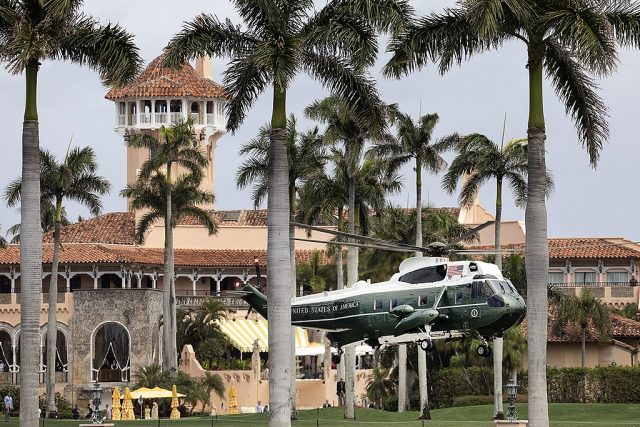
Marine One lifts-off after returning President Donald J. Trump to Mar-a-Lago Friday, March 29, 2019, following his visit to the 143-mile Herbert Hoover Dike near Canal Point, Fla., that surrounds Lake Okeechobee. The visit was part of an infrastructure inspection of the dike, which is part of the Kissimmee-Okeechobee Everglades system, and reduces impacts of flooding for areas of south Florida. (Official White House Photo by Joyce N. Boghosian) [Photo Credit: The White House from Washington, DC, Public domain, via Wikimedia Commons]

PALM BEACH, Fla. — A 21-year-old man was shot and killed early Sunday after allegedly breaching the secure perimeter of President Donald Trump’s Mar-a-Lago estate, prompting a multi-agency federal investigation, the U.S. Secret Service confirmed.

The incident unfolded around 1:30 a.m. when the suspect made what officials described as an “unauthorized entry” onto the property.

According to the Secret Service, the individual was observed near the north gate carrying what appeared to be a shotgun and a fuel can. Agents, along with a deputy from the Palm Beach County Sheriff’s Office (PBSO), responded immediately.

Sheriff Ric Bradshaw identified the suspect as Austin Tucker Martin, 21, of North Carolina.

Bradshaw said during a press conference that a deputy and two Secret Service agents assigned to the detail confronted the man after he entered what authorities described as the “inner perimeter” of the estate.

“They confronted a white male that was carrying a gas can and a shotgun. He was ordered to drop those two pieces of equipment that he had with him — at which time he put down the gas can, raised the shotgun to a shooting position,” Bradshaw told reporters. “At that point in time, the deputy and the two Secret Service agents fired their weapons and neutralized the threat.”

Bradshaw said the suspect did not respond verbally to commands from law enforcement officers to drop the items.

Martin was pronounced dead at the scene.

Officials confirmed that no Secret Service personnel or sheriff’s deputies were injured during the confrontation. No Secret Service protectees were present at Mar-a-Lago at the time of the incident, and Trump was not in Florida when the shooting occurred.

The FBI, Secret Service, and Palm Beach County Sheriff’s Office are jointly investigating the shooting, including the suspect’s background, actions, potential motive, and the use of force.

FBI Miami Special Agent in Charge Brett Skiles said the bureau is assisting due to the location being under Secret Service protection.

The FBI’s evidence response team is processing the scene and collecting physical evidence. Skiles urged residents in the area to review surveillance footage from late Saturday night into early Sunday morning.

“If you see anything that looks suspicious or out of place, please contact us,” he said.

FBI Director Kash Patel said in a post on X that the agency “is dedicating all necessary resources in the investigation of this morning’s incident,” adding that the bureau “will continue working closely with @SecretService as well our state and federal partners and will provide updates as we are able.”

Heightened Security After Previous Threats

Sunday’s incident comes amid heightened security surrounding Trump following multiple high-profile threats and assassination attempts in recent years. Most notably, Trump survived an assassination attempt during a July 2024 campaign rally in Butler, Pennsylvania, where a gunman opened fire, injuring Trump and killing a rally attendee. That attack prompted sweeping reviews of Secret Service procedures and significantly intensified protective measures at Trump properties and public events.

Since then, federal authorities have reported disrupting additional threats against the former president, contributing to an already elevated security posture.

Mar-a-Lago, which serves as Trump’s private residence and a frequent venue for political and public events, operates under layered security protocols when under Secret Service protection. Officials have not yet indicated whether Sunday’s incident is connected to any broader threat.

The investigation remains active, and authorities say additional details will be released as they become available.

Report: Trump Advisor Warns ‘90% Chance’ Strike On Iran Is Coming

President Donald Trump gestures to the crowd after delivering remarks at the House GOP Member Retreat, Tuesday, January 6, 2026, at the Donald J. Trump- John F. Kennedy Center for the Performing Arts in Washington, D.C. (Official White House Photo by Daniel Torok)

A senior adviser to President Donald Trump is warning that U.S. military action against Iran may be imminent as diplomatic efforts appear to be faltering.

One senior adviser told Axios reporter Barak Ravid on Monday that there is a “90% chance” the United States could launch strikes within weeks.

“The boss is getting fed up. Some people around him warn him against going to war with Iran, but I think there is 90% chance we see kinetic action in the next few weeks,” the adviser said.

The comments come amid heightened tensions following three-hour talks in Geneva between Trump advisers Jared Kushner and Steve Witkoff and Iranian Foreign Minister Abbas Araghchi. Both sides publicly stated that discussions “made progress,” though significant differences remain.

Vice President JD Vance echoed that assessment, signaling that while diplomacy has not collapsed, it may be nearing its limits.

Negotiations “went well” in some ways, Vance said, but “in other ways it was very clear that the president has set some red lines that the Iranians are not yet willing to actually acknowledge and work through.” He cautioned that diplomacy could soon have “reached its natural end.”

The administration has consistently maintained that Iran will not be permitted to obtain a nuclear weapon, a position widely supported by Republican lawmakers and national security hawks. Trump has repeatedly emphasized that Tehran must meet strict conditions or face serious consequences.

At the same time, U.S. military deployments in the region have accelerated. Two aircraft carriers, dozens of warships, and hundreds of fighter jets are being positioned across the Middle East. More than 150 cargo flights have reportedly delivered weapons systems and ammunition to support forces in the region.

According to Axios, a potential strike on Iran would likely unfold as a sustained and coordinated U.S.-Israeli effort. Sources familiar with planning discussions indicated that any operation would not be limited to nuclear facilities but could also target key regime assets.

While the president has continued to leave the door open to a negotiated solution, senior officials suggest patience is rapidly wearing thin.

On Tuesday, Iranian Foreign Minister Abbas Araghchi said the two sides reached a “general agreement on a number of guiding principles” and agreed to begin drafting text for a possible agreement during a meeting between the two countries, with plans to exchange drafts and schedule a third round of talks. 

“Good progress was made compared to the previous meeting,” he said, adding that while drafting would slow the process, “at least the path has started.”

War Department Takes Out Cartel-Owned Drone

By Gage Skidmore from Peoria, AZ, United States of America - Pete Hegseth, CC BY-SA 2.0

On Wednesday morning, the White House confirmed drone activity from Mexican drug cartels caused the sudden closure of U.S. airspace over El Paso, Texas.

In a statement to Newsweek the White House said: “Mexican cartel drones breached US airspace. The Department of War took action to disable the drones.

“The FAA and DOW have determined there is no threat to commercial travel.”

A Trump administration official told Fox News that the initial lockdown came in response to “Mexican cartel drones” that breached U.S. airspace. The FAA had announced Wednesday morning that all flights to and from El Paso were being grounded, including commercial, cargo and general aviation. The restriction was initially set to be effective from February 10 at 11:30 p.m. MST to February 20 at 11:30 p.m. MST.

“Mexican cartel drones breached US airspace. The Department of War took action to disable the drones. The FAA and DOW have determined there is no threat to commercial travel,” the official told Fox News.

Restrictions set earlier by the Federal Aviation Administration (FAA) have been lifted and authorities say there remains no threat to commercial air travel.

“The temporary closure of airspace over El Paso has been lifted. There is no threat to commercial aviation. All flights will resume as normal,” the FAA said on its X account.

This is a breaking news story. Please check back for updates.

Attempted Trump Assassination Suspect Sentenced In Court

Just in…

On Wednesday, Ryan Routh was sentenced to life in prison plus seven years over his attempt to assassinate Donald Trump on a Florida golf course.

Prosecutors argued that Routh, 60, should get a life sentence after a jury last year convicted him on five counts for allegedly plotting “painstakingly to kill President Trump, and [taking] significant steps toward making that happen.” 

“Routh’s crimes undeniably warrant a life sentence — he took steps over the course of months to assassinate a major presidential candidate, demonstrated the will to kill anybody in the way, and has since expressed neither regret nor remorse to his victims,” prosecutors argued in a court filing. 

During the September trial, a jury quickly found Routh guilty on five felony counts, including attempted assassination of a major presidential candidate and assaulting a federal officer. 

Routh allegedly hid in the bushes of the Trump International Golf Club in West Palm Beach and pointed a military-grade SKS rifle towards Trump and a Secret Service agent. 

“Routh’s crimes of conviction reflect careful plotting, extensive premeditation, and a cowardly disregard for human life,” prosecutors wrote. “Routh’s motive for his crimes was unconscionable – preventing the American people from electing the candidate of their choice for President. Routh’s gloss on his crimes has always been that anything he may have done was justified by events in Ukraine or American domestic politics.”

Since his conviction, Routh was appointed an attorney and has requested a 27-year sentence that would allow him to “experience freedom again as opposed to dying in prison.” His lawyer argued that Routh could not have a fair trial because he represented himself, even though Routh made that decision after repeated warnings about the potential consequences. 

Routh represented himself at trial and attempted to argue that he never intended to harm Trump or the Secret Service agent, claiming his actions were a form of protest

Judge Aileen Cannon, a Trump-appointed judge, dismissed the criminal case against the president in 2024 related to his handling of classified documents. Routh unsuccessfully attempted to have Cannon removed from the case by arguing her appointment by Trump is a conflict of interest.

This is a breaking news story. Please check back for updates.

Russian Military Plane Lands In Cuba As Trump Declares National Emergency

0
Kremlin.ru, via Wikimedia Commons

A sanctioned Russian military cargo plane landed Sunday night at a Cuban military airfield outside Havana, raising fresh concerns in Washington as President Donald Trump sharply escalates pressure on the communist government in Cuba.

The aircraft — an Ilyushin Il-76 heavy transport jet operated by Russian state-linked airline Aviacon Zitotrans — touched down at San Antonio de los Baños Airfield, a Cuban military installation roughly 30 miles south of the capital, according to public flight-tracking data. The Il-76 is commonly used to move military equipment and personnel and has been scrutinized by U.S. officials in past operations.

Flight records show the plane traveled through St. Petersburg and Sochi in Russia, Mauritania, and the Dominican Republic before arriving in Cuba. Each stop would have required authorization from host governments, highlighting which countries continue to permit Russian military-linked aircraft to operate despite Western sanctions.

The same aircraft conducted multiple flights to Venezuela, Nicaragua, and Cuba in late October 2025, during a period of heightened tensions between Washington and Caracas. Those movements preceded U.S. military action in Venezuela that resulted in the capture of longtime strongman Nicolás Maduro, an operation U.S. officials and analysts have since cited as a warning sign when assessing similar Russian aviation activity in the region.

Now, attention has turned to Cuba — and to President Trump’s increasingly aggressive posture toward Havana.

On Thursday, Trump declared a national emergency related to Cuba, stating that the Cuban government poses an “unusual and extraordinary threat” to U.S. national security and foreign policy interests. The administration also announced it would impose penalties on any country that sells or supplies oil to Cuba without U.S. authorization, a move aimed at further isolating the regime.

Trump confirmed Sunday that the United States is engaged in direct talks with Cuban officials.

“Cuba is a failing nation. It has been for a long time, but now it doesn’t have Venezuela to prop it up,” Trump told reporters at Mar-a-Lago. “So we’re talking to the people from Cuba, the highest people in Cuba, to see what happens. I think we’re going to make a deal with Cuba.”

Trump and Secretary of State Marco Rubio have both signaled support for political change in Havana, though the administration has not said whether it would pursue that goal through military action.

Russian military ties to Cuba have long alarmed U.S. officials. While Moscow’s presence on the island diminished after the Cold War, Russia has steadily rebuilt defense and intelligence cooperation with Havana over the past decade — a development Washington views as a potential security risk just 90 miles from the U.S. mainland.

The Il-76’s capabilities only heighten those concerns. The aircraft can carry roughly 50 tons of cargo or up to 200 personnel, and its operator, Aviacon Zitotrans, has a well-documented history of supporting Russia’s defense sector. The airline has been sanctioned by the United States, Canada, and Ukraine.

“Aviacon Zitotrans has shipped military equipment such as rockets, warheads, and helicopter parts all over the world,” the U.S. Treasury Department said when it sanctioned the company in January 2023.

It remains unclear what the aircraft carried on its most recent flight. During earlier operations tied to Venezuela, Russian state media and a Russian lawmaker said the same plane delivered Pantsir-S1 short-range and Buk-M2E medium-range air defense systems to Caracas.

With the Trump administration pressing Cuba economically and diplomatically — and with Russian military activity once again surfacing in the Caribbean — U.S. officials are watching closely

Trump Confirms The US Used New Sonic Weapon

The White House, Public domain, via Wikimedia Commons

President Donald Trump confirmed in a NewsNation interview this week that the U.S. used a previously undisclosed weapon during the mission that captured Venezuelan strongman Nicolás Maduro earlier this month.

During a conversation with NewsNation host Katie Pavlich, Trump was asked about reports claiming a “sonic weapon” was deployed in Venezuela—one that allegedly disabled Maduro’s Cuban bodyguards and left them unable to fight back.

Trump didn’t offer technical details, but he strongly implied the reports were accurate.

“Yeah, something I don’t wanna— Nobody else has it,” Trump said, suggesting the U.S. possesses capabilities that America’s enemies simply can’t match.

Trump added that the U.S. military has “weapons that nobody knows about,” saying it’s better not to discuss them publicly—but praising the operation as a total success.

“That was an amazing attack,” Trump said. “Don’t forget, that house was in the middle of a fort, an army base, a big one, a lot of soldiers, and they came in and they did their job. We lost nobody.”

Leavitt amplified viral claims of a “sound wave” weapon

The conversation follows a viral post shared on X by White House Press Secretary Karoline Leavitt on January 10. Leavitt reposted a dramatic account from influencer Mike Netter, writing, “Stop what you are doing and read this…”

Netter’s post claimed to feature an exchange between a Venezuelan security guard loyal to Maduro and an interviewer. In the account, the guard described U.S. forces as overwhelmingly precise and unstoppable, even while badly outnumbered.

The guard alleged the Americans used such advanced firepower that it seemed “each soldier was firing 300 rounds per minute,” and claimed the attack wasn’t just about guns.

According to the account, the turning point came when U.S. troops launched something the guard described as “a very intense sound wave.” He claimed it caused instant physical effects—including nosebleeds, disorientation, and even vomiting blood—leaving Maduro’s men collapsed and defenseless.

The guard also claimed the raid ended with roughly twenty U.S. soldiers defeating hundreds of defenders without a single American casualty.

Legacy media largely ignores the story

Despite Trump’s comments and the attention Leavitt’s post received online, the story has seen limited coverage from major U.S. outlets.

However, several British tabloids—including The Independent and Daily Mail—reported on Trump’s remarks, with the Mail running the headline: “Trump reveals details of secret ‘sonic weapon’ used in Venezuela raid: ‘Nobody else has it.’”

Trump Rules Out Deploying Military Forces To Acquire Greenland

1
Gage Skidmore Flickr

President Donald Trump on Wednesday used his appearance at the World Economic Forum in Davos, Switzerland, to sharpen his case for bringing Greenland into the U.S. strategic orbit—while also explicitly rejecting the idea of using military force to do it.

“We probably won’t get anything unless I decide to use excessive strength and force where we would be, frankly, unstoppable. But I won’t do that,” Trump said. “I don’t have to use force. I don’t want to use force. I won’t use force,” he added.

Greenland—the world’s largest island—sits in the Arctic and handles most of its domestic affairs while remaining part of the Kingdom of Denmark. In recent years, its strategic importance has grown rapidly as Russia and China expand their Arctic interests and the region becomes more militarized.

Trump argued the United States is the only nation with the power and reach to defend Greenland effectively, framing the island as essential to protecting America and its allies from modern threats.

“I have tremendous respect for both the people of Greenland and the people of Denmark, tremendous respect. But every NATO ally has an obligation to be able to defend their own territory, and the fact is, no nation or group of nations is in any position to be able to secure Greenland other than the United States. We’re a great power,” Trump said.

Watch:

The president called for “immediate negotiations” to revisit Greenland’s status and said the goal is a formal acquisition rather than a temporary arrangement. As Trump framed it, ownership matters both legally and strategically—especially in an era when missile defense, radar coverage, and Arctic power projection could determine the outcome of any future global conflict.

Outlining his demand that the U.S. acquire Greenland in “right, title and ownership,” Trump argued, “you need the ownership to defend it.”

“You can’t defend it on a lease. No. 1, legally, it’s not defensible that way. Totally. And No. 2, psychologically, who the hell wants to defend a license agreement or a lease?” he asked.

While critics have mocked Greenland as remote, ice-covered, and sparsely populated, national security leaders across multiple administrations—Republican and Democrat alike—have recognized the Arctic as one of the most important front lines in the 21st century. Long-range missiles and hypersonic weapons, for example, don’t follow the routes Americans picture on a classroom map. The shortest path between rival powers often runs straight across the polar region, making Greenland a critical location for early-warning systems and missile tracking.

Trump emphasized that point bluntly, describing Greenland as “a large piece of ice in the middle of the ocean,” but warning of its strategic value “if there is a war” with Russia or China.

“Much of the action will take place on that piece of the ice. Think of it, those missiles would be flying right over the center of that piece of ice. That’s all we want from Denmark. For national and international security, and to keep our very energetic and dangerous potential enemies at bay, is this land on which we’re going to build the greatest golden dome ever built,” Trump said.

Trump also criticized Denmark for what he described as a lack of meaningful presence and investment in Greenland’s defense—remarks that align with longstanding Republican calls for NATO burden-sharing and for European allies to meet their commitments rather than relying on American taxpayers.

Moments earlier, Trump said the U.S. is uniquely capable of defending and developing the territory.

“It’s the US alone that can protect this giant mass of land, this giant piece of ice, develop it and improve it,” he said, adding there was “no sign” of Denmark on the island and accusing Copenhagen of underspending on defense.

The White House has reiterated that Trump views Greenland as a national security priority. Officials have also not ruled out the potential use of the U.S. military as the administration evaluates options—though Trump’s remarks in Davos were aimed at drawing a clear distinction between military conquest and diplomatic negotiation.

Trump was asked Tuesday—on the one-year anniversary of his inauguration—how far he would go to secure Greenland and gave a brief response: “you’ll find out.”

Trump first publicly raised the idea of acquiring Greenland in 2019, a move that at the time was dismissed by many media outlets as unserious. But Republican supporters argue the strategic rationale has only strengthened since then, especially as Russia increases its Arctic military infrastructure and China seeks influence through investments and shipping routes enabled by receding ice.

From the administration’s perspective, Greenland is not simply a territorial issue—it’s a matter of U.S. homeland defense, energy and mineral security, and protecting key routes through the North Atlantic and Arctic regions. Conservatives have also pointed to the need to counter China’s global resource strategy, especially as Greenland is believed to hold major deposits of rare earth minerals critical for defense systems, aerospace manufacturing, and advanced technology.

Trump also warned European allies that U.S. patience is running out and tied Greenland negotiations to economic consequences. He said European countries must reach a deal by Feb. 1—or face tariff penalties. Under his plan, goods from Denmark, Finland, France, Germany, the Netherlands, Norway, Sweden, and the United Kingdom would face a 10% tariff if no agreement is reached, rising to 25% by June 1.

European leaders at Davos largely portrayed the tariff push as economic coercion, with European Commission President Ursula von der Leyen calling Greenland “non-negotiable.”

She also said the EU would show “full solidarity” with Greenland.

“In politics as in business: a deal is a deal. And when friends shake hands, it must mean something,” von der Leyen said, referencing a trade deal the U.S. finalized with the European Union last summer.

Trump’s supporters argue the broader message is consistent with the “America First” framework that helped power him into office: secure U.S. borders, confront China’s long-term ambitions, push allies to contribute more fairly, and treat national security as non-negotiable.

To Republicans who favor a stronger defense posture and tougher diplomacy, Trump’s Greenland push is seen less as a provocation and more as an attempt to address a changing geopolitical reality—one where the Arctic is becoming a central theater in global competition. At the same time, Trump’s comments made clear he wants the issue resolved through leverage and negotiation, not conflict.

“I don’t have to use force. I don’t want to use force. I won’t use force,” Trump said.

Mexican President Pushes Back On Trump’s Latest Cartel Proposal

By The White House - https://www.flickr.com/photos/202101414@N05/54581054338/, Public Domain,

Mexico’s new president, Claudia Sheinbaum, says she had “a very good conversation” with President Donald Trump on Monday — a call that focused heavily on cartel violence, cross-border drug trafficking, and the Trump administration’s push for tougher action against transnational criminal groups

The call lasted about 15 minutes and came after Sheinbaum said she requested direct dialogue with the Trump administration, following a week of escalating rhetoric from Trump about the cartels and Mexico’s security crisis.

A familiar dispute: U.S. military action vs. Mexican sovereignty

Trump has repeatedly suggested the United States could use the U.S. military to strike cartel networks inside Mexico — an idea that resonates with many Republican voters who view the cartels as a direct national-security threat tied to fentanyl deaths, human trafficking, and illegal immigration.

Sheinbaum, however, again rejected the idea of U.S. intervention, signaling that her government wants continued security cooperation, but on Mexico’s terms.

Trump “still insisted that if we ask for it, they could help” with military forces, Sheinbaum said, adding that she rejected the offer again:

“We told him, so far it’s going very well, it’s not necessary, and furthermore there is Mexico’s sovereignty and territorial integrity and he understood.”

For Republican-leaning audiences, the tension here is straightforward: Mexico wants U.S. support — but not U.S. control, even as American communities continue facing the fallout of cartel-driven fentanyl trafficking.

Trump presses the issue: “The cartels are running Mexico”

Trump’s posture has been consistent: treat cartels like the enemy force they are.

In a Fox News interview aired last week, he said:

“We’ve knocked out 97% of the drugs coming in by water and we are going to start now hitting land, with regard to the cartels. The cartels are running Mexico. It’s very sad to watch.”

That message plays to a key Republican argument: the U.S. cannot allow criminal organizations to operate with near-military power just across the border, especially when those groups fuel drug deaths and destabilize communities on both sides.

Venezuela raid adds new weight to Trump’s threats

The conversation also came in the wake of a dramatic U.S. operation in Venezuela — the removal of Venezuelan President Nicolás Maduro — which Sheinbaum said Trump raised directly.

“He (Trump) asked me my opinion about what they had done in Venezuela and I told him very clearly that our constitution is very clear, that we do not agree with interventions and that was it,” Sheinbaum said.

Sheinbaum’s comments reflect a longstanding Mexican government position against foreign military interventions, but the timing matters: the Venezuela operation has made leaders across the region take Trump’s warnings more seriously — including when he talks about Mexico, Cuba, and even Greenland. AP News+1

Rubio demands “tangible results” from Mexico

The Trump administration’s pressure campaign hasn’t been limited to the president.

Mexico’s Foreign Affairs Secretary Juan Ramón de la Fuente spoke Sunday with U.S. Secretary of State Marco Rubio, who called for “tangible results” and more cooperation to dismantle cartel power, according to the U.S. State Department.

That demand reflects what many Republican voters have argued for years: Mexico must do more than make promises — it must deliver measurable enforcement.

Sheinbaum claims progress — and wants credit

Sheinbaum said Mexico shared results with the U.S. side, including:

  • a significant drop in homicides
  • falling U.S. fentanyl seizures
  • lower fentanyl overdose deaths in the U.S.

Even so, U.S. officials and border-state Republicans have frequently questioned whether Mexico’s progress is durable and nationwide, or simply temporary or concentrated in certain regions while cartels continue adapting.

Why intervention is still unlikely — for now

Experts say U.S. intervention in Mexico remains unlikely because Mexico is currently doing much of what Washington has requested and remains one of America’s most important economic partners. But they also expect Trump to keep using hardline rhetoric to maintain pressure.

Cuba left out — but still a point of friction

Sheinbaum said the two leaders did not discuss Cuba, even though Trump has recently threatened action related to the island. Mexico remains an important ally of Cuba, including through oil shipments, which have become even more significant now that the Trump administration has moved to stop Venezuelan oil from reaching Cuba.

Iranian Cleric Threatens Trump, Calls To Execute Protesters

By The White House - https://www.flickr.com/photos/202101414@N05/54581054338/, Public Domain,

Ayatollah Ahmad Khatami, a hard-line Iranian cleric close to the regime, on Friday openly called for the execution of protesters in Tehran as the Islamic Republic intensifies its crackdown on demonstrations spreading through the capital.

“Armed hypocrites should be put to death!” Khatami declared in a sermon broadcast on Iranian state radio, according to The Associated Press.

Khatami’s remarks underscore what many conservatives have long argued: Iran’s leadership is not a conventional government but a revolutionary theocracy that rules through intimidation, mass arrests, and violence—especially when faced with internal dissent.

Regime turns its fury toward Trump and Israel

Khatami also aimed his threats at President Donald Trump, who has warned the Iranian regime that executions of demonstrators would cross a red line that could trigger a U.S. military response.

Khatami described the demonstrators as “butlers” of Israeli Prime Minister Benjamin Netanyahu and “Trump’s soldiers,” accusing both men of “disintegrating the country.”

“They should wait for hard revenge from the system,” Khatami said of Netanyahu and Trump, per the AP. “Americans and Zionists should not expect peace.”

For Republican-leaning Americans who view Iran as the world’s leading state sponsor of terror, Khatami’s comments serve as another reminder that Tehran’s ruling clerics continue to treat the United States—and Trump in particular—as an enemy to be threatened, not a partner for diplomacy.

Iranian state TV escalates rhetoric against Trump

The comments come amid renewed concerns over inflammatory messaging carried by Iranian state media. Iran’s government-controlled television networks—which operate as propaganda arms of the regime—have repeatedly aired hostile messaging targeting the United States and Israel, including threatening rhetoric directed at President Trump.

Iran’s state broadcasters have often been used to amplify the regime’s “Death to America” ideology, glorify attacks against U.S. interests, and signal the leadership’s intent to retaliate against Western pressure. That same infrastructure is now being used to justify domestic repression, painting protesters as foreign agents rather than Iranian citizens demanding freedom.

Judiciary chief pushes for “fast” punishment

Khatami’s call for executions followed remarks earlier this week from Iran’s judiciary chief, Gholamhossein Mohseni-Ejei, who urged rapid action against protesters.

“If we want to do a job, we should do it now. If we want to do something, we have to do it quickly,” Mohseni-Ejei said, according to The Associated Press, citing a video from Iranian state television.

“If it becomes late, two months, three months later, it doesn’t have the same effect. If we want to do something, we have to do that fast,” he added.

His statement reflects a familiar authoritarian playbook: move quickly and harshly to crush resistance before it spreads—through intimidation, public punishment, and fear.

Trump says executions halted after U.S. warning

Iranian shopkeeper Erfan Soltani was expected to be among the first to face the death penalty, but the Trump administration said hundreds of executions were halted following the president’s intervention. Trump on Wednesday said he’d been told by good sources that Iran would not proceed with executions.

On Tuesday, Trump canceled talks with Iranian leaders and issued a blunt message of support to demonstrators.

“Iranian Patriots, KEEP PROTESTING – TAKE OVER YOUR INSTITUTIONS!!! Save the names of the killers and abusers. They will pay a big price. I have cancelled all meetings with Iranian Officials until the senseless killing of protesters STOPS. HELP IS ON ITS WAY. MIGA!!!” he wrote in a Truth Social post.

The president has said any acts of violence against protesters would draw a “strong” response from the U.S., while White House press secretary Karoline Leavitt told reporters “all options remain on the table.”

To Republicans who supported Trump’s maximum-pressure strategy, the moment is being viewed as a test of whether deterrence still works: the U.S. draws a clear line, and hostile regimes back down when they believe America is serious.

Death toll rises as Iran tightens grip

The U.S.-based Human Rights Activists News Agency reported 2,797 deaths in Iran amid the government crackdown as of Friday afternoon.