Media

Home Media Page 10

Bill Maher Open To Voting Republican – But With Some Changes

2
Missvain, CC BY 4.0 via Wikimedia Commons

Comedian and longtime liberal commentator Bill Maher told Fareed Zakaria on CNN’s GPS that he could “of course” envision voting Republican — but only if the party becomes something markedly different than what it has been.

Maher, who has been a longtime critic of Donald Trump and a traditional supporter of Democrats, laid out a number of caveats before making such a move. “They would have to certainly lose the idea of ‘we don’t concede elections,’” he said.

He added his biggest concern:

“And my biggest worry is that they feel that the excesses of the left are so great, that they are so anti‐common sense. And again, they’re not completely wrong about that — that they are so — never met something that was counterintuitive that they didn’t embrace. That they just can’t let these people take power and, therefore, even if there has to — if democracy has to be sacrificed for hanging on to power,” Maher said.

Maher also questioned the GOP’s long‐term commitment to democratic norms after Trump:

“Will they still keep that idea that we cannot let these people take power? These people who just do not have any idea of common sense, they want to reinvent everything. They are revolutionaries in a country that is not asking for [a] revolution — they’re just asking for politicians to fix things. That is my biggest concern.” He noted a hope for a “return to normalcy” after Trump — though he expressed skepticism.

At the same time, Maher acknowledged areas where he believes Trump was right:

He pointed out the border, DEI (diversity, equity, inclusion) initiatives, and NATO contributions. “He showed that you can close the border. It wasn’t something you needed congressional help for. You could just do it, and he did it. He just did it too far. And people don’t like to see people tackled at Home Depot and people they know who have been in this country for a long time.”

He wrapped up by hitting both parties:

“Why can’t either one be normal?” he asked rhetorically.


Why this matters for Republicans

Maher’s comments underscore a key opportunity and challenge for the GOP: there are non‐traditional voices who might vote Republican — but only if the party reaffirms core democratic norms and common‐sense governance rather than radical transformation. If Republicans continue to be associated with election denial, extreme rhetoric, or sweeping change beyond what voters ask for, they risk alienating such swing voices.

For Republican-leaning audiences focused on policy, governance, and institutional credibility, Maher’s remarks are a reminder that expanding the party’s appeal may hinge more on tone and norms than just raw policy wins.

Appeals Court Tosses Out ‘Meritless’ Trump Lawsuit Against CNN

1

A federal appeals court panel has rejected President Donald Trump’s attempt to revive his lawsuit against CNN over the network’s repeated use of the term “Big Lie” to characterize his claims about irregularities in the 2020 election. The 11th Circuit Court of Appeals ruled Tuesday that CNN’s wording—despite its historical connotations and its association with Adolf Hitler—falls under First Amendment-protected opinion rather than a provable factual assertion.

The three-judge panel, which notably included two judges appointed by Trump, concluded that CNN’s choice of language, while controversial, could not sustain a defamation claim.

“Trump’s argument hinges on the fact that his own interpretation of his conduct — i.e., that he was exercising a constitutional right to identify his concerns with the integrity of elections — is true and that CNN’s interpretation — i.e., that Trump was peddling his ‘Big Lie’ — is false,” the unanimous panel wrote. “However, his conduct is susceptible to multiple subjective interpretations, including CNN’s.”

Because statements of opinion cannot be proven true or false, the court determined CNN’s phrasing did not meet the legal threshold for defamation.

“CNN’s subjective assessment of Trump’s conduct is not readily capable of being proven true or False,” wrote Judge Adalberto Jordan, an Obama appointee, joined by Trump appointees Kevin Newsom and Elizabeth Branch.

Trump now has the option to request a rehearing by the full 11th Circuit or appeal to the Supreme Court. A spokesperson for Trump’s legal team indicated he plans to continue challenging the ruling, saying he “will pursue this case against CNN to its just and deserved conclusion.” CNN declined to comment.

The appeals court’s decision affirms a July ruling by U.S. District Judge Raag Singhal—also appointed by Trump—who dismissed Trump’s $475 million lawsuit last year. That lawsuit argued that CNN used the phrase “Big Lie” to intentionally evoke Nazi comparisons, but Singhal found that even harsh or offensive opinions are protected unless they include false statements of fact.

The appellate judges agreed, writing: “Trump’s argument is unpersuasive. Although he concedes that CNN’s use of the term ‘Big Lie’ is, to some extent, ambiguous, he assumes that it is unambiguous enough to constitute a statement of fact. This assumption is untenable.”

This decision represents another setback in Trump’s broader effort to challenge major media outlets he says have misrepresented him. While he has secured some favorable settlements—including from ABC and CBS’s parent company—his lawsuits against the New York Times and CNN have faced significant resistance in court. Most recently, Trump criticized and threatened legal action against the BBC over edits made to his January 6, 2021, speech on the Ellipse.

BBC Officially Apologizes To Trump For Deceptive Edit

0

The British broadcaster BBC has formally apologized to the White House for the way it edited a clip of President Trump’s speech on January 6, 2021 — the day before the Capitol attack. The apology comes just days after President Trump’s legal team threatened the BBC with a $1 billion lawsuit over the segment, which appeared in a documentary.

According to a BBC spokesperson, “Lawyers for the BBC have written to President Trump’s legal team in response to a letter received on Sunday.” The BBC added: “Chair [Samir Shah] has separately sent a personal letter to the White House making clear to President Trump that he and the Corporation are sorry for the edit of the President’s speech on 6 January 2021, which featured in the programme.” The BBC also confirmed that there are no plans to rebroadcast the documentary Trump: A Second Chance? on any of its platforms.

The broadcaster acknowledged that “the way the speech was edited did give the impression of a direct call for violent action,” and referred to it as “an error in judgement.” The BBC nonetheless stated that it strongly disagrees there is a valid defamation claim.

The specific clip in question showed Trump saying to his rally crowd: “We’re going to walk down to the Capitol, and I’ll be there with you. And we fight. We fight like hell.” A fuller official transcript and video, however, show that Trump also told his supporters to march “peacefully and patriotically” to the Capitol.

President Trump’s lawsuit accuses the BBC of defamation, alleging the broadcaster caused “overwhelming financial and reputational harm” with the editing. With this apology, the BBC has taken a step toward mollifying the matter — but the threat of litigation remains.

President Trump has a well-documented history of filing lawsuits (or threatening them) against major media outlets. Here are a few notable examples:

  • Trump’s legal team recently filed a $15 billion defamation and libel lawsuit against The New York Times, four of its journalists, and publisher Penguin Random House. He accuses them of publishing false allegations about his business and political career, saying they harmed his brand and business interests.
  • Earlier in 2025 he filed a $10 billion lawsuit against The Wall Street Journal and its owner (including Rupert Murdoch) over an article about alleged ties between Trump and the financier Jeffrey Epstein.
  • In 2024, a settlement was reached when parent company Paramount Global (of CBS) paid $16 million to resolve a suit Trump brought over purportedly misleading editing of a 2024 interview on 60 Minutes.
  • Legal-watchers note that by mid-2025 Trump was involved in as many new media and defamation lawsuits as he was in all of 2024 — reflecting a significant escalation of his willingness to use litigation in his media disputes

Tucker Carlson Says He Was Attacked By A Demon, Sparking Debate Over His Fitness For Leadership

0

Leaving him with bleeding claw marks and…

Conservative commentator Tucker Carlson says he was the victim of what he describes as a “demonic attack,” an incident he claims left him with bleeding claw marks and struggling to breathe. The account, shared publicly for the first time during a Megyn Kelly Live Tour event in New York, has prompted concerns about his mental health and overall fitness for leadership.

Carlson’s Account

Carlson said the episode occurred about 18 months ago, around 2:30 a.m., while he and his wife were asleep with their four hunting dogs. He said he woke up unable to breathe and felt as though he was “graying out.” Moments later, he experienced sharp pain under his arms and along his ribs, “as if ripped with a knife.”

When he turned on the light, Carlson said, he saw bleeding claw marks on both sides of his chest. His wife awoke and, according to Carlson, immediately concluded that “something attacked you.” None of the dogs stirred during the incident, a detail he said made it even more unsettling.

Aftermath and Reflection

Carlson described feeling an overwhelming urge to read the Bible before falling asleep for a few minutes and waking to believe it had been a dream — until he discovered blood on the bedsheets and noticed the same marks again.

He told Kelly that an assistant later suggested the incident was a form of “spiritual warfare,” echoing his wife’s interpretation. Carlson said he does not expect skeptics to believe him but remains convinced that “something real” took place.

“I can’t explain it, but it was not a dream,” he told Megyn Kelly. “It was something that happened in the physical world.”

Reaction and Ridicule

Critics, including Project 2025 contributor and The Origins of Woke author Richard Hanania, questioned Carlson’s mental state and credibility. “This is not the kind of thing a stable person says publicly,” Hanania wrote on X.

Observers suggested the incident described by Carlson is consistent with a “nocturnal panic attack,” a phenomenon that occurs during deep sleep and can cause sudden awakenings marked by intense fear and physical distress. Unlike nightmares, these episodes are not typically tied to a specific dream or outside stimulus.

Medical experts note that while panic attacks do not usually cause self-harm, people may inadvertently injure themselves if they move violently or attempt to “escape” a perceived threat while half-awake and disoriented.

Other scientific explanations for self-inflicted marks during sleep include severe anxiety, night terrors, and REM behavior disorder — in which people act out dreams — and coexisting mental health conditions such as obsessive-compulsive or trauma-related disorders.

Other conservative critics were equally bemused, relying on the principle of Ockham’s Razor — the idea that the simplest explanation is usually correct.

Supporters, many of them evangelical Christians, framed Carlson’s experience as evidence of the spiritual conflict they believe lies at the heart of America’s cultural and political divide. They praised his willingness to speak openly about faith, calling it a sign of moral courage.

Implications for Carlson’s Role

Even after the controversy surrounding his friendly interview with white nationalist Nick Fuentes, Carlson remains one of the most influential figures in digital media, commanding a broad following across multiple platforms. However, critics argue that promoting claims of a demonic attack risks alienating mainstream voters and undermining the credibility of both the conservative movement and conservative journalism.

Carlson also claimed in an interview during the final day before the 2024 election that demonic forces created nuclear technology, linking the dropping of the atomic bomb that forced Japan’s unconditional surrender to the rise of secularism.

Carlson did not address how the bombings of Hiroshima and Nagasaki — combined with Russia’s declaration of war and invasion of Manchuria — eliminated the need for a costly invasion of Japan’s home islands (Operations Olympic and Coronet) or a prolonged blockade, actions that historians widely agree would have caused millions of additional deaths.

He also did not mention that in the early 1900s, church membership and attendance were relatively modest. In 1890, the census found that 33% of Americans identified as belonging to a church.

After World War II, however, the United States experienced a remarkable religious revival. Church membership grew from ~43% attended church before the war to “more than 55%” by 1950, rising to 69% by the end of the 1950s. Gallup polls from the era show about 45% of adults reported attending church or synagogue weekly, a sharp increase from earlier decades.

The revival spanned denominations: Protestant, Catholic, and Jewish congregations all saw dramatic growth. Many Americans tied this renewed faith to national identity — a Cold War-era contrast with “godless communism.”

Despite the backlash, Tucker Carlson’s fans aren’t backing down. They say his openness about faith isn’t weakness — it’s courage.

To them, his honesty reflects humility and conviction — the very traits America needs in an age that has grown increasingly secular in recent decades.

What’s Next

Carlson has not provided photos or medical documentation of the alleged injuries, and there is no verifiable evidence to support his account.

Whether the story ultimately strengthens or weakens his influence may depend less on the broader electorate than on how conservative audiences interpret it — as a test of faith or a question of credibility.

Republicans Uncover Epstein’s Coordination With Reporters To Smear Trump

3
By Ralph Alswang, White House photographer - https://www.snopes.com/fact-check/clinton-epstein-maxwell/, Public Domain, https://commons.wikimedia.org/w/index.php?curid=143417695

Just hours after the White House publicly accused congressional Democrats of selectively leaking emails related to Jeffrey Epstein on Wednesday, Republicans on the House Oversight Committee released tens of thousands of additional pages of documents. These include email exchanges between Epstein and prominent journalists.

A significant portion of the new material shows correspondence between Epstein and writer-turned-biographer Michael Wolff. Wolff reached out to Epstein multiple times, discussing not only Epstein’s public image but how to leverage criticism of Donald Trump for strategic benefit.

In February 2016, Wolff wrote to Epstein:

“NYT called me about you and Trump,”
“Also, Hillary campaign digging deeply. Again, you should consider preempting.”

A month later they discussed plans ahead of the release of Filthy Rich — a true-crime book by James Patterson about Epstein, who was Patterson’s neighbor in Palm Beach. Wolff suggested to Epstein:

“Becoming an anti-Trump voice gives you a certain political cover which you decidedly don’t have now.”
And he added:
“Patterson can be counted on to produce a bestseller, and while he isn’t regarded as a serious writer, he’ll surely be unloading a lot of tabloid copy … Because this will be tied to the election, the Trump-Clinton angle will amp up the attention 10-fold, in fact, possibly, a hundred fold. Possibly more than anything you’ve encountered before.”

When Epstein asked Wolff what he should say publicly about his relationship with Trump, Wolff’s advice was pointed:

“If he says he hasn’t been on the plane or to the house, then that gives you a valuable PR and political currency,”
“You can hang him in a way that potentially generates a positive benefit for you, or, if it really looks like he could win, you could save him, generating a debt. Of course, it is possible that, when asked, he’ll say Jeffrey is a great guy and has gotten a raw deal and is a victim of political correctness, which is to be outlawed in a Trump regime.”

In further correspondence, Wolff requested introductions for Epstein to two figures close to Trump: business leader and inaugural-committee chair Tom Barrack and former federal prosecutor Kathy Ruemmler. He told Epstein he sought “an off-the-record perspective on White House procedures,” while researching his book about Trump’s first 100 days in office. He also asked whether former President Bill Clinton would confirm he had never been to Epstein’s private U.S. Virgin Islands island, Little St. John — a place Clinton has publicly denied visiting. Epstein’s longtime associate Ghislaine Maxwell has also denied seeing Clinton there.

The documents show that Epstein and Wolff planned to meet as recently as May 2019 — months before Epstein died in a federal jail cell while awaiting trial.

Read some of the emails below:

Some of the newly released material included a short video of a dog and what appear to be chew toys modeled after Trump and the 2016 presidential rival Hillary Clinton. Others appear to be slides from an adviser working to generate positive search-engine results for Epstein following his 2008 conviction for child-sex crimes.

Earlier, Democrats had released documents that included an especially cryptic email from Epstein to Maxwell — one that mentions Trump by name, and refers to an unnamed victim of Epstein’s trafficking network. The email read:

“I want you to realize that that dog that hasn’t barked is Trump,” Epstein wrote on April 2, 2011.
“[VICTIM] spent hours at my house with him…he has never once been mentioned. Police chief. etc. I’m 75% there.”

Officials later identified the “unnamed victim” as well-known Epstein accuser Virginia Giuffre, who died by suicide earlier this year. Giuffre repeatedly stated that Trump was not involved in wrongdoing and “couldn’t have been friendlier” to her in their limited interactions. The White House press secretary, Karoline Leavitt, responded:

“The fact remains that President Trump kicked Jeffrey Epstein out of his club decades ago for being a creep to his female employees, including Giuffre.”

In his own post on Truth Social, Trump weighed in:

“The Democrats cost our Country $1.5 Trillion Dollars with their recent antics of viciously closing our Country, while at the same time putting many at risk — and they should pay a fair price,” he wrote.
“There should be no deflections to Epstein or anything else, and any Republicans involved should be focused only on opening up our Country, and fixing the massive damage caused by the Democrats!”

As a reminder: Epstein secured a highly-controversial so-called “sweetheart” deal in 2008 for child-sex crimes. He was arrested again in 2019 on more serious trafficking charges — but died before the case went to trial. Maxwell was convicted of grooming and procuring girls and young women for Epstein; she is appealing and continues to assert her innocence.


Key Takeaways for a Republican Audience

  • The timing of the document releases and allegations of selective leaking by Democrats raises questions about political motive and media stratagem.
  • The correspondence shows efforts to frame Epstein’s narrative around Trump — part of a broader attempt to tie the story to the 2016 presidential election and cast Trump in a negative light.
  • Trump’s defenders argue the documents reinforce his long-standing disassociation from Epstein, as well as serve to remind voters of Democrats’ role in political maneuvering, rather than holding criminals accountable.
  • For Republicans focused on institutional integrity and media accountability, the episode reinforces concerns about selective exposure of documents, agenda-driven leaks, and manipulation of public perception.

Trump Ups The Ante On Imminent BBC Lawsuit

2
Tyler Merbler, CC BY 2.0 , via Wikimedia Commons

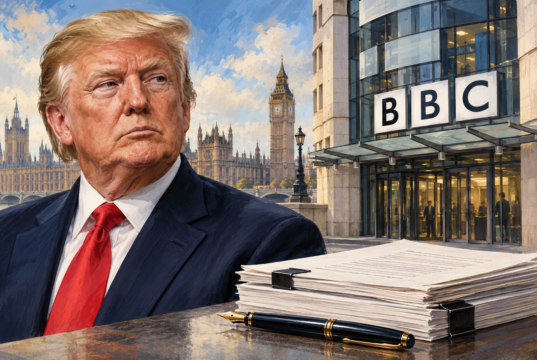
President Donald Trump is threatening to sue the BBC for at least $1 billion, accusing the British broadcaster of defamation after it aired a misleadingly edited clip in its pre-election documentary, “Trump: A Second Chance?”

The film, which aired ahead of the November 2024 election, includes footage from Trump’s January 6, 2021 “Stop the Steal” rally, just before Congress certified Joe Biden’s 2020 victory. The BBC’s version of Trump’s remarks spliced together two separate parts of his speech to make it appear more inflammatory.

The documentary quoted Trump as saying:

“We’re going to walk down to the Capitol, and I’ll be there with you. And we fight. We fight like hell.”

However, in reality, Trump’s words were more measured. He told supporters:

“We’re going to walk down, and I’ll be there with you, we’re going to walk down, we’re going to walk down. Anyone you want, but I think right here, we’re going to walk down to the Capitol, and we’re going to cheer on our brave senators and congressmen and women, and we’re probably not going to be cheering so much for some of them. Because you’ll never take back our country with weakness.”

He continued:

“You have to show strength, and you have to be strong. We have come to demand that Congress do the right thing and only count the electors who have been lawfully slated, lawfully slated.”

Trump also explicitly called for peaceful protest, adding:

“I know that everyone here will soon be marching over to the Capitol building to peacefully and patriotically make your voices heard.”

It wasn’t until about an hour later in his remarks that Trump said the second part of the BBC’s edited clip:

“And we fight. We fight like hell. And if you don’t fight like hell, you’re not going to have a country anymore.”

BBC Leaders Step Down Amid Backlash

The controversy was first exposed by The Daily Telegraph, which published an internal BBC memo acknowledging the editing issue. Following the uproar, BBC Director-General Tim Davie and BBC News CEO Deborah Turness both resigned.

In a message to staff, Turness admitted that “mistakes have been made” but denied claims that the BBC is “institutionally biased.”

Trump’s Legal Response

Trump’s attorney, Alejandro Britt, sent the BBC a legal letter demanding a full apology and retraction. The letter accuses the broadcaster of “defrauding the public” and misrepresenting Trump’s words to paint him in a negative light.

“Well, I guess I have to,” Trump told Fox News’s Laura Ingraham on Tuesday, confirming his intent to sue. “Why not? Because they defrauded the public, and they’ve admitted it.”

A Pattern of Media Accountability

This is not the first time the President has successfully taken on major media outlets.

Last year, ABC News settled with Trump for $15 million after anchor George Stephanopoulos falsely claimed on-air that Trump was found civilly liable for rape in the E. Jean Carroll case. The jury had, in fact, found him liable only for sexual abuse.

In July 2024, Trump won another $16 million settlement from Paramount, following claims that a “60 Minutes” interview with Kamala Harris was heavily edited to favor her during the election season.

Trump also has an ongoing $10 billion lawsuit against The Wall Street Journal, accusing it of defamation after it published a supposed birthday note he allegedly wrote to Jeffrey Epstein—a note Trump denies ever writing.

BBC Chiefs Quit After Accusations Of Deep-Rooted Bias

1
The White House, Public domain, via Wikimedia Commons

LONDON — The BBC’s top two executives are stepping down amid mounting pressure over editorial credibility, shaking confidence in the U.K.’s national broadcaster just as it faces critical decisions on funding and governance.

On Sunday, BBC Director-General Tim Davie and BBC News chief Deborah Turness announced their resignations. The dual departure follows weeks of mounting backlash over allegations of systemic bias in the network’s coverage — from President Donald Trump and the war in Gaza to debates over transgender rights.

Pressure Built After Leaked Memo

The tipping point came with a leaked internal memo from former BBC adviser Michael Prescott. The memo accused the broadcaster of “serious and systemic bias” across a range of politically charged topics.

Chief among them: an episode of Panorama that aired selectively edited footage of Trump’s Jan. 6, 2021, speech. Critics said the edits gave the false impression that Trump directly called on supporters to storm the U.S. Capitol. The full version of the speech did not support that claim.

Controversy also surrounded the BBC’s coverage of the Gaza conflict. Accusations included overreliance on anti-Israel voices, sourcing from extremists on its Arabic service, and distorted portrayals of children and wartime suffering.

In a separate thread of concern, BBC staff raised red flags over the network’s handling of trans-related issues, arguing its reporting often lacked balance and downplayed the contested nature of the debates.

Davie and Turness Respond

In a message to BBC staff, Davie acknowledged the broadcaster’s imperfections.

“Like all public organisations, the BBC is not perfect,” he wrote. “While not being the only reason, the current debate around BBC News has understandably contributed to my decision.”

Turness, while taking responsibility for the news division, rejected claims of structural bias.

“While mistakes have been made,” she wrote, “I want to be absolutely clear: recent allegations that BBC News is institutionally biased are wrong.”

BBC Chairman Samir Shah called it a “sad day,” affirming the board’s support for Davie but conceding the strain he had been under.

A Deeper Governance Crisis

The BBC, funded by the public through license fees, is required by charter to deliver impartial journalism. The resignations expose a deeper institutional crisis at a time when the broadcaster’s mandate and funding model are under review.

The current Royal Charter is set to expire in 2027. Debates about the future of the license fee, the role of public media, and political interference are already in motion. The timing of this leadership vacuum could have significant downstream effects.

What Comes Next

The BBC board now faces the task of finding replacements for two of its most senior posts. The outcome will shape the editorial tone and strategic direction of the broadcaster for years to come.

Internal reviews are expected, especially around how the Panorama episode was handled and whether internal warnings were ignored. Broader investigations may follow, probing the extent of bias across the BBC’s output.

In the near term, the corporation faces reputational damage. With over 100 BBC employees and 200 industry professionals having signed an open letter last year criticizing Gaza coverage, pressure is mounting not just from the public but also from within.

Regulators and government officials may push for increased oversight, new editorial controls, or funding reforms as part of the charter renewal debate.

Looking Ahead

Davie, who took over in 2020, exits during one of the BBC’s most fraught moments in recent history. His successor will inherit a broadcaster under siege — from all sides — and with a shrinking window to restore public trust before the next charter review begins in earnest.

What happens next at the BBC won’t just shape a news organization — it will help define the future of public broadcasting in a divided media landscape.

Fox News Host Clashes With Trump In Tense Interview

4

President Donald Trump’s latest appearance on The Ingraham Angle turned out to be anything but routine. In a Monday night interview filmed in the Oval Office, Fox News host Laura Ingraham pressed the president repeatedly—on housing, the economy, foreign policy, and the MAGA movement itself—leading to one of Trump’s most combative televised exchanges in recent memory.

Before the interview even aired, a preview clip posted to Ingraham’s Facebook page hinted at the unusual tone. Filming amid Trump’s famously gold-adorned surroundings, she teased, “So these aren’t from Home Depot?” The moment didn’t make it to air, but it set the stage for what followed: a testy back-and-forth between two of the most influential voices in conservative politics.

Trump on Housing and the Economy

Ingraham began by raising concerns about housing affordability and the average age of first-time homebuyers now hitting 40. Trump interrupted, “We inherited that, you have to understand,” but Ingraham shot back, “Let me get to the question, though.”

She challenged Trump on his proposal for a 50-year mortgage—a concept some in the MAGA base criticized as prolonging debt. “Is that really a good idea?” she asked.

“It’s not even a big deal,” Trump said. “I mean, you go from 40 to 50 years.” Ingraham corrected him: “30 to 50 years.” Trump deflected, blaming “Joe Biden and his lousy Fed person, Jerome Powell,” before asserting, “If we had a normal person, the Fed would have really low interest rates.”

Ingraham pressed further: “Why are people saying they are anxious about the economy?” Trump dismissed the premise. “I don’t know that they are saying [that]. I think polls are fake. We have the greatest economy we ever had.”

Her question came as Republicans are still reeling from setbacks in the New Jersey and Virginia elections. “Do you think voters have the wrong perception?” Ingraham asked. Trump responded, “More than anything else, it’s a con job by the Democrats. Costs are way down.”

The $10,000 Bonus Controversy

Ingraham also questioned Trump’s Truth Social post offering a $10,000 bonus to air traffic controllers working through the government shutdown. “There are a lot of delays now, sir,” she noted.

Trump replied, “I’m not happy when I saw people refusing to do unpaid work during the shutdown. Look, life is not so easy for anybody. Our country has never done better. We should not have had people leaving their jobs. What I basically said—the ones that stayed, there were a lot of them—I’m sending them a $10,000 bonus.”

When Ingraham pressed, “Where is that money coming from?” Trump quipped, “I don’t know. I will get it from some place. I always get the money from some place, regardless. It doesn’t matter.”

Sparring Over China and Foreign Students

The discussion turned global when Ingraham cited a CNN report on China expanding its missile facilities. “China are not our friends, sir,” she said.

“They don’t want to mess around with us,” Trump countered. When Ingraham noted China’s theft of U.S. intellectual property, Trump asked, “Do you think the French are better?” Ingraham said yes. Trump shot back, “I’m not so sure.”

The tension deepened when Ingraham raised the issue of foreign students. “A lot of MAGA folks are not thrilled about this idea of hundreds of thousands of foreign students in the United States,” she said. “Why, sir, is that a pro-MAGA position?”

Trump defended the policy: “Without foreign students, you would have half the colleges in the United States go out of business.”

“So what?” Ingraham said bluntly. Trump replied, “I think that’s a big deal.”

The MAGA Movement—and Media Dynamics

Ingraham repeatedly framed questions around the “MAGA folks” critical of Trump’s ideas. Trump pushed back: “MAGA was my idea. It was nobody else’s idea. I know better than anybody else MAGA wants to see our country thrive.”

That line captured Trump’s increasingly defensive posture—not just toward Democrats, but toward members of the conservative media who now challenge him more openly. While The Ingraham Angle once provided friendly ground, Monday’s interview underscored the shifting balance between Trump and right-leaning outlets seeking to assert independence ahead of the 2024 election.

Observers note that Trump’s prickly demeanor may reflect deeper frustrations: inflationary pressures remain despite his attacks on Biden’s policies; conservative pundits are fracturing over strategy; and Trump’s own polling among independent voters has shown volatility. Within this context, even mild criticism from longtime allies can provoke his ire.

A Tense Exchange Symbolizing a Larger Rift

The Oval Office encounter stood in stark contrast to Ingraham’s earlier visit in March, when Trump jovially showed off his “Coke button” and griped about paving over the Rose Garden. This time, there were no laughs—just sharp exchanges between two seasoned figures who have long shaped Republican discourse.

Nancy Pelosi Attacks ‘Vile Creature’ Trump In Wild CNN Interview

5
Nancy Pelosi via Gage Skidmore flickr

Former House Speaker Nancy Pelosi (D-CA) called President Donald Trump “a vile creature,” adding that he is “the worst thing on the face of the earth” during an unhinged interview.

Pelosi made the comments during a sit-down interview with CNN that aired on Monday. The hostile remarks come as political violence in the United States continues to rise, following two assassination attempts on President Trump in 2024 and the assassination of conservative commentator Charlie Kirk in September.

“He’s just a vile creature, and the worst thing on the face of the earth, but anyway,” Pelosi said of Trump.

“You think he’s the worst thing on the face of the earth?” asked CNN journalist Elex Michaelson.

“I do, yeah,” Pelosi replied.

She defended her harsh words about Trump, arguing that he “does not honor the Constitution of the United States.”

“In fact, he’s turned the Supreme Court into a rogue court. He’s abolished the House of Representatives. He’s chilled the press,” Pelosi added. “He’s scared people who are in our country legally.”

The 85-year-old congresswoman was not asked to explain how Trump has made the Supreme Court a “rogue court” or what she meant by arguing that the House of Representatives has been “abolished.” The CNN interview focused on California’s special election on Tuesday, when voters will cast their ballots on Proposition 50, which aims to redraw the state’s congressional maps to further favor Democrats.

On Thursday, the 20-term Congresswoman announced her retirement.

In a video posted to social media, Pelosi described her love for San Francisco, saying that in the midst of all the titles she’s held, “there has been on greater honor for me than to stand on the House floor and say I speak for the people of San Francisco.”

“I will not be seeking reelection to Congress. With a grateful heart I look forward to my final year of service as your proud representative,” she added. “As we go forward my message to the city I love is this. San Francisco, know your power. We have made history, we have made progress, we have always led the way. And now we must continue to do so by remaining full participants in our democracy and fighting for the American ideals we hold dear.”

Newsweek Editor Receives Backlash For Calling For Tucker Carlson Should Be ‘Neutralized’

1
Photo via Gage Skidmore Flickr

Newsweek senior editor-at-large Josh Hammer came under fire Wednesday after publishing a column that some critics mischaracterized as calling for harm against Tucker Carlson — an accusation Hammer says is rooted in bad faith and deliberate misinterpretation.

In his Daily Mail piece, Hammer criticized Carlson for his recent interview with controversial commentator Nick Fuentes, arguing that Carlson’s platforming of Fuentes’ “repugnant beliefs” undermines what Hammer described as “the forces of civilizational sanity on the MAGA Right.”

The line that drew the most attention, however, came at the end of the article:

“The fox is now comfortably ensconced in the hen house. And unless the fox is neutralized, the victim could be the entire extant GOP coalition itself.”

Critics — many of them fellow conservatives — quickly pounced on the word “neutralized”, accusing Hammer of reckless rhetoric, particularly in light of recent violence targeting right-leaning public figures.

Conservative Figures Sound the Alarm Over Dangerous Climate

Among those voicing concern was The Blaze host Jason Whitlock, who called the phrasing “irresponsible,” noting that the statement came just weeks after the assassination of Turning Point USA founder Charlie Kirk. “Josh Hammer calls for Tucker Carlson to be neutralized,” Whitlock wrote on X. “This is a Keith Olbermann-style Twitter post, not something that should be published by a news outlet. We just witnessed the assassination of Charlie Kirk. This is irresponsible by the Daily Mail.”

The article was also condemned by Kirk’s former friend Candace Owens, who wrote, “I cannot believe the @DailyMail allowed this to be published.”

Whitlock’s remarks reflect a growing anxiety across conservative media as political violence against the right has intensified. In addition to the shocking murder of Kirk, former President Donald Trump has survived multiple assassination attempts — including a rally shooting this summer that left several attendees wounded. Other conservative officials and commentators have faced threats, doxxing campaigns, and physical harassment in recent months.

Republicans argue that these attacks are part of a broader cultural and political escalation — one amplified by a media ecosystem that downplays or outright ignores violence directed at conservatives, while eagerly condemning right-wing rhetoric as “dangerous.”

Hammer Pushes Back: “Quit Lying”

In response to the online backlash, Hammer took to social media to clarify his meaning and denounce what he described as willful misrepresentation.

“One has to be truly stupid or willfully disingenuous (or both, as the case may be) to think that ‘neutralized’ here means anything other than its most common usages,” he wrote. “Quit lying.”

He later posted a screenshot of a dictionary definition of “neutralize,” which reads: “To make (something) ineffective; counteract; nullify.” Hammer emphasized that his critique of Carlson was political — not personal — and that he was calling for Carlson’s influence to be curtailed, not for violence of any kind.