President Donald Trump’s new press secretary hasn’t finished her first week — and he’s already told her to think about whether she wants to stay.
Trump told reporters Friday that he advised Katie Zacharia to reconsider the role after a rocky debut and days of scrutiny over her legal credentials, according to The Hill.
“I said, ‘Honestly, if I were you, I’d reconsider,’” Trump said, describing their conversation.
“I said, ‘You think about it, but I would reconsider,’” he continued.
ZACHARIA IS ON THE WAY OUT ALREADY 👇
Q: Would you have liked to have known that Katie Zacharia didn't pass the bar?
TRUMP: Katie has been treated very badly by the media. Very very badly. Very unfair. I just asked her, is this for you? And she's a nice person. I'm going to let… pic.twitter.com/S6cUJiBK8E
Trump said the decision ultimately belongs to Zacharia and that he would speak with her upon his return from a trip that includes a Georgia rally and time in Florida. He said he wants her “to be happy” and accused the news media of treating her unfairly.
A Briefing That Became The Story
Zacharia’s Tuesday debut lasted roughly 14 minutes and included just three questions, from Breitbart, Fox News and the Daily Mail. She also briefly referred to her husband as “my president” before correcting herself — a stumble that quickly became fodder for critics, Forbes reported.
Former Biden press secretary Jen Psaki compared the appearance to a “Saturday Night Live” skit. Anthony Scaramucci, whose stint as Trump’s communications director lasted just 11 days, publicly started counting down her tenure. Trump initially praised her performance, telling reporters Tuesday, “I thought she was very good.”
Zacharia told Hannity she had received briefing materials Tuesday morning and had little preparation time, according to Fox News.
Bar Exam Questions Take Over
The media has also seized on Zacharia’s failed bar exam and her public identification as a lawyer. Trump described her as an attorney when announcing her appointment.
That coverage now includes an acknowledgment from Zacharia herself. During Thursday’s appearance on Sean Hannity’s Fox News program, she confirmed that she had not passed the exam and had never retaken it, ABC News reported.
Earlier Thursday, she told Real America’s Voice that she took the exam after graduating from Pepperdine’s law school in 2011 but considered the results “somewhat inconsequential” because she planned to move to China, where she subsequently worked in international transaction law.
She also said legal professionals had advised her that she could describe herself as a lawyer providing legal analysis, distinguishing that from an attorney providing legal advice, according to ABC News.
Questions intensified after she responded to a reporter asking where she passed the bar by referring to her move to China. She later told The New York Times that helicopter noise had prevented her from hearing the question correctly, ABC reported.
By Friday, Trump was publicly offering his new spokeswoman a chance to reconsider — leaving her future behind the podium unresolved.
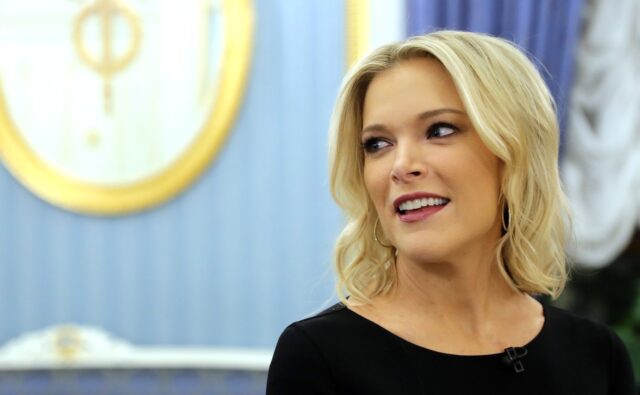
Don Lemon is floating a presidential run — and Megyn Kelly is giving him an unexpected push.
The former Fox News host encouraged the outspoken Trump critic to pursue the White House, arguing that a career in television journalism should hardly disqualify him. But her surprising show of support came with a swipe at some of the Democratic Party’s biggest names.
“OK, I’m going to shock you,” Kelly said on Tuesday’s episode of her show, according to The Hill. “I think he should do it. I actually think he should do it.”
“First of all, it’s not a dealbreaker that he has spent his life as a journalist. I mean, you could absolutely parlay that into a career in public service.”
An Endorsement With An Edge
Kelly’s encouragement quickly became a pointed assessment of the politicians Lemon might hope to join.
She questioned whether former Vice President Kamala Harris or former President Joe Biden had demonstrated greater intelligence than the former CNN anchor. She also suggested Lemon could hold his own against Rep. Alexandria Ocasio-Cortez, D-N.Y., Mediaite reported.
“Are we so enamored with our public officials now we don’t think somebody like Don Lemon could do it? Honestly, I’m not,” Kelly said, according to The Hill.
Her enthusiasm also came with an acknowledgment that a Lemon campaign would provide plenty of material for the people covering it.
“I encourage him and I’m rooting for him. He doesn’t actually think he’s going to win, however,” she added.
That makes her remarks something more complicated than a straightforward political endorsement: encouragement for Lemon to enter the race, delivered alongside digs at Democrats and anticipation of the spectacle.
Lemon Leaves The Door Open
The discussion followed Lemon’s Oct. 3 appearance on “Uncloseted” with Spencer Macnaughton, where he described viewers asking whether he would consider running for office.
“If the people want me, I’ll do it,” Lemon said.
He acknowledged that a presidential campaign would require a full-time commitment and said he still wanted to devote much of his time to journalism. He nevertheless raised the possibility of combining his media work with a campaign.
There is a significant distinction behind the 2028 chatter: Macnaughton asked about the chances Lemon would run at some point in his lifetime. Lemon’s estimate of 65% to 70% was not a firm commitment to the next presidential election.
Lemon also said he believed Americans could elect a gay Black president, while expressing doubts about whether the current political moment was right for such a candidacy.
The former CNN host, who launched his own show after the network fired him in 2023, has yet to turn that speculation into an announced campaign.
But he already has one unlikely voice urging him toward the starting line.
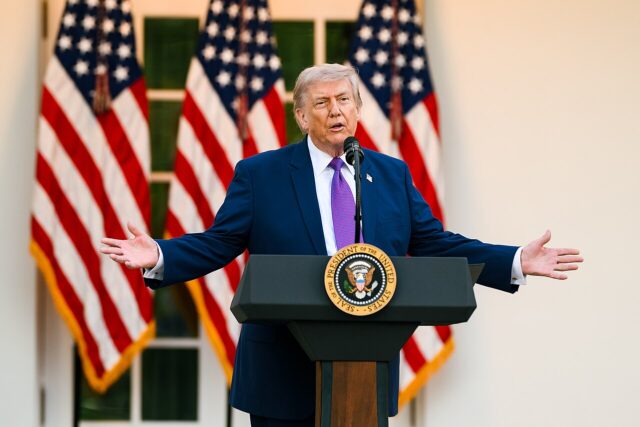
President Donald J. Trump hosts a Rose Garden Club dinner in honor of Police Week in the White House Rose Garden, Monday, May 11, 2026. (Official White House Photo by Molly Riley)
President Donald Trump is pressing former Anchorage Mayor Dave Bronson to leave Alaska’s governor’s race, warning that a crowded Republican field could hand Democrats an opening in November.
Speaking with Fox News after his Tuesday rally in Wasilla, Trump urged Bronson to step aside for Bernadette Wilson, the Republican candidate he endorsed earlier that day.
“He doesn’t have to, but he should, because, frankly, he lost in the primary by substantial numbers to Bernadette,” Trump told Fox News.
Wilson finished as the top Republican in Alaska’s August primary. She now faces Bronson, fellow Republican Treg Taylor and Democrat Jonathan Kreiss-Tomkins in the contest to replace term-limited Republican Gov. Mike Dunleavy.
Trump made clear that he sees the three-way Republican competition as a liability.
“So now you have three Republicans running against one Democrat. And I don’t like that. I don’t like those odds very much,” he told Fox News.
“But there, she’s great, and maybe she’ll get in, but I thought I had an obligation to endorse her.”
A Disputed Deal To Step Aside
Trump’s call for Bronson to withdraw followed a sharper accusation on Truth Social: that the former mayor had already agreed to leave the race, then reversed course.
According to the Alaska Beacon, Trump claimed Bronson sought his endorsement and agreed to withdraw at the president’s request, only to abandon that commitment three days later.
Bronson disputed that account.
Speaking with Alaska’s News Source at the rally, Bronson said the president’s recollection was “different from mine.”
Bronson described discussions about consolidating the Republican field, including a proposal that Trump endorse him and ask his rivals to stand down. He said the arrangement never came together.
“The deal didn’t unfold the way it was supposed to, so I stayed in the race,” Bronson told the station.
Why Three Republicans Are Still Running
Alaska’s election system helps explain the crowded field.
The state holds a nonpartisan primary in which the top four candidates advance regardless of party. Wilson’s position as the leading Republican therefore did not eliminate Bronson or Taylor—or make her the sole Republican nominee.
The general election uses ranked-choice voting. Voters can rank multiple candidates, allowing their votes to transfer to another choice if their preferred candidate is eliminated. That means three Republicans on the ballot do not automatically produce the same vote-splitting problem as a traditional plurality election.
The political concern is whether Republican voters will use those additional rankings.
The Alaska Beacon reported that Bronson and Taylor have encouraged voters to rank all three Republicans. Dunleavy also urged support for the Republican candidates at Tuesday’s rally, while Trump pushed for unity behind Wilson and backed repeal of the state’s election system.
The pressure comes as the race grows more competitive. Cook Political Report moved Alaska’s governor’s contest from “Toss Up” to “Lean Democrat” on Tuesday, according to additional reporting from The Washington Post.
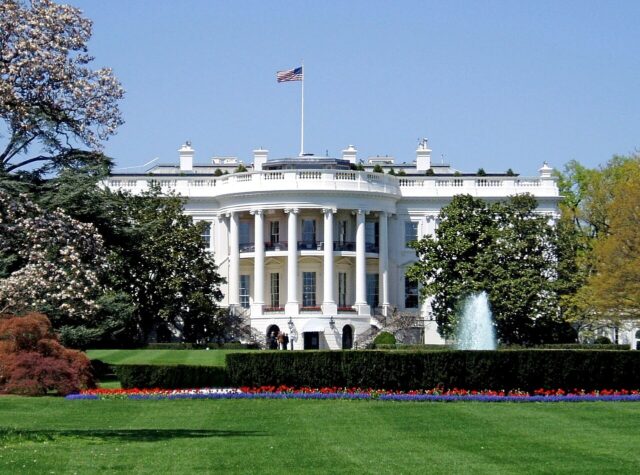
The White House, Public domain, via Wikimedia Commons
President Donald Trump delivered a stark warning to Republicans Monday night: Lose Congress, then the White House, and the GOP could be locked out of the presidency for good.
Speaking at a rally in Youngstown, Ohio, Trump argued that Democrats would use a return to power to reshape Congress, expand the Supreme Court and tilt the electoral map against Republicans.
“I will be the last Republican president because they will add about twelve more electoral votes,” Trump said, according to The Hill.
“They’ll add four more senators. They’ll add ten more congresspeople, approximately,” he continued. “They’re gonna rig the Supreme Court through just a lot of people.”
His warning stretched beyond November’s midterms. Trump was describing a scenario in which Democrats control both chambers of Congress and reclaim the White House in 2028, Mediaite reported.
Trump Takes Aim At Court Expansion
Trump claimed Democrats’ ambitions for the Supreme Court go much further than the 13-seat expansion proposal backed by some party lawmakers.
“The real number that they dream of is 23,” Trump said, according to The Hill. “They say 13. Who wants 13?”
A 23-member court would mean adding 14 seats to the existing nine-member bench.
Democratic lawmakers have previously introduced legislation to expand the court to 13 justices. Sen. Ed Markey (D-Mass.) and Rep. Hank Johnson (D-Ga.) unveiled the Judiciary Act of 2023, arguing that expansion would restore the court’s legitimacy.
That proposal called for four additional seats. Trump’s claim that Democrats ultimately want 23 justices goes beyond the legislation those lawmakers put forward.
A Warning To His Own Party
Trump previously linked the same warning to D.C. and Puerto Rico statehood in September, Fox News reported.
On Monday, he also renewed his demand that Republicans eliminate the Senate filibuster to advance the SAVE Act, according to Mediaite. The outlet reported that the House-passed measure would require proof of citizenship when registering to vote and photo identification when voting, but lacks the 60 votes needed to advance in the Senate.
The president made his pitch while campaigning for Sen. Jon Husted (R-Ohio) and Republican gubernatorial nominee Vivek Ramaswamy. Husted faces former Democratic Sen. Sherrod Brown in a closely contested Senate race, Mediaite reported.
Both Husted and Ramaswamy have leaned on Trump to energize Republican voters, The Hill reported, even after his victories in Ohio in three consecutive presidential elections.
With November approaching, Trump is casting the stakes as bigger than congressional control: He says Republicans’ ability to win the White House again is on the line.
Sen. Thom Tillis (R-N.C.) had a pointed warning for President Donald Trump after the president publicly shared another Republican senator’s phone number during a weekend policy feud.
“With all due respect, I got his number too,” Tillis said Monday during an appearance on ABC’s “The View.”
The remark came after co-host Ana Navarro suggested Trump could retaliate against Tillis by publishing his phone number, particularly as the retiring North Carolina senator promotes a new book detailing his increasingly contentious relationship with the president.
Trump had done exactly that to Sen. Tom Cotton (R-Ark.) just days earlier.
The president posted what appeared to be Cotton’s personal cellphone number on Truth Social on Saturday while pressuring the Arkansas Republican to support the Sunshine Protection Act, legislation aimed at ending the twice-yearly clock change and allowing permanent daylight saving time.
“Almost everybody wants ‘The Sunshine Protection Act’ to pass, except for Tom Cotton,” Trump wrote, before encouraging Arkansas voters to contact the senator.
Trump included Cotton’s number in another post and urged supporters to tell him to “GET IT DONE!”
Fox News Digital reported that it called the number Trump posted, which carried an Arkansas area code, but did not reach Cotton. The Washington Post similarly reported that a call to the number went directly to a full voicemail inbox.
Cotton refused to budge.
“No one likes changing the clock, me included, but Congress has enacted permanent Daylight Saving Time multiple times before and repealed it each time once Americans experienced absurdly late sunrises in the winter,” Cotton wrote on X.
“Arkansans don’t want their kids going to school in the pitch dark, and I’ll always put Arkansas first.”
The dispute has put two normally aligned Republicans on opposite sides of an unusual policy fight.
The House passed its version of the Sunshine Protection Act in July by a bipartisan 308-117 vote, but the measure has stalled in the Senate, where Cotton is among several Republicans opposed to the change. The Senate is currently out of session until Nov. 3, meaning lawmakers cannot act on the measure before the midterm elections.
Tillis, meanwhile, appeared amused by the possibility that he could become Trump’s next target.
The North Carolina Republican was appearing on “The View” to promote his new book, “How to Lose Friends and Antagonize Presidents,” which recounts his clashes with Trump and members of the president’s administration.
After Tillis discussed private exchanges with Trump included in the book, Navarro quipped that the president might “give your phone away after this.”
Tillis immediately fired back.
“With all due respect, I got his number too.”
When asked whether he feared retaliation from Trump over the book, Tillis said, “Not at all.”
The senator, who is not seeking reelection, has become increasingly willing to criticize the administration as his time in Washington winds down.
His book describes his vote to confirm Defense Secretary Pete Hegseth as the “biggest regret” of his congressional career. During Monday’s interview, Tillis went even further when asked about an effort to impeach Hegseth.
“I hope he gets fired,” Tillis said.
Still, Tillis offered Trump some praise, calling him a “great political force” who demonstrated an ability to assemble an unusual coalition of voters.
But he warned Republicans that some of those gains may be slipping away heading into the midterms.
“The support among Hispanics has almost evaporated,” Tillis said. “So the very coalitions that the president … was able to pull together are falling apart.”
Tillis’s warning over the phone-number episode also carries a bit of history.
Trump has used the tactic before. During his first presidential campaign in 2015, he publicly read out then-Sen. Lindsey Graham’s cellphone number at a South Carolina rally after Graham criticized him.
Jeff Bezos built an empire delivering packages. His wife reportedly has another address in mind: 1600 Pennsylvania Avenue.
Lauren Sánchez Bezos is encouraging the Amazon founder to consider a future in politics — and can envision herself as first lady — according to an October 2 report by celebrity gossip columnist Rob Shuter in his Naughty But Nice Substack.
The report offers an intriguing window into the couple’s alleged private conversations. But it comes with a significant qualifier: Shuter’s sources say there is no campaign and no indication Bezos has decided to seek office.
“Lauren loves the idea of President Bezos,” an unnamed source told Shuter. “She talks about legacy, influence and what Jeff could do that money alone cannot buy. And yes, she can absolutely see herself as First Lady.”
According to Shuter, Sánchez’s fascination with Washington intensified after the couple attended President Donald Trump’s state dinner for Chinese President Xi Jinping. Their attendance at the September 24 gathering was documented in coverage of the event.
The dinner put the billionaire couple back inside the White House. Whether Bezos wants to move in remains another matter.
A Presidential Push — Or A Billionaire’s Fantasy?
Shuter’s sources describe Sánchez as someone looking beyond her husband’s business accomplishments toward a potentially bigger legacy.
“Lauren looks at Jeff and sees someone who conquered business, built a space company and became one of the most powerful men alive,” an insider told the columnist. “Her question is always: What’s left? In her mind, the presidency is the ultimate final act.”
Shuter is a longtime entertainment journalist and former celebrity publicist whose clients included Jennifer Lopez and Jessica Simpson. He also served as executive editor of the U.S. edition of OK! magazine and co-hosted VH1’s The Gossip Table. His reporting comes from the world of celebrity insiders, rather than a presidential campaign announcement.
Other outlets, including The Post Millennial, have picked up his Bezos report. Their coverage cites Shuter’s sources, rather than independently establishing that the billionaire is weighing a run.
Even within Shuter’s account, enthusiasm is hardly unanimous.
“Some people think it’s complete fantasy,” an insider told him. “But Lauren doesn’t dream small. She can already picture President Bezos — and herself standing beside him as First Lady.”
From Trump Feud To White House Guest
The political backdrop adds a twist: Bezos has been warming to the president he once publicly sparred with.
During their earlier feud, Trump attacked Amazon and Bezos’ ownership of The Washington Post. Bezos responded in 2015 by joking about reserving Trump a seat on a Blue Origin rocket.
Years later, the relationship looked considerably different. Bezos and Sánchez dined with Trump at Mar-a-Lago in December 2024, and Bezos attended his January 2025 inauguration.
Before Trump returned to office, Bezos also expressed support for his push to reduce regulation.
“I’m actually very optimistic this time around,” Bezos said at the December 2024 New York Times DealBook Summit. He indicated he wanted to help with that effort.
Trump reciprocated. In a March 2025 interview reported by Fox News, he called Bezos “a good guy” and described their improved relationship.
Those developments establish that Bezos has become more comfortable around Trump and Washington’s power circles. They do not establish presidential ambitions.
For now, the White House dream belongs to Sánchez — at least according to Shuter’s unnamed sources.
Former New Jersey Gov. Chris Christie is already taking a blowtorch to Vice President JD Vance’s 2028 ambitions — while leaving room for a White House comeback of his own.
Christie predicted that Vance’s close association with President Donald Trump could keep him from capturing the next Republican presidential nomination, arguing that GOP voters will be focused on finding a candidate who can win the general election.
“He is going to reek with the stink of Donald Trump,” Christie said Thursday during an appearance at George Washington University.
Christie argued that Republicans could ultimately decide nominating Vance would make it more likely that a Democrat wins the White House.
The comments represent a sharp challenge to the widespread view that Vance is the early heir apparent to Trump’s political movement. They also put Christie — one of Trump’s most vocal Republican critics — back in the middle of the emerging 2028 conversation.
Christie Questions Whether Vance Can Match Trump
Christie’s criticism went beyond policy and political baggage. He also questioned whether Vance possesses the personal appeal that helped Trump reshape the Republican Party.
“JD is not nearly as charming as Trump,” Christie said. “You say what you want about Trump, but he has charm and he has some charisma, when he decides to use it. I haven’t seen that out of Vance yet.”
During the discussion, George Washington University professor Frank Sesno asked whether Vance could create some distance from Trump, much as George H.W. Bush established his own identity after serving as Ronald Reagan’s vice president.
Christie rejected the comparison.
He argued that Vance would struggle to separate himself from an administration in which he played a central role. Democrats, Christie suggested, could also use Vance’s dramatic evolution on Trump against him: Vance once compared Trump to Adolf Hitler before eventually becoming his running mate and vice president.
Vance’s supporters would likely offer a very different assessment. Trump has repeatedly discussed Vance as a potential successor, and Mediaite reported in August that the president had privately told donors, “At the end of the day, we need to elect JD.”
Trump has not issued a formal 2028 endorsement, however, and has also spoken favorably about Secretary of State Marco Rubio.
Rubio Gets Written Off, Too
Christie was also skeptical that Rubio would enter the 2028 race.
The former governor described Rubio as politically shrewd and suggested the secretary of state understands that his service in the Trump administration has branded him as a “Trump Republican.” Christie predicted Rubio may wait for a later election rather than battle Vance and other candidates for the nomination in 2028.
That assessment conveniently leaves more room for another contender — including Christie himself.
When Sesno asked whether he might run, Christie did not close the door.
“I’m gonna look at it,” Christie said, while cautioning that “a number of things” would need to happen first.
Christie Eyes A Third Shot
Thursday’s answer was not the first time Christie has hinted at another campaign.
During a September appearance at the Granite State Summit on Responsible Gaming in New Hampshire, Christie admitted he was considering a third presidential bid but said he wanted to see how Republicans performed in the midterm elections before deciding.
“Anybody who comes up here and has ever run for president and not won and told you they’re not looking at it again is lying,” Christie said at the event.
He suggested major Republican losses could force the party to reconsider its direction and leadership. Christie also said any campaign would require a credible path to victory — something that eluded him during his previous runs.
Christie ended his first presidential campaign after a disappointing finish in the 2016 New Hampshire primary. He endorsed Trump shortly afterward, but the alliance eventually collapsed. Christie returned in 2024 as one of the GOP field’s most aggressive Trump critics before dropping out ahead of the Iowa caucuses.
Sesno reminded Christie that 2028 would mark his third attempt at the presidency.
“True, just like Reagan,” Christie replied. “He got elected on the third time.”
Reagan sought the Republican nomination in 1968 and 1976 before winning the White House in 1980.
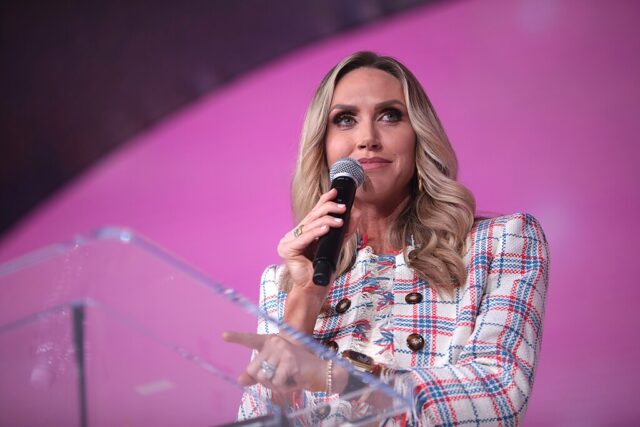
Lara Trump acknowledged that the war with Iran could cost Republicans control of Congress this November — but said preventing Tehran from obtaining a nuclear weapon would justify that political price.
The president’s daughter-in-law and former Republican National Committee co-chair made the admission during a Tuesday interview with British journalist Harry Cole on his YouTube program, “Harry Cole Saves the West,” according to The Hill.
Asked whether the prolonged conflict could damage President Donald Trump’s legacy, she pointed to a more immediate risk.
“Well, it could cost him these midterms,” Lara Trump said.
Still, she defended the president’s place in history, saying his legacy remains unfinished and predicting he would ultimately rank among America’s greatest presidents.
Losing Congress Would Be Worth It
Cole later pressed her on whether the administration’s campaign against Iran would be worth Republicans losing both the House and Senate to Democrats.
“Yeah,” she answered.
“Look, I think he just understands that when Iran gets a nuclear weapon, it doesn’t matter who is in charge of the House. It doesn’t matter the majority in the Senate,” she continued. “This world is a really frightening place and you really can’t come back from that.”
Her answer put the potential consequences plainly: even a Democratic takeover of Congress would be an acceptable price, in her view, for preventing a nuclear-armed Iran.
The comments were a warning about what could happen in November, rather than a prediction that Republicans will lose.
Accusing Iran Of Playing The Election Calendar
Lara Trump also acknowledged that the conflict has frustrated the president. She said he “really hates the way that things have gone with Iran” and wished progress had come more quickly.
But she blamed Tehran for prolonging the standoff, arguing that Iranian leaders believe Republican losses would improve their negotiating position.
“The Iranians are absolutely holding out until these midterm elections,” she said, accusing them of trying to damage the president’s electoral prospects.
That assertion conflicts with Iranian President Masoud Pezeshkian’s public position. According to The Hill, Pezeshkian told reporters during last week’s United Nations General Assembly that he wanted an agreement before November.
“We don’t want it to get to the midterm elections,” he said.
The competing statements underscore the disagreement over whether the election calendar is delaying a deal.
The Costs Keep Mounting
The interview comes as the conflict stretches beyond the brief operation Trump initially described, with higher fuel prices adding pressure on Republicans heading into November.
The financial burden also continues to grow. Roll Call reported that a Pentagon estimate put the war’s costs at $43.6 billion through September 3. That figure included $11.2 billion in operating expenses and $32.4 billion in replacement costs for munitions, damaged aircraft and other assets. It excluded some additional expenses, including damage to U.S. military facilities across the region.
Axios separately reported that Republican strategists remain uncertain whether their campaign advertising can overcome voter anger over prices and the Iran war.
A Call For A Stronger Explanation
Lara Trump’s defense of the war came with an acknowledgment that Republicans could do more to explain it.
When Cole questioned whether the administration had adequately made its case to Americans facing higher gasoline prices, she said many people feel geographically removed from Iran.
Although she said the president discusses the issue frequently, she urged other Republicans and White House officials to explain more clearly what they believe is at stake.
Her message left Republicans with a difficult argument heading into November: the war could help cost them Congress, but she believes its national security objective outweighs the price.
President Donald Trump’s Dallas convention was supposed to give Republicans a boost before November. Behind closed doors, one of his most prominent Senate candidates reportedly offered a far less encouraging assessment.
Texas Attorney General Ken Paxton, the Republican nominee for Senate, told conservative donors and lobbyists that the gathering had hurt his campaign’s numbers, according to an audio recording obtained by The New York Times.
“So to be honest with you, the numbers — when we did that convention — it dropped our numbers. Everybody’s numbers dropped. Right now, yeah, not good,” Paxton said, according to the newspaper.
The remarks put Paxton’s private assessment at odds with Trump’s public claim that the convention helped him. They also come as Republicans pour money into a surprisingly competitive fight to hold a Texas Senate seat.
Private remarks draw a campaign rebuttal
The Times reported that the recording came from a private Washington fundraiser on Sept. 24 attended by roughly a dozen people. An attendee who opposes Paxton’s campaign provided the audio and received anonymity because the remarks were private.
In the recording, a questioner asks, “Do you feel like he’s a little bit of a drag?”
The newspaper cautioned that the audio is muffled at times and does not clearly establish whom the questioner meant. Paxton’s response, however, specifically addressed the convention and what he described as declining numbers.
Three other people with knowledge of the event confirmed Paxton attended, according to the Times. Two remembered the question, and one recalled his response about the convention’s negative consequences.
Paxton’s campaign sharply disputed the report.
Nick Maddux, a senior adviser, called it “more manipulated nonsense from The New York Times to create a story that doesn’t exist.”
“Our latest poll from the last week has Ken Paxton leading by three points, and every serious pollster will tell you that our numbers have improved since early September,” Maddux told the newspaper.
He added that Paxton expects to win and looks forward to “closing strong alongside President Trump.”
Trump offered a different assessment
Paxton has closely aligned himself with Trump, whose support helped him defeat Sen. John Cornyn in this year’s Republican primary, the Times reported.
The Dallas convention gave Paxton a prominent platform in his home state and opportunities to connect with Republican donors. Trump praised him onstage, even while teasing his appearance.
Afterward, the president offered an assessment that directly contrasted with Paxton’s recorded remarks.
“The fact that we had such a successful convention really helped Ken Paxton,” Trump said, according to the Times. “He was a big part of it.”
“The convention helped Ken Paxton a lot,” he added.
Whether the gathering actually hurt Republican candidates remains unresolved. The Times reported that public surveys of the Texas Senate race did not appear to show a significant convention-related change.
A costly fight in Texas
The broader polling picture nevertheless shows why Republicans are concerned.
As of Sept. 30, RealClearPolling’s average put Democratic state Rep. James Talarico ahead of Paxton, 47.6% to 44.7%, a 2.9-point advantage. That differs from the campaign’s claim of a three-point lead in its own poll.
A former White House ethics lawyer says government-funded television ads promoting President Donald Trump could cross a line serious enough to warrant impeachment.
Richard Painter, who served as chief ethics lawyer in President George W. Bush’s White House, made the warning Sunday as ads featuring Trump aired ahead of the November midterms. “This could be an impeachable offense,” Painter wrote on X, referring to comments he made to The New York Times. He argued that a president has no right to use taxpayer money for campaign advertising.
As I told @baylisswagner of the @nytimes here, this could be an impeachable offense. @POTUS has no right to use taxpayer money for campaign ads. Congress has expressly prohibited government sponsored political propaganda, which is dangerous for democracy.https://t.co/EIlOeAwJWI
The impeachment warning is Painter’s assessment. The White House disputes his description of the ads, calling them public service announcements.
The ads behind the fight
One 30-second spot flashes images of Trump while touting tax cuts, manufacturing and law enforcement. It uses audio of the president promising to defeat “communism, socialism and Marxism in America,” followed by praise from UFC CEO Dana White. The screen identifies it as “Paid for by the U.S. Government.” ABC News reported that the spot ran on Fox News and Newsmax in several markets; ad-tracking firm AdImpact estimated the buy at roughly $14,000 as of September 24.
A separate black-and-white spot features Trump’s 2024 campaign rhetoric about the “deep state,” “warmongers” and the news media. The New York Times reported that the footage had previously run as a campaign ad. Painter told the Times that using federal funds for the spots could constitute an abuse of power and an impeachable offense.
The dispute centers on whether the ads serve a government purpose or promote a political figure with public money. Painter contends that federal restrictions on government-funded political propaganda apply. His warning is not a legal finding or an announcement of impeachment proceedings.
Criticism reaches both parties
Sen. John Kennedy, R-La., criticized the spending after being shown one of the ads on CBS’s Face the Nation Sunday. He said public officials, including Trump, should not spend public money on ads for themselves. Kennedy acknowledged that the White House sees the spot differently and said he believed there probably was a rule against using public funds for self-promotion.
The watchdog group Public Citizen filed a complaint Friday with the Government Accountability Office and the Office of Special Counsel. It alleged that the ads violate restrictions on government propaganda and political activity, and called for them to be pulled. The complaint states the group’s allegations; it does not establish that a violation occurred.
The White House said Friday that Trump is not on the November ballot and that the ads contain no call to vote. It cited government-funded public information campaigns under previous presidents, including messages about Medicare, health insurance enrollment and COVID-19 vaccination. The administration says its spots promote patriotism and clearly disclose who paid for them.