Foreign Affairs

Home Foreign Affairs Page 3

Trump Sends Ultimatum to Maduro Allies as U.S. Signals End to Negotiations

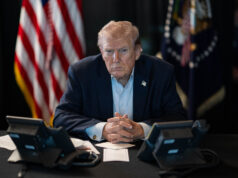
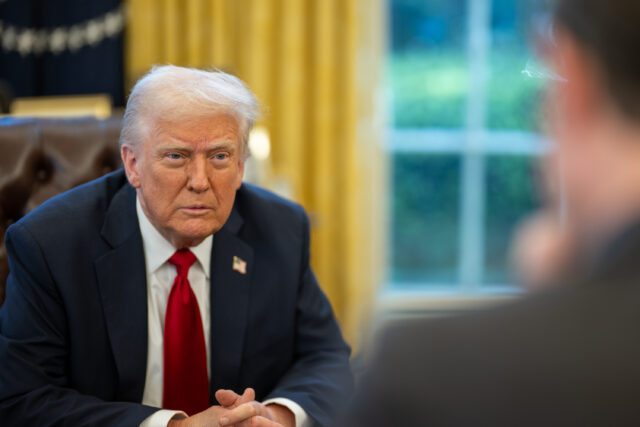
President Donald Trump monitors U.S. military operations in Venezuela, from Mar-a-Lago Club in Palm Beach, Florida, on Saturday, January 3, 2026.

President Donald Trump has delivered a blunt message to Venezuelan strongman Nicolás Maduro and his inner circle: cooperate with the United States—or step aside.

Fox News senior foreign correspondent Benjamin Hall revealed Sunday that Trump personally warned Maduro’s allies that they must either “surrender or play ball,” underscoring what the administration describes as a decisive shift away from diplomacy and toward direct action.

According to Hall, President Trump spoke directly with Maduro roughly a week before Saturday’s strike in Caracas. During that call, Trump reportedly issued a clear ultimatum demanding Maduro’s surrender. Maduro, Trump said, “was not willing.”

Hall noted that while Maduro has now been removed, several senior figures within the Venezuelan regime remain aligned with him, presenting an ongoing challenge for U.S. policymakers seeking stability in the region and an end to what they describe as narco-terrorist activity emanating from the country.

Operation Absolute Resolve – January 3rd, 2026

That message was reinforced by Department of Homeland Security Secretary Kristi Noem, who made clear that the Trump administration has no intention of tolerating continued obstruction from Venezuela’s remaining leadership.

“President Trump is done negotiating. He proved that a couple of days ago, that he is a man of action, that when someone is threatening the United States, he will defend it with every resource that we have, and he’ll continue to do that,” Noem said on Fox News Sunday.

Noem explained that Trump’s communications with Venezuela’s vice president were deliberately direct and unambiguous.

“His conversations now with the vice president in Venezuela are very matter-of-fact and very clear: ‘You can lead, or you can get out of the way because we’re not going to allow you to continue to subvert our American influence and our need to have a free country like Venezuela to work with rather than to have dictators in place who perpetuate crimes and drug trafficking,’” she said.

Her remarks followed the Trump administration’s high-profile operation on Saturday that resulted in the capture of Nicolás Maduro—an unprecedented move that sparked intense debate in Washington. While Democrats and some Republicans raised questions about the legality of the action and the long-term implications for Venezuela, supporters of the operation argued it sent a long-overdue message to hostile regimes.

The operation capped months of U.S. efforts to dismantle what officials describe as a network of narcoterrorism tied to the Venezuelan government. Those efforts included strikes against suspected drug trafficking vessels operating in Caribbean waters and increased enforcement against illicit oil shipments.

Noem pointed to those actions as further proof that the administration is committed to protecting American security interests and cutting off financial lifelines to adversarial governments.

“The Coast Guard has been heavily involved in stopping a lot of this shadow fleet of oil that has been trafficking illegally to many of our enemies in other countries,” she said.

Administration officials argue that Venezuela’s instability has long fueled drug trafficking, mass migration, and regional insecurity, and that decisive action was necessary after years of what they view as failed appeasement. Supporters say Trump’s approach represents a return to peace through strength—using American power to deter threats before they reach U.S. shores.

Israel’s President Directly Refutes Trump’s Pardon Claim

0
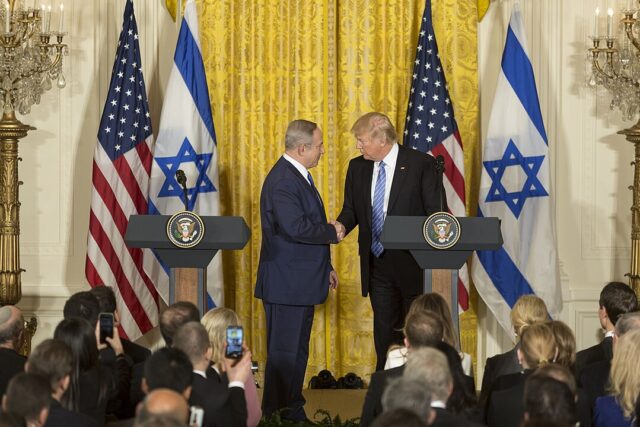
President Donald Trump and Israeli Prime Minister Benjamin Netanyahu shake hands during their joint press conference, Wednesday, Feb. 15, 2017, in the East Room of the White House in Washington, D.C. (Official White House Photo by Leslie N. Emory)

President Donald Trump sparked a brief diplomatic dust-up this week after remarks he made during a bilateral press appearance suggested that Israel’s president was preparing to pardon Prime Minister Benjamin Netanyahu.

Trump and Netanyahu met for several hours at Mar-a-Lago on Monday, followed by an extended question-and-answer session with reporters. During the exchange, Trump was asked whether Netanyahu—who is currently facing multiple corruption trials in Israel—deserved a pardon.

“I think he will,” Trump replied. “How do you not? He’s a wartime prime minister who’s a hero. How do you not give a pardon?”

Trump went further, telling reporters that he had personally discussed the matter with Israel’s head of state. “I spoke to the president, he tells me it’s on its way,” Trump said. “You can’t do better than that, right?”

Within hours, however, Israeli President Isaac Herzog’s office publicly pushed back, disputing Trump’s account. In a statement released shortly after the press conference, Herzog’s office said there had been no such conversation.

“There has been no conversation between President Herzog and President Trump since the pardon request was submitted,” the statement said.

The clarification went on to explain that while there had been prior contact involving Trump’s team, it did not involve any new assurances or commitments. According to Herzog’s office, “Several weeks ago, a conversation took place between President Herzog and a representative on behalf of Trump, who inquired about the American president’s letter. He was given an explanation of the stage the request is currently at, and that a decision on the matter would be made in accordance with the established procedures.”

The statement emphasized that this explanation mirrored what Herzog had already told the Israeli public.

Trump has been outspoken in his support of Netanyahu, both during and after his presidency. In October, while addressing Israel’s Knesset, Trump publicly urged Herzog to issue a pardon, brushing aside the allegations against Netanyahu as politically motivated. “I have an idea, why don’t you give Netanyahu a pardon?” Trump said at the time. “Who cares about cigars and champagne?”

Netanyahu’s legal troubles stem from several ongoing cases. He has been charged with unlawfully accepting gifts—including cigars and champagne—from wealthy associates, as well as more serious allegations involving quid pro quo arrangements. Prosecutors claim Netanyahu offered regulatory benefits to major media companies in exchange for favorable coverage, charges his supporters argue reflect judicial overreach and a politicized legal system targeting Israel’s most successful conservative leader.

Herzog, a former leader of Israel’s Labor Party, has the constitutional authority to issue pardons, though such decisions are traditionally handled cautiously and through formal procedures. While Trump formally requested a pardon in a letter sent in November, Herzog has made clear that no final decision has been reached.

Democrat Senator Openly Backs Trump’s Iran Proposal

Gage Skidmore Flickr

President Donald Trump said Monday that the United States and Israel have already destroyed Iran’s nuclear program and warned that Tehran would face renewed military action if it attempts to rebuild its weapons capabilities. His remarks came as new reports allege the Iranian regime is pursuing chemical and biological warheads for its ballistic missiles.

Speaking at Mar-a-Lago alongside Israeli Prime Minister Benjamin Netanyahu, Trump delivered a blunt warning to Tehran over its nuclear and missile ambitions.

“Now I hear that Iran is trying to build up again, and if they are, we’re going to have to knock them down,” Trump said. “We’ll knock the hell out of them.” He added that Iran would be “much smarter” to pursue a deal.

Trump framed Iran’s defeat as central to restoring stability in the Middle East, crediting joint U.S.-Israeli military action with fundamentally shifting the regional balance of power.

“We just won a big war together,” he said. “If we didn’t beat Iran, you wouldn’t have had peace in the Middle East. We wiped it out.”

When asked whether he would support further Israeli military action if Iran continues advancing its missile or nuclear programs, Trump responded without hesitation.

“If they continue with the missiles — yes,” he said. “The nuclear — absolutely.”

Pressed on whether he would support efforts to overthrow Iran’s ruling regime, Trump declined, while pointing to the country’s internal turmoil and economic collapse.

“I’m not going to talk about overthrow of a regime,” he said. “But they have tremendous inflation. Their economy is busted.”

Trump also noted that widespread protests inside Iran are frequently met with deadly force by the government.

The president’s comments followed a report Sunday from Iran International alleging that Iran’s Islamic Revolutionary Guard Corps is accelerating work on unconventional missile payloads, including chemical and biological weapons. The report cited unnamed military and security sources.

Sen. John Fetterman (D-Pa.) echoed Trump’s hardline stance in a Monday post on X, saying he would support military strikes to prevent Iran from obtaining nuclear weapons.

“Iran can’t ever develop a nuclear weapon,” Fetterman wrote.

“Fully supported the strike earlier this year. Fully support any future strikes to damage or destroy their nuclear ambitions,” added Fetterman, a vocal supporter of Israel.


USA Strikes ‘Big Facility’ In Campaign Against Venezuela

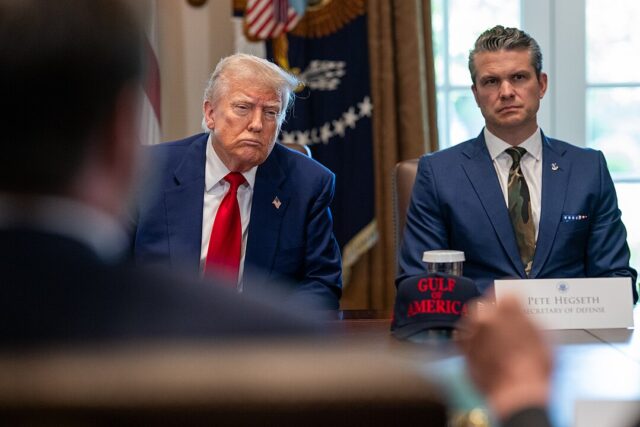
President Donald Trump holds a Cabinet meeting, Wednesday, April 30, 2025, in the Cabinet Room. (Official White House Photo by Molly Riley)

President Donald Trump suggested this week that U.S. forces may have carried out a direct strike on a major drug-related facility inside Venezuela, a development that—if confirmed—would represent a significant escalation in his administration’s campaign against narco-trafficking and the Maduro regime.

In an interview Friday with radio host John Catsimatidis on The Cats & Cosby Show, the president discussed ongoing U.S. military operations targeting suspected drug-smuggling vessels operating off the Venezuelan coast. During that conversation, Trump appeared to reference a successful strike on a fixed facility connected to those operations.

“They have a big plant or a big facility where the ships come from,” the president said. “Two nights ago, we knocked that out.”

While Trump did not publicly identify the location of the facility, U.S. officials later told The New York Times that the president was referring to a drug facility located inside Venezuela that had been destroyed. At this time, the president’s comments remain the only public indication such a strike occurred. Neither the Venezuelan government nor other Latin American governments have acknowledged or confirmed an attack of this kind.

If U.S. forces did strike a facility on Venezuelan soil, it would mark the first known land-based military action in Trump’s broader effort to disrupt drug trafficking networks tied to the regime of Venezuelan strongman Nicolás Maduro. That effort has intensified since September, when the administration began authorizing military strikes on vessels believed to be transporting narcotics in international waters near Venezuela.

According to public reporting, more than 100 people have been killed since those maritime strikes began. The administration has defended the operations as necessary to combat transnational criminal organizations that U.S. officials say operate with the protection—or direct involvement—of the Maduro government. The Trump administration has repeatedly labeled Venezuela a “narco-state,” accusing senior regime figures of facilitating cocaine trafficking into the United States.

In October, The New York Times reported that the president had “secretly authorized the C.I.A. to conduct covert action in Venezuela,” a claim Trump later confirmed publicly. The authorization reportedly expanded U.S. intelligence and operational capabilities aimed at undermining drug cartels and weakening Maduro’s grip on power.

Beyond military operations, the administration has steadily increased pressure on Caracas through economic and strategic measures. Trump ordered the shutdown of Venezuelan airspace, citing security concerns, and earlier this month the U.S. began seizing oil tankers near Venezuelan shores as part of what officials describe as an enforcement action against illicit oil shipments funding the regime. Supporters of the policy argue these moves are designed to cut off revenue streams used to prop up corruption and criminal networks.

The president has previously made clear that land-based options were under consideration.

“What’s the next step in this war on cartels, and are you considering options? Are you considering strikes on land?” an off-camera reporter asked Trump in the Oval Office in October.

“Well, I don’t want to tell you exactly, but we are certainly looking at land now because we’ve got the sea very well under control,” Trump replied.

That comment, combined with Trump’s remarks during Friday’s radio interview, has fueled speculation that the administration may already be acting on those plans.

Despite the president’s statements, military officials told The New York Times they had no information to share regarding the reported destruction of a “big facility.” Both the CIA and the White House declined to comment, a response consistent with the administration’s approach to sensitive national security operations.

Supporters of the president argue that Trump’s aggressive posture reflects a long-overdue willingness to confront drug cartels and hostile regimes head-on, rather than relying solely on diplomatic pressure. Critics, meanwhile, warn that direct military action inside Venezuela could escalate tensions in the region.

For now, the administration has offered no further details—but Trump’s remarks make clear that his campaign against drug trafficking and the Maduro regime is far from over.

Nobel Laureate Praises Trump’s Tough Stance on Maduro

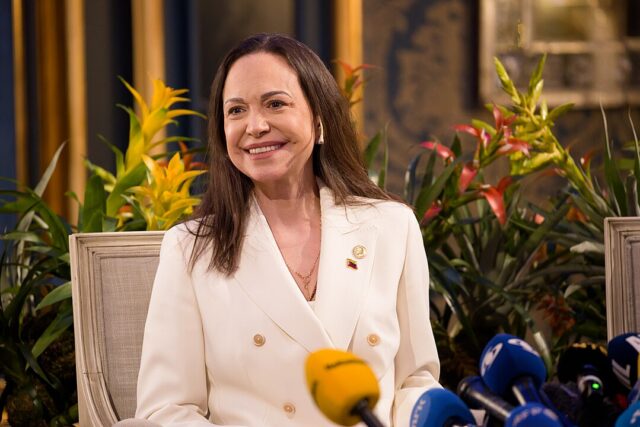
By Kevin Payravi - Own work, CC BY-SA 4.0, https://commons.wikimedia.org/w/index.php?curid=179718533

Nobel Peace Prize winner María Corina Machado, one of Venezuela’s most prominent pro-democracy leaders, is strongly backing President Donald Trump’s hard-line approach toward Nicolás Maduro’s authoritarian regime. In a new interview that aired Sunday on CBS’s Face the Nation, Machado said Trump’s strategy has given hope to millions of Venezuelans suffering under socialist rule.

Asked whether she supports increased U.S. sanctions on Venezuelan officials and further U.S. seizures of illicit oil shipments, Machado was unequivocal.

“Look, I absolutely support President Trump’s strategy, and we, the Venezuelan people, are very grateful to him and to his administration, because I believe he is a champion of freedom in this hemisphere,” Machado told host Margaret Brennan.

Speaking from Oslo, where she accepted the Nobel Peace Prize after spending nearly a year in hiding, Machado noted that she had dedicated part of the award to Trump.

“I think that he finally has put Venezuela in where it should be, in terms of a priority for the United States’ national security.”

Machado argued that Maduro’s regime is far more dangerous than a conventional dictatorship.

“This is a very complex criminal structure that has turned Venezuela into a safe haven of international crime and terrorist activities, starting with Russia, Iran, Cuba, Hezbollah, Hamas, the Colombian guerrilla [groups], [and] the drug cartels operating freely and directed in partnership with Maduro and his regime.”

Machado has long been one of Maduro’s most effective opposition figures. After she overwhelmingly won the opposition primary in 2023, the regime barred her from running, then orchestrated an election that independent experts later declared “mathematically and statistically impossible.” Despite that, Maduro claimed victory and refused to relinquish power. Machado endorsed a stand-in candidate but remained the movement’s central figure—until she was forced into hiding for her safety.

Now, speaking publicly for the first time in months, Machado is calling for increased international pressure.

“We want every legal action through law enforcement … not only from the United States, also from other Caribbean, Latin American and European countries that further block the illegal activities of the regime.”

Her argument is straightforward:

“We need to increase the cost of staying in power by force. Once you arrive to that point in which the cost of staying in power is higher than the cost of leaving power, the regime will fall apart. And it’s the moment where we advance into a negotiated transition.”


Additional Context: Trump and the Nobel Peace Prize

Machado’s praise comes as Trump has repeatedly been nominated for the Nobel Peace Prize, particularly for:

  • The Abraham Accords, which normalized relations between Israel and several Arab nations—an achievement some foreign-policy experts called one of the most important diplomatic breakthroughs in decades.
  • His diplomatic efforts in reducing tensions with North Korea, which earned him multiple nominations from European lawmakers.
  • His support for democracy movements in Latin America, including Venezuela, Cuba, and Nicaragua.

Tucker Carlson Reveals Plans To Purchase Home In Qatar

1
Tucker Carlson via Gage Skidmore Flickr

DOHA, Qatar — Tucker Carlson told an audience at the Doha Forum on Sunday that he plans to buy real estate in Qatar on Monday, framing the move as a statement of personal independence after months of criticism from fellow conservatives over his foreign-policy views and his media business relationships.

During an on-stage interview with Qatar’s prime minister, Mohammed bin Abdulrahman bin Jassim Al Thani, Carlson addressed allegations that he and his media outlet, the Tucker Carlson Network, have benefited from Qatari-linked money. Carlson denied it — then announced his intended purchase.

“I have been criticized as being a tool of Qatar, and I just want to say, which you already know, which is I have never taken anything from your country and don’t plan to,” Carlson said. “I am, however, tomorrow buying a place in Qatar.”

He continued: “I like the city, I think it’s beautiful, but also to make a statement that I’m an American and a free man and I’ll be wherever I want to be.”

Carlson’s remarks drew a brief round of applause from the crowd.

Why it’s causing heartburn on the Right

For many Republican voters — especially those who view Qatar primarily through the lens of Hamas, Iran, and Middle East conflict — the announcement landed like a political grenade. Some prominent conservatives have long labeled Qatar a bad actor because it maintains ties to Hamas and has hosted some Hamas leaders. Carlson raised that criticism directly, referencing Sen. Ted Cruz (R-TX) describing Qatar as a “terror state,” and asked the prime minister to respond.

Al Thani defended Qatar’s posture by arguing it had been asked by the U.S. and Israel “more than a decade ago” to maintain channels to Hamas, claiming those channels were useful in negotiations. Carlson presented the exchange as a case for diplomacy and communication — but critics argue it blurs moral lines and underplays the danger of legitimizing terror-linked organizations.

The Gaza exchange: what Qatar said on stage

In the interview, Al Thani rejected the idea that Qatar should bankroll reconstruction in Gaza, saying:

“We are not the ones who are going to write the check to rebuild what others destroyed.”

He added: “When you are talking about Gaza, Israel flattened this land.”

Those comments come as Qatar continues to present itself as a central player in negotiations surrounding Gaza, even as the region remains volatile.

Doha Forum’s unusual mix of speakers

Carlson wasn’t the only headline name in Doha. The forum featured a wide-ranging lineup that included Hillary Clinton, Donald Trump Jr., and Bill Gates, along with journalists from major outlets spanning left and right.

Carlson’s growing fractures with the GOP — and the Nick Fuentes backlash

Carlson’s Qatar appearance is also landing amid a broader tension between Carlson and parts of the Republican coalition. In recent months, he has drawn increasing criticism from elected Republicans and conservative institutions who say his platform has drifted from defending core U.S. interests and has instead amplified figures and arguments that divide the party.

One flashpoint: Carlson’s recent interview with Nick Fuentes, a far-right influencer widely denounced for antisemitic rhetoric. The decision to give Fuentes a high-profile platform triggered condemnation from within the party — including House Speaker Mike Johnson, who reportedly called the interview a “big mistake” and described Fuentes as “vile.”

That controversy has widened a fault line on the Right: between voters who want a harder line against antisemitism and extremist activism, and voices in the “populist” media sphere who argue they’re simply questioning establishment taboos. The dispute has spilled into open feuds among prominent conservatives — and Carlson’s Qatar announcement only added fuel.

Report: Ukraine Agrees To US-Brokered Peace Deal

4
By President Of Ukraine - https://www.flickr.com/photos/165930373@N06/54169325552/, CC0, https://commons.wikimedia.org/w/index.php?curid=156221279

Ukraine has agreed to a peace deal with Russia that was brokered by the United States, but a cautious Volodymyr Zelensky warned “much work” remains to be done.

“Following the meetings in Geneva, we see many prospects that can make the path to peace real,” Zelensky wrote in an X post on Tuesday. “There are solid results, and much work still lies ahead.”

A U.S. military official in Abu Dhabi told CBS News Driscoll spent hours negotiating Tuesday with Russian representatives, going in and out of meetings all day. 

“We remain very optimistic,” the official said. “Secretary Driscoll is optimistic. Hopefully, we’ll get feedback from the Russians soon. This is moving quick.”

It is not clear who else is in the U.S. delegation in Abu Dhabi. A U.S. official told CBS News on Tuesday that a Ukrainian delegation was also there and has been in contact with Driscoll and his team.

A source with knowledge told CBS News that Driscoll was working in Abu Dhabi off of a revised version of the White House’s 28-point proposal, following productive negotiations in Geneva.

Report: US Planning Prisoner Swap With Russia

0
Kremlin.ru, via Wikimedia Commons

The United States and Russia are reportedly quietly reopening talks on a possible prisoner-exchange that could determine the fate of at least eight Americans still held in Russia. According to Russian special envoy Kirill Dmitriev—who visited Washington in late October—discussions with U.S. officials were “humanitarian in nature, such as possible exchanges of prisoners that the U.S. side has been working on.” A senior U.S. official confirmed the outreach and described the atmosphere as constructive, though emphasized that no agreement has yet been reached.

“The U.S. will welcome the release of any detained American,” the official said, underscoring that Washington views this strictly through the lens of American lives, not political grandstanding.

During Dmitriev’s trip he met U.S. envoy Steve Witkoff. A source familiar with the conversations told Axios that Moscow hopes such a swap would “create more trust between the countries.” From a Republican perspective, this is exactly the kind of outcome our diplomacy should be pursuing: Americans held abroad should be brought home, and Russia should see we are serious, not passive.

While a handful of Americans were released earlier this year under separate agreements, these talks focus squarely on the eight who remain behind bars—several caught up in cases the U.S. describes as politically tinged or based on contested evidence. According to Axios, the names sent to Moscow earlier by the U.S. include:

  • Stephen James Hubbard, 73, accused of fighting as a mercenary in Ukraine
  • David Barnes, serving a 21-year sentence after a cross-border custody dispute
  • Robert Gilman, former Marine convicted of assaulting a police officer
  • Eugene Spector, sentenced on bribery and espionage charges
  • Michael Travis Leake and Robert Romanov Woodland, jailed on drug offenses
  • Daniel Joseph Schneider, convicted of abducting his son
  • Gordon Black, a U.S. soldier imprisoned for theft and alleged threats

U.S. officials haven’t confirmed whether these eight are the focus of the current discussions—but with Moscow signalling interest, and Washington keen to show it can deliver for detained Americans, the groundwork for a high-stakes swap is clearly in motion.

Why this matters

For the Republican-minded audience, this is about America first: no American left behind, accountability for Russia’s malign practices, and the restoration of American strength in diplomacy. Critics of past Democratic administrations argue that Russia has often treated U.S. citizens as bargaining chips—and the fact that Washington is now engaging quietly, but seriously, signals a turn toward a tougher posture.

What have we achieved so far under Trump?

It’s worth remembering that under the Trump administration, significant steps were taken to bring Americans home:

  • In February 2025, the U.S. secured the release of Marc Fogel, an American schoolteacher imprisoned in Russia for possession of medical cannabis (a 14-year sentence), in what was acknowledged as a prisoner exchange.
  • In April 2025, another U.S. citizen, dual-national ballet dancer Ksenia Karelina, was freed from Russia in a swap described by U.S. Secretary of State Marco Rubio as secured through Trump’s efforts.

These releases underscore a Trump-era focus on returning Americans held by adversarial powers, not leaving them forgotten. While this upcoming swap is not yet finalized, the very fact that Moscow and Washington are in active dialogue is a sign the U.S. is not passive when its citizens are wrongfully detained.

The road ahead

There are still major questions to resolve: who exactly will be part of the swap? What will the U.S. give up?

FBI Director Kash Patel Shuts Down Charlie Kirk Foreign Intelligence Probe

Image via gage Skidmore Flickr

FBI Director Kash Patel reportedly shut down efforts by Joe Kent, head of the National Counterterrorism Center and a close ally of Tulsi Gabbard, to investigate whether a foreign power was behind the assassination of conservative leader Charlie Kirk.

Kent Pushes to Expose Possible Foreign Ties

According to The New York Times, Kent began reviewing FBI case files to determine if Kirk’s alleged killer, Tyler Robinson, received outside help. Robinson, 22, has been charged with fatally shooting Kirk with a sniper rifle while the Turning Point USA founder was addressing students at Utah Valley University on September 10.

Kent’s investigation raised alarms at the FBI. Patel reportedly believed Kent was overstepping his authority by digging into an active bureau investigation — even though Kent’s mandate at the Counterterrorism Center includes monitoring potential foreign threats to national security.

White House Tensions Boil Over

When Patel learned Kent had accessed internal FBI materials, he demanded a high-level White House meeting. The tense roundtable brought together Patel, Kent, Gabbard, Vice President JD Vance, Chief of Staff Susie Wiles, and senior DOJ officials.

Kent defended his actions, saying a lower-level FBI official had granted him access. Supporters of Kent argue he was doing his duty to ensure foreign adversaries weren’t behind the killing of one of the conservative movement’s most prominent voices.

However, Patel and other officials worried the probe could complicate the prosecution, possibly giving Robinson’s defense attorneys an opening to claim there were multiple suspects or motives at play.

Jurisdictional Turf War

The standoff reflects ongoing turf battles between the FBI and the Counterterrorism Center, particularly over how intelligence is shared during active criminal cases. Despite the controversy, Kent’s team reportedly collected intelligence from other agencies about potential foreign funding or coordination, including possible links to left-wing extremist groups like Antifa.

So far, it’s unclear whether either agency is still investigating possible foreign involvement in the attack.

Trump Warns Hamas of U.S. Military Action if Violence in Gaza Continues

5
Photo via Gage Skidmore Flickr

President Trump warned Thursday that the United States will have “no choice” but to use lethal force against Hamas if the militant group does not stop its renewed violence in Gaza.

“If Hamas continues to kill people in Gaza, which was not the Deal, we will have no choice but to go in and kill them. Thank you for your attention to this matter!” Trump wrote on Truth Social.

The warning comes amid reports that Hamas has reasserted control in Gaza, launching a campaign of retribution following Israel’s withdrawal under a U.S.-brokered ceasefire. According to Reuters, Hamas fighters have killed at least 33 people since the ceasefire began last week. One widely circulated video showed several men being dragged into a Gaza City square and executed.

On Wednesday, the U.S. military also issued a stern message to Hamas, urging the group to “immediately suspend violence and shooting at innocent Palestinian civilians in Gaza.”

Residents in Gaza told Fox News Digital that Hamas fighters have returned to the streets and issued an ultimatum to suspected Israeli collaborators, giving them until Sunday to surrender and seek amnesty.

Hamas has also failed to uphold its agreement to return all deceased hostages to Israel. Families of the victims described the ongoing wait as “torturous.”

On Thursday’s episode of Fox & Friends, Orna Neutra — the mother of Israel Defense Forces Capt. Omer Neutra — said it is “devastating” to wait for her son’s remains to be returned.

“We came here on Sunday, prepared to receive him on Monday and, as the day went by and only four hostages were released, and our son wasn’t among them, it was devastating,” she said.

Omer Neutra, a fallen platoon commander, is one of two American citizens whose bodies have not yet been returned by Hamas under the first phase of the peace deal.