Featured

Home Featured
Featured posts

Former Jan. 6 Committee Lawyer Running for Congress in Trump District

    3

    An uphill bid…

    Robin Peguero, who served as investigative counsel for the House select committee investigating the Jan. 6, 2021, Capitol attack, is launching a bid to unseat Rep. María Elvira Salazar (R-Fla.) in Florida.

    “It’s time for us to write a new story for South Florida — one where hard-working families stop being forced to choose between making rent or seeing a doctor, where small businesses have access to resources and tax relief, and where we no longer get squeezed by corporations and billionaires while politicians like María Elvira Salazar do their bidding,” Peguero said in a statement on Tuesday announcing his candidacy. 

    “Miami deserves a representative in the House who fights for them. That’s the leader I’ll be.”

    Peguero is the latest Democrat to enter the race to take on the Florida Republican. Former Key Biscayne Mayor Mike Davey, accountant Alex Fornino and businessman Richard Lamondin have also launched bids on the Democratic side to take on Salazar. 

    The Florida Republican handily won her last election in November against Democrat Lucia Baez-Geller by more than 20 points. President Trump won the district last year by close to 15 points, according to The Downballot.

    The seat is one of 35 held by House Republicans that the Democratic Congressional Campaign Committee said it plans to target in the 2026 midterms.

    The list, which the DCCC called its Districts in Play, includes Alaska Rep. Nick Begich (R); Arizona Reps. David Schweikert (R), Eli Crane (R) and Juan Ciscomani (R); California Reps. David Valadao (R), Young Kim (R) and Ken Calvert (R); Colorado Rep. Gabe Evans (R); and Florida Reps. Cory Mills (R), Anna Paulina Luna (R) and Maria Elvira Salazar (R).

    The committee is also targeting Iowa Reps. Mariannette Miller-Meeks (R), Ashley Hinson (R) and Zach Nunn (R); the open seat in Kentucky’s sixth congressional district; Michigan Reps. Bill Huizenga (R) and Tom Barrett (R); the open seat in Michigan’s 10th congressional district; Missouri Rep. Ann Wagner (R); Nebraska Rep. Don Bacon (R); New Jersey Rep. Tom Kean Jr. (R); and New York Rep. Mike Lawler (R ).

    The final names on the list are Ohio Reps. Max Miller (R), Mike Turner (R) and Mike Carey (R); Pennsylvania Reps. Brian Fitzpatrick (R), Ryan Mackenzie (R), Rob Bresnahan (R) and Scott Perry (R); Tennessee Rep. Andy Ogles (R); Texas Rep. Monica De La Cruz (R); Virginia Rep. Rob Wittman (R); and Wisconsin Reps. Bryan Steil (R) and Derrick Van Orden (R).

    RNC Chair Lara Trump Releases New Single

    1
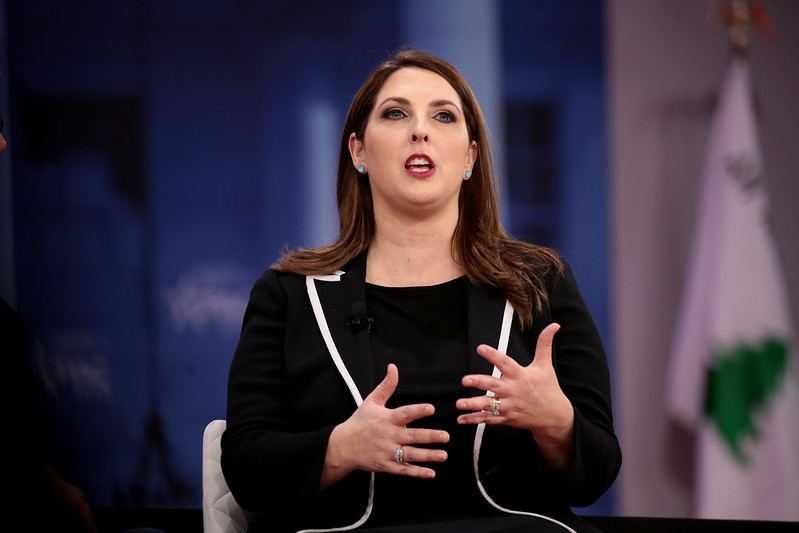
    Image via gage Skidmore Flickr

    The Trump family is full of talents.

    On Thursday night, RNC chair Lara Trump released her second single and teased the release of several more songs coming soon.

    According to Mediaite, Trump—who made headlines with her 2023 cover of Tom Petty’s “I Won’t Back Down”—spontaneously dropped yet another single, “Anything is Possible,” at midnight on Thursday evening.

    “A little something I had fun with over the winter,” wrote Trump in a social media post announcing the song. “And a few more too that I’ll save for a future date, special for my YUGE fans in the liberal media [winky face emoji].”

    In the uplifting single about faith, which is currently available to stream on Spotify and Apple Music, Trump sings, “I’ve had my ups and downs, cried when no one’s around. Still I gotta put my game face on, even when I’m not feeling strong. No matter how it seems, I wouldn’t trade a thing, ’cause all of it makes me who I am.”

    She continues in the chorus, “Don’t think, just jump, you can’t give up. Know that anything is possible. Have faith, believe, just trust, you’ll see, anything is possible.”

    It is unclear whether Trump currently has an album in the works or whether she has just produced a collection of singles.

    Earlier this month, Trump was elected to serve as co-chair of the Republican National Committee following Ronna McDaniel’s exit.

    Ex-White House Lawyer Says Supreme Court Could Rule Unanimously In Trump Case

      3
      Duncan Lock, Dflock, CC BY-SA 3.0 via Wikimedia Commons

      Former White House lawyer Ty Cobb predicted the U.S. Supreme Court will rule “9-0” in favor of former President Trump in a potential appeal of the Colorado Supreme Court’s ruling.

      On Tuesday, The Colorado Supreme Court ruled 4-3 to remove Donald Trump from the state’s primary ballot. (RELATED: Colorado Supreme Court Rules On Trump Ballot Ban)

      Steven Cheung, a spokesperson for Trump’s campaign, has already vowed the Trump campaign will appeal the ruling to the U.S. Supreme Court, which has a 6-3 conservative majority and includes three justices nominated by the former President. 

      “The Supreme Court though will not hesitate to move quickly on this; they know what the stakes are. They know what their responsibility is,” Cobb continued. “And they can delay some of these Colorado dates to the extent that they feel they’re obligated to or have to.”

      “I think this case will be handled quickly. I think it could be 9-0 in the Supreme Court for Trump,” Cobb said in an interview on CNN, adding later, “I do believe it could be 9-0, because I think the law is clear.”

      “The real key issue in this case is — is Trump an officer in the United States in the context in which that term is used in the Article 3 of the 14th Amendment,” Cobb said. “And in 2010, Chief Justice [John] Roberts explained in free enterprise that people don’t vote for officers of the United States.”

      Cobb further argued the ruling “vindicates” Trump’s “insistence that this is a political conspiracy to interfere with the election and that … he’s the target and people shouldn’t tolerate that in America.”

      Colorado’s Supreme Court put its ruling on hold until Jan. 4 to allow Trump to first seek review from the U.S. Supreme Court. 

      Big Tech Censorship is the Real Danger to Our Democracy, and Our History

        0
        Photo via Pixabay images

        ANALYSIS – The collusion between the far-left, the Democrat Party, and Big Tech is one of the most dangerous threats to American democracy today.

        It threatens our 1st Amendment right to free speech, and our ability to get valuable and dissenting views and news online.

        It also threatens to erase and rewrite history akin to the vile practices of totalitarian communist leaders Joe Stalin or Mao Zedong.

        This obscene censorship is also opposed by most Americans.

        According to a piece published Thursday by the American Enterprise Institute (AEI), suppressing so-called “misinformation” and “disinformation” online (code words for conservative views they don’t like) about topics like climate change, or elections, could rewrite history.

        A very dangerous thing indeed.

        Quoting the AEI authors, Media Research Center (MRC) NewsBusters writes:

        “[C]onsider now how future historians will view our societies if the collective digital record that has replaced paper diaries, letters, notes, and newspapers is purged of dissenting views,” wrote AEI nonresident senior fellow Bronwyn Howell

        “If records of the views of climate change skeptics were removed to make it easier to implement changes, it may never be evident to those in the future that this was in fact a highly contentious issue that divided societies and influenced the choices made by political leaders as the complex issues unfolded.”

        Howell specifically called out New Zealand Prime Minister Jacinda Ardern for her speech to the United Nations (UN) General Assembly in September. In the speech, Ardern justified censoring certain content around climate change and war, as well as content subjectively deemed “hateful and dangerous.”

        “How do you successfully end a war if people are led to believe the reason for its existence is not only legal but noble?” Ardern told the multilateral body. “How do you tackle climate change if people do not believe it exists? How do you ensure the human rights of others are upheld, when they are subjected to hateful and dangerous rhetoric and ideology?”

        Anything that offends anyone can be deemed ‘hateful and dangerous,’ and aggressively suppressed, especially by the Left which uses these terms as weapons to pummel all views opposed to their radical agenda.

        Beyond just rewriting history, NewsBusters notes the threat to altering our present elections today. 

        By censoring contrary views that they deem ‘misinformation,’ the Left – having hijacked Big Tech social media platforms like Twitter, Facebook, and LinkedIn – are rigging elections in favor of the Democrats and their far-left ideology.

        Note: LinkedIn, the giant business and professional site, while generally not mentioned along with the other big ones, is one of the worst offenders. 

        It banned me for posting legitimate, well-sourced stories on China, Hunter Biden, the Wuhan bio lab link to COVID-19, as well as other political topics, including anything critical, or mocking, of the radical ‘trans’ agenda.’

        Newsbusters adds that:

        Just like the Chinese Communist Party-linked TikTok, American-in-name-only companies Facebook and Twitter are working to thwart certain posts about elections, interfering with the American democratic process and potentially altering the course of history.

        Big Tech companies regularly scrub social media of views they deem objectionable, and MRC’s CensorTrack database has documented over 4,500 total cases of censorship by these tech giants.


        Yet, a new national poll, conducted last week for The Federalist by Susquehanna Polling and Research, Inc., concluded that a significant majority of Americans disapprove of this Big Tech censorship.

        As CNS News reports:

        [The poll] asked U.S. voters the following question about the practice by behemoth social media platforms of censoring political content:

        “Do you approve or disapprove of Big Tech companies such as Twitter, Facebook, and Google censoring news stories and preventing users from sharing articles and information related to the upcoming election in November?”

        According to the poll’s results, two-thirds (66%) say they disapprove of Big Tech’s censorship – including 55% who “strongly” disapprove.

        About a quarter (24%) say they support Big Tech preventing users from seeing, sharing or posting political content that the social media platforms don’t like. 

        Almost 10% had no opinion or were undecided.

        But it isn’t just the far-left-controlled Big Tech censorship that Americans are opposed to, they also don’t trust the establishment media.

        As CNS News reports:

        Asked if they “trust the corporate news media to tell the truth when covering news stories” or think media “misrepresent the facts to push a political agenda,” just 13% say they believe in the media’s veracity, while three-fourths (77%) of voters think media aren’t telling the truth, in favor of a political narrative.

        So, over three quarters of all Americans don’t trust the establishment media and believe it pushes a political narrative.
        When the nation’s largest social media companies collude with one party, and one ideology, to suppress contrary views and news, our democracy is clearly in danger.

        As The Washington Post’s new motto posted after Donald Trump’s election says: ‘Democracy Dies in Darkness.” 

        And indeed, Big Tech and the establishment media are ensuring it does.

        Opinions expressed by contributors do not necessarily reflect the views of Great America News Desk.

        Report: Trump Indictment Unsealed!

        5
        Gage Skidmore Flickr

        The charges against former President Donald Trump have been revealed after he was arraigned on Tuesday.

        The indictment against the former president, People of the State of New York against Donald J. Trump, Indictment No. 71543-23, has been unsealed. Trump faces 34 counts of falsifying business records in the first degree. 

        Read the indictment below:

        https://twitter.com/EricTrump/status/1643323850057306112

        The charges come one day after Trump arrived in New York for the criminal proceedings.

        Last Thursday, the New York grand jury voted to indict former President Donald Trump for his alleged role in a hush money bribe to adult film star Stormy Daniels amid the 2016 presidential election in DA Alvin Bragg’s yearslong investigation into the real estate mogul.

        Federal prosecutors in the Southern District of New York opted out of charging Trump related to the Daniels payment in 2019. The Federal Election Commission also tossed its investigation into the matter in 2021.

        On Tuesday, the former President surrendered to the Manhattan Criminal Court for his arraignment

        “Heading to Lower Manhattan, the Courthouse,” he said on Truth Social as he made his way from Trump Tower to the courtroom.

        “Seems so SURREAL — WOW, they are going to ARREST ME,” he said. “Can’t believe this is happening in America. MAGA!”

        Trump was processed and then escorted to Justice Juan Merchan’s courtroom for the arraignment proceedings. Trump was not handcuffed, as some are during an arraignment, and did not have a mugshot taken. Detectives handled the arrest of the former president. However, the arraignment has been surrounded by a media firestorm after Trump became the first president to be indicted.

        At least two helicopters hovered over the courthouse and the adjacent public park as protestors gathered. Dueling chants of “USA!” and “lock him up!” were fired back and forth between crowds of pro-Trump and anti-Trump demonstrators assembled in the public square across the street from the courtroom.

        Trump pleaded not guilty to the charges and has called on District Attorney Alvin Bragg to be indicted himself over his handling of the case, claiming the DA “illegally leaked” details of Trump’s case.

        “Wow! District Attorney Bragg just illegally LEAKED the various points, and complete information, on the pathetic Indictment against me,” Trump wrote on Truth Social Tuesday. “I know the reporter and so, unfortunately, does he. This means that he MUST BE IMMEDIATELY INDICTED. Now, if he wants to really clean up his reputation, he will do the honorable thing and, as District Attorney, INDICT HIMSELF.”

        Numerous conservatives have publicly tweeted their support of Trump.

        This is a breaking news story. Click refresh for the latest updates.

        Inside DOGE: Elon Musk’s Bold Move To Rewiring Federal Thinking

        Screenshot via X [Credit: @amuse]

        In the history of American bureaucracy, few ideas have carried the sting of satire and the force of reform as powerfully as Steve Davis’s $1 credit card limit. It is a solution so blunt, so absurd on its face, that only a government so accustomed to inertia could have missed it for decades. And yet, here it is, at the center of a sprawling audit by the Department of Government Efficiency, or DOGE, that has, in just seven weeks, eliminated or disabled 470,000 federal charge cards across thirty agencies. The origin of this initiative reveals more than cleverness or thrift. It reflects a new attitude, one that insists the machinery of government need not be calcified. The federal workforce, long derided as passive and obstructionist, is now being challenged to solve problems, not explain why they cannot be solved. This, more than any tally of dollars saved, may be DOGE’s greatest achievement.

        When Elon Musk assumed control of DOGE under President Trump’s second administration, he brought with him an instinct for disruption. But disruption, as many reformers have learned, is often easier said than done. Take federal credit cards. There were, as of early 2025, roughly 4.6 million active accounts across the federal government, while the civilian workforce comprised fewer than 3 million employees. Even the most charitable reading suggests gross redundancy. More cynical observers see potential for abuse. DOGE asked the obvious question: why so many cards? The initial impulse was to cancel them outright. But as is often the case in government, legality is not aligned with simplicity.

        Enter Steve Davis. Known for his austere management style and history with Musk-led enterprises, Davis encountered legal counsel who informed him that mass cancellation would breach existing contracts, violate administrative rules, and risk judicial entanglement. Most would stop there. But Davis, adhering to Musk’s ethos of first-principles thinking, chose another route. If the cards could not be canceled, could they be rendered functionally useless? Yes. Set their limits to $1.

        This workaround achieved in days what years of audits and Inspector General warnings had not. The cards remained technically active, sidestepping the legal landmines of cancellation, but were practically neutered. The act was swift, surgical, and reversible. It allowed agencies to petition for exemptions in cases of genuine operational need, but forced every cardholder and department head to justify the existence of each card. Waste thrives in opacity. The $1 cap turned on the lights.

        Naturally, the immediate reaction inside many agencies was panic. At the National Park Service, staff could not process trash removal contracts. At the FDA, scientific research paused as laboratories found themselves unable to order reagents. At the Department of Defense, travel for civilian personnel ground to a halt. Critics likened it to a shutdown, albeit without furloughs. Others, more charitable, described it as a stress test. And indeed, that is precisely what it was: a large-scale audit conducted not by paper trails and desk reviews, but by rendering all purchases impossible and observing who protested, why, and with what justification.

        This approach reflects a deeper philosophical question. What is government for? Is it a perpetuator of routine, or a servant of necessity? The DOGE initiative, in its credit card audit, insisted that nothing in government spending ought to be assumed sacred or automatic. Every purchase, every expense, must be rooted in mission-critical need. And for that to happen, a culture shift must occur, not merely in policy, but in mindset. The federal worker must no longer be an apologist for the status quo, but an agent of reform.

        Remarkably, this message has found traction. Inside the agencies affected by the freeze, DOGE has reported a surge in what one official described as “constructive dissent.” Civil servants who once reflexively recited reasons for inaction are now offering alternative mechanisms, revised workflows, and digital solutions. One employee at the Department of Agriculture proposed consolidating regional office supply chains after realizing that over a dozen separate cardholders were purchasing duplicative items within the same week. A NOAA field team discovered it could pool resources for bulk procurement, saving money and reducing redundancy. These are not acts of whistleblowing or radical restructuring. They are small, localized acts of efficiency, and they matter.

        Critics argue that these are marginal gains and that the real drivers of federal bloat lie elsewhere: entitlement spending, defense procurement, or healthcare subsidies. And they are not wrong. But they miss the point. DOGE’s $1 limit was not about accounting minutiae, it was about psychology. In a system where inertia reigns, a symbolic shock is often the necessary prelude to substantive reform. The act of asking why, why this card, why this purchase, why this employee, forces a reappraisal that scales. Culture, not just cost, was the target.

        There is a danger here, of course. Symbolism can become performance, and austerity can become vanity. If agencies are deprived of necessary tools for the sake of headlines, then reform becomes sabotage. This is why the $1 policy included an appeals process, a mechanism for restoring functionality where needed. In a philosophical sense, this is the principle of proportionality applied to public finance: restrictions should be commensurate with the likelihood of abuse, and reversible upon demonstration of legitimate need.

        DOGE’s broader audit, still underway, has now expanded to cover nearly thirty agencies. It is not simply cutting cards. It is classifying them, comparing issuance practices, flagging statistical anomalies, and building a federal dashboard of real-time usage. This is not glamorous work. There are no ribbon-cuttings, no legacy-defining achievements. But it is the marrow of good governance. As Aristotle noted, excellence is not an act, but a habit. The DOGE team has adopted a habit of scrutiny. And that habit, when instilled in the civil service, is a kind of virtue.

        Here we arrive at the most profound implication. What if the federal workforce is not inherently wasteful or cynical, but simply trapped in a system that rewards compliance over creativity? What if, when given both the mandate and the moral permission to think, civil servants become problem solvers? The $1 limit policy is, in this light, less a budgetary tool than a pedagogical one. It teaches. It asks employees to imagine how their department might function if every dollar mattered, and to act accordingly.

        In a bureaucratic culture where the phrase “we can’t do that” serves as both shield and apology, DOGE has introduced a new mantra: try. Try to find the workaround. Try to reimagine procurement. Try to do more with less. This shift may not register on a spreadsheet. It may not win an election. But it rehumanizes the federal workforce. It treats them not as drones executing policy, but as intelligent actors capable of judgment, reform, and even invention.

        The future of DOGE will no doubt face resistance. Unions, entrenched bureaucrats, and political opponents will argue it oversteps or misunderstands the delicate machinery of governance. Some of that criticism will be valid. But what cannot be denied is that DOGE has already achieved something rare: it has made federal workers think differently. It has shown that even the most byzantine of systems contains levers for change—if one is willing to pull them.

        The $1 card limit is not a policy; it is a parable. It tells us that in the face of complexity, simplicity is a virtue. That in the face of inertia, audacity has a place. And that in the face of sprawling bureaucracies, sometimes the best way to fix the machine is to unplug it and see who calls to complain. That is when the real work begins.

        Sponsored by the John Milton Freedom Foundation, a nonprofit dedicated to helping independent journalists overcome formidable challenges in today’s media landscape and bring crucial stories to you.

        READ NEXT: Federal Judge Blocks Hugely Popular Trump-Backed Reform

        Trump Reveals Latest Change In Biden Debate Plan

          2
          President Joe Biden delivers remarks in National Statuary Hall on the one-year anniversary of the January 6 attack on the U.S. Capitol, Thursday, January 6, 2022, in Washington, D.C. (Official White House Photo by Cameron Smith)

          Former President Donald Trump just revealed the Biden camp has made yet another adjustment to the scheduled televised debates after already making a number of changes.

          Among Biden’s initial non-negotiable proposed standards were no live audience, a select variety of networks to host, and only two candidates on stage.

          Now there appear to be more. Trump told John Catsimatidis and Rita Cosby on 77 WABC AM that the Biden campaign is requesting that the candidates sit at a table for the entirety of the debate.

          “I hear now we’re sitting at tables. I don’t want to sit at a table,” Trump said.

          “I said, ‘No, let’s stand.’ But they want to sit at a table,” Trump continued. “So we’ll be sitting at a table as opposed to doing it the way you should be, in my opinion, in a debate.”

          “But I agree to their requests because I want to debate him,” Trump told Catsimatidis and Cosby.

          “I want him to tell us why he did that in Afghanistan, why it was the worst, most embarrassing day in history where we gave back — think of it — we gave them 85 billion dollars worth of equipment. 13 people killed, 45 people just so badly hurt —of our people — and hundreds of people killed overall. And we left hostages behind. I call them hostages. We left a lot of Americans behind,” the former president continued.

          In addition to no live audience, Biden’s campaign proposed that the debates only be held by networks that hosted the 2016 Republican primary debates and the 2020 Democratic primary debates in 2020, The NYT reported. Those networks include CNN, ABC News, Telemundo and CBS News.

          Biden and Trump have both accepted two debates: one on June 27 broadcasted on CNN and the other Sept. 10 on ABC News. Trump has accepted a proposal for a vice presidential debate on Fox News, though the Biden campaign has not. Instead, the Biden campaign opted to accept CBS News’ vice presidential debate proposal.

          FBI Arrests ‘Anti-Trump’ Gunman Who Shot ABC Studio After Kimmel Suspension

          2

          The FBI arrested the “anti-Trump” gunman who fired three shots into a local ABC studio after late-night host Jimmy Kimmel was suspended last week just hours after he posted bail in California.

          FBI Director Kash Patel on Monday morning posted on X that Hernandez-Santana was taken into custody “under a federal hold for interference with licensed broadcasts.”

          He added: “Targeted acts of violence are unacceptable and will be pursued to the fullest extent of the law.”

          Anibal Hernandez-Santana, the 64-year old suspected shooter, was arrested by the FBI on Saturday, one day after he opened fired on ABC 10 in Sacramento in a drive-by shooting. Hernandez-Santana had posted $200,000 bail earlier on Saturday before he was arrested by the FBI for “violating a statute that says no one can interfere with any communication of any station licensed by the U.S. Government,” KCRA 3 reporter Peyton Headlee reported on Sunday.

          The suspect is now facing federal charges and is ineligible for bail, according to Mediaite.

          The suspect is now facing federal charges and is ineligible for bail.

          Variety, over the weekend, reported Hernandez-Santana’s X account contained “a steady stream of anti-Trump commentary.”

          “Where is a good heart attack when we need it the most?? Please Join in my thoughts and prayers for the physical demise of our fearful leader,” Hernandez-Santana posted last Thursday.

          His attorney, Mark Reichel, told KCRA 3 that Hernandez-Santana is being overly scrutinized because of his anti-Trump posts.

          “If you look at his social media, they’re going to say, ‘Boy, it sure shows that he’s liberal and left wing.’ So you think they’re going to overlook something like that? I don’t think so,” Reichel said.

          The shooting happened during the early hours of Sept. 19, a day after a protest was held in front of ABC 10 following Kimmel’s suspension. About 15 people showed up for the protest, the Sacramento Bee reported.

          Kimmel had his show pulled after he implied the person who shot Charlie Kirk was a Trump supporter.

          This is a breaking news story. Please check back for updates.

          ‘Squad’ Member Spent Nearly $500k on Security Despite Advocating to Defund the Police

            9
            Cori Bush via Wikimedia Commons

            Radical House Democrat Cori Bush has reportedly spent $490 thousand on private security over the past two years despite her repeated push to defund the police.

            Bush’s campaign paid out over $100,000 for security services during the third quarter of 2022 alone, according to Federal Election Commission records. Just over $71,000 went to private security, while the other $30,000 was categorized for other security services. She has spent $490,000 overall, according to The Washington Examiner.

            “The thing about ‘defund the police’ is we have to tell the entire narrative,” Bush said in an interview on Good Morning America. “People hear ‘defund the police.’ But you know what they’ll say? Say ‘reallocate,’ say ‘divest,’ say ‘move.’ But it’s still the same thing. We can’t get caught up on the word. People spend more time focusing on the word ‘defund’ than they spend on caring and addressing the problem of police in this country.”

            Bush previously pushed back on comments against her high expenditure on security last year after Fox News noted that the congresswoman was paying for private security. The security was because people had made death threats against her in the past, Bush said.

            “They would rather I die?” Bush asked CBS News in 2021. “You would rather me die? Is that what you want to see? You want to see me die? You know, because that could be the alternative.”

            Bush, along with other progressive “Squad” members, have doled out some serious cash for private security services despite publicly crying out against the funding of police.

            Other Squad members have also paid thousands of dollars for private security despite pushes to defund the police. Rep. Ilhan Omar’s (D-MN) campaign paid $27,081.14 to Relative Intel LLC, a Minnesota-based personal-protection firm. Rep. Ayanna Pressley (D-MA) spent $4,676 on private security, and Rep. Rashida Tlaib (D-MI) spent $2,230, according to Fox News.

            McConnell Breaks From Trump On ‘Vilifying’ Biden

            3
            Mitch McConnell via Gage Skidmore Flickr

            Senate Republican Leader Mitch McConnell (R-Ky.) notably diverged from former President Donald Trump’s harsh rhetoric toward President Joe Biden on Tuesday, calling the incumbent commander-in-chief a “good guy.”

            The Kentucky Republican’s remarks stand in contrast to Trump’s persistent portrayal of Biden as a corrupt figure intent on manipulating elections and targeting political adversaries.

            “I know Joe Biden pretty well. He’s a good guy; I like him personally,” McConnell shared with an audience in Louisville on Tuesday.

            Despite stylistic differences with Trump, McConnell maintains there are significant policy-driven arguments for opposing Biden. Other Republicans are encouraging Trump to focus on Biden’s job performance rather than personal attacks tonight.

            Moreover, McConnell remains critical of Biden’s policies. “I never thought he was moderate in the Senate, but he ran as a moderate,” he stated. “But as soon as the president got elected, he pretty much signed up with the far left of the Democratic Party, which has created another set of problems for all of you who are in business. This has been a regulatory nightmare by this administration.”

            A Tactical Endorsement

            On March 6, 2024, McConnell endorsed Trump for the upcoming presidential race. This endorsement followed Trump’s decisive victories on Super Tuesday, which solidified his position as the GOP front-runner. McConnell acknowledged the substantial support Trump had garnered from Republican voters, expressing his backing for Trump’s nomination in a strategic move to unite the party.

            The Path Forward?

            As the debate rapidly approaches, McConnell’s tempered tone towards Biden could offer Trump a blueprint for a more policy-focused campaign. By addressing Biden’s track record and regulatory policies, Trump might find a path to appeal to undecided voters and moderate Republicans, who McConnell seemed to be addressing.

            Article Published With The Permission of American Liberty News.